
How Language Proficiency Testing Informs Curriculum Development

As schools continue to support multilingual learners and strengthen language programs, proficiency assessment is playing a larger role in both student success and curriculum planning.
Along with measuring language ability, assessment data:
Gives educators a clearer picture of where students are thriving and where additional support may be needed
Provides educators with an understanding of how instruction can better reflect real-world communication skills
Helps educators recognize and validate students’ multilingual achievements in meaningful, measurable ways
To measure language proficiency and inform curriculum development, schools use key ACTFL assessments exclusively delivered by Language Testing International®. Tests like the ACTFL Assessment of Performance toward Proficiency in Languages and the Oral Proficiency Interview (OPI) & Writing Proficiency Test (WPT) evaluate students' real-world communication skills in speaking, writing, reading and listening. Analyzing the results helps educators identify instructional gaps, support student growth and award credentials like the Seal of Biliteracy.
Why Effective Language Assessment Is Key for Student and Program Success
Global migration patterns have created an urgent need for effective language assessment in schools. As of 2020, approximately 36 million children worldwide were international migrants. Many enter schools in the United States needing to develop English proficiency while maintaining their heritage language skills.
Assessment-driven instruction produces measurable results. Recent studies show that schools with higher levels of assessment implementation saw greater student achievement scores. Proficiency data also helps educators track growth over time, evaluate program effectiveness, and make evidence-based decisions about resource allocation and instructional priorities.
Language Testing International (LTI) serves as the exclusive delivery partner for ACTFL assessments. Schools can select from an inventory of assessments designed to meet different programmatic needs, from entrance and placement to graduation and teacher credentialing. Understanding Seal of Biliteracy assessment requirements further helps educators choose the right tools to measure student progress and support data-informed curriculum planning.
How Do Schools Use Language Testing for the Seal of Biliteracy?
States award the Seal of Biliteracy to students who demonstrate proficiency in English and at least one additional world language. Requirements vary significantly, making it essential for educators to understand their specific Seal of Biliteracy assessment requirements.
For example, California's Education Code 51461 biliteracy amendment clarifies specific pathways students must follow. To earn the credential, students must achieve Intermediate Mid or higher on ACTFL assessments. California also sets a 3.0 grade-point average (GPA) for the coursework pathway, which emphasizes classroom achievement alongside assessment scores.
North Carolina sets different standards through its 2.5 GPA and proficiency requirements, offering both coursework and external assessment pathways. This flexibility allows schools to document students' language skills in ways that fit their programs. Because requirements vary widely, schools need to research their state's specific criteria before implementing biliteracy programs.
What Language Proficiency Testing Do Schools Use for Students?
Once schools decide to implement proficiency testing, they face an important choice in selecting the right assessment. LTI offers three assessments as leading program options for those seeking ACTFL-aligned measurements.
ACTFL Assessment of Performance Toward Proficiency in Languages
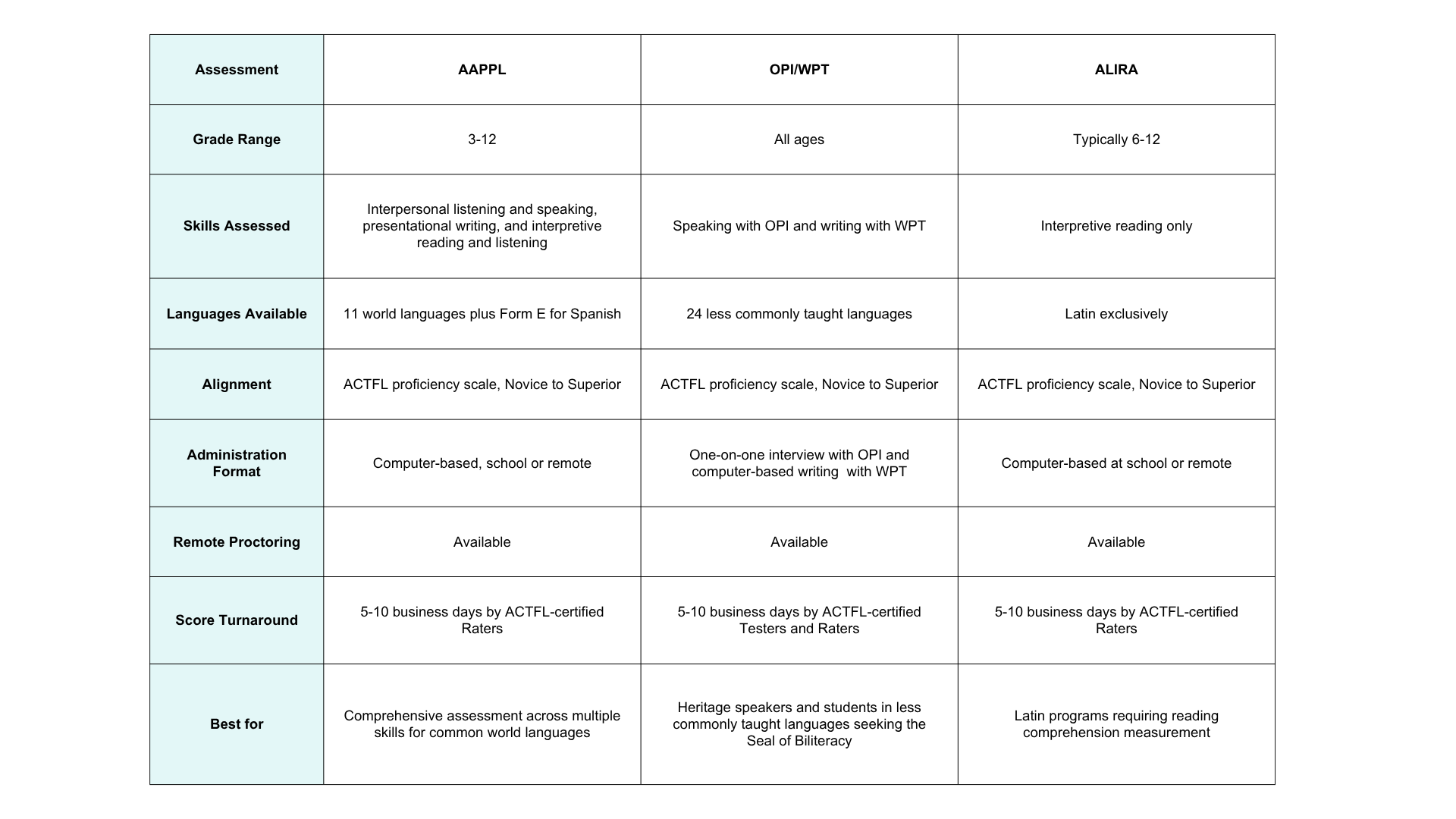
The ACTFL Assessment of Performance toward Proficiency in Languages (AAPPL) serves students in grades 3-12 across 11 world languages. This assessment evaluates both performance and proficiency across three skill areas, including interpersonal listening and speaking, presentational writing, and interpretive reading and listening.
Spanish-speaking learners in grades 5-12 who have been in the U.S. three years or less can also use Form E, which provides developmentally appropriate content.
Key Features
Tailored content for students in grades 3-12 ensures age-appropriate assessment experiences
Evaluates four communication modes to provide detailed proficiency profiles
Computer-based delivery for testing at school or remotely with proper proctoring
Results that map directly to the ACTFL proficiency scale from Novice to Superior levels
2. ACTFL Oral Proficiency Interview and Writing Proficiency Test
Schools frequently use LTI’s OPI and WPT for the Seal of Biliteracy, particularly for less commonly taught languages. With availability in 24 languages, such as Arabic, Hindi, Korean, Portuguese, Russian and Vietnamese, these assessments fill gaps that standard curriculum tests cannot.
While the OPI assesses speaking proficiency through conversation with a certified tester, the WPT evaluates writing skills through carefully designed prompts. Both produce official ACTFL ratings that states recognize for biliteracy credentials.
Key Features
Available in 24 less commonly taught languages beyond standard curriculum offerings
Offers individualized evaluation through conversation with certified testers through OPI
Provides formal ratings and certificates recognized by states and institutions
Allows schools to administer both assessments remotely, reducing scheduling and staffing constraints
3. ACTFL Latin Interpretive Reading Assessment
LTI administers the ACTFL Latin Interpretive Reading Assessment (ALIRA), which specifically serves Latin students by measuring interpretive reading comprehension. Students read authentic Latin passages matched to their proficiency level, then demonstrate comprehension by responding to questions about the texts. Because ALIRA uses a computer-based format, schools can administer it in traditional classrooms or remotely.
Key Features
Purpose-built for assessing comprehension of classical language texts
Evaluates the skills most central to Latin instruction and scholarship
Uses genuine Latin content that reflects what students encounter in coursework
Provides scheduling flexibility for Latin programs
Comparing Language Proficiency Tests for K-12 Students
Understanding the distinctions among available assessments helps educators select tools that align with their program goals and meet Seal of Biliteracy assessment requirements. LTI delivers all three ACTFL assessments, each with strengths suited to specific instructional contexts.
Frequently Asked Questions
Educators often have practical queries about implementing language assessments. The following commonly asked questions address test selection, curriculum applications and logistics.
-
AAPPL assesses modern world languages such as Spanish, French, Chinese and German across multiple communication modes, including speaking, writing, reading and listening. In contrast, ALIRA exclusively assesses Latin reading comprehension, which aligns with how Latin instruction emphasizes interpretation of classical texts rather than conversational skills.
-
Proficiency data reveals specific gaps in student learning. For example, if results show students struggling with presentational writing but excelling in interpretive reading, teachers can shift more instructional time toward writing practice.
Assessment data also informs placement decisions, helping schools create leveled groupings where students receive targeted instruction matched to their proficiency. Teachers can select materials and activities that address the exact skills their students need to develop.
-
LTI provides remote proctoring for many ACTFL assessments, which addresses staffing and scheduling constraints. Schools can deliver computer-based tests like AAPPL, WPT and ALIRA outside traditional classroom settings with appropriate supervision.
The OPI conducts speaking assessments through video conferencing with ACTFL-certified testers. This flexibility helps schools manage testing windows without overwhelming staff or requiring extensive on-site coordination.
Building a Data-Informed Path to Biliteracy
Proficiency testing generates actionable data that improves instruction, supports student growth and formally recognizes language achievement. LTI’s ACTFL assessments provide schools with the testing infrastructure needed to align with Seal of Biliteracy requirements and build data-informed language programs.
This is a sponsored post written in collaboration with inHUB from The Henry Ford. We only share products and services we believe bring value to our readers.