
Episode 180: Growing an Online School with Brittanie Bates of Crimson Global Academy
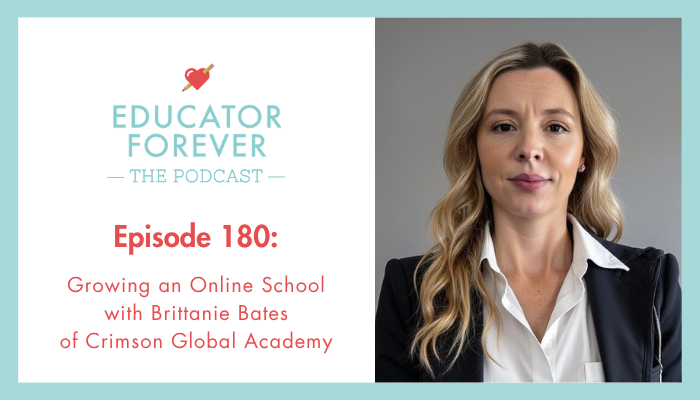
Brittanie Bates is a curriculum developer, educator, principal, and parent who's redefining what's possible in global online education. As the Founding Academic Head and Principal of the global private online school, Crimson Global Academy’s US Diploma Pathway, she has built an online learning model that proves digital education is a powerful catalyst for breaking down barriers and unleashing student potential worldwide.
Brittanie and I talk about her teaching journey and how she fell into online teaching. She gets into how the Crimson Global Academy started and what led to its success, and provides some great advice for teachers wanting to transition into online teaching.
Topics Discussed:
How she didn’t like online teaching at first
Using AI with purpose
The importance of critical thinking
Resources mentioned:
If you’re enjoying this podcast, please leave a rating and review on Apple Podcasts.
Related episodes and blog posts:
Read the transcript for this episode:
Welcome to Educator Forever, where we empower teachers to innovate education. Join us each week to hear stories of teachers expanding their impacts beyond the classroom and explore ways to reimagine teaching and learning.
Brittanie Bates is a curriculum developer, educator, principal and parent, who's redefining what's possible in global online education. As founding academic head and principal of the global online school, Crimson Global Academy's U.S. diploma pathway, she has built an online learning model that proves digital education is a powerful catalyst for breaking down barriers and unleashing student potential worldwide. Welcome, Brittany, so nice to have you here.
Brittanie Bates 0:25
Thank you. Nice to be here.
Lily Jones 0:28
In any direction you'd like. I would love for you to take us through your professional journey.
Brittanie Bates 0:34
Wow, I'm in such a love hate relationship with this question. I love it because it forces reflection. I hate it, because it forces me also to remember that the human experience is not always up into the right or exactly how we plan. So I came into education. Later. I had already been a real estate appraiser and done other things with my life, and was really looking for a career and something that could anchor my focus in and when I chose education, my friend group, my peer group, my colleagues, all looked at me and said, Yes, you've always been an educator. Like did you? How did you not know that? And I really found my home in elementary public education. I to this day, love getting ready for the beginning of the school year, we'll call friends and say, Can I do a bulletin board? Do you need me to sharpen pencils like I I love it. And so I started teaching. I started teaching K through six English language to students in elementary school. And then I helped found their extended day kindergarten program, because that was at a time when kindergarten was generally half day. Now it's hard for some people to remember, but that is how it used to be. And then from there, taught third and fourth grade, did some long term subbing. Just really, just actually, sorry I should back up before I found my home in a school I did long term subbing intentionally to get a feel for districts and kind of figure out what I wanted out of, out of education, and where if I had a favorite grade. Turns out I do not, but do still love the kindergartners. Right? There's just something about this, this tiny humans. So then my husband and I decided to have kids, and that's such a wonderful place to be. And I was looking at going back, and I was teaching at a school that I, to this day, adore, and it was a 90 minute commute, and just we went, I don't see how we make this work. So I opted to stay home with the first baby, and the second one came not long after. And so then I was really itching to get back into the classroom. I have to be honest, I love education and I love teaching. And so I was trying to find any avenue back. Could I team teach with another teacher? Could I adjunct? Like, what? How was I going to keep doing this? And that's when I kind of expanded my world and discovered online teaching. And as I did that, I had this internal struggle of, Am I still a real teacher? Is this really school? Because I don't know about you, but when I went through to become a teacher. A teacher was a specific thing. You had a physical space. You taught 20 to 30 kids. You showed up every day, you set up your bulletin board. And I really struggled, but I was grateful for the school that I interviewed with and hired me and the very first student I received was based in Singapore, and he was kindergartner, and I was going to teach him how to read online. The beauty of it was, as I did that I didn't know that that was hard, because teaching kids to read is not easy, as many of us know, and so I didn't know that it was in my mind. I was just like, Okay, we're just going to learn how to read online. Great. Happy to say, All went well. I was in touch. I've been in touch with him even to this day. His since, you know, graduated high school and is doing splendidly. But from there, I kept calling that school's director of education and curriculum director and saying so I've been thinking, really, we should be set up like this, or, Hey, what if? What if we trained teachers like this? And at the time, they only had about 76 students, and there was a very small teaching staff, and they hadn't really sussed out how, how they were going to go about building out a teaching staff. And so I was in a great opportunity at that moment, and didn't even realize it, to help lead the way. And so before I knew it, they said, Well, why don't why don't you help train our teachers? Why don't you help write our curriculum? And I grew into a role of director of education in that role in that school. Fast forward a number of years, and I we found ourselves in covid, and I started consulting and doing some things. And then, lo and behold, CGA, the current school and passion project of. My life, gave me a call and said, Would you by chance be interested in helping us launch a US diploma pathway? And I said, Absolutely, it's the type of project I'm all in on. And the rest, as I say, is history. I've been at CGA now almost five years, and helped launch their high school, junior high, primary school, and so it's been a journey
Lily Jones 5:24
So cool. I love hearing about this, and definitely relate to so many parts of what you shared. I also started my career as a kindergarten teacher. I taught kindergarten in first grade for seven years till I had my daughter, who's now 14, which is crazy. And I also was like, I love so many things about teaching and all I taught tiny kids, and it was so hard for me to wrap my head around having tiny kids of my own and also spending my days teaching tiny children. So I went the direction of like, working in ed tech and curriculum development and creating learning experiences for kids that way, and being able to have the like, hands on kid time with my own kids, but I appreciate hearing about your journey and kind of the struggles between what we want and what's possible for us at different stages and being able to blend those together. So can you tell us a little bit more about CGA? What do you offer there? I know part of your job is being in charge of curriculum, and I am a curriculum nerd myself, so I would love to hear a little bit more about that offering too.
Brittanie Bates 6:27
Absolutely. So Crimson Global Academy, our us diploma pathway started as offering part time APs and ESL instruction, and we grew that to now a full us diploma offering. We offer two different types of diplomas for our students, and really, I'm all about what, what can we do, on online, not what can't we do? So we offer small group live instruction. So we kept our classrooms at 15, and our students come in for timetabled, scheduled classes with teachers, and they can take one or two classes, if that's what they need. They can come to us full time and earn their full diploma. We offer a couple of different diplomas, and 18 credit diploma for students who maybe aren't seeking university admissions, and a 24 credit diploma. In addition to that, we also it's been such a wonderful time, we've launched a few different learning modes. So we've launched a one to one learning mode. So for students who may be for a variety of reasons, can't make small group, maybe they have a rigorous schedule outside of CGA. We have actors, athletes, students trying to launch companies. We have, you name it, that type of student has walked through our virtual doors. And so they have, we have, they have that option. And then we also have this flexible learning mode, which I am quite excited about, because I know that a number of online schools offer asynchronous and when you think online school, you think async, or you think, I'm just going to watch a video and do some things. And not all schools are built that way, right? I just described CGA, and we do something quite different, but we offer this asynchronous model with what I like to call guardrails, so students can watch the recording and do the homework and receive teacher feedback, but they do it in line with our school calendar, to ensure that they have a target end date to help keep us motivated Toward the end, because even with our best of intentions, sometimes it's really easy to just close that laptop and go the other way. So it's our way of really keeping those students engaged in the community, kind of moving with the teacher. But if they need to take, you know, a few weeks off for training or the time really doesn't work for them, that's an option for them.
Lily Jones 8:39
So interesting. I love how that's been so thoughtfully designed that I know even like creating online courses for teachers. You know, there's a wide variety of like, do this thing on your own and then maybe it doesn't get done.
Brittanie Bates 8:55
That massive intentions part?
Lily Jones 8:57
Yeah, exactly. And like so much of what we know about learning is that it is CO created and done in a community. And so I love this kind of mix of being able to do some things on your own, some things together with support to a strong end goal there.
Brittanie Bates 9:12
Thank you. Yeah, our students actually can mix and match the methods too, so it's or the modes too. So what's nice about that is our I have some students who take a variety of classes group, but then one student springs to mind who just came into my office and said, I really, really want to take calculus, but I'm struggling. And so we they were able to, you know, do calculus one to one, go maybe a little bit slower, that teacher can differentiate in the moment and help move them through and so I love moments like that for learning, where the student and teacher can really come together, especially when a student is so driven and motivated, even if it's something hard.
Lily Jones 9:55
Yeah, that's the best, I think, when they're ready to tackle something and take it to the next level. Cool, and so I know you made the transition from a brick and mortar school to working online. Can you talk a little bit more about what you think makes a successful or engaging online experience for kids?
Brittanie Bates 9:55
The people? I mean, I would love to say the fancy platforms. I'm a big advocate of quality platforms for our students, but it's the people. It's everyone being involved with the same mission and vision and values moving forward and meeting those students and helping them get to where they want. So it's everyone from myself to our teachers to our deans, even our parents. Because if we're all in it, then those kids get what they need, and the community just kind of forms. I often call it walking our virtual hallways, and I do it a few days a week, where I just walk into our spaces, either virtually, and see what's going on in chat, maybe pop into a classroom, watch a recording, but then that everybody's just used to seeing each other around. You know, we have times where our virtual door is open and we're just answering emails so a staff member can pop in and say hi. It's just everybody aligned on that vision of we're building a community, and we're in this together.
Lily Jones 11:11
It's so interesting to hear about the parallels, too, between a traditional classroom too, of being able to pop in, same thing can happen online, and I love that you've intentionally created those opportunities for connection, because just like in a traditional classroom, like the magic is also in the people, and so I appreciate the centering of that. But along with that, I know there are so many different tools and technologies that we can use to enhance online experiences, and I believe that CGA has an AI generated component. Is that correct?
Brittanie Bates 11:28
Yes, we do. We have a few in the works. So I've helped our CEO create a learn platform, and we are rolling it right out right now across our primary school, Emmy. And for CGA, we also are implementing that for students coming soon, but we have a couple of AI powered moments at CGA. The first is our key takeaways. So every interaction, every class, is recorded at CGA to help ensure that, you know, students can go back to recording if they needed. It's great for safeguarding, right? There's so many reasons. And when students leave the classroom, they have these AI powered key takeaways. And we talk to our teachers about how you, you know, just as if you were sitting in a physical space, how are we? How are we intentional about our language? So there's a little bit more intentionality needed when you want to put something like aI on top, because it's a robot, right? It can only do what we tell it to do, and it will help catalog the key vocabulary, the lesson objectives, what was studied, so that if that student leader goes, Oh, I feel like we talked about isotopes, they can go back into the platform, type in isotopes, and it will show every lecture that that student attended or was taught by their like, was taught in their within their schedule that had that so that they can go back and find the moment that they want to refer to the lesson or that. And then also in our Learn platform, we are, we have an AI powered helper. And so that helper, what's great about this. It's intentional. So it uses Socratic questioning. It doesn't just give the answer. It will only pull from what's in the lesson, but the analytics on the back end are what makes it so powerful for our educators. Because as you know us educators, we're reflective practitioners, right? We take them on, like, Okay, what went well, what didn't, and this can help surface that, so that, as a teacher, I can go back and say, I think I hit every moment of these learning objectives. See, I did a check for understanding. Looks like everybody got it. I got a thumbs up from everyone on my screen. But then if I go back and take a look, I can see, oh, absolutely everyone asked about this exact same concept. We need to go back and do a reteach, or I assign this homework, and I see that everyone used the helper in the same spot. So that helps us bring that human element, because AI isn't going anywhere. Let's use it for what it's good at, but we still need that human touch in education, and that's how we're doing it at CJ.
Lily Jones 14:19
I love that intentionality again. I mean, I agree that AI can be such a great tool if used well and intentionally. And I think always having that, like pedagogical perspective, as we use AI in curriculum or reflective practice or with the questions, like, I appreciate that you're like, oh, it's Socratic questioning. Because I think the danger is when people are just like, plugging things into AI, without intentionally thinking about what pedagogical background you know, they're using, or what research they're drawing upon. So I appreciate this as like a tool to help all the humans, teachers, students, to do the best work that they can.
Brittanie Bates 14:58
And to not take the thinking. Way, I don't know about you, but I hear a lot of us, me included, we're worried about AI taking away our students thinking we want to ensure that they struggle a little bit. That productive struggle is incredibly valuable.
Lily Jones 15:11
So valuable Absolutely, and for us too, as grown ups. So you know, really leading into the productive struggle too is so important. And I think sometimes with AI. It's like hard to even get the perspective for me, because I already have this background knowledge, right, and this experience that I can look critically at what's being spit out. And I think about my 14 year old using AI to, like, figure out calculus or, like, algebra, or whatever it is. She doesn't have that background. So it's interesting thinking about, you know, the different use cases and where we're encouraging thinking, or maybe kind of skipping over some important parts of the process. I agree. So going back to the growth of CGA, I know you've been with the US program since the beginning, and it started as a weekend offering, and now has grown to over 400 students. Can you talk to us about kind of what drove that growth?
Brittanie Bates 16:05
Excellent question. Our educators and and being aligned to vision. So quality education, really, it's students and teachers, right? I mean, I would love to take all of the credit. That would be fantastic. But our educators showed up and didn't say, this how education supposed to be, or, Oh, we can't do it this way. They showed up and went, Okay, I see what you're saying here. And we went through a few different educational models, right? We originally were like, We're project based learning, and as we dug into that, this is, I love project based learning, and I love it in a physical space, and I love it and I love it at times in an online space. But as we watched our students and we watched our teachers work through that, we're really not that so then we went to flip classroom model, and again, love it. Think there's great pieces, and every time we came back together, what was being shown is that we shouldn't take or identify as just one model. And I think a lot of educators would educators would be on board with this. Instead, we need to put all of these tools in our toolbox. And so we've been identified as an I've identified us as an integrated project design model. We integrate projects, we integrate flipped classroom, we integrate Socratic questioning. Our teachers put all of these tools in their toolbox. They go through professional development in all of these areas, and we layer in what's needed based on the cohort of students in front of us and the subject matter we're teaching. And that is what I really think has driven our growth. Because students have come to class and felt like getting what I need. I have an educator who sees me in the room, is adapting in the moment, who is sending me notes or sending my parent notes. We also have an amazing community and operations team who just help ensure that as our students walk into our virtual spaces, that they get everywhere they you know, they come, usher them through those front doors, that they make it to their classroom, which sometimes in a virtual space is easy, right? It's a click of a button. But also there's moments when that's harder for students. And so those those human elements, is really what helped drive the growth.
Lily Jones 18:10
I love hearing about the experience of coming up with the model too. I mean, not only centering the teachers and their experience, but also not really knowing exactly what's going to be the best option from the beginning, and so being able to say, Hey, I'm going to start with this best idea of doing project based learning, and then get feedback from all the different stakeholders and adjust, I think that's a very realistic and inspiring look at growing something good like we often don't have it all planned out from The beginning. It gets better and better in community, with people actually testing out the ideas.
Brittanie Bates 18:46
Yeah, and again, it's that community piece. Those the human piece, the students willing to show up to a survey or come to a conversation, and those teachers being willing to send the email. This isn't quite what we had in mind when we got started, and I I really value that.
Lily Jones 18:59
So I know you have a unique experience, not only working at an online school, but being a parent of an online student. Can you talk about what that's like?
Brittanie Bates 19:10
I can and it came completely by, like I'm completely shocked that I'm parent of an online student, even though I have been a strong advocate for online education for years, my daughter is about to turn 13, and she was wrapping up grade six, and in our district, you go to Junior High in grade seven and eight, and she went to the school tour, and she just came home and plopped down one day and looked at me and said, I Think that's for me. I was like, oh, okay, um, can you share a little bit more with me about what, what that means? What are we talking about here? Like, I want to do what you do. And as a mom, you just, like, your heart just explode. You're like, oh, well, what do you want to do? What I do? I. Right? She's like, I want to be able to kind of schedule my day. I want to go to school online. I want to give that a try. She's like, I have a lot of things that I'm really interested in that I don't ever have time to do because I'm at school all day, and then you have work and and I said, Oh, okay, we can give we can give that a look. And she I wish I wish I were just saying this, because I'm being put on spot. She's thriving. She has she's one of those students that helps hold herself accountable, and she helped designate her own workspace. And now I was also, as a parent, great to see where maybe we could do better about communicating, although I will say kitchen table conversations are a little different now, because now she's like my mom. I was at school today, and I don't like this, okay. Oh, good to know. But no, it's it's been fantastic for her. I did spend a little bit of time, maybe listening to external factors more than I thought I would initially, where, like, Oh, what about her socialization? Which, as an online school leader, I spend a lot of time telling families that, yes, you need to be a little intentional, but as long as you know, you are in a part of a community, hopefully your students doing other things. So even though I had that base knowledge, I did spend some time, you know, listening to grandparents or aunties or, you know, start talking about, well, she's going to online school. And then I had to remind myself that I'm on a mission to remove the stigma of online education. I want to get rid of the, oh, they go online, right? I want education. And I believe CGH really delivers. This is the best, or could be the best for the right students, right? That's why we need a diverse model of education out there. And so in my case, it's proven to be just fine. Bristol is thriving and loves her teachers, comes with all sorts of ideas, has time in her day to play the piano and the saxophone and learn Spanish. And just, she's finishing up a class right now, and she will just kind of be like, Oh, I'm going to go build this thing we just learned about rockets. Oh, okay, it's definitely working for her.
Lily Jones 22:16
So inspiring. I love hearing about it from both ends too, and I appreciate your honesty. Of like, I've had this experience with my own kids of being like, Oh, I've worked on this thing for many years, and then like, oh, seeing it from that perspective, like they often have used curriculum that I've worked on in their classrooms, you know, and it's like, oh, wait, tell me more, right
Brittanie Bates 22:36
Or I walk by perspective and I go, Oh, that doesn't look how I thought it was going to look on the screen?
Lily Jones 22:46
Oh, absolutely, absolutely. So given that experience of you know, both working as an educator and raising your own kids, what do you think tomorrow's learner actually needs?
Brittanie Bates 22:58
They need thought partners. They need people to help challenge their thinking. They need what we've always known as teachers is we are teaching students how to learn, but we need to really anchor ourselves in the I have base skills that you must learn. There are certain things we all we all should learn to read. We all should learn basic basic mathematical skills. We should all learn some basic science principles, right there are the basics that we all should have, but my true job as an educator, and what all students need is I need to learn how to learn. I need to learn how to think critically. More importantly, now than ever, I need to learn how to evaluate a source. I also I need a technology partner. I don't know about you, but there is this, let's see almost a lens that goes over everyone that thinking that a certain generation just knows technology. And then you get in a room with, you know, even my daughter's age, and they don't know what every button does at the top of a Google document, or they don't know how to format a Word document. So we technology partners for this most simplistic skills, but then also the greater ones. What does it mean when I open up my favorite chat bot and put something in, what is it sending to me? And that is what we're going to need to make sure that we also educate our students in is these are the tools out there. Let's learn how to decide if this is a good tool and if it's a reliable tool.
Lily Jones 24:29
And so many of those skills of critical thinking and thought partnership are applicable no matter what comes right. So really thinking about where we're at right now and also the uncertainty of where we're going to be in 10 years, 20 years, I appreciate that these are very transferable skills. And so thinking about our audience out there, you know, most of them are teachers who may be looking to do something beyond the classroom, or maybe they transition out of the classroom. What advice do you have for them?
Brittanie Bates 25:00
So if they're transitioning out of the classroom, don't be afraid of online online teaching is fantastic. It can allow you to do more things than you ever thought possible. It's just a paradigm shift of I'm used to walking next to the student and highlighting how do I make that come to life on a screen? And the next is, don't be afraid of the tools that are coming out. I think that as educators from I'll just use the calculator. It's like, if you look back to the calculator, right? We tried to push it out of classrooms, right? You're never going, like, you're going to always have to do multiplication tables. That I'm still saying, learn your multiplication tables. That's always the first thing I tell the students. Math is so much easier if you just know those. But anyway, we push those, we push that aside, and then the internet computers, and we put them in computer labs, thinking, Oh, well, compute, you know. And then before you know it, it's a we're one to one device schools, smartphones. We're kind of doing the same thing. We're putting, I mean, not that they're not distracting. We're putting them in pouches, but we just, as educators, we just keep pushing technology aside, and I think it's our moments to learn the tools, start thinking about how we should use them, and then design how we teach kids, and we come alongside technology. I think AI is our moment as educators. I think if we really spent time and got involved there, we could transform education in the way that we all want.
Lily Jones 26:23
So powerful. Well. Thank you so much, Brittany for coming on. Can you tell folks where they can connect with you?
Brittanie Bates 26:29
Absolutely, I'm on LinkedIn. B dot Bates, I believe you also have my LinkedIn link, if you can include it in session, in the podcast notes. But yes, I'd love to connect with anybody who's interested?
Lily Jones 26:41
Awesome. Thank you so much.
Brittanie Bates 26:43
Thank you. Have a wonderful rest of your day.
Transcribed by https://otter.ai