
Episode 182: From Classroom to Congress with Will Staton
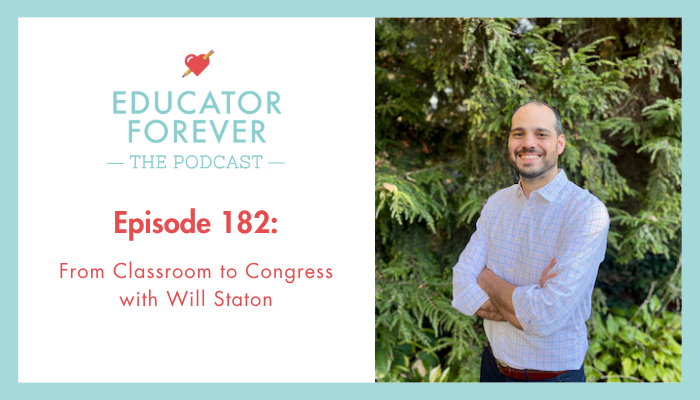
Will Staton began his career as a high school history teacher. He’s worked as a teacher, dean, and administrator in Memphis, New York City, and Washington, DC. Most recently, Will worked as an independent nonprofit consultant.
Now he is running for Congress as an independent in central New York, where he lives in Syracuse with his wife and two daughters. In our talk, Will and I discuss his journey from education to politics, and how he wants to improve the public school system. If you care about our education system, you’ll want to tune in.
Topics Discussed:
Focusing on overlooked children
Public education needing a functional makeover
The impact of independent candidates
Resources mentioned:
If you’re enjoying this podcast, please leave a rating and review on Apple Podcasts.
Related episodes and blog posts:
Read the transcript for this episode:
Welcome to Educator Forever, where we empower teachers to innovate education. Join us each week to hear stories of teachers expanding their impacts beyond the classroom and explore ways to reimagine teaching and learning.
Will Staton began his career as a high school history teacher, and has worked as a teacher, Dean and administrator in Memphis, New York City and Washington, DC. Most recently, will worked as an independent nonprofit consultant, and he is now running for Congress as an independent in central New York, where he lives in Syracuse with his wife and two daughters. Welcome Will so nice to have you here.
Will Staton 0:23
Hi Lily, thanks for having me on. I really appreciate it.
Lily Jones 0:25
So I always start with the same gigantic question that you can take in whatever direction you want, which is to tell us about your journey in education.
Will Staton 0:33
It is a gigantic question. So let's see. My parents were university professors. I you know, from Mississippi, born and raised there. And so my parents worked at Ole Miss. My father was a mathematics professor. He would have said mathematics, not math, which I think is you get to be snobby about that if you have a PhD in it, I guess. And my mom began her career as a law professor, and ultimately was the first woman to be provost at Ole Miss, which is something I'm really proud of. I had never thought about a career in education, and if anything, probably, like a lot of folks when they're younger, imagined that I would do something very, very different than my parents in college, I ended up studying religion and history, classics, ancient history, just because I was interested. I've always kind of been a history nerd, and I didn't really know what I wanted to do with that. I just enjoyed studying it. But my senior year of college, I had fewer classes to take some more time. And so I worked a number of on campus jobs, including as a student recruiter for Teach for America. And so I learned a whole lot about TFA and the the work that they were doing and their mission through that experience, and it caused me to reflect on my own education. In particular, I did my final two years of high school at boarding school. So I left Mississippi and spent my junior and senior year in New Hampshire. And you know, seeing some of the schools where TFA corps members were teaching, learning about that and reflecting on especially where I went to boarding school inspired me to join TFA, and so I did. I fell into it almost completely on accident, and feel very fortunate, glad that I did.
Lily Jones 2:31
Fantastic. So did you start by teaching history? Or where did you start off?
Will Staton 2:36
Correct? Yes, I began my career as a high school history teacher. US history in Memphis, Tennessee, which is really close to where I'm from, in north Mississippi. I had kind of hoped to teach World History, but I was excited to have the chance to teach history at all. And it was, it was great. So yeah, and that was, that was the beginning of my career in education.
Lily Jones 3:01
So great. And then you transitioned at some point to working on the administration side. Can you talk to us about that? And kind of what that taught you from seeing both the teacher and administrator sides.
Will Staton 3:12
Definitely. And so yeah, I have hopped around a bit and had positions that are both kind of directly student and family facing, and those that are on the back end and more of a support capacity. And I think there's a few different takeaways to that. One is that it's an ecosystem. I think that's the most important thing, right, folks, all the different stakeholders, and there's so many meaningful ones in education, including, of course, the students who often are overlooked, because especially when they're young, it's, it's almost impossible to really have them as part of that conversation. So but you know, when you are on the back end and doing work that still matters as part of that ecosystem, but you're a little bit further removed from it, because you're not necessarily interfacing with students and families every day, it can be harder to, you know, maintain a focus on the mission, we'll say, but the work matters again. It's, you know, it takes a village kind of approach. So that's, that's, I think the biggest element of it is that you got to have all of those different folks, you know, on the same page, communicating and working together. I, you know, I think in in other ways, when talking about just the takeaways of it. It does make me appreciate teachers so so much. There aren't any, like, truly easy jobs, but you know, especially the way that we view teachers, you know, is incredibly unfortunate given what they are asked to do, and how far beyond that, most of them go just because of circumstances. And you know how little we support them as a society? So I have done, you know, work in education, on, on both of those ends, and again, it all matters. But yeah, I have a tremendous amount of respect for people who teach.
Lily Jones 4:59
Yeah, so let's talk about that a little bit more. I mean, I absolutely agree it's been a long time since I was in the classroom, but spent seven years teaching, mostly in Oakland, California, and then moved into curriculum development and consulting and, you know, supporting teachers in various ways. And 100% agree that is an incredibly challenging job that just has gotten more and more challenging. So what do you think are the most the biggest challenges facing teachers and students right now?
Will Staton 5:26
Yeah, I mean, it's, I think, and, you know, fixing things like this is easier said than done. It's kind of easy to be the armchair quarterback, and pinpointing one thing is tough. But I think at the end of the day. My biggest, I guess, concern, we'll say, with the overall system, is that we have a public education system that was created in the late 19th century and hasn't really evolved too much since then, while the world around it has changed a ton, and I don't think so many of the things about how we structure the education experience today work well and are compatible with the the world that we are living in. So I really think that our K 12 public education system, in a lot of ways, needs a pretty fundamental makeover. I know you asked maybe what the most specific challenge is, and certainly we could hone in on things, but in general, I think the reason that we're seeing all sorts of negative outcomes, whether that's teacher burnout and retention, or students not doing well, or families being frustrated, you name it, is, we're kind of trying to force us a square peg with 21st Century students into a round hole with a, you know, a system designed in the 1880s and 1890s so yeah. I mean, starting with just, you know, how the school day and the school year are structured. But again, it could go, could spend two or three hours on that, at least.
Lily Jones 7:01
For sure. I mean, absolutely, I think there's so much systemically that needs to change, and it's really hard. I think one thing that, like, leads to burnout for teachers sometimes is feeling like, Oh, I just wish I could change this. And like, let me just work and work and work to try and change things. And no matter how much you work, there are some things that we can't change because, as you're saying, and like, this whole system needs an overhaul, and there's so many parts that work together.
Will Staton 7:25
Absolutely, yeah, and I understand that frustration, because I, you know, lived it as a teacher and even as an administrator. And you know, there's a reality to what students are dealing with in schools is a reflection of what's going on outside of school. And so we could even take a step back, and you know, this gets into a little bit about why running for office at this point. But I would argue that you know, part of the reasons that you know schools are dealing with students who are dealing with issues is because students and families are dealing with more issues as society is, and I think that reflects a political failure and by itself that's not going to, you know, undo something like social media, right, which is its own big topic that would have to be addressed. But I think we could go a long way towards some real reform if we could fix our political system?
Lily Jones 8:23
Yes, absolutely. I mean, everything is interrelated and affects each other. And especially, you know, working in public schools, you get to see a wide variety of how these issues affect students and families. Absolutely, tell us a little bit about, after being an administrator, what happened? And now you're running for Congress? How did that happen?
Will Staton 8:47
Yeah, so, well, it's a little bit of a hop around, I guess. And so I'll, I'm going to go back, if that's okay, Lily, for a moment. So I'm, you know, to kind of put this in context a little bit. So I'm, I'm 40 years old. I have never run for office before at any level, and I'm trying now, you know, I'm kind of diving into the deep end running for Congress, especially as an independent, but I have paid attention to politics at the national level since I was 11 or 12 years old. And I always say here, you know, by all means, judge me for that. I judge myself a little bit for that. But the reason why is that my mother was actually very close personal friends with Secretary Clinton. They were law school classmates and lifelong friends, and Secretary Clinton came down to Mississippi in early 2017 when my mom passed to speak at her services. And so because of that relationship, I just kind of had a, you know, when lens into that world a little bit. And as I mentioned, I'm kind of a history nerd, we'll say. And so that dovetails with some of the things that fall under the political umbrella. So I've paid a lot of attention for a long. Time, and I've thought about running for a long time, probably about half my life. I can recall some conversations as far back as college where you know, the idea was percolating, and there were always things about it that you know were appealing, but there were always things about it that were a big turn off as well and made me want to have absolutely nothing to do with it, but the idea of running one day, you know, if the time ever felt right, has lived in my head for probably about half my life. And so here we are, and the time feels right now, because in so many ways, the Times actually feel very wrong, and I have lost faith in the groups who got us here to get us out of the mess they created, and you know, for for my entire adult life, it has been pretty much a race to the bottom. If you look at data on things like, you know, wage stagnation and the cost of living and inflation and stuff like that, the data tells a pretty clear and pretty damning tell. And you know, only two groups have ever had any chance to be in charge of this and and figure out you know how to make life better for folks, and at different times, both of those groups have had full control of everything, and yet here we are. So I very much believe that we are kind of at a pivotal moment in our nation's history, and that we need to take a real hard look in the mirror about how we got here, and not just how we fix it in the moment, but also, how do we reset the foundation to you know, I think the two party system incentivizes competition and a race to the bottom, and I think unless we can get out of that and reset a rotten political model, we're not going to get meaningful policy.
Lily Jones 11:52
So interesting. Yeah, I appreciate that. And so talk to us a little bit about running outside of the two party system. What's that like I hear you, and I'm sure it's challenging in so many ways, and so talk to us about that.
Will Staton 12:08
It is challenging, it's exciting. And, you know, I'll complain a little, but not too much, right? I chose to do it this way, so I made the bed, and I have to sleep in it, but it's interesting. You know, on the one hand, you do something like this, and there's kind of a gravitas that comes with it. On the other hand, because I'm doing it as an independent that gravitas is, like, immediately weaker than it would be if I had a D or an R in front of my name, right? And that much is kind of obvious. Again, okay, no complaints, but it does mean, yeah, I got to work that much harder hustle that much more to get media organizations to pay attention to me, for example, to convince potential donors that, you know, I'm actually viable, and that I have a path to victory, those sorts of things, So that that is real. In fact, I'll be dealing with this starting next Tuesday, in a different way here in New York State, you know, candidates for any office, state, federal, etc, local, have to get signatures. Inc, signatures still to, you know, access the ballot. So to run for Congress as an independent, I need 3500 signatures the Democrat and the Republican who just finished collecting their signatures need 12 150 a piece, so like a pretty clear disincentive for someone like me to even try, right and on top of that, I have to ask and find volunteers to help me Go get that, whereas, if you are the you know, the party supported Democratic or Republican candidate, the party apparatus is out collecting those signatures for you. So, you know, I've been at this for four months, but actually the next six weeks are a pretty make or break moment for me, because if I don't get that the signatures, then it's game over, legally speaking. And I, again, I can't count on like, great all the committee members will be out there. So it is a real, you know, the infrastructure just simply isn't there, whether that's media, donors, volunteers, whatever, one of the exciting things about that, though, Lily has been that since I started this in the last I guess it's really been more like five months now, I have begun connecting with individuals across the country, independent candidates and some professional folks, campaign managers and other political operatives who have real experience on the back end and are working to connect us try to create opportunities for media exposure, fundraising, fundraising, excuse me, for independent candidates. So it's it's new, it's grassroots. There's a long way to go, and certainly there's no talk of a third party, but there is a growing group of people, and that has been really exciting. You know. I knew when I decided to do this, it wasn't just me, and I wouldn't be the only one, but you do imagine you're on your own little island out there, and for the most part, I guess we still are, but it's been a lot of fun and pretty exciting to connect with this movement nationwide. And the truth is, I'm inspired by some of the other folks who are doing this, because at the very least my district here in central New York is purple. This is another part of my pitch, and what the data show pretty clearly, right? That the over the last 20 or so years, you know, the number of purple competitive congressional districts has dropped from like 190 to 40 because of gerrymandering. But at least for me, there's, you know, the the math works potentially in a purple district. But a lot of the folks who are trying this as independents are in, you know, ruby red or sapphire blue places, and they're making the same case regardless. You know, in Massachusetts, it's the Republicans never going to win here. But my Democrat is old. He is out of touch. He does not respond. He is not right, like he's done nothing in four decades, or at least in two of the four decades he spent in office. The guy in Kentucky, it's the same pitch for the other side. My Republican is old. He's out of touch. He does nothing. Or Democrats never gonna win here, but I might so it is, it's, it's cool and exciting, and it inspires me to see those folks doing something that I think is even harder than what I'm trying to do.
Lily Jones 16:29
So interesting. And, yeah, that's so interesting, seeing how it, you know, changes in different places, but what stays the same, too, and what you can learn from campaigns all over Absolutely. So I know that you talk about finding common ground and pragmatic solutions. What does people over party mean in practice?
Will Staton 16:49
Yeah, great question. So I would argue that right now, the the needs, you know, necessities, basics of life for most people is at best, kind of the third concern for both of the two parties after the needs and wants of their donors and their brand image, right? Again, I think that's basically supported by the data, and I think the reason for that is because, again, the two party system incentivizes competition. Competition is an awesome incentive for the NFL, right? Like when I go watch football on Saturdays and Sundays, I am glad that what I am seeing is rooted in competition. That is, it's a piss poor foundation for a society and for a government, right? We have real problems, we have real differences, and we need people who are willing to work together, cooperate, collaborate, but this system, it incentivizes the opposite, and those words have become toxic, right? So I do think I really, truly believe there are so many good faith people who get into this and run and you know, even if I might disagree with them, are in it for, let's say, like the right reasons. But I think that doing it as either a Democrat or a Republican shackles you to a system that has proven it cannot be reformed. It doesn't corrupt everyone who participates in it, right? Some people go in as good people, and they leave as clean people, but no one has ever changed it from the inside. If anything, it's only gotten more corrupt over time, and it does corrupt Even good people, right? Like we've legalized bribery, and because of that, you know, if you dangle a few million dollars in front of someone for a vote, and there is no crime taking it, it becomes pretty easy, pretty quick to dismiss the moral concern there, right? So again, I don't see that either of the groups who benefit from that legalized bribery have an incentive to change it. And I think that the good faith people who go in with a D or an R in front of their name, gets sucked into playing a game that they might not want to and are forced to then do things that prioritize the needs of the party, not their constituents.
Lily Jones 19:10
So yes, as you're talking, I'm like, this reminds me of schools when you think about competition, right? Like standardized tests, how we grade schools, how we grade students, right? So much of that is also competition, rather than true collaboration and support, and then same, like teachers, administrators, we all get entrenched in the system, but so toxic in many ways. And like take on that toxicity, and like act it out ourselves in a similar way that I think you're describing with political parties too.
Will Staton 19:45
I think that's absolutely right. And you know, when it's just how things are, and it feels like you know the system, whatever that is, whether it's the two parties or a school district, like either way, for one person that is a mountain. 10, right? So it doesn't matter how frustrated you might be or how correct you might be in your analysis of what's wrong, it can just be overwhelming to even make the effort right again with with the political thing, like needing 3500 signatures as compared to the party. So it does it. You know, you get entrenched in this system where, like, you know you're going to be evaluated on test scores, and you know that might affect your salary, and you know that it's going to be the same for the teacher, and you know two hallways over and two school buildings over, and it just like y'all could all be working together, sharing best practices for your students. But that's not exactly how we set it up.
Lily Jones 20:40
Yes, yes. So I would love to change gears a little bit. Our audience is mostly teachers, you know, either in the classroom or maybe looking to do something outside. And so I'd love to first hear from you, you know, what did you learn being a teacher that you found helpful? Now moving into politics.
Will Staton 21:02
So I think, and I would like to think I had started learning this before, but certainly teaching and working in education helped, helped me learn it and helped me grow. But it back to that idea that, like, it takes a village, and then, therefore, what does it take to make a village function, right? So if you really want to get something done, whether it's running an effective school or running an effective government, it that is bigger than any one person. And I'd pause here to say quickly, this is kind of part of my problem with what the political system has become like. Without wanting to knock either of these two individuals, just pointing out simply that a lot of folks believe that either Barack Obama or Donald Trump was going to be the solution to our problems. And that's not true, because that's not how things work. No one person, right? And so again, it if you know it takes a village. Okay, well, then how do we form a healthy, functioning, stable village where people can, you know, participate, bring their strengths, feel supported. And I think that rests on, you know, a foundation of communication and and empathy, respect, right? And this is kind of one of the things that I'm trying really hard to do with my campaign. We've gotten to a point, I think, where our default reaction, a lot of times, to disagreement, is discussed or worse. And in some cases, maybe that's appropriate, but on a lot of things, that sets a poor foundation, and I think it actually makes the real divisions that we have even worse. So, you know, building those bridges requires being intentional about hearing things, listening asking questions, that the answers might make you feel uncomfortable sometimes, right? But if we can show people that there's a place for them at the table, we can build something that they feel like they're actual contributors to and want to be a part of, and will then give their time, talent skills to being a part of that. And I've seen schools do that well, and I have seen schools do that poorly, and kind of like the political system, it stinks when it that happens poorly, because even in schools that don't have that good culture, there's still so many good teachers working really hard on their own the islands, and there's still so many kids that deserve, you know, the great education. But yeah, it's not, you know, a one awesome teacher in the school of chaos is not a superhero changing lives, right? So, yeah, yeah, I appreciate that.
Lily Jones 23:42
And so my last question is for teachers who are looking to do something beyond the classroom, whether it's running for Congress or, you know, just doing something else outside of the classroom. In education, what advice do you have for them?
Will Staton 23:57
I would say, you know, do pursue it right? Pragmatically, I guess my best advice would be, you're going to encounter kind of the stereotypical frustration of like, well, you're a teacher, so you know, what skills do you have that fit in, like the more traditional nine to five role, which I mean that model is changing anyhow, perhaps early in my career, my my second year teaching, I lost my first student. I think I've maybe lost three students in my career, and that was a, you know, like getting punched, right? I mean, that was, that was probably what shattered the wall of idealism that I had surrounded myself up with up until, you know, to and through college. And so I finished my two year commitment to Teach for America, and I ultimately did stay in education, but that was a moment of reflection for me, and in the summer in between, I did look briefly at jobs in the private sector and applied and things like. At that, and I interviewed it a few places and got the feedback, you know, like, oh, you know, we think you're great, but we're not sure if you have the ready for the pressure of an office environment, or, like, if you've got the right skill set, because you were a teacher and, you know, on the one hand, like, really, you want to talk to the pressure, talk to me at the pressure of a cubicle, like, I'll trade you, right? Give me a nine to five and a little square, and I will give you 2716 year olds, and we'll see who plays first, right? So that was the one thing, but then the other thing, and, you know, I guess the the onus is a little bit on us to make this clear to people. But like, what skills do you have, other than teaching all sorts of them, right? Time management, communication, data analysis and keeping you name it I've got all So breaking that down and making it clear for people. And again, that's that's the more pragmatic part. On a bigger level, whatever it is that you might want to do or decide to do next, take teaching with you. And I mean that in two ways. One, the mission you know that led you to be a teacher in the first place, whatever it was, Teach For America like me, or understanding about that yourself before, and taking it with you on a more traditional path. You know, remember the kids, because there are so many other ways outside of being a teacher or outside of working directly in education that you can contribute meaningfully to a positive school community and ecosystem. So make sure that you continue to try and do that in the ways that you can. And then I would also say, take your teaching skills with you, because you will find, I would bet good money in a lot of other environments, that there is a need for people who have that teaching ability, you know, and all sorts of different ways to train employees to deliver information to stakeholders, whatever it is. And you might find that that is a skill that you have, that a lot of people in certain organizations don't, and even if they don't realize that you could step in and fill a void there pretty quickly in terms of how you help people, whether it's internally or turnkeying information and communication to external stakeholders, I've seen organizations that have struggled with that. I'm sure everyone has, but I think teachers are actually much more well positioned than folks might think to help you know, do that pivot, right? It's like taking something from a textbook and delivering it from kids. You probably didn't just read it straight to them. You did it in the most effective manner, right?
Lily Jones 27:36
Yeah, that's great advice. Well, will it's been so nice talking with you. Can you tell folks how they can connect with you?
Will Staton 27:43
Yes and thank you again, Lily, I really appreciate the the opportunity and your time. I website for my campaign, Staten for congress.com, we are on Instagram at Staton for NY, 22 also on Facebook at will, Staton for Congress. We're not using x and Tiktok at this time, but if you are interested, you know, by all means, please do connect with us. On Twitter, on our website, you can also email us. We do have a volunteer team, but like you, will probably get a message back from me directly if you email us, and that's just stating for congress@gmail.com
Lily Jones 28:27
Wonderful. Thanks so much.
Will Staton 28:28
Thank you, Lily. Have a great one.
Transcribed by https://otter.ai