
Episode 193: Empowering Kids Through Art with Chinon Maria of Art World Explorer Kids
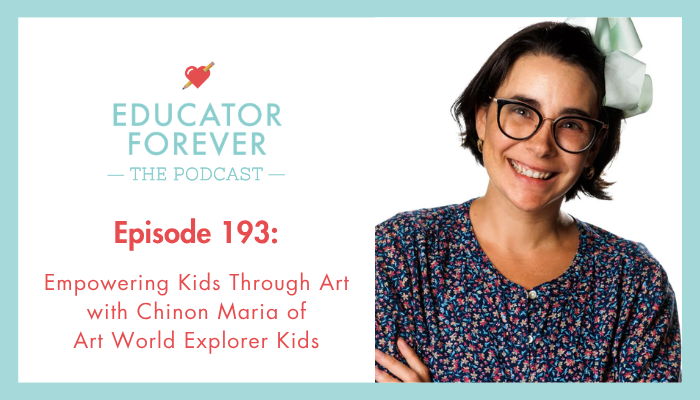
Chinon Maria is an artist, educator, and founder of Art World Explorer Kids. For the past 15 years, she has dedicated her work to empowering and teaching children across the globe about the power of art.
In this episode, Chinon tells Lily how art became such a major part of her life and educator journey. She also discusses how she balances her successful art career while being an educator.
Topics Discussed:
Painting Mural to Unite in New York City
The importance of inspiring curiosity in art students
Working on a project for a decade
Resources mentioned:
If you’re enjoying this podcast, please leave a rating and review on Apple Podcasts.
Related episodes and blog posts:
Read the transcript for this episode:
Welcome to Educator Forever, where we empower teachers to innovate education. Join us each week to hear stories of teachers expanding their impacts beyond the classroom and explore ways to reimagine teaching and learning.
Chinon Maria is an artist, educator, and founder of Art World Explorer Kids. For the past 15 years, she has dedicated her work to empowering and teaching children across the globe about the power of art. Hi, Chinon, and so nice to have you here.
Chinon Maria 0:14
Thank you so much, Lily, for having me on. I'm very excited about this conversation.
Lily Jones 0:18
Me too. So I'd love for you in whatever direction you'd like to take us. Walk us through your professional journey.
Chinon Maria 0:25
Absolutely. So my name is Chinon Maria. I am an artist. I'm an educator and an entrepreneur. And my journey began. I guess I mean it's interesting because as an artist, you know people ask me when did you when did you like when was it that you thought that you were an artist, right? Like when did that hit? And my story is when I was six years old. Like at six, I went to the Museum of Modern Art, the MoMA, in New York City. My mom took me, and we went to go see a beautiful Matisse exhibition, and it was like the first time all his work was together. And right as you get into the lobby, there's a big staircase, and there was just a massive, bold, bright, beautiful painting. And I just stood there, and it was like, I want to do this. Like this, it just called to me in a way that nothing in my life, ever had before, and so it was in that instant that I knew I wanted to be an artist. That that was the way that I knew how to communicate the best. That was the way I felt most alive in my body was to be an artist. So really, you know, understanding that about myself at a really young age was was really really wonderful. Now fast forward, you know, 18 years later, and I find myself graduating from Montana State. I was out in Montana because I was a professional skier. I was on their Division One ski team, and so once I graduated from Montana State in Bozeman. I said to myself, the only place I need to be is in New York City, and I scored a two incredible internships: one with Oscar de la Renta, and the other one with Paper Magazine. And these were two very, very different jobs. Like one was very, you know, like I was expected, you know, at Oscar de la Renta, very more conservative. You know, like I was working doing PR stuff and turning doing PR, and then on the other side, here was Paper Magazine, where I was like wearing a tutu and like go to fashion shows, and I got to you know just explore like the cultural vibrancy of downtown New York City, and I quickly realized which one I kind of preferred. And really, Paper Magazine opened up my life and my world to many people, many artists, the art scene, the cultural scene in New York, and it just really helped me navigate myself as an artist. But just like any young person living in New York, it's it's a hard go, you know, as far as to make it. And so naturally, I had to find a second job to support my free working that I was doing as an intern for Paper Magazine.
Lily Jones 3:18
Sure.
Chinon Maria 3:21
And so I started to be. I was a nanny for a family of six children.
Lily Jones 3:24
Oh wow!
Chinon Maria 3:25
I started to realize like how much I loved working with children, and so there was this you know funny balance again where here I am working with children all the same time, and yet you know also then working at this magazine, and more and more I wanted those worlds to collide, and I wanted them to kind of come together. These two parts of me, really. And so, really, ever since my early 20s, two passions grew very, very quickly. One was art and creativity and culture, and the other was working with kids and loving to teach kids and loving to get them excited about learning, and so it was beautiful to have that clarity. Now the road, you know, even though that clarity was there, you know, the road was a little bit like this. You know, as an artist, no, it's it's not a straight line, right? Turns and funny twists along the way, but through it all, I was able to work with some great people in the art industry, some great art advisors. I went on to go work with some more art magazines, and it gave me an inside clue about you know the art world, the contemporary art market, and and I continued working with kids, and I had an opportunity to learn a lot about street art. So I began painting large-scale murals, and one of the reasons for why I loved murals so much and large-scale pieces was because of its transformative power of space. And it really makes me feel like art can change the world. Like art has the power to transform spaces and inspire people. And so I naturally started to actually incorporate, you know, community workshops. And so there, I could work with kids more. And so I brought schools in. I would go to schools. I'd give workshops. We would paint together. One of my largest pieces I've done was with the UN Refugee Agency, and we created a piece at the World Trade Center. It's a 220 foot long mural. It's called Yeah, it's called Mural to Unite.
Lily Jones 5:34
Cool.
Chinon Maria 5:36
And we had kids from all over New York City, and then 1500 kids from around the world who also incorporated their quotes into this piece, and it's the refugee crisis of girls' faces, and then the messages of kids, and all these children from from the area came in to help me paint it, and it was just a, it was such a beautiful moment in time where everything came together in such a beautiful way,
Lily Jones 6:03
amazing!
Chinon Maria 6:04
Thank you, thank you. And it's still there. If anyone's to go see it, it's still there. It was only supposed to be up for one year, and it's seven years going strong. So go see it. You can go see a beautiful mural. And really, that's what I love. I love to inspire young children, I love to inspire our next generation of artists, but also creative thinkers. And what better way to do it than through art? And you know, and now fast forward, I've been teaching at the grammar school in Putney, Vermont, for seven years. I have two young children who I have the opportunity to have them attend the school with me, and I absolutely adore inspiring these children and getting to work with them-not just for one little moment in time, right-but year after year and watch them grow and and really find themselves as as artists, so that's a little bit you know about everything up to then now what I'm currently kind of launching at the moment, which is called Art World Explorer Kids.
Lily Jones 7:13
What a wonderful story, and I love following you down this path from you being a little kid, you know, being so amazed by art and being like I'm an artist, to then you know working in the city and doing all this work and be like oh and I'm also my teacher, right? And blending those two worlds together over time, and I think it's just a powerful testament too of like you don't have to choose one, right? Sometimes there are ways really of blending these interests together, and often there are that just make them stronger, and so I know you've had a lot of different experience. You know, working with kids and teaching art. How would you describe your approach to teaching art?
Chinon Maria 7:50
One of curiosity. Like I think the the first thing that you always like, for me at least as as an educator, is just that curiosity, that excitement, that wonder, right? I I love teaching art by first I just show them a piece of work. I don't tell them what our next unit is. I let them discover it. I let them explore it. I have them put on their archeology hats and think like okay like how big do we think it is well what is the material if it's this material or if it's this size what does that mean like and so I'm allowing them to kind of all of a sudden become their own explorers and letting them really discover something and that curiosity starts to bubble, right? And so then all of a sudden, when it's time to do the unit, you know, we've had now an understanding of it, and it just becomes that much more enthralling to find a piece versus just putting something in front of them, saying this is what we're doing, right? Let them be an active participant in that in that learning experience.
Lily Jones 9:01
Yeah, they explore. explorer framing is so engaging. You know, who doesn't want to be an explorer? And I think it puts the power back to the kids in some ways too. That like whatever they want to explore is possible and valid, and it's not just a teacher saying like today we're learning about Picasso, and these are the things to pay attention to,
Chinon Maria 9:22
And this is why you should care.
Lily Jones 9:23
Yeah, exactly, exactly. Or this is what like the art world says.
Chinon Maria 9:26
Right? Exactly, exactly, exactly.
Lily Jones 9:29
So I know, along with the explorer line of thinking, you have started Art World Explorer Kids. Can you tell us about that?
Chinon Maria 9:37
Yes. So this has been a passion project in the making for over a decade, so you know, while I was doing these community murals and these community workshops, you know, more and more I was like, I, I want to do something bigger. Like, I want to do something that's more concrete. I want to be able to reach more people. I want to be able to inspire. Hire more people. Like it's just, I I knew that there was something that was there, and every year or two, I would kind of revisit it and try to figure out like how am I going to do this, and I just wasn't sure, you know, about about what that was going to actually look like. I so I started to develop some characters, and I started to develop, like you know how how mr. Rogers used storytelling, or how you know with Lava Burton and reading Rainbow. These are you know these were great programs that just inspired me as a child and got me got me into reading and got me into like understanding my feelings or you know all these sorts of things. So I wanted to be able to do the same thing, you know, but with art, and it really wasn't until I did a little bit of a short pilot right around COVID that I put out, and it was just exciting, but it was very very scrappy. Like it was just kind of like I, you know, let's let's do something, you know, scrappy and it was fun and you know it's it's up on YouTube and you know, but really now that I have the full basis of teaching now for six years, I'm going on my seventh year at the grammar school. I really feel like now is the time. Like I really have my toolkit. I understand and basically Art World Explorer Kids is taking all of these units and all these lessons. I have over 100 lessons that like are all up here, and I just want to share it. I want to be able to let kids explore art through storytelling, through discovery, through exploration, through using their imagination, and right now, it's just kind of we're still in the pilot process of the whole project, but it's very exciting. You know, I have basically there's three characters that take you through the stories of art history. There's Miss Chichi, which is a you know it's a illustration of basically myself of a similar personality, right? And Chichi is your mentor who takes you through more of the art side of stuff. Then we have a Professor Walnut, and he rabbit, a lop-eared rabbit, and he has been given the serum of longevity through the history, and he teaches you why about this? Like, why should you care? Why should you under like you should understand the history and the people and the time? So all of a sudden, this art makes more sense to you. It's he's giving you the context behind it, and then you have little Miss Zula, who is a little hummingbird, and she's very excitable, and she has all sorts of questions, and she's zooming around, you know, galleries and archeological sites, and asking questions. And she's more of like the student, the you know, the young mind who has all this curiosity to want to learn and to want to understand the world a little bit more. And so, through these three characters, you know, we go on these beautiful art journeys together, and discover the world through art.
Lily Jones 13:05
So fun! I love having the three characters too. I mean, that just seems like such a fun thing to play around with, and how they each serve their different purpose together, and really tell the story together.
Chinon Maria 13:16
Yes, thank you.
Lily Jones 13:17
So, tell us a little bit about what is offered in the pilot program that you're doing now, and where do you see this growing?
Chinon Maria 13:23
Yes, thank you. So right now, the pilot program is a it's around six hours long for a lesson that would, for most, I think for most students or most teachers, it would take you about a month to go through. So it's a month long unit, and through this unit, it takes you through our like each step of the process, so you are given once you sign up through my website through ArtWorldExplorerKids.com, you are offered this free pilot lesson, and it's available to anyone, not just teachers. It's available to parents, to homeschool communities, anyone who wants to be able to explore art, but in a deeper, more meaningful way-a very holistic experience-and they can come in and they'll be able to receive what it's a basically an online catalog that you can flip through. You can also download it or print it. But the online version, what's beautiful about it is that you also have audios that you can actually listen to. So through universal learning, you know you have visuals, you have reading material, you have audio, you have videos. We have games. You do you know you do a step by step art project through it all. So it really offers every student an opportunity to access the information the way that they learn best. So it's not just it's not just a handout. The expectation that everyone's going to learn from a handout. It really is allowing all learners to come and find and find their way into the story.
Lily Jones 14:59
Beautiful. Yes, that's so fun and so helpful, and I appreciate that it's for teachers, but for anyone who might want to be teaching art to kids, and I know that there's a strong storytelling component through this too. Why do you think that's so important to weave in?
Chinon Maria 15:14
Storytelling is the essence of human culture, right? Its stories have been with us for so long. If you just look at, you know, the cave paintings, right? They were telling stories, and how we, you know, in so many ways, you know, gathering around a fire and telling stories, you know, how we, you know, go about selling a house or how we go about just everything in life-it's through stories. It's how we communicate. Communication is so key, and so through storytelling, it's such a beautiful way to welcome as many participants as possible. Great storytelling has such a power to really transform what it is that we are trying to teach.
Lily Jones 16:05
I love storytelling as welcoming too. Really resonates with me. Yes, and so I-I mean, you don't have to convince me on the importance of arts education and visual literacy, but I know you know for our teachers out there working in schools where maybe arts hasn't been a priority, or you know, for families who maybe like I want to teach art to my kids, but like I don't know, you know, I have all these other things to do. Why do you think it's so important to focus on arts education?
Chinon Maria 16:34
Well, I think I'm going to put it bluntly: art saves lives. Like I truly believe that the art room for so many students is the place that they can be themselves. They can they can show up really authentically. They feel safe. Art is so important for our self expression. But beyond people who maybe don't find themselves as the artist, right? Just it's like I can't do art. That door is still so wide open for you because learning how to love art, experience art, but learning the importance of art that has had on our culture, the creative mind. You know, this is the creative mind has is what has built civilizations. Without that creative mind, we would be nowhere today. So really, art in that way of expressing ourselves, or thinking big, or creating something that lives beyond us, it's so essential to the human experience. And so I think of theater, and you know, and I say art, and I'm being you know big umbrella here: theater, music, dance, visual arts. You know, this is all art. This is all creativity that we all need, and it's essential. Essential. You know, you look at maybe a CEO, you know, and of a Fortune 500 company, and I bet you that person, although they seem to just want to crunch numbers all day long, they've had to think very creatively in their, you know, in their history of getting to that point to be that successful.
Lily Jones 18:21
Yes, creative thinking is not just in art, right? Like it's a through line, it's something that you can develop this fluency with.
Chinon Maria 18:29
Absolutely, absolutely. So art is essential. It's just... it is essential, and sadly, it's one of the first things to get cut from a program because you can't test it, right? And or you know, in college you can get to be tested on our art history.
Lily Jones 18:50
Not the same.
Chinon Maria 18:51
It's not like nothing quantifiable sometimes, right? So you know, it's one of these first things that gets cut, and so that was one of the other reasons for why I wanted to develop to develop Art World Explorer Kids was number one for families at home who just know that maybe they want more art in their child's life. This is a turnkey experience, you know, for the family or for a teacher. I've laid everything out there for them, so it's really just you know, it's a journey that they can take at their own pace, but everything is there for them to really explore and learn and experience, and the art making is just one part of it, right? Which is something that is so important about the way I teach. You know, so a lot of kids, you know, there we spend you know at least two classes, you know, you know, talking about it, learning about it, understanding how to see that visual literacy.
Lily Jones 19:48
Yes,
Chinon Maria 19:51
Right? Because let me tell you, my four-year-old, you know, he can recognize a McDonald's sign, a Dunkin' Donuts sign like this. Why can't he also like this look at a Picasso and say that's Picasso, right? Or understand the difference? So you know, or you know, and people say to me all the time, like you know, my child loves dinosaurs. I'm like, that's fantastic. I love dinosaurs too. But if your child can say Diplodocus, they certainly can say Abstract Expressionism.
Lily Jones 20:19
Good points, absolutely. So I think your story is such a great example of taking something that worked for you. You know that you've developed over the years in your classroom. You know you've created these lessons and then have decided to share it on a bigger scale. And a lot of our audience, you know, are educators who maybe have something on their hearts, or that they've been doing for a while, that they want to share too. Do you have any advice for them about getting started?
Chinon Maria 20:47
Yes, I mean, I as educators, we just we want to give. That's part of why we are in education is because we want to give. We want people to learn. We are givers, and for all those out there who have something, I mean, there is no better time than right now, right? To be able, there's so many platforms that are out there for teachers across the board to be able to share their knowledge, and I think that so many of us have, you know, there's these fears that kind of crawl up in here, and they can control, you know, our emotions and our, you know, our feelings too. Then say, "Oh no, I maybe not, but really, we we have a window and we have an opportunity. And there's so many great people who have started great platforms, you know people just like you, Lily, who are offering opportunities, who are encouraging, who are inspiring educators to really say, you know, now's the time. Now's the time that I can do this. Like, and we all know, you know, 90-5% of teachers are underpaid, you know.
Lily Jones 22:02
Maybe more.
Chinon Maria 22:03
And we all put on our table, you know, and every so often, maybe sometimes we want to do a little something special, like you know, go on a nice vacation or you know, open up a box of caviar, and you know, and I think that there is there's so many avenues now to be able to to share what it is that we love, and and it takes a lot of work. But really, and I'm not like you know someone who's going to be like rah rah rah my drums for AI. There's a lot of problems with AI that are out there, but at the same time, for many of us though too, it it can be used as such an important tool, especially as entrepreneurs, as someone who's starting who may have lots of questions and nowhere to turn to, really. And so, really, now's a great time to be able to like you know sit down and be able to figure out a business plan, like some of these things that were barriers for us, you know, for many many years, because we're like, I don't know, I I don't know what my business plan should look like, or how do you know? So it's really now there's such a great opportunity for um for learning and exploring how to go about, you know, starting something new, and so I encourage everybody to take the leap, take the step, follow your heart, follow your passions, because there is absolutely opportunities out there in this world for us.
Lily Jones 23:31
Here, here, and I appreciate how you said there was a window too. You know, we all have a window, and that window could be long or it could be short, but there's a window, right? And it doesn't have to be a perfect window, and so I think that you know recognizing that you have things to share and taking that leap, no matter how big or small, to make it a reality can be so empowering.
Chinon Maria 23:52
Absolutely, empowering is absolutely the word to use.
Lily Jones 23:55
Yes, and like what teachers need, right? What we all need. Well, Chinon Maria, it's been so nice talking with you. Can you tell people how they can connect with you?
Chinon Maria 24:05
Absolutely. So I can be found through either Facebook, Instagram, or through my website. So on Instagram, my handle is Chinon Maria, or you can follow my Art World Explorer Kids at Art World Explorer Kids on Instagram, and same on Facebook, so it's just Art World Explore Kids and Chinon Maria, and then the website for Art World Explore Kids is ArtWorldExplore kids.com
Lily Jones 24:31
Wonderful, and we'll put all the links in the show notes too. Thank you so much for coming on.
Chinon Maria 24:35
Thank you, Lily. I really enjoyed our conversation.
Lily Jones 24:38
Me too.
Transcribed by https://otter.ai