
Episode 196: Career Change Tips for Teachers
There comes a moment for many teachers in their careers when the classroom no longer feels like the right fit.
It can show up as burnout or exhaustion. Or it might be a curiosity or a feeling that there’s something else out there for you.
If you’re a teacher considering a career change, you’re likely wondering what’s next. The great news is you don’t have to leave your passion for education behind.
In this podcast, I break down how to make a successful career change for teachers (or former teachers), so you can navigate your next step with clarity and confidence.
Topics Discussed:
Identifying skills and strengths
Upskilling and learning opportunities
Job search strategies
Resources mentioned:
If you’re enjoying this podcast, please leave a rating and review on Apple Podcasts.
Related episodes and blog posts:
Read the transcript for this episode:
Welcome to Educator Forever, where we empower teachers to innovate education. Join us each week to hear stories of teachers expanding their impacts beyond the classroom and explore ways to reimagine teaching and learning.
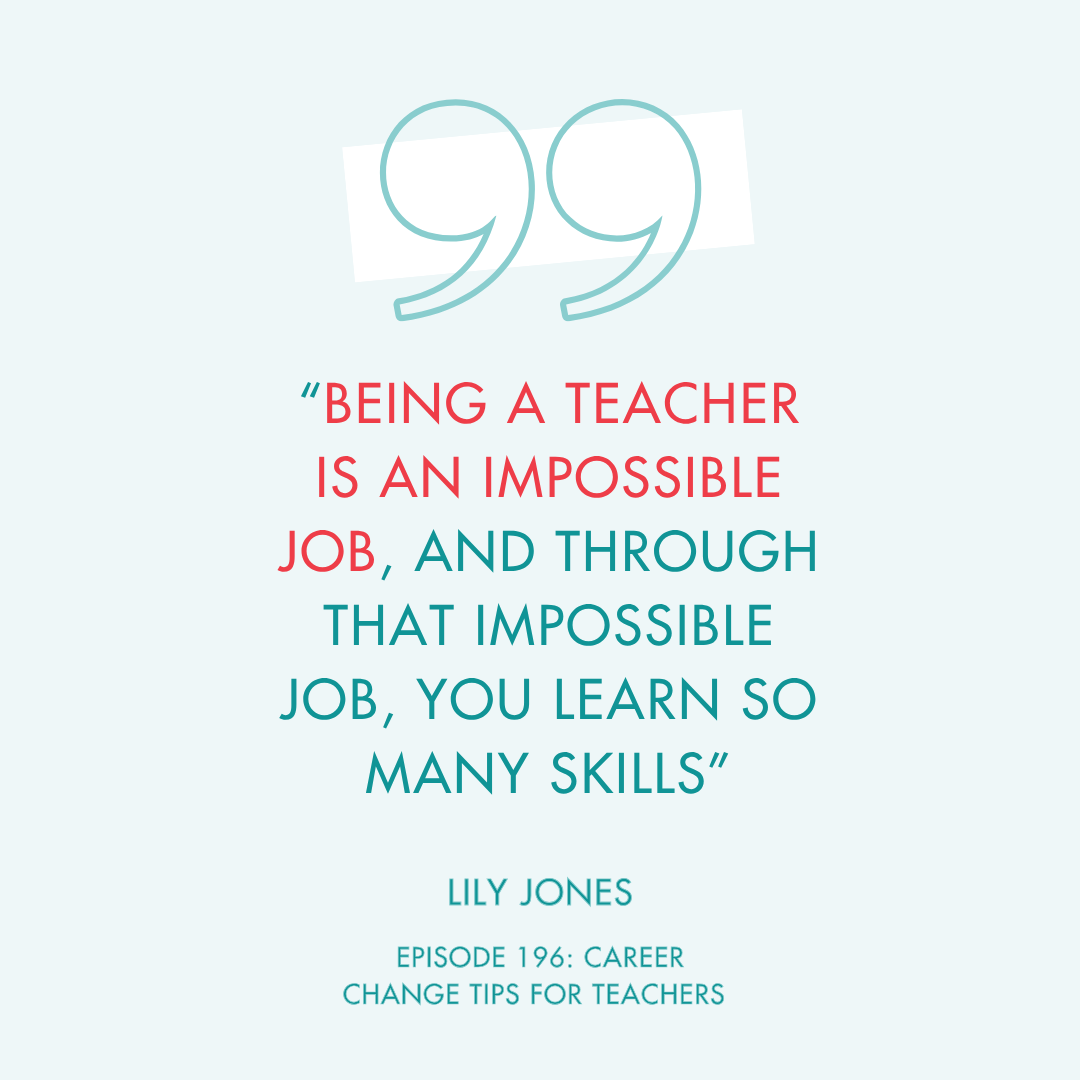
Today I want to talk to you about career change tips, and as you're considering a career change from teaching, it can feel totally overwhelming. And so I want you to see this as a process. That's not something where you snap your fingers and immediately know what's going to happen next. It's not even something where you have to make this decision right away. It's just allowing yourself to explore whatever it is that's calling to you. And maybe you're thinking about a career change because you're totally burnt out. Maybe you're thinking about a career change because you need more money. Maybe you are thinking about a career change because you want to spend more time with your family and have flexibility. Maybe you're thinking about expanding your impact or just learning something new and stretching yourself in a new way, there are so many completely valid and inspiring reasons for a career change. And so, I would get clear on first why is it that you're looking to change careers, and leaning into that why as you move forward, and so as you make this shift, going from classroom teacher to doing something else in education, maybe you want to be a curriculum developer, an education consultant, or start your own business. Whatever it is, start by knowing that you're not starting at zero. Being a teacher is an impossible job, and through that impossible job, you learn so many skills, and so the first step really is thinking about what do you bring to the table. If you really are setting your sights on a specific role, spend some time reflecting on what about being a teacher sets you up for success, and so think about what you actually do in the day-to-day life of a teacher. You probably manage complex projects like you do lesson planning, curriculum planning, etc. etc. etc. You lead groups all the time and facilitate engagement, and probably use strategies like universal design for learning to make sure that all students are engaged. You also analyze data and you adjust strategy. I mean, we do this all the time, right? Like teaching something in a certain way and getting feedback that a kid really doesn't get it. We're going to change it up. We're going to use that data, and we're going to adjust. We also just interact with so many people all the time: diverse audiences, stakeholders, families, fellow teachers, students, and that's a huge skill, being able to communicate with such a wide audience. And so, thinking about that experience, you think about, all right, well, what skills do I bring to the table then? Communication, organization, presentation skills. You also probably bring leadership, interpersonal skills, emotional intelligence, data analysis, problem solving, project and time management, curriculum, writing, content design-so many different skills that you bring to the table. So I'm going to go over a few steps that you can take as you explore options beyond the classroom. And with those steps, I have some tips for you. But the first tip is exactly what I just said: think about what do you already have. Actually, I guess I shared two tips. Think about what your why is. Why are you making this change? Then think about what do you bring to the table that would be applicable to the types of jobs that you want. Then think about along with that what are my strengths. So this is along the lines of your skills, but really dig deeper now. What parts of being a teacher energize you, and what parts drain you? Think about what kinds of problems do you enjoy solving, and what do others often come to you? What do people ask you for? What do people stop by your classroom for? Then along the same lines of thinking about why you're making this change, think about what kind of lifestyle or work environment you're really craving now. So this step here is really getting clear on what you want, what you bring to the table, what you want and what you don't want. And after you get clear on that, you get clear on your skills. You get clear on your desires. You get clear on your why. Then there's probably going to be some things to learn because you're amazing. You have amazing relevant skills, but that does not mean that you don't have things to learn.
And so there's probably some degree of upskilling that you need to do, and you can do it strategically. That means thinking about what do I need to learn to get to where I want to go, and so you can think about certification programs. Like if you want to be a curriculum developer, we have our curriculum development foundations program that certifies teachers in curriculum development. It's a great way to upskill to learn how to use your experience in a new field, there are a variety of different certification programs out there. You can also do online courses. Of course, we have many here at Educator Forever, or join a membership like our Educator Forever Network, which comes with our Beyond the Classroom course. There are people who have done these things that you want to do, so learn from them and learn with them. You can. Also, take on some portfolio building projects, and they don't have to be paid. This can be like, "Hey, I want to be a curriculum developer. Let me create a portfolio. You can do that. You can do that through our program. You can do that on your own too, right? But creating the experience that you need is really empowering. You don't have to wait to get hired. You don't have to wait for permission to create the experience that you need and the learning that you need, then thinking about the job search, you need to align your resume and cover letter with the positions you want to apply for, and all the works and tips that I just mentioned. You know, getting clear on your skills, getting clear on your why, getting clear on the connections. All of those things are really valuable when writing resumes and cover letters. And so, a strong resume for a teacher career change should translate teaching jargon and acronyms. Like, take out the acronyms. There are so many acronyms in the world of education and teachery words. Try and make it so like a lay person can read your resume and understand where you're coming from. Highlight measurable impact where possible, like what was the impact of your teaching strategies. Give specific examples of strategies or approaches you used. Add in your transferable skills, just like I had you brainstorm. Put those in your resume, and then align it with the roles you're applying for, so if you're applying for an instructional coach role, I want to see your resume reflect your coaching experience. Doesn't have to be formal, but maybe it's professional development sessions that you've led, or teachers that you've mentored, or student teachers you've had. In your cover letter, your cover letter is a chance to connect your unique experience, your resume, to the job posting, the specific job posting, highlight the value you bring, why your expertise and skills make you a strong match. Highlight how your experience applies to the new role. Like really, this is a persuasive essay persuading the reader why you're the best person for the job, and most importantly, honestly, highlight your excitement and your passion for the specific role or organization. Why do you really want to do it? This connects back to your why. If your mission is to support students with phonics, and you're applying for a phonics job, amazing alignment, right? Make it clear to the person reading it, and that enthusiasm goes a long way, and so as you think about making a career transition, I want you just to smart start small. You don't need to quit your job tomorrow, and if you're feeling overwhelmed, take small, imperfect actions. You do not have to quit right away. You do not have to blow up your life. You have to take small actions to explore the different options that you're interested in. So that could be maybe taking on a freelance project while you're teaching. Maybe it's taking one of those online courses or certification programs. Maybe it's updating your LinkedIn and start connecting with people. Maybe it's just talking to people, talking to friends, colleagues, family members about what you want to do speaking what you want into existence? It's underrated, but it's super important. And so, gather information, try new things, test things out, collect data to inform your way forward. And as you do that, expect emotional friction.
Lily Jones 8:18
You know, being a teacher is so laden with our identities, and we probably had dreams and goals around being a teacher, and so it can feel upsetting or disorienting to make this change. You might be feeling guilt for leaving your students or colleagues. You might be feeling the unknown, a fear of the unknown, being like, "Well, who am I if I'm not a teacher? What can I do? You might be doubting your abilities or having this pressure to like figure it all out quickly. All of that is really normal. Change and growth rarely feel certain, and it often feels like questioning everything. But you still have to move forward, and so let the discomfort exist, but don't let it make your decisions for you. Take small, imperfect action along the way, and you don't have to do it alone. You should build a support system that can really inspire you and cheer you on through all the ups and downs. Our Educator Forever Network is one support system full of amazing educators doing flexible work beyond the classroom or starting their businesses, expanding their impact would love to have you check that out. And there's also mentors in your field. There's family members. There's friends. There's colleagues. Don't go at it alone. There are so many people who can help you along your way, who have done things that you want to do, and you can learn from them. So again, as you make this transition or explore this transition beyond the classroom, I want you to really get clear on your skills and your strengths, what you want and what you don't want. I want you to get clear on your why, and then I want you to really put what you want out there in the world through resumes and cover letters, through talking. People through taking imperfect action and really learning from the imperfect action that you take. I also want you to lean into learning new skills, recognizing that you have amazing experience, but you don't have to learn it alone, and you don't know everything. Nobody does. So maybe there's a class, or a certification or a workshop that you can do or a book you can read or videos you can watch to really lean into learning and last but not least create the experience that you need. You don't need to wait to be hired. You don't need to wait for the perfect moment. You have agency and you can take the steps forward to create the life that you want.
Transcribed by https://otter.ai