
Episode 197: From Teacher to Web Designer with Jenelle Rawlins
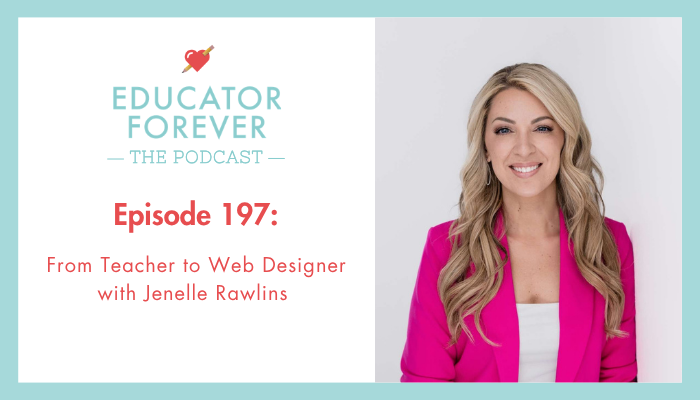
Jenelle Rawlins is the founder of Jenelle Marie Web Design and Branding. She helps businesses that have outgrown their current website and want to work with more premium clients. She specializes in custom logo design and website makeovers so that her clients have confidence, authority, and messaging.
In our discussion, we talk about how Jenelle taught for 16 years before getting into web design. Then we dive deep into her work, from how she learned web design to the aspects of design that folks might not know. If you need a website for your new business, you’ll want to tune in.
Topics Discussed:
The issues with DIY website creation
When you should invest in website design
Jenelle’s rebrand
Resources mentioned:
If you’re enjoying this podcast, please leave a rating and review on Apple Podcasts.
Related episodes and blog posts:
Read the transcript for this episode:
Welcome to Educator Forever, where we empower teachers to innovate education. Join us each week to hear stories of teachers expanding their impacts beyond the classroom and explore ways to reimagine teaching and learning.
Jenelle Rawlins is the founder of Jenelle Marie Web Design and Branding. She helps service businesses who have outgrown their current website and want to work with more premium clients. She specializes in custom logo design and website makeovers so that her clients have the confidence, authority, and messaging they need to raise their prices. As a former teacher, Janelle especially loves working with teacher-turned entrepreneurs, education consultants, and teacher influences who are building businesses beyond the classroom. Hi, Jenelle. Welcome.
Jenelle Rawlins 0:28
Hi, Lily. Thanks for having me.
Lily Jones 0:31
So nice to have you here. I always start with a gigantic question, which you can take in any direction you'd like, which is to tell us about your professional journey.
Jenelle Rawlins 0:40
That is a big question. Well, my background is in teaching. I taught for 16 years. I was-I feel like a lot of teachers go into it like, oh, I-I always wanted to be a teacher. I always knew, or they came from a family of teachers. That was not me at all. I was actually majoring in interior design because I've always been drawn to creative endeavors, and I started tutoring a middle school boy, just kind of like for volunteer experience, right? In college, and then I fell in love with teaching, and so I changed my major, ended up teaching middle school, which I loved for, like I said, 16 years, and just I always wanted to keep the joy and the fun of it alive, and keep the kind of the big picture of making memories with the kids. And I taught language arts, and so my passion was really connecting kids with good books and series and authors to help them kind of catch that love of reading. So yeah, I loved it for a long time when I did it.
Lily Jones 1:48
Amazing, and I know that you then transitioned out of the classroom and you started Janelle Marie Web Design and Branding. How did that out?
Jenelle Rawlins 1:59
Yeah, I think so. So being the kind of teacher that I wanted to be, which was always trying to be creative and innovative and do something new each year and keep it fresh, and really connect with the kids, that takes a lot. It just takes a lot, right? And so I had kids of my own, and then there's only so much of you to go around, and so it just started really the the mental and the emotional kind of like wear on me trying to be the amazing teacher that I wanted to be and be the mom that I wanted to be. It just started feeling like a lot, and so I started sort of questioning. Like I love what I'm doing, but I don't know if I can do this for 30 years, right? I didn't. I didn't see myself as a lifer, so I actually started. I had always loved creating curriculum and making beautiful slideshows and things like that for my lessons and and worksheets and things like that, right? So I actually got into being a virtual assistant for other teacher content creators, like on TPT, and I was doing that while I was teaching in the classroom, doing that on the side, and I really liked that. And then I had a client who needed her website redone, and she was like, "Hey, can you learn website design and redo my website for me? And I said, "Sure. And so, and then I just fell in love with website design. So after a couple years of doing that on the side, I transitioned out of the classroom and started my own business. And now that's what I do full time: web design and branding.
Lily Jones 3:32
Fantastic! And how did you learn about web design?
Jenelle Rawlins 3:36
You know, anyone can learn anything now. I mean, it was I taught myself. I watched a million YouTube videos. I took a course on kind of like how to start my own business. I took another course specific to WordPress and website design. And then from there, you know, just every project you do, you learn how to get better and faster and tweak things until you can hone your craft and just learn it on the fly, like we're so good at doing as teachers.
Lily Jones 4:06
I love that advice too, because it is like you can learn anything. And I think when teachers leave the classroom or anybody in a transition, it can feel a lot of like I don't know how to do this. And I think your initiative of being like, yeah, all right. I can figure this out, right? Is exactly what we all need to learn something new along the way.
Jenelle Rawlins 4:25
And fake it till you make it. Like, how many times as a teacher did I? I was teaching something that I had just learned for the first time the night before, or some new topic, and you know, you're you're just going with the flow and putting on a happy face and kind of performing, and you're figuring out as you go.
Lily Jones 4:41
It's definitely a teacher skill.
Jenelle Rawlins 4:44
Right?
Lily Jones 4:44
Yeah, and it's like as teachers, we're experts in learning, so you can apply that to yourself as well.
Jenelle Rawlins 4:51
Yes, we are experts in learning, always learning new things.
Lily Jones 4:55
It seems cool too. I can imagine that you mentioned, you know, starting with interior design. And that more kind of creative approach to things, and then going into teaching, I can imagine that web design is also kind of in that creative mode. Do you see similarities to your original interior design work?
Jenelle Rawlins 5:14
Yeah, in fact, because I had I actually had my degree in interior design. I finished that degree, and so when I started learning web design, and it was balance and proportion and color harmonies and and things like that, it was exactly everything that I had learned in college about interior design. So there's there's so much overlap. Like good design is good design, and then because I was a language arts teacher, the other thing that I love is writing. And so as a website designer now, a big piece of that is I write the website text, the copywriting for my clients as well, and so so that is that's a skill that you know comes in handy when the messaging is such an important part of what you're trying to convey on your website, which is really just a sales tool. So kind of being able to have the right words to connect with your audience is is another big piece of it. So it's like a perfect blend of creativity and writing, which are two things that I love.
Lily Jones 6:11
So I know that making that transition from being a teacher to being an entrepreneur can feel really overwhelming to people, and you've gotten that a bit of the teacher skills that you brought to the table. Are there any other things that you found yourself being like, "Oh, I use this as a teacher" that have helped you as a business owner?
Jenelle Rawlins 6:30
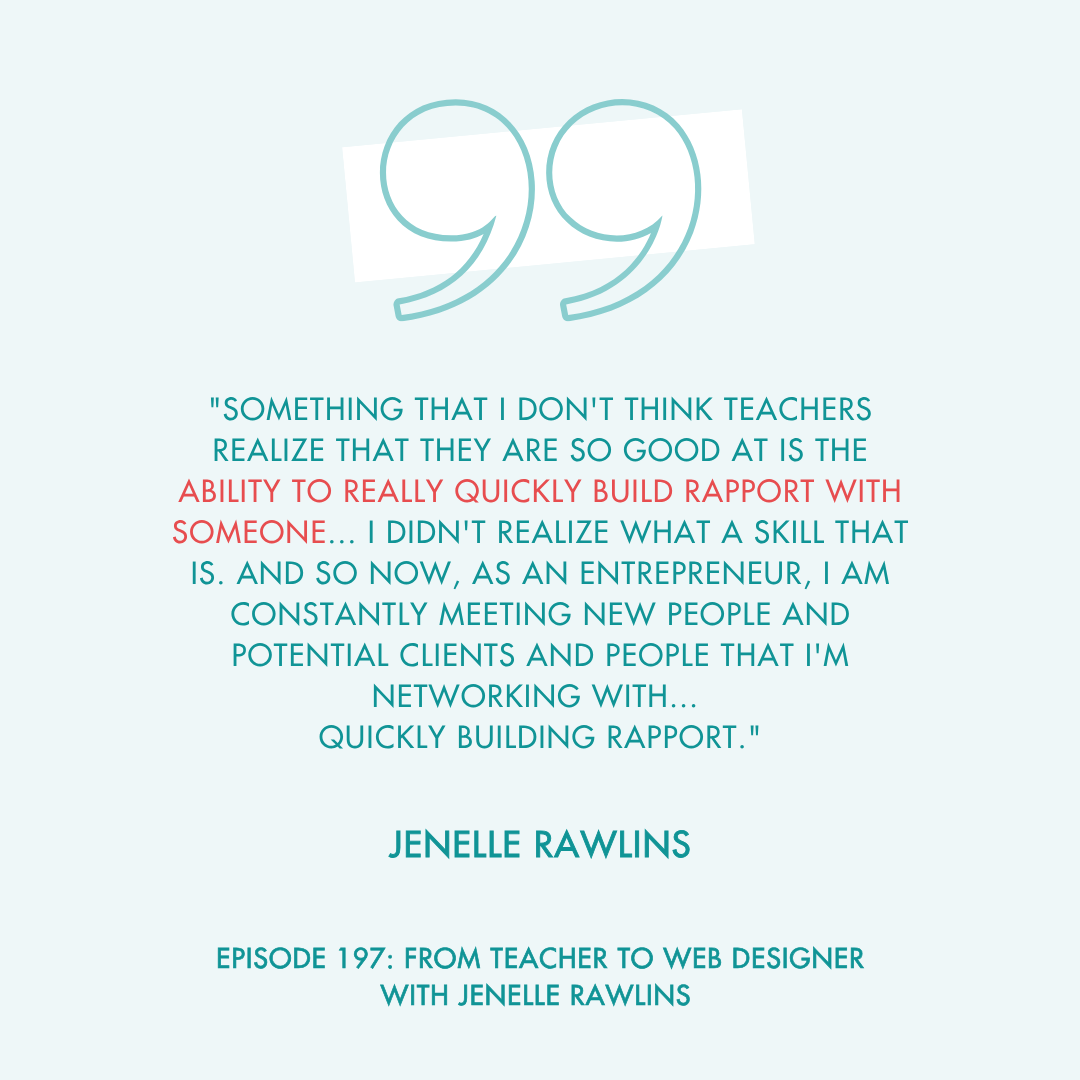
So something that I don't think the teachers realize that they are so good at is I was thinking about this the other day: the ability to really quickly build rapport with someone because every year. So I taught middle school, and so every year it was a fresh batch of 100 new kids. And I always felt like my most important job at the beginning of the year was to, as quickly as possible, establish a relationship with each kid. Right? You want to get to know them quickly. You want to let them know, hey, you can trust me. You can learn from me, and you're doing the same thing with their parents. So doing that over and over and over and over every single year, I didn't realize what a skill that is. And so now, as an entrepreneur, I am constantly meeting new people and potential clients and people that I'm networking with, and so much of networking and sales is just quickly building rapport, seeing like what do we have in common, how can we help each other. If you are wanting to sell your services or something that you offer, you want the person to as quickly as possible feel comfortable with you and that they can trust you and that you're an expert. And those are all the things that we are working so hard, you know, with each fresh school year to establish those relationships with students and parents, and so that translates really well into having your own business.
Lily Jones 7:53
Absolutely, yeah, that's a great that's a great connection, and so I want to shift a little bit to actually creating websites, a lot of our audience, you know, maybe they have ideas of things they want to do beyond the classroom, or maybe they're starting an education business. And often I hear from people like, "I don't know how to get myself out there, or they feel overwhelmed about making websites. Can you talk a little bit first about kind of what what to do and what not to do, like maybe some common mistakes that people make when DIYing their website.
Jenelle Rawlins 8:26
Yeah, so I would say the most common thing is too much text, and we, as teachers as well, we're so good at explaining things, and we want to tell all of the reasons and all of the why, and if you are, you know, for example, you're a teacher and you're kind of selling your curriculum or resources, things like that, on the side, you might feel like you need to tell all of the great things about it and how you designed it and developed it and why it's so great for students and things like that. And there, there is a place for that sort of further down the funnel, but it's not on your homepage or your about page. You don't need to have so much text and so much information. So your website is really a sales tool. So on your homepage, your first job is to connect with your audience. Let them know that you empathize with them, that you understand their the problem that they're facing, and then you introduce why you are the right person to to help them with that problem before you even get into your services or your products and and what's included. So a lot of DIY websites that I see are maybe a little bit disorganized that there is just so much text, too much text, especially on the homepage, too much explaining, too many different calls to actions. Really want to keep it really, really simple, really clear, because people that are browsing online, they're they're in a hurry. They're skimming. They're going fast. If your audience is other educators, we know how busy they are, and so they don't want a big, overwhelming, cluttered website. They want something that feels like a breath of fresh air. It's clear. It's clean, and they can see exactly this is what I need to do next. Oh, yep, this person can help me. She has helped other people like me, and I know exactly what to do to take the next step.
Lily Jones 10:26
That's very relatable too. I think that I've definitely been in that mode of being like, I want to put out everything and overshare and put so many words. And I think that's fantastic advice because as a consumer, if you go to somebody's website or even their Instagram profile or whatever, and it's just too much text. It's overwhelming, and when there's too much, it actually becomes less clear, not more clear.
Jenelle Rawlins 10:50
Yeah, and when you can communicate clearly, that conveys competence. If you need to use 100 words to explain how you do something psychologically, people don't trust that as much as someone who can really clearly, in 10 words, say exactly how they can help you. So it's also a psychological principle that the you know the clear beats clever, being really concise conveys competence.
Lily Jones 11:14
So many people might start off by DIYing their website, and of course there are tools and sites to help you do that, but eventually they might get to a place where they outgrow their DIY website. Do you have any, you know, tips about how you might know when it's the time to invest in somebody to help you with a website?
Jenelle Rawlins 11:34
Yeah, so a lot of most of the clients I work with already have a website, and they're at that point, that they have outgrown it, and so a lot of what I hear is they feel kind of embarrassed to send people to their website. Typically, their business and their expertise has grown, and the website hasn't grown with them. As you know, as a business owner, once once you get busy and working with clients, and you get into a groove. It's hard to carve out time for everything, right? We're we're marketing, we're networking, we're trying to be on social media. We are serving our own clients, and so often your website just kind of gets put on the back burner. People often kind of just set it up once, and then they don't really think about it again for a couple years. The other thing I see is that maybe over the years you've just been adding and adding and adding to it, and it starts to become this big monster with like two levels of navigation and all these drop-down menus, and just kind of if you've been adding a lot and you haven't deleted anything in a while or kind of curated anything in a while, and you feel like maybe it isn't super clear for a user what they should do next or where they should go. If you're feeling like it's getting kind of big, it's getting kind of clunky, and you're not excited to send people to your website, you're maybe a little embarrassed to send people there. Those are good signs that it might be time for a professional redo to match how your business has grown.
Lily Jones 13:02
And I like thinking about this in terms of evolution. Like it can be kind of scrappy to start, right? Just like getting it out there, seeing what it looks like, and then once you test it out and make it real, and maybe get some clients, then it can be time for an upgrade. And can you talk a little bit about? I mean, I know personally how branding and website design can help increase business, but how have you seen focusing on branding and web design help people increase their prices or bring in more business?
Jenelle Rawlins 13:30
Yeah, it it really is buyer psychology, and it's so interesting. And there's so much research that's been done into buyer psychology. So the the language, the messaging that you use, the design to a lesser extent, I think, than the messaging. I think the messaging is even more important. But all of those things are sort of communicating to someone before they even see your prices. They're kind of like preparing them for your prices. They're they're priming them. So the words that you use the design. If you're wanting to charge higher prices, you need to be preparing that person psychologically to see those prices. So the if you have a few sort of words like like premium and luxury and things like that, if you're sprinkling those in before you get to your services, that person is primed to expect a higher price. There's also a lot of psychology behind trust building and your social proof, like testimonials and reviews and case studies. If people can see, wow, this person has helped other people like me, and they see themselves as you know, they see that other person as a peer. Oh, they have a similar business as mine, and Lily helped them so much that also primes them to be willing to pay more. And pricing is-it's incredible how flexible pricing is. And people, there are people that'll pay $100 for something, and people that. They'll pay $1,000 for the same thing. So part of it is identifying who is your target market, and if your target market is the $100 person, that's fine too. You're going to use different language and things like that, and you're probably doing more of a of a volume kind of a marketing. But if you are, most of my clients are wanting to work with fewer, more premium clients, higher prices. So we're doing things like cleaning up their branding, decluttering their website, putting in those priming words to let people know that this is going to be a luxury, professional kind of experience. And then with branding, having your having your brand be consistent across all of your social media, your website, your colors, your fonts-all of that just psychologically makes people feel safer, and they feel like they can trust you. Because every time I see Educator Forever, like that's the logo, those are the colors. It just creates this this sense of safety that helps them trust you more. So there's so much interesting psychology behind design. I just love it.
Lily Jones 16:06
I love that idea of a sense of safety too. I haven't ever thought about it like that. But yeah, I mean that's what we resonate with. And again, I can imagine. I mean, I don't know about interior design, but I can imagine too, right? Like you want a house that has a sense of safety and calm, and it's the same thing when it comes to website and design.
Jenelle Rawlins 16:22
Yes.
Lily Jones 16:24
So you've talked a little bit about working with people who are in transition of like maybe they have a scrappy website and they're ready to uplevel. Can you talk a little bit about what your process is when you work with people?
Jenelle Rawlins 16:34
Sure. Yeah, we typically start with what I call a brand blueprint, which is really the strategy phase. So, before you invest in a big website project, I want to make sure that we're building the right website for your business. So, we would do things like a really deep conversation into your target audience, your goals. I would do a deep audit of your current website, the messaging, talking about your offers in your business, how have things evolved in the last three to five years? Where might there be a mismatch between what you're currently offering or what you're wanting to offer or the prices that you're wanting to charge and what your current website is sort of presenting? So we do all of that strategy first, and then from there, if we need a brand revamp or redesign, we would do that next, and then we would do the website redesign. Often there are considerations for SEO and AI optimization now. If search engine, if that organic traffic is a big part of your business model, we need to have a strategy for That so, yeah, and just being a teacher, I still love educating and explaining things. So I really love sharing the why behind everything that we're doing, so that my clients feel really confident and empowered, and just kind of knowing the reason behind what all the decisions that we're making
Lily Jones 18:01
Fantastic. And so thinking about our educators out there who maybe are at the beginning stages of building a business or thinking about building a business, what advice would you give to them?
Jenelle Rawlins 18:12
So I think so much of it is mindset, and I'm in a mastermind with other women business owners, and we're always business is all about experimentation. So you have to know it's just like what we tell our students, right? You fail, and then you learn from failure, and then you keep going and you try something new. And as an entrepreneur, you are you're just always trying new things and you're experimenting with your offers, with your prices, with your niche. So you have to have that mindset that it is-it's not going to be perfect immediately. And I try to stay off social media as much as possible, honestly, because sometimes you'll like comparison is the thief of joy, right? And so when I was just starting my business, I noticed I was comparing myself to these other women entrepreneurs that they had been in business for five years or 10 years, and I and I had just started. Right, so don't compare your beginning to somebody else's middle. So it's so much about about the mindset, and instead of thinking about the worst case scenario, thinking about the best case scenario, I feel like you're constantly like in therapy with yourself as an entrepreneur, staying focused and staying positive, having one goal that you are constantly working towards because the shiny object syndrome or getting distracted is is very real. So I have found that some of the most successful entrepreneurs I've gotten to work with-they're really, really focused on you know like the one thing that they're really passionate about that they do really well, and not being distracted by maybe I should make a course or maybe I should sell products or right like pick your thing, and you got. Stick with it at least, you know, six months to a year. Give it a good shot before you're, you know, changing focus.
Lily Jones 20:09
Easier said than done. I've totally been there. But yes, absolutely. Yeah. Oh, or I can do this, or maybe this thing, or maybe this thing. But yes, and I guess on the flip side, it's also empowering to focus on just one thing and go deep rather than going broad and feeling like you have to do all these things. Like you can be more specialized.
Jenelle Rawlins 20:32
Yeah, and there's so much advice out there for business owners, but it doesn't all apply to you, right? So I there's relationship marketing and then there's high traffic marketing and I remember at first being confused like oh I should be doing this and this and that and then I learned those are different business models that's for high traffic kind of marketing and so being able to cut through that noise especially at first was was really difficult, but then just kind of being confident in what you're doing and what you're good at, and keep experimenting, keep iterating to hone your skills.
Lily Jones 21:12
Wonderful. Well, Jenelle, it's been so nice talking with you. Can you tell folks how they can connect with you?
Jenelle Rawlins 21:16
My website is hellojenelmery.com. It's J-E-N-E-L-L-E. I'm in the middle of a rebrand, so when this episode comes out, it might be Site Crush Studio. I'm opening a boutique agency, expanding a little bit, but it'll redirect you to the new site if you do Hello Chanel Marie.
Lily Jones 21:35
Wonderful, yeah. Tell us a little bit. I know we're wrapping up, but now I'm curious. Tell us a little bit about this evolution.
Jenelle Rawlins 21:42
Oh yeah. Well, when I started, I always knew that my kind of individual personal brand genomey that that was that was just a starting point. I definitely have visions of building something bigger, bringing in a small team. I've been fortunate to find a couple of subcontractors that I really love working with. So just being able to expand and to bring on more clients and to help more people so yeah rebranding to Site Crush Studio specializing in WordPress redesigns for expert business owners
Lily Jones 22:14
Wonderful. Thanks again Janelle. So nice talking with you.
Jenelle Rawlins 22:17
You too thanks Lily.
Transcribed by https://otter.ai