Episode 164: STEM for All with Jim Hollis of Calculus Roundtable
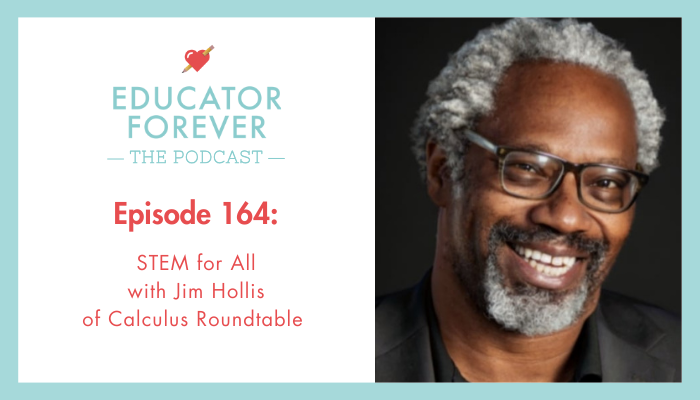
Jim Hollis is the founder and executive director of the Calculus Roundtable, a nationally recognized nonprofit that improves math and science achievement for underserved students. Under his leadership, the organization has worked with over 65 schools across California, Washington, and New York, earning accolades such as the New Profit Foundation’s recognition of Hollis as one of America’s top 24 social entrepreneurs of equitable education.
Jim and I talk about the experiences that led him to start Calculus Roundtable, as well as how it makes a difference in the classroom. We also get into the importance of providing engaging content in the classroom and the future of his organization.
Topics Discussed:
How COVID influenced the expansion of Calculus Roundtable
Maintaining the quality of education when the classroom expands
Including parents in a child’s education
Resources mentioned:
If you’re enjoying this podcast, please leave a rating and review on Apple Podcasts.
Related episodes and blog posts:
Read the transcript for this episode:
Welcome to Educator Forever, where we empower teachers to innovate education. Join us each week to hear stories of teachers expanding their impacts beyond the classroom and explore ways to reimagine teaching and learning.
Jim Hollis is the founder and executive director of the Calculus Roundtable, a nationally recognized nonprofit that improves math and science achievement for underserved students. Under his leadership, the organization has worked with over 65 schools across California, Washington and New York, earning accolades such as the new profit Foundation's recognition of Jim as one of America's top 24 social entrepreneurs of equitable education. Welcome Jim. So nice to have you here.
Jim Hollis 0:27
Great to be here. Lily, thanks for having me absolutely.
Lily Jones 0:30
Well, I know you and a little bit about your journey, but I would love for you to fill folks in on your path to where you are now, in whatever direction you want to take this.
Jim Hollis 0:40
Sure. Oh, boy, that's a long path.
Lily Jones 0:42
You need visuals?
Jim Hollis 0:45
Yeah, right. Just measured by my gray hair, I guess is the best way to do it. But I've been in education for almost 20 years now, and I started out in the private sector. I'm an economist by trade, and I went into education thinking, oh, I'll just go on for a couple years and change it all, and then I'll go back to private sector. 18 years later, I'm used to Lily or there's a lot of work to do. There's a lot of work to do. I found more than just changing the colors on websites and things like that, but I started out working for an organization called Springboard schools that was part of the Annenberg challenge back in the 90s for systemic school reform. I did that work in the Bay Area. That organization still around. It's changed its names a couple of times, but the real work was about systemic school reform in some of the largest school districts in the country, Los Angeles, Chicago, Seattle, and I did that work at the policy and implementation level, but realized quickly, like, I am not working with kids. Why am I working for a nonprofit, and I'm not working for kids, with kids? So I, over time, after doing that for was the director of the innovation incubator for 11 years, and that's where I did the work with the school districts. And then I really wanted to really wanted to work closer with children, and transitioned that work very seamlessly, as it were, into working with county offices of Ed, doing professional development and consulting with them that was a little closer to the kids. And then our my organization, calculus roundtable, our first big projects were with the Obama administration and the My Brother's Keeper initiative. And we built, worked with cities to build their plans of what they should do to implement these great pros that the President had put out into practical policy. And often we wrote ourselves into the policy. That's what you need. But really it was about using all the all the work that was happening in a community, because as an African American young man, I was very interested in school and had lots of role models around education. And I remember, I didn't really think about this until I got an education Lily about how these things are connected. But when I was a sophomore, my parents divorced, and we moved from the Bay Area to Seattle, and my mother had a job across town, and she's like, you know, you're old enough to go register for yourself. Here's your transcripts. And I got on the bus and transferred two times, and got to the school with my transcript, and my counselor wrote out my schedule, looked at my what I had done, and wrote out my schedule, and he handed it back to me, and there was no math on my roster.
Lily Jones 3:39
hmmmm.
Jim Hollis 3:40
And I was like, I had that same result -- hmmmm.
Lily Jones 3:42
Yeah, that's not alright,
Jim Hollis 3:43
You forgot somethin! And I'll never forget I'm getting goosebumps just thinking about it to this day. He said, Oh, you don't need enough math. You don't need any more math. You've got enough math now to graduate. I was 15, and it was a little mother of my I said, you know, my mom will never believe if I could go home like this. Never believe that you said that out loud. And so I had to really force him to give me a math class, which really changed me being here today to where it might have been. And I never thought to this day, I don't think that he was trying to discriminate against me. He thought he was doing me a favor. And when I got the education, and really thought about that moment, that really resonated with me, and where a lot of the young people that we work with are and, you know, kids don't drop out of school because they're dumb. They drop out because they're bored. They're just bored. And how can we give children things that they already they already resonate with them, instead of trying something new and having them being frustrated, what do they already know that we can build off of? I remember living in East Oakland, and, you know. Hearing all the hoopties and the big cars with the radios going by. And I would think, you know that kid probably dropped out of high school, but he's got $60,000 of electronics in his car. How can we transfer that knowledge into what's happening in schools? A lot of times, I found that schools really are not conducive to multiple ways of learning and multiple ways of getting to knowledge, unfortunately, especially even more exacerbated by students of color and students who have not traditionally been in those situations, or who have family who have college backgrounds, and we see a lot of knowledge just go to waste. And when I was at that education Think Tank, I did a study that looked at how many students in the Bay Area, how many African American students were in a calculus class, and in the night, this was 2012 but in the nine counties of the Bay Area, there were Less than 100 African American students.
Lily Jones 3:43
That's horrifying.
Jim Hollis 3:43
Hundreds, a 100
Lily Jones 3:43
awful.
Jim Hollis 3:43
It's awful, and in some ways, not surprising. And I thought at being a numbers guy like I am, oh, if I can get 10 more kids, I've increased the number. And it's not that, you know, we're named calculus roundtable, but it is not that we believe that every child should take calculus. It's more an indictment on the system. Why aren't more kids on these pathways? And it doesn't start in 11th grade. It really starts in fifth grade and learning some of the skills and techniques that will propel students so when they get there, it is not something completely unknown. That's sort of our meta mission is to, is to get kids engaged in math and science in the ways that they My goal is for a kid to say, Mr. Hollis, are you sure this is a math class? This is like, really easy, or this is really fun? It's like, No, this is what it's all about. Taking it out of that sort of, you know, homework assignment sheet, and put it into the real world makes a lot of difference. In years, we work with over 30,000 students.
Lily Jones 7:13
So awesome. I mean, it's so powerful, and I resonate with so much of it. I think it even starts like before fifth grade. It starts at preschool, as a kindergarten Right? Like all the ways I saw from even being a kindergarten teacher, the kids come in being excited about learning, you know, being excited about all the ways that they could connect to their own lives. And then even in the kindergarten year, you know, having that change, being in a formal school, and I thought, such a shame, you know. And even thinking about your examples of like, well, who is education for and where does it exist? Like it exists everywhere. And you know, what's prioritized in school is not often, what all kids experience is education. And so I really appreciate how you're not only increasing engagement, but also access through your work.
Jim Hollis 7:57
And it's access for the students, clearly, but it's also access for the teachers and the educators to see their kids in this environment. We become a scaffolding like, Oh, I didn't know Hector could do that. What do you mean? He did what? And it changes how teachers perceive their students. Some of those small things of like, when we start the class, when we do our icebreakers, or things like that, we try to ask kids questions that we know they already know. I mean, as simple as who's wearing socks today? Like you want to get kids answering questions and not just waiting for the right answer, but to really be a part of the learning and not spoken to, but participate with.
Lily Jones 8:42
Absolutely. And so tell us a little bit more about you. You mentioned, you know, how you started Calculus Roundtable. But why did you start it? Like was there a moment that led you to decide to venture out on your own and start your own nonprofit? Or how did that come about?
Jim Hollis 8:58
You know, I really, I've come to believe that STEM is the civil rights of the 21st Century, and just those I told you that situation about me, but I now I see it all the time with educators and administrators like, or the walk into a math class. Oh, I'm not a math person, but what are you guys doing? Like, why would you why would you say that? And just removing that phobia of math that most of us have. So I loved math, and I remember this counselor like, we're going to save you from math. Like, why are you trying to save me from math? I love math, and I just saw that in small ways with so many students. And once we gave them, we that first project we did with the Obama administration. We did we worked with Richmond, in the city of Richmond, and we did a physics class in the public housing projects. Now. Everyone said we were great. Why are you doing that? There's nobody who's going to be able to do that work. But we knew we were working with younger kids, and there were concepts that we could we could explain to them. And we started out what's called a roller coaster class. How do roller coasters operate? What happens with mass and centrifugal force? And using that academic vocabulary, they were able to understand a lot of things that no one thought they could. So first, 45 parents came to opening night to see the program, and it was sold out every time. And by the mid of middle of that class, we weren't calling it a roller coaster class anymore. We were calling it a physics class. So when the parents would pick their kids up, what were you doing today? Oh, we're doing physics. What? That's chalk on the parents face that resonated with the kids. Oh, wait, I did do that. So really, not like, you know how it used to be with No Child Left Behind. At the beginning, we would post the standards on the wall of, Okay, we're gonna learn this that's not do it, and then tell you what you did after it that removed all the barriers. So once we remove the barriers, once we included the family in the accomplishments of the students, we just saw a night and day change with those students who were far below basic in math and science. And then, of course, that made their surprise. Surprise. When you give them something interesting, they were more appreciative. They stayed in class more there was less fighting, there was less suspensions, and their grade points went up right now. Ed Trust West just did a study on us, and they said that our grade, our grade for African American students, grew 27 points in a year, amazing. So that kind of again, and I needed all of those things to work, because you could get an advantage with a group of kids in this, in the system itself. Oh, well, that's because of this. Well, instead of, like, really encouraging it, they were always looking for reasons why they couldn't achieve. Our kids weren't doing well, but neither is Berkeley, neither is Oakland, neither San Leandro... That's not the way to move forward. So being an example in the school system, with schools with administrators, with students with parents, really opened up a lot of opportunities for for kids who are struggling in math and science.
Lily Jones 12:26
It's so cool to hear about that program and the impact of it and the impact of your work. And I think it makes me think about, like, not only the engagement piece, but also the challenge. You know, kind of going back to your personal story that you shared, like, sometimes people are like, Oh, we're just not going to make it challenging, right? And it's like, the challenge actually is the engagement. So there's part of learning that makes it fun. When it's hard, I appreciate that it's both, you know, it's not just, it's fluffy, it's fun, right? Like, we're making a roller coaster, yeah, it's like, and it's challenging, and that's what makes it truly engaging.
Jim Hollis 13:00
100%, and when those kids would say, this is not math, this is so easy, our response is, no, this is hard. This is math, and it's hard, and you did it and you can do it, yes, you can do it again. And once they see that, they can get through that. This is sort of an international thing, right? This is how education works in other places. It's not that one culture is smarter than another culture. It's the way that we bring education to the students. You know, many in Japan, if you don't learn timetables in the fourth grade, that fourth grade teacher follows you around in fifth grade at lunch and like, Okay, it's time for six times tables. It's time for like, the teacher's responsibility is longer than eight months. And the way education is set up. Now, if you don't learn that skill in that eight months, you are not going to get it again. Really what's in the system, you'll have to put a scab on it and go around it. But you that skill, the ability for the school to teach you that skill is very limited.
Lily Jones 13:58
Yes, I mean, there are so many structural things that I can talk about forever that just make all this hard, right? Like we know foundational things about learning and what's helped, what helps humans learn. And then there's this system that's so flawed and inequitable and not set up for a lot of those things. And so I think that's where really, like a lot of my frustration as a teacher came too. Being like, well, I know what would work, but do I have the resources, or, like, ability to do it right? Sometimes, no.
Jim Hollis 14:31
Very much so. And and that, you know, education is so unique. As someone who can't started outside of education and see it, never been around a profession with more smart, intelligent postgraduate people, but then they closed their door in a room with 30 little kids. Again, yes, and that lesson plan is laminated, and that's the way it is. So. Trying to break out of that and be still surprised at how many teachers don't work, don't really collaborate together. That's sort of the little other secret, not even in their school, much less around the district or around the community and and even when those things are set up, they seem to be set up more like a career exploration for one teacher, and instead of an investment by the district in education, doesn't really get back into the system. It might make you better teacher, but that knowledge doesn't actually flow back into the education system that you're part of.
Lily Jones 15:40
Yeah, that was surprising to me as a teacher, being like, well, I know there's other people down the hall doing similar things. Like, Can I see it?
Jim Hollis 15:47
Can I just take a look at it?
Lily Jones 15:50
Please, please. Yeah, so tell us a little bit more about how Calculus Roundtable has grown over the years, and what are your offerings now?
Jim Hollis 15:59
Yeah, I think really for us, because of how we started, as I explained, and knowing that technology, not only is it connected to stem it's the quickest way to hack time, right? You can, if you have access to technology, you can get around some of the things that that we just described. So when the pandemic happened in the school shut down, we had, we were working with six schools at the time, but we had already mastered how to do hybrid classes and do part of it online and part of it in the classroom. And so when all the systems shut down, we were up. We could have all of our students continue to learn. We were our set. Our test scores were actually going up during the pandemic because we had more time with the students. And the school saw that, and sort of asked us to really help them make that transition. So during the pandemic, at this we started with six schools, and we ended up in a year later, with 40 schools. So in a tremendous amount of growth, which everyone is like, congratulations, and I'm like, no, no, congratulations. Don't be afraid. I'm afraid so that has been, that has been, really the challenge is to manage the amount of growth. But we work with about 40, like I said, about 40 to 45 schools and or districts right now, so that really has been the big growth, and still combining online learning and hybrid educational practices that we found out we could actually do during the pandemic, right? No one thought we could that could happen, and we got through it as educators. But then as soon as the Panic was over, oh well, the kids don't like to be we didn't really get a lot of bang for the buck by doing stuff online. They really, they really don't like to be taught online. I'd be like, really, because they go home and go on roadblocks for four hours after they leave your class. So maybe it's not the online environment, right? How we're treating that online environment? A lot of educators and schools treat it like the classroom, one big desk, 30 little desk. I'm going to talk and you memorize what I say. And it's such an opportunity to have the students take over the class. Okay, Tommy, now you tell me what's going on. You share your screen and and so finding a lot of ways to get around the hurdles that were there that seem now to be abandoned, and I'm big advocate of bringing what did we learn around teaching during the pandemic that we can bring back into the classroom, not only just as a growth of education, but the political condition that we're in now with chronic absenteeism and and ice being at the school district office and and families not trusting the system even more than they did before, and they still are constitutionally guaranteed an education. So it's us to make the we can't just offer the same things and hope for the same results. We weren't even that crazy about the results we received before. So it's like a great opportunity. You know, I see a challenge in the system as an opportunity to get better as a social entrepreneur, I guess. So I'm really, I'm really enthusiastic about where we are now in education, and I do see schools slowly coming around to some of these things, especially with the teacher shortage and all these other things happening, we have to be more dynamic about how we teach students with school and professional educators being at the heart of it, but more out of school activities that that aren't just separate but connect to what's happening in the classroom. And we're, you know, especially in this world of dei is such a bad word, but it really even if you separate that element of it, which is a systemic issue that that's a whole nother talk show, as we say, but having an opportunity to learn things outside of the classroom happens. In really well resourced communities, and it doesn't happen in struggling communities. So even if you separate the race issue or the gender issue, if you don't have things to do that grab you, you're left with what's in school. And God bless teachers. But a lot of our students like you ask them, who's your science teacher? Oh, you mean today or at the beginning of year, or maternity leave, or like they they don't have consistent math and science in a lot of these schools, and if they do, it's three hours a week. You think about that. That's not a lot of time, you know. And a good after school program that enforces what's happening in school can be three hours a day or two days. So it's if you met, if it's not just a, you know, tiddlywinks program, and it really aligns with what's happening in the classroom, there's a great opportunity to bridge some of these big gaps that we have in education.
Lily Jones 21:02
Yeah, I appreciate the reimagining, you know. I think that teachers, educators, schools, often get stuck in like, rules, you know, like this way it is right, like we teach this here, like, you know. And so thinking about all the different ways that we can teach things, that we can learn, things that we can support students, is really powerful.
Jim Hollis 21:21
It really, it really is.
Lily Jones 21:22
So thinking about, where do you see Calculus Roundtable going next?
Jim Hollis 21:27
Wow. Well, we're, we're doing a lot of work at the state level through in California. Of course, the new California math framework is in place, and again, much like a big initiative, schools don't know how to actually implement it because they've never done it before. So helping schools implement the new math framework, along with a very structured family engagement section, which is more than just math night one Thursday in the school year. It's like, how do you engage families in in mathematics? So that's really been sparking my interest lately, and we've been doing a lot of that. And of course, AI looking at AI policies and how it's implemented in the schools. And, you know, like most new technologies that come in the classroom when I when I talk to educators or do some professional development around AI, I have a picture I show of the Los Angeles Unified School District many years ago, where the math teachers were on strike because kids were using calculators. This is going to ruin education. We got to put a stop to this, and maybe we should have, but it's an indicator that, you know, technology can always be used as a tool, and if we exclude the things that are part of our society in school because we're afraid they're going to cheat on a paper, that is, that is, again, why I say that the stem is really the civil rights of the 21st Century? Because when you protect air quotes kids from these things, and it's part of society, they could be experts in two years of something that's going to be around for the next 50 but when we say, Oh, we don't want you to of course, you haven't done well in your papers this far, and so we don't want you to use any element that help you do better. So if you think about it, it's like, really? So that that mentality of like either you're either you know it, or I teach it to you, or you're cheating, those are sort of the three places in a lot of education system, not teachers, but that's what comes down. You can see it in so many ways. So opening that up to students, having students work together, not cheating on the paper, but work like you do in college. Who knew? You know, working in teams could be how the new economy is actually functioning. So a lot of the things that we protect kids from, I go back to that book. What would Google do if you've ever seen that book? I remember reading that like all of these, you know, working in teams, coming up with decisions on your own. Like, if you did that in school, you'd be suspended, is doing in their offices. So we need to change how we see, like you said, how we see learning, and how we engage students in the way that they learn, using it as a discipline. For sure, one of the ways we do that is we just like we take everything a student says as law, which is, which is just a philosophy, which is, sometimes a student come up with some crazy What's five times five, and all the boys raise their hand, yes, did you see the football game today? It's like we weren't talking about the football game. But how can I incorporate that? Yes, I did see the football game. And speaking of five times five, they did that in the game. And you Oh, yeah. Like, how can we when you really take honestly, what children say, you start to think on their level and start to understand where they are. And sometimes they're just especially in the middle school and elementary we know, since we have kids that era, like they're not testing to be bad, testing you to be bad. They're testing you to see where the boundaries are. How do I learn if I don't know where the edge is? So if you listen to them and take what they say seriously, a lot of times, they'll say, Well, I was just teasing. I didn't really mean that. I kind of know the answer. Or they will, they internally, will say, Wow, he was really listening to me. I wasn't expecting him to respond to that. And you build up that level of trust. So thinking about all of our courses as being student centered, what do students want to know that I can put the math and science behind it instead of the other way around? And that helped us to determine classes we have a program called Think like a game designer, which we work with game developers, which it's, I might as well bring Mick Jagger into the classroom, like, oh, he worked on what? Oh, my gosh. Like, they're stars, and we can build off of that, right? So it's not just learn how to code and make a ball bounce, but what happens in a video game company? How does this get marketed. Who makes these decisions? How do the clouds move in video game like all those small, micro elements, are places to learn where the student already has an interest. Once we find the student's passion, we lean in hard on what that knowledge is.
Lily Jones 26:38
And knowing that there are actual people who made these games, you know, like, even just making that connection so often, I remember this even, like being a teacher and moving into curriculum development of being like, Oh, wait, somebody wrote this. It doesn't just appear, right? Like, oh, maybe I want to be that person. So I think showing that, like there's people behind this who once were kids who learned some things you know, very make the path more evident to kids.
Jim Hollis 27:04
You really do. You really do. And when they see, when they work with somebody at NASA, and it's like, oh, it's Craig at NASA, I know, I know him. Connection. It just, it just elevates all of it. And you don't have to put barriers on students at that point, they learn a lot higher than the expectations you have for them in many cases, which is why, again, we call our organization calculus roundtable. Sometimes we might be the only place they ever hear the word calculus is in the name of our organization. So where some people like, aren't you scaring some people away? We're like, No, we're raising the bar for all students, and when they get there, they feel the impact of it as much as we do. We don't have to tell them that they're doing well. They know they're doing well because they can, they can feel it.
Lily Jones 27:54
So I want to shift a little bit to your own personal experience of starting calculus roundtable, and just think about like, what have you learned about yourself in general, through the process of starting this.
Jim Hollis 28:08
Do stuff before you realize how hard it is. Jump in, because a lot of it is really no teaching. You just have to be a part of the educational journey, and it's hard to see sometimes if you're doing the right thing, because it sometimes it takes years for those things to really set in. But I think the level of growth, and I'm an econ guy, so I love how things are built and how businesses are made. And in education, you know, for where we sit, we have contracts with school districts, and we often, you know, you can't have a five year contract with a school district. The superintendent might even be there five years. So, you know, sometimes, once we get a relationship with the school district, we can build it out. But a lot of young organizations in this field will ask me, like, how did you actually get into a school? Doesn't it take years and years? And sometimes it does, and sometimes it doesn't, because we're not here to supplant what teachers are doing. We're here to emphasize and support what teachers are doing. And I think that that is also a big, a big element of it. On the business side, I tell my staff I'm like, our business model is the refrigerator business. Nobody buys a refrigerator when there's a new feature. They buy a refrigerator when their refrigerator breaks, oh, when the school system breaks, when there's holes. They didn't ever come to us a year before and say, you know, we're doing really well, and we want to do better. It's always like nobody else says, We suck, we need help. It's always external. It's very rarely internal, the change mechanism in school, so understanding that, not overriding it, and really, like I said, being there is scaffolding, not we're not there to teach teachers how to be better. Teachers. We're there to give them examples of different ways to teach, and while we're focused on those kids at the beginning that teach, oh my God, thank goodness I have help in the classroom. I can do my one on ones. I can do this. And that's that's a great relief for them too, right, to have someone who's going to continue the education while they do a lot of the little things that are really important to do that they don't have time to do. And then by halfway through, they're looking, oh, huh, that's an interesting idea. Let me write that down. I never thought that way. And by the end, they're fully engaged in what we're doing and see and see how it helps them. So a lot of times I see education organizations going into like, be a better teacher, or to teach the teachers how to be better. But teachers know how to teach. There's a reason they went into education and they are where they are. And often school districts will put all these you said, mandates, okay, we're going to bring these people in and then teach you how to be a better teacher. Like, don't say that. Please. Don't say that. Is not helpful. But to be so to really be a partner with the education system is how I see our work. And while we impact individual teachers, we're there to improve the system for the students. However, we are able to do that. Sometimes it's professional development for teachers, but often it's just giving teachers room to blossom and do what they were already going to do.
Lily Jones 31:27
Yeah, it reminds me of the parallels of just the teacher experience and the student experience as like humans learning, right? We want to affirm what they know. Help them make connections. Help them feel engaged. Help them feel like it's relevant. Like, same for teachers doing. PD, you know, you want to know, like, what can I do tomorrow? How can I use in my classroom? Or, how is this going to help me, while also affirming, like, they already have a lot of great knowledge that we're going to connect with there.
Jim Hollis 31:52
Yes, yes. And the fact that we work with so many schools is also a great help. Because I remember when I was just a school reformer, and it goes someplace and I'd say, Oh, you don't understand our kids. This is we're very unique. Like, okay, there's 1000 school districts in California. I think I understand it a little bit. And so you see the same patterns in in wealthy schools and struggling schools and high achieving schools and low achieving schools, that there's a culture inside those four walls of how to teach, and you have to understand that where they're coming from, and it's based on experience. They're not they're not making it up. This is okay. This isn't a great example, but this guy is going to be gone in a year, and we're going to have a new principal, and it's going to start all over again. I better just keep where I am. So a lot of those, again, those PD sessions when they're about the individual teacher and not not supporting the system, you you lose that knowledge, that knowledge stays with an individual person and not with the system, learning, doing things like best practice, institutes within a district, right or now practices we don't, because the Best Practices would scare teachers off. What are your now practices? Tell me what you're doing now in the classroom is working. Doesn't have to be some out of some, you know, Ed trust, West or West Ed paper, but what are you doing that's working? And a lot of times, because all those doors are closed, like you said, the teacher next door doesn't even know about that thing. And then when we find those, oh, had a teacher who was working in a special ed situation, and at she found that all the students were very engaged during lunchtime, right? Like, I don't want to eat that. So she started putting little icons and things on the plates of the students, and they were doing math with their plates while they were eating. This is just a little thing I'm doing, but it sort of when the other teachers found that out, it revolutionized how they taught those kids, because it made sense to them, and they can take that practice and put it in their classroom, and then that original teacher becomes elevated because they're the expert of that one thing. You don't have to be an expert at everything. But if you can find 10 experts in your school that does one practice that will elevate the entire system very quickly. So finding, even within a school system, even with a school, finding where the experts are on individual micro experts, right? Then they continue to get better at that skill, and they want to teach other teachers. It's like my professor called, it's called duh science, like, Duh like, right?
Lily Jones 34:33
Yes, absolutely. Well, Jim, it's been so nice to talk with you and learn more about your work. Can you tell folks where they can connect with you.
Jim Hollis 34:41
Thank you, Lily. I so appreciate it. Calculus Roundtable. You can find us at www dot calc round.org, and we do work in the Bay Area, all of California, and some in Washington state, New York.
Lily Jones 34:55
Awesome. Thanks. Jim.
Jim Hollis 34:56
Lily, thank you so much.
Transcribed by https://otter.ai