Episode 165: Navigating Special Education Systems with Karen Meyer Cunningham, The Special Education Boss
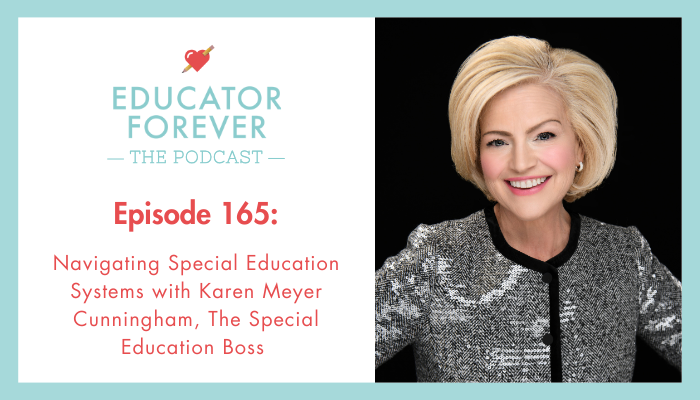
Karen Meyer Cunningham is a nationally recognized special education advocate, speaker, and mediator with over two decades of experience guiding families, educators, and professionals through the complexities of special education systems. Known as The Special Education Boss®, she brings deep expertise in IDEA, Section 504, and disability advocacy, with a clear commitment to ensuring equitable access and meaningful outcomes for students with disabilities.
Karen details how a difficult introduction to special education set her on her path to helping others. She also gets into her book, The Epic IEP, and how she runs her Special Education Academy. Make sure to tune in to hear how special education programs can improve.
Topics Discussed:
How an Ethernet cord made all the difference
Kids are not software
Writing a book to meet a demand
Resources mentioned:
If you’re enjoying this podcast, please leave a rating and review on Apple Podcasts.
Related episodes and blog posts:
Read the transcript for this episode:
Welcome to Educator Forever, where we empower teachers to innovate education. Join us each week to hear stories of teachers expanding their impacts beyond the classroom and explore ways to reimagine teaching and learning.
Karen Meyer Cunningham is a nationally recognized special education advocate, speaker and mediator with over two decades of experience guiding families, educators and professionals through the complexities of special education systems known as a special education boss. She brings deep expertise in IDA section 504, and disability advocacy with a clear commitment to ensuring equitable access and meaningful outcomes for students with disabilities. Welcome, Karen. So nice to have you here.
Karen Meyer Cunningham 0:27
Thanks for having me, dear.
Lily Jones 0:29
So I'd love for you to take us through your journey as an educator in whatever direction you'd like. Yeah.
Karen Meyer Cunningham 0:35
So I'm not an educator in the sense of being a teacher, but I have been training and educating people for almost 29 years of the special education space. And so I always say educators are amazing because they actually went to college and graduated. But I'm just sort of self taught, and I share strategies and protocols and practices for writing an amazing IEP so kids with disabilities have successful student outcomes,
Lily Jones 1:02
Wonderful. And how did you find yourself in this space?
Karen Meyer Cunningham 1:05
Well, I was thrust into this space. It was sort of baptism as fire. Was not planning on doing this. I was planning on sitting at my salon talking about people all week, and then, you know, putting it on the prayer list at church. And my son was identified with a disability when he was two and a half, and I thought, this is going to be great. I'll just send them to school. They'll fix everything. And that is not what happened at all. And I started the process of IEP meetings. And about a month after he started school, the teacher called Child Protective Services on us, which is not really how I wanted to get support, and that was so I sort of worked through that and and then five months later, she did it again, and I was like, welcome to the world of special education. And I remember I went down to the Child Protective Services Office, which you probably shouldn't do, and that was the first person to give me a resource. And I thought, how odd is it that the first person to give me a resource for special education was because of a fraudulent CPS call, and so I just became obsessed with these kiddos, with this space, with education and the law, and I thought, this is just really good. We we have this need, we had this law, we have these great teachers. We're just going to put it together, and it's just going to happen seamlessly. That is not what happened. And so in the process, I just started helping families, bossing them around. I mean, helping them, and I just do amazing little puzzle to put together a child's needs that schools support. And, you know, serving families at the highest level.
Lily Jones 2:38
And it's such a complex puzzle, I appreciate hearing about your path too, and how it came out of a real need, and seeing something being thrust into it, but also having the courage and interest and commitment to commit to learning more about it absolutely be like all right, this is happening to me. It must be happening to other people too. Yeah. So how can I help them? Absolutely, and so I know that your path has grown, you know, since then, and that you're now known as the Special Education boss. Can you tell us a little bit about what happened after?
Karen Meyer Cunningham 3:09
Yeah, so, you know, that was in the 90s, when I was still young Lily. I had thyroid back then, and you know, even then, when I was trying to get information on, probably my dial up on AOL, there just wasn't information. There were some sort of like going through a medical challenge. There's so much information, but it's not useful in the moment, right? And even now, in 2025 if you type in special education training, we have law books and you know statutes and trainings at colleges, and you know, evaluation books, but in the meeting, those IEP meetings, that's not helpful. And so I started training years ago, and we had this little thing called the pandemic, and my two boys went to Ace Hardware and got me this thing called an Ethernet cord. I thought it was witchcraft. And now we get to share and train and equip school districts and parents and families all over via this amazing platform of technology and so special education boss really is what I do and who I am, and I want to train other special education bosses however you sit at the table to write an IP that changes a child's life.
Lily Jones 4:19
How cool is it that the internet and this Ethernet cord allowed you to really expand your impact in so many different ways? And so can you tell us a little bit about Special Education Academy? What is that and what does it offer?
Karen Meyer Cunningham 4:32
Yeah, so we have, every Monday night at 8pm Central, we have an hour Academy. Sometimes it's longer. And I train on federal law and statutes in a way that's, you know, the letter of the law, the spirit of the law, but really the the intent of the law, and then we open it up for questions. And so the biggest blessing out of the academy has been that 75% of the people that are in the academy and train with us are school based members. And why would they follow me or get information from me? Because. They're not trained in their schools. They're just not, you know, God bless teachers. We bring them in a week before school starts, have them sign 500 pieces of paper, put a bulletin board, Go Bobcats, right? And, you know, we don't have any requirements for educators to have post college, continuing ed hours about special education, which was shocking to me, I assume, well, surely they're being trained annually. No. And so we have amazing teachers who love kiddos and are doing quote, unquote the best that they can. But sometimes when we're doing the best that we can, without a specific, pristine roadmap, we're actually handicapping the child even more. And so I see at schools that you know, school district members are very voracious about populating software, and as soon as we learn a software, we change the software, right? And kids aren't software. Their needs do not exist in a software. So I wanted to take this very complex, very legal, very dry, you know, process, and write it in a way in the epic IEP that's actionable. So whether you're a casa member, you know a psychologist, a parent, a step parent, the principal that we could pick this up, the seven piece framework, and understand the need, the specificity of the child's circumstances, and then know how to serve them so that we can teach them skills and strategies to self manage their disability.
Lily Jones 6:22
So important. And, yeah, I mean, we hope that schools will provide so much more than they often are able to. I mean, I definitely felt like that as a teacher, being like, so now where's the ongoing training?
Karen Meyer Cunningham 6:33
Well, this is what they say, Lily. They're like, well, Lily has access to it because, you know, Lily at eight o'clock at night on Saturdays when she's doing nothing with her own family, we'll go through the State's website and watch 500 hours of whatever. Right, right?
Lily Jones 6:47
Yeah, if only so you mentioned the epic IEP your new book. Can you tell us about that and how it came about?
Karen Meyer Cunningham 6:55
Yes, it was. It was a hostage book. I was like, Oh, you wanted to write this. I did not. I'm a speaker, I'm a comic. My gift is speaking, right? And so writing it was like it was a dark and stormy night, but it was so important so many people, as I trained districts and naturally for agencies and people, they're like, but is that written down somewhere? I'm like, I just told you, ma'am, but it's written down. I'm like, I just told you. And so it has been a labor of love, but it's, you know, it's my love note to people, so that they can have for a very small barrier of entry, you know, just purchasing a book, they can literally have the same practices and processes and protocols that I literally use for my child, the 500 students that I serve annually for the last three decades. So that you can be an advocate, you can know how important these components are and why they're important and why they build on each other, but in a way, that's simple. I'm very simple. I love educators, but there is a saying that only an educator can take something simple and make it complicated, right? And you add that onto law, and people are like my head hurts so and it's also a book of hope, right? It tells stories that were my kiddos that I served, and I hope that it really re energizes all of us at the table to get back in the game, that we all can participate and we all can win.
Lily Jones 8:17
I love hearing about this, and I love hearing about how it's like you weren't setting out to write a book. No, no, no, no, but it was asked for, and you listened. And so I'm curious a little bit about that experience, not being, you know, naturally drawn to writing. How was that writing a book?
Karen Meyer Cunningham 8:34
Well, I'm glad you asked me that. So my modality, my gifting, is speaking. So what I did was what I do, is I literally talked to myself on Zoom and talked the chapters, and then we would put that in format. And then, you know, with my editors and the team, we need more here. We need we need less here, Karen and, you know, and so taking my gifting, but still, you know, that written expression, getting it down on a piece of paper, and it was so important. And I think that if this wasn't demanded by the people that I teach, I would have never done it. I would have just assumed, you just know what I said right at 52 conferences. But that was the way for me to get the book written, in a way that is it's going to be life changing. We're just so excited where we know that it's going to be an international book, because special education is not limited by political parties or boundaries or countries or counties, and it's a need everywhere. And I think this is going to be the first actionable book that it's useful for everybody.
Lily Jones 9:36
And it seems like you already had such a great background and framework to bring to the table when writing this book. And I'm curious about the process of writing it or putting it on the page, like, how did that inform what you already did? Do you find yourself making any different, any changes, or reflecting on anything?
Karen Meyer Cunningham 9:53
Yeah, so now everybody's like, it's sort of like when you get married, when you get married, they're like, when you're having a baby, and you have a baby, when you have the next baby, and be like, when's the next book? And I want to say never, but if there is, there are other books coming, but this will be a really big foundational piece. It's been a 13 month process from I just Oh, I'm going to do this. And I just thought it would be so easy, and it was so much editing, so many rounds of editing, editing, editing. I'm like, I don't even know what a semicolon is. And so had an amazing team at mission driven press, and Simon and Schuster and forefront books, phenomenal team, if you ever need somebody, but we I'm excited that they worked with me to make an amazing editorial product that's going to change lives.
Lily Jones 10:37
Congratulations. I mean, what an amazing accomplishment, and can't wait to see it go out there in the world. And so let's talk about the world of IEPs. And I would love to hear from you kind of about the pervasive, systemic issues in the implementation of IEPs. Like, what's the State of the Union? What can parents and teachers do?
Karen Meyer Cunningham 10:57
Yeah, I mean, I think for parents and teachers, we're on the same team. I think we have these goofy people in charge at school districts that maybe aren't always so on board. You know, the truth is, children with an IEP are rarely going to be a school board meeting photo op, and also, they're the most expensive student in the school. And while special education will be 50 years old next Tuesday, I don't know that we all believe in the ROI and kids with disabilities, but you know, there is this, this. I think the biggest problem is the appropriation of money. We are not running low on money. We are running low on how we use the money in a district and what we think is important, and what we fund we focus on, and what we fund we care about. And you know, we have these amazing colors of a lady that follows me in the UK, and she's like, I like the picture of you at the Coliseum. I'm like, ma'am, that's a football stadium, right? And I love football. I'm from Texas, at state law here, but if we put the same focus and the same high quality in the pay of all of those persons that serve kids with disabilities, we would have different, different outcomes. And so we just still have antiquated, biased beliefs about children with disabilities,
Lily Jones 12:12
Absolutely. And so how do you think parents and teachers can kind of try to combat those beliefs? Some of it feels like something we can change, and some of it feels so like systemic and left up to other people of how they write the budgets. So what about...
Karen Meyer Cunningham 12:27
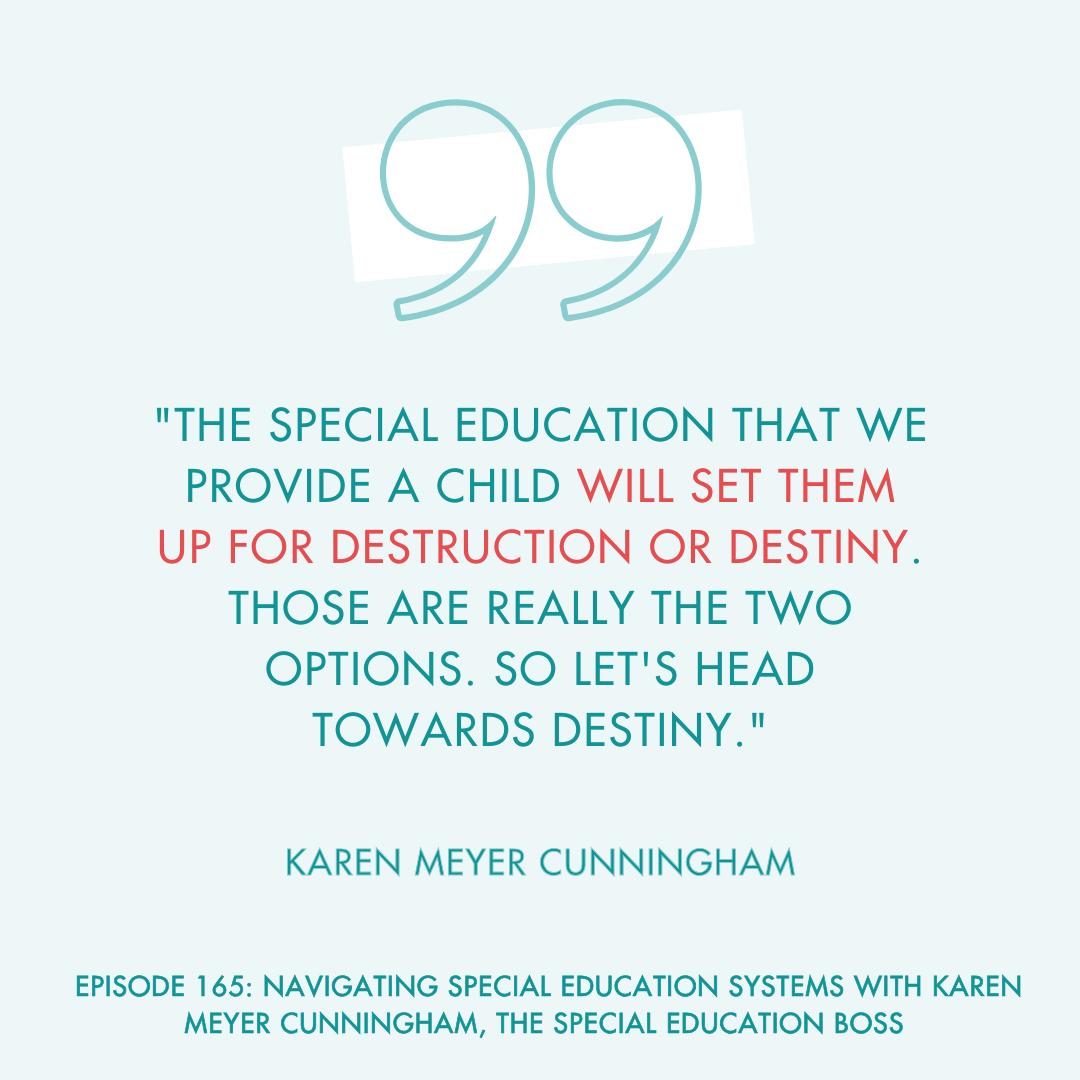
I always say that idea the federal law for special education, which is a federal grant program, is the only federal law implemented by parents, right? And I hope, out of this book, that we can believe in something we haven't seen, right? I don't think that there's enough success stories about investing in our child, kids with disabilities, with time and resources and funds and attention, and what's the end outcome? Right? We don't usually hear about how did you know Terry do, or how is Sally doing, or how is Billy doing, and and I think that teachers and parents get frustrated with kids with exceptionalities, and often when we try to serve them, we're literally drilling in the wrong place. And so hopefully these pieces will enlighten people to kind of take a breath and step back. And these are children. No child asked to struggle, no child asked to be growing up in poverty. No child asked to have be different. Nobody asked for that. And so we have to give these children, their children, no matter how they show up in school, their children, and we have to resource them in a way that's, you know, from a purview that serves them. And I think that we get so always say there's two people too close to the child, often the parent and the school. And, you know, as an advocate, we have the ability to step back and look at the whole child, right, sociological, emotional, behavioral, communicative, intellectual, and kind of see how what they need. And we've got to do better serving kids with disabilities, and we can we get it right so often? And I just want to get us right almost all the time, because the special education that we provide a child will set them up for destruction or destiny. Those are really the two options. So let's head towards destiny
Lily Jones 14:22
So inspiring and so important, absolutely. And I love that reminder too, of yeah, they're children. They're children, yeah, and it's our responsibility to set them up for their destiny and set them up in a way that they can be successful and celebrate all parts of who they are with the support they need, absolutely. So I'd love to switch gears a little bit, back to you starting your own business. You know, you mentioned you got thrown into the world a special education. You rose to the challenge. You got the Ethernet cord. You started this online version of what you had done, some in person. And can you talk about that process of just building a business? So what's that been like? For you, what have you learned about yourself through the process?
Karen Meyer Cunningham 15:02
I've learned that people are very passionate about what they type on the internet and to not take yourself so serious, whether somebody thinks that I walk on water or I'm an angel or the other a word, probably neither one of them are really true. You know, the great thing about this cell phone. Thing that we have is it's a business with no borders, and it's people's input with no borders. And so I literally built this business going live on my Android phone, and that's it. I don't edit it. I don't make it. I don't literally, I don't know how to get something out of the chat or put something in the chat. If Lily said, I'm gonna give you a million dollars, if you can do that, I'm Lily, you have to keep your million dollars. So I think people are so busy when they build the business online of trying to make it perfect, people don't care about that. They care about two things, content and good audio, right? And so perfect is never done. Done is never perfect. And I always say, Start messy. Build the plane while you're flying it. Because whatever your message is to the world, people need it now, and getting ready to get ready will never occur. And so I just shared something that I could not share, and it opened up a conversation nationally that people were going the same do the same thing that I was. And so the community that we've built out of this is really humbling. Last month, we had nine and a half million impressions on our I'm like, that's why I got to wear pantyhose and make sure my lipsticks on every day. And it's a great honor to serve people through this vehicle. And it's such a great time to have a business, whatever that is, because you don't have to go open up a business and pay rent and all of that. And I love it. I love that we have this opportunity, and it's a great opportunity for kids with exceptionalities, right? They don't have to go get a traditional job. So I think it's an amazing time to live in.
Lily Jones 16:50
I love your advice of just diving in. And I absolutely agree. I think that we often get paralyzed being like, All right, well, we have to have the website, and we have to have a video editor that costs 1000s of dollars a month and all the things, and it's like, Nope, you have a phone.
Karen Meyer Cunningham 17:03
You have a phone, and it has, like, a plus sign, and you could hit plus when would you do that now? Yeah, nobody, like, when would you do it right now?
Lily Jones 17:11
Yeah, yes, yes, totally. And just trying it out. And I think it's like, also normalizing, that the first few times, you know, 100 times, might feel kind of awkward, and that's okay, right? But the way it gets less awkward is by doing it. Yeah, absolutely. So do you have any other advice for educators out there? You know, a lot of our audience are teachers who maybe have something they're very passionate about and want to do something in addition to teaching or instead of teaching, you know, building their own business or leaning into their passion or their calling. What advice do you have for them?
Karen Meyer Cunningham 17:42
So I am happy to be a teacher abductor. So one of the best advocates that we get to train and send back out are educators like they're 95% in they've got the insider trading. And some educators are ready to retire. They're ready to pivot. They're ready to advocate on the side. They're ready to do records review. I mean, they have so much information that's so beneficial to parents that I will never have, and so we would, you know, be happy to train them. We have a two day epic IEP intensive, and then a six week mastermind for people that want to go full time. You know, there's eight and a half million children in America with an IEP and about six good advocates in the nation, and I'm being honest, those families need support, right? And so it is an endless need field with no workers and parents need support, whether things are going good or not good. You know why this isn't their space? You wouldn't think it was odd if Lily got a realtor to sell her house or a broker for investments. And so parents and families and school districts need advocates, and so it is an amazing time to pivot. And you know, teachers are such a great resource. They can do anything, and now that they can do it via their phones. You know, I have amazing advocates that I've trained that are now tutoring. They tutor nationally, because we can do it all over the internet. You know, they're doing evaluations on the side, it's just endless. If you are ready to leave the teaching field and being able to wear jeans 24 hours a day, then we would be happy to train you. But there's endless jobs for educators, because families, whether they're a general ed student or special ed students, still need that educator support after school or on the weekends. And it's limitless what you can do.
Lily Jones 19:19
Wonderful. I love that, and I love how you're providing that opportunity for other people too, to be able to build on their skills and learn new skills and have a different pathway forward. Well, it's been so lovely talking to you, Karen, can you tell folks how they can connect with you?
Karen Meyer Cunningham 19:34
Yeah, so you can find us at Special Education Academy or special education boss, across all platforms, and that's our website, Special Education Academy. We would love to connect with you. We would love to resource you. We have lots of we put out 52 pieces of content every 24 hours, so we have a little bit of content out and continue to be a voice and support you in any way.
Lily Jones 19:59
Wonderful. Thank you so much, Karen.
Karen Meyer Cunningham 20:02
Thank you. Bye.
Transcribed by https://otter.ai