
Episode 194: Scaling a Business and Building a Personal Brand with Luba Patlakh of Kidology
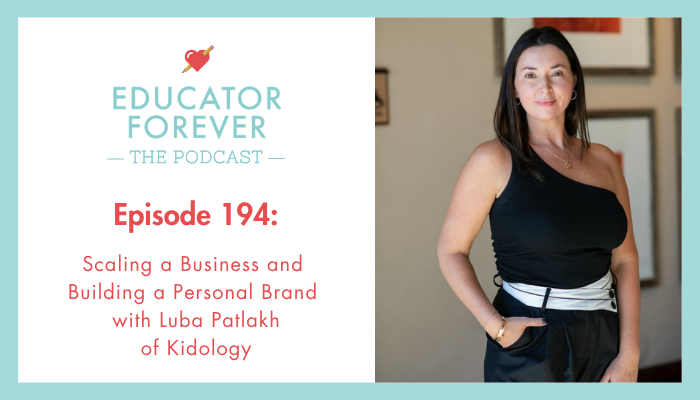
Luba Patlakh is a speech and language pathologist, myofunctional therapist, and founder of Kidology. She's also an entrepreneur, podcast host, and children's book author. Luba has expanded her mission beyond one-on-one services through education, content creation, and community building. She is the host of the Growth Lab podcast, author of the children's book Bobo Wears a Bowtie, and creator of The Confident IEP Parent, an ebook to help parents navigate the IEP process with greater confidence and clarity.
In our discussion, Luba and I talk about her busy life, going from broadcast journalism to entrepreneurship and founding Kidology. She also gets into the importance of one’s communication skills when working with children and the challenges of being an entrepreneur. If you’re thinking about starting your own brand, you need to tune in to this episode!
Topics Discussed:
How being a speech-language pathologist helps her in business
Scaling a business today
Starting a brand to reach a larger audience
Resources mentioned:
If you’re enjoying this podcast, please leave a rating and review on Apple Podcasts.
Related episodes and blog posts:
Read the transcript for this episode:
Welcome to Educator Forever, where we empower teachers to innovate education. Join us each week to hear stories of teachers expanding their impacts beyond the classroom and explore ways to reimagine teaching and learning.
Luba Patlakh is a speech and language pathologist, myofunctional therapist, and founder of Kidology. She's also an entrepreneur, podcast host, and children's book author. Luba has expanded her mission beyond one-on-one services through education, content creation, and community building. She is the host of the Growth Lab podcast, author of the children's book Bobo Wears a bow tie and creator of the Confident IEP Parent, an ebook to help parents navigate the IEP process with greater confidence and clarity. Through her work, Luba combines clinical expertise with honest insights on entrepreneurship, personal branding, and building impact-driven businesses. Welcome, Luba. So nice to have you here.
Luba Patlakh 0:39
Thanks so much. I'm excited to chat with you today.
Lily Jones 0:42
Yeah, I'm so excited to get to know more about you. So I'd love for you to kick us off by telling us about your professional journey.
Luba Patlakh 0:49
It's been a long journey. So actually, I wasn't always in the in the business of speech language pathology or in pediatric spaces. I thought I was going to be a broadcast journalist, and actually, behind me, this is me. This is my immigrant card. I came to America when I was just two years old. This is a couple years later, or maybe this this was I don't know, but this is when we finally made it in. Resident alien. I was a resident alien when I was eight, I think, is when I became an American citizen because my parents passed the citizenship test. But we immigrated here due to religious persecution back not when it was happening. And I was well traveled by the age of two. I had been in Austria and Italy, and then we made our way to the United States, which is pretty crazy. I was literally potty training and emigrating, and they said I had a little toilet, like a little potty. Oh my gosh! So that was my beginning, very humble beginning. But yes, I really wanted to be always in front of people. I love people. I love learning about people and helping people. But I was always deathly afraid of blood and needles, so sadly I was not going to become the doctor my parents so badly wanted to have. And my mom was a nurse in the Ukraine, and then worked in clinical research when we were here in the states. And my grandfather was a famous dentist, so there was medical within my family. It just didn't carry over to me. And in the post grad time, I had a undergraduate degree in broadcast journalism from Hofstra, and I lived in New York City. And it was amazing. I mean, I got to be a production assistant in the Encyclopedia of African American History. I'm published there. They sent me the the books, which was cool. But I simultaneously worked at Good Morning America weekend show, and I did that. But it wasn't it. I just knew it wasn't it. And I decided to move back home to Pennsylvania from New York. Well, forced out of my apartment by my parents, I came back to the crickets of the and the burbs, and I sat down at the computer, and I was like, "What are top careers, you know, in the next decade? And speech language pathology was one of them. So I decided, you know, I have the gift of gab. I think that I'm going to go for this. It doesn't require blood and needles. Little did I know I would end up getting certified as a myofunction therapist in the last three years, and now I'm looking in people's mouths all the time.
Lily Jones 3:22
Even you couldn't avoid it.
Luba Patlakh 3:26
Still no blood and needles personally. You know you can't be you can't be afraid. But it's been a beautiful journey. I expanded my wings beyond just getting a master's in speech therapy and maybe working in a hospital. Or there's wonderful opportunities as a speech language pathologist. So many paths you could take, which is why I chose the field. But ended up falling in love with the pediatric population. Again, it allows me to meet families and people, but really help growth. And I started to work in special instruction and speech therapy, and ended up falling into being an entrepreneur. So it was it was a really cool situation how it all worked out. It was not something I had planned, but I thank God every day, of course.
Lily Jones 4:12
So amazing! I love hearing about people's paths because sometimes you know there are these connections that we really just can't see coming. And even sitting down and having that intention of like, all right, I'm going to go into speech language pathology. It wasn't the end, right? It was the beginning of this new chapter. And I know you mentioned becoming an entrepreneur. Can you tell us about that and what you founded?
Luba Patlakh 4:34
Well, I am the founder of Canalogy Inc. So we are a pediatric early intervention and private care clinic-based company. We do have brick and mortar services. So right now we're just located in Pennsylvania. We have two locations. They're both about 6000 square feet. They have services like speech, OT, PT, speech, occupational therapy, physical therapy. For people who don't know what those acronyms. For and of course behavior services, we staff psychologists and all of the therapy types that I've mentioned, and we work with families in our clinic setting in one-on-one therapy rooms, and now in our expanded play gym spaces called the Cureology Play Spaces. It is a separate entity; it did not start that way, but it became really popular for birthday parties, so we had to separate the two. But kids come to us at Kidology for special needs if they have something as little as like a misarticulation, or they broke their leg and they need physical therapy to you know diagnose children with autism or other diagnoses that require support assistance. You know, advanced technology that would require them to need therapy or counseling for the family. So we're a comprehensive, multilingual, multidisciplinary company.
Lily Jones 5:50
Amazing! And as a parent, I love that all of that's under one roof.
Luba Patlakh 5:54
That's the best -- a one-stop shop. That's all I wanted because I used to drive around in my car when I first started is just you know I worked for other companies and I was a contractor and that was something families were always saying to me oh I really wish I a they don't have time so it's like when I'm home on my day off all the therapists have to come or I don't see the therapist because they go to Susie's school or we're on the weekend going to four locations and I don't get to rest. So these were things that I really absorbed at the time. And I'm like, okay, I if I'm gonna do something, I'm gonna do it like this. So that's kind of how it evolved into a one stop place.
Lily Jones 6:32
So thinking about that transition from being a speech language pathologist to starting your own business, I'm curious, you know how you use some of the skills that you developed through being a speech language pathologist, of course, in the services that you're providing. But how did those help you in terms of being an entrepreneur?
Luba Patlakh 6:50
Oh man! Well, the whole premise of my job is to help others communicate. So I guess I got really good at decoding what people were saying. The communication as a whole for me really evolved. I feel that I was always a good communicator, but even better now. I'm became a better listener. Also, I think for a long time I and I love to talk. If you can't tell, but I I did a lot of educating, and then a time really came where I was like, okay, I need to listen to everything people are saying. Not only did it help me with feedback in my business, but I was really able to deliver the things people wanted because I could hear it through their worries or through their complaints or whatever it was that was happening, and also collaborating among other professionals in my area, like primary care physicians or surgeons, who were delivering the messages of the people too. So I think communicating as a whole, the listening, receptive, and expressive, and that's like really like those are terms from my from my field. So listening and putting it out.
Lily Jones 7:58
So interesting. I mean, I think about that too. I was a kindergarten and first grade teacher before starting a business, and I'm like, I'm using the same skills, you know, breaking down big ideas into small chunks, modeling.
Luba Patlakh 8:11
All of that's so true, and this is what we do every day.
Lily Jones 8:15
So thinking about a lot of our audience, you know, maybe they're educators who have an idea, something they want to start, or maybe they've already started a business and they're thinking about that next phase. And I know you've gone through several different like growth periods and starting off with that one-on-one services, and then thinking about kind of scaling this business. Can you talk to us about how that worked?
Luba Patlakh 8:37
It doesn't happen overnight. I'll tell you that. I think you're here, and and it's the truth. Like for a long time, when I first started, I did everything, and that took a lot of work for me too. Understanding that I cannot do everything if I'm going to run a successful business or any business, it's overwhelming. You load yourself up too much, which leads you to not be successful because you're burning out and you're tired, so that takes away from your attitude in the business. But really, I it's a roller coaster every time you know you're on the way up, you're just about to go down again, and just stay positive because it's up and down all the time. But you know, in the five year mark, and you know we were making money, and I was doing well, but I didn't have that business experience where. And thankfully, Google targeted me. I guess because of all the things I was searching, my biggest issue back then was always how do I support my back end administration? How do I support? Because I wanted to work in the field. I wanted to work with people all the time, treat the children, and there wasn't enough of me for both things. I had to cut it somewhere. Either I wasn't going to see the kids, or I wasn't going to be in the administration. So, like, which one was it going to be? Well, this week I'm needed over here, so here I go. And this week. It was it was challenging until I was able to really this targeted ad helped me take a business course that really put things into perspective in terms of what I was missing, fine tuning policies and procedures, handbooks, things that really allowed me to excel further in the administrative part, which allowed me to do what I loved, which is work with the families, and then over time, what I once thought, well, how could I ever possibly teach this to somebody and train them to do these things when it's all in my head? I had it on paper, and it became a repeatable process. And that is where you can actually train and teach people to help you because, hey, this is a job. Here's what you have to do and let's let's get moving. I didn't always have that or even an understanding of that it could be successful. I'm very Type A. I really wanted to do a lot. I did a lot. I still do a lot, but I have a lot of help now. And I learned more about how businesses operate. I learned how much data matters. I learned how much putting in, you know, KPI, which stands for key performance indicators, matter. And now you're really intertwining a business that's for people that you want to help people come up with a business, a real business where numbers and data are true. And if you want to grow and scale, you need to have an education in both. You can't only be good at the people piece. You need the administrative and the numbers, which I was okay at, but not as seasoned. And learning and training myself, and even today, I take courses and I go to lots of Conferences. I go to conferences to further my education to meet other people in my position, so that you do best as an owner when you're in a collaborative environment, and you kind of feed off of each other and learn and learn about other people's experiences to get you by a lso
Lily Jones 12:10
These are all such important stages that I have also experienced and continue to experience of the realizing that you're only one person and you have limited resources, which I think is really hard when starting a business, and it's really hard. At least it was for me in the middle of like realizing that was true and not knowing exactly how to hire a team, train a team, feeling like it was a scary financial leap to hire people. So like I might as well just do it, which doesn't work. Like it always backfires at some point, right? Like we have...
Luba Patlakh 12:42
These are all normal things, but when you're in it, and as a first timer, just like a first time parent, or you're like, is this right? Like, why do I should I do this? Should I not do this? Until you really find your sweet spot where you know yourself, you know your business more, but that comes from educating yourself. So I couldn't agree more with you.
Lily Jones 13:03
Yes, and that education piece. I mean, I you know was a kindergarten teacher know about starting a business, so I also just like you have had to learn those things. And so I think rather than feeling overwhelmed, like realizing that these are learnable skills, where we can kind of create our own professional learning plans and figure out, you know, how to get the skills that we might not already have is so key.
Luba Patlakh 13:26
Absolutely.
Lily Jones 13:28
So I know now you're building this personal brand too. Can you tell us how that fits into the mix?
Luba Patlakh 13:35
So Kidology is actually going national this September.
Lily Jones 13:39
Congratulations! So exciting!
Luba Patlakh 13:41
Thank you. Again, not something I anticipated, but it's been 11 years, and it's like, so what are we doing? How are we doing it? How are we going to help more people? The decision to go with a personal brand was more so because how am I going to differentiate Kidology from Luba and Luba from Kidology. Yes, I am the founder of Kidology, and you know maybe to someone that's plenty, and they're like, "That's great, you run this business, like that's amazing, keep at it. But I saw a bigger vision for this, and often people, this kind of started in COVID because a lot of my families were going to live with grandparents or relatives in Florida, and I needed to obtain a license in Florida. And I started to kind of feel like, well, should I open something here? But I have I have three kids, and they're still fairly. I mean, it's they're 10, eight, and four. And in COVID, they were even younger. I only had two kids then, but I was like, I can't pick up and just like go start a business in a different state. That's not possible, and I didn't trust and have all these things where I could just send someone to do it. That's just you know, I'm still pretty boutique business. Like, so couldn't do all those things. The intention was though that okay, people want this and they want this in a different state. How do we pursue it? And look how many years it's been since those thoughts and conversations. But now that is happening. But the personal brand is more so a also for people to know who I am. But I have been able to just here in my state have such a positive large reach, and in the age we live in of AI and tools online and available resources to people, well, when I didn't have this idea of expansion to the nation, I was like, "How am I going to touch these other families? I created a couple of different other programs, not kidology related, that help families who are struggling with IEP services. They can get on the phone with me. I can consult with their school. Part of the personal brand. I wrote a children's book. It's called Bobo Wears a Bow Tie. Yeah. And please, people visit our website is bobo wearsarbow tie.com But it's available on Amazon and Walmart and Barnes and Noble. And we have a YouTube jingle, so it's really cute. It's a positive message that actually my mom always instilled in me, and I feel like fundamentally, and everything I do in my life, from kidology to all the services, are for building a solid foundation for families, for children. But fundamentally, if you have this ability, so the the bear puts on his bow tie every time he feels like he can't do something, but it's really you're turning on your mindset and creating a positive shift for yourself. Like, of course, I can do it if I believe I can achieve. So that's the message of the book. There's also some fun exercises in the back to learn new words and clap through sounds. So I did that, but the intention is that I'm the voice of the families. LubaPatlock.com is the website they can visit. There's free resources they can download just to better understand where their child is. A lot of families emigrated here in the last few years due to war. I do speak Russian, and people were sending them to me, relatives from my area, because they're like, "This woman will help you. I love people, and I want to see everybody succeed, especially young children. Life is hard as it is, and add on a diagnosis or disability, or a parent who can't speak English and just moved here. And as a child with autism, no matter how many doors they're going to knock on, they're not going to get the services because there's not going to be the help that they require. I want to be that navigator for all the people that need it, whether they're first-time parents or truly lost in the system or not getting the services that they're supposed to be from their schools or community. I advocate for families, and that is truly the message behind the personal brand. It's just a couple of different pieces, but all of the projects that I work on are visible on my website, so people can see. And if it can help you, just click the bubble, and it takes you to where you can download the information.
Lily Jones 17:52
Fantastic and congratulations! That book sounds amazing.
Luba Patlakh 17:56
It's really cute, especially as a kindergarten teacher. That would be... E verybody's loving it.
Lily Jones 18:03
Yeah, amazing, and I think it's just such an interesting evolution. You know, it makes sense to me, and I definitely have been at this phase with Educator forever too, where it's like, oh, this thing that used to be just you, you know, becomes so much more than you. So then, like, where do you go?
Luba Patlakh 18:21
Like last spring, my local chamber, the Bucks County Chamber, like I won the award for Entrepreneur of the Year, right? And I get up there, I'm so excited to go, and then I get on stage and I just start hysterically crying, and nobody could even understand. It was a little bit embarrassing, actually. I came down, my dad was like, "Are you serious? Like we couldn't even understand what you were saying, but I was saying in the speech that to this to this point that you're making too, I am so excited that finally this is something for me. I've worked so hard on these larger things that included me that I found that there are me, but the business gets the awards or the accolades, but that time it was for me. It was about me, so I just really want to continue on for people to know that I'm reliable for them. And if somebody has any difficulty navigating something or has questions about their child's development, I'm I'm your person. So give me a call.
Lily Jones 19:21
Yes, you're there. I love it. And so thinking about you know this whole journey of your career and with entrepreneurship, I know that entrepreneurship is such a personal development journey. And so I'd love to hear you know what have you learned about yourself through this journey.
Luba Patlakh 19:41
It's not easy. I've had to change. I think a few times. I've evolved.
Lily Jones 19:47
Yes.
Luba Patlakh 19:49
Entrepreneurship is not for the faint of heart because you always there's really difficult days. Especially, it used to always be like the time. That I was going away on vacation with my family that first day in Florida, everybody, everything's wrong, and you're like, why is this happening?
Lily Jones 20:08
course, it's always the first day of vacation.
Luba Patlakh 20:11
It's always the first day of vacation. It's so easy to feel defeated as an entrepreneur, and that is something I had to learn to turn around within myself because you can't. The road is still forward, and if you're gonna go backward, you're not gonna go forward. So no matter what challenge comes your way, it's best to sit down and work through what you've learned from the mistake or what you've learned from the situation, versus thinking, "Oh, that's it. I had a failure. I had a bad situation. I had a bad moment, and I have to quit. That's not as an entrepreneur. People need to learn that early on, because I've seen a lot of people who are so talented and have so much potential, but something goes wrong, or somebody said something wrong, and they don't know how to recover. So knowing how to recover? I think for me was a big one, but again, I had always four years ago my mom passed away, which is another reason. Thank you. It's it's horrible. I hope nobody experiences that from cancer, s adly.
Lily Jones 21:14
My dad too a few years ago.
Luba Patlakh 21:16
Oh, I'm so sorry. It's just not... It's terrible. But I think that it really pushed me to not allow. Like growing up, my parents always taught me just keep going, no matter what kind of situation you run into or what day you've had. I've never in my life like stopped to like fully recover like that. Like I didn't take a break, and I think that what helps me is the idea of like where else can I go if I continue to go? It's a hamster wheel, but recovering here in your mind, speaking to yourself, being like it's okay, and also learning that people can't read your mind. I had to learn how to communicate better, believe it or not. Even though I'm a thorough communicator, but I had this wonderful example from one of my mentors along the way, and it was like, if you send somebody to the store to buy you bread, but you're like, hey, here's $5 go buy me bread. They're gonna come back and they're gonna bring me bread. You're gonna be like, what's wrong with you? That's the wrong bread, and they're gonna be like, what? And you're gonna be like, go buy me the bread, I another bread, and then they're gonna come back. You know, buy me the bread that has the yellow package. Well, they get to the store, but there's like four breads with the yellow package, so they bring you a new one, and you're like, no, this is the wrong bread. But if you had gone from the beginning and given them a detailed description, I want the rye bread that's you know dark with raisins and sesame seeds in the yellow package, then they would have given you the bread you wanted from the beginning. Hopefully, but if you're just a bit, you know, less descriptive and you're not giving exactly what you want, people are not always going to deliver that. And being able to understand, it's also your delivery that matters too.
Lily Jones 23:01
Yes, for sure. I mean, I appreciate the focus on communication, and also what you were saying about recovery. I think that is so key, and just normalizing. You know, it is this up and down roller coaster, and it is always possible to recover. And that recovery is a skill is really empowering too. Like it's something that you can build within yourself, whether it's mindset or support systems or specific skills. You know, it's something that you can learn how to get better at.
Luba Patlakh 23:28
I agree.
Lily Jones 23:30
Well, Luba, it's been so nice talking with you. Can you tell folks where they can connect with you?
Luba Patlakh 23:34
I would love to connect with you guys. I'm on all the socials. You can find me on Facebook and LinkedIn. I love my Instagram. I'm giving out all kinds of information to parents. I'm at Luba Patlack there, and if you search my name on any of the platforms I mentioned, you'll find me. I do also have a TikTok. I don't know if anyone out there is into that. Some of the stuff is comedy about speech and being a business owner. Some of it is real life advice for parents and families navigating swallowing issues, speech therapy, myofunction therapy, and just developmental needs. And of course, you can check out Kidology. We're online as well, and my websites. I you'll list maybe in the the bottom of the show notes. Absolutely.
Lily Jones 24:15
Well, thank you so much.
Luba Patlakh 24:18
Thank you.
Transcribed by https://otter.ai