
Episode 191: What Educators Need to Know About Childhood Trauma with Julianna Burmesch
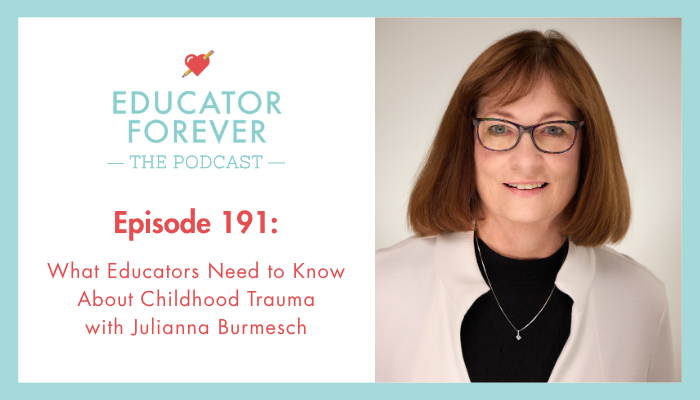
Julianna Burmesch is a former principal, speech pathologist, brain development trainer, and parent educator. She is also the author of Life with Less of Me, a memoir about the connection between trauma and long-term physical and mental health.
Julianna and I discuss her education journey and her studies in communication disorders. We also go through her book, talking about the long-term effects of childhood trauma and her work pushing for educators to address it in schools. Get ready to dive deep into social emotional learning!
Topics Discussed:
Using a team approach to address trauma
Principals needing to be responsive to teachers’ needs
Unconditional positive regard
Resources mentioned:
If you’re enjoying this podcast, please leave a rating and review on Apple Podcasts.
Related episodes and blog posts:
Read the transcript for this episode:
Welcome to Educator Forever, where we empower teachers to innovate education. Join us each week to hear stories of teachers expanding their impacts beyond the classroom and explore ways to reimagine teaching and learning.
Julianna Burmesch is a former principal, speech pathologist, brain development trainer, and parent educator. She is also the author of Life with Less of Me, a memoir about the connection between trauma and long-term physical and mental health. Welcome, Juliana. So nice to have you here.
Julianna Burmesch 0:18
Thank you. I'm excited to be here.
Lily Jones 0:20
So, in whatever direction you'd like, I would love you to tell us about your professional journey.
Julianna Burmesch 0:26
Well, I started out with a degree in a bachelor's in communicative disorders, went on for a master's in speech and language pathology, and I worked in speech pathology for several years, and went on to get a master's in educational leadership, and I became a principal. Started out in a k5 principal principalship and found a much better match in an early childhood pre kindergarten program, and I started the pre kindergarten programs in Wausau and led the pre kindergarten movement in the state of Wisconsin.
Lily Jones 1:20
Wonderful.
Julianna Burmesch 1:21
Yeah, thank you.
Lily Jones 1:23
And so I know that you have written a book, Life With Less of Me. Can you tell us what the book is about, and what led you to write it?
Julianna Burmesch 1:32
The book is about adverse childhood experiences, and how they affect your long-term physical and mental health, and it is. I'm going to give a little content warning, because I did not hold back on what happened to me when I was a child, and it's some sometimes for some people it's very difficult to read, so just a little content warning, but I think it's very important for people to understand the relationship between what happens when you're a child, childhood trauma, because as teachers we are seeing more and more children coming through with trauma. What does that look like, and why doesn't the child respond? Those kinds of things. I think it's really important for people to understand what's happening. I told my book as a story, because you know, as a speech pathologist and as a principal, I did a lot of factual writing. Very, this is like this is how the child scored. This is, you know, the results of that scoring, and this is the interpretation with all facts. And I knew that I couldn't get a lot of people to read it if I wrote it that way. Sure, I hired a book coach who helped me write in a more interesting and creative way, and we, we got through. I needed to take a lot of breaks, because of writing creative, creatively, in order to do that, you need to remember, and remember not only what happened, but also how you're feeling, and that was very difficult, because I had to relive a lot of the trauma, so when I started writing, I realized that I needed, I really needed to go into trauma therapy, and I did. I wouldn't recommend doing it when you're 60 years old if you have a lot of childhood trauma, you know that trauma wears on your body, and I'd recommend doing it a lot earlier than 60 years old.
Lily Jones 4:34
But better late than never.
Julianna Burmesch 4:35
Better late than never. So it took me six years to write the book, and it is out there, and I hope it makes a difference.
Lily Jones 4:45
Yeah, so powerful. And thank you for sharing. I mean, I can only imagine, you know, what an experience it was writing the book, and I would love to hear a little bit more about, just, you know, what was that process like in terms of how you came back. Thought about working with kids who are dealing with trauma themselves.
Julianna Burmesch 5:10
One thing that I realized when I was a teacher is that you can't always be your best self all the time, because we all have stresses in our lives, and sometimes if you are either in a dysregulated state or for me sometimes when I'm triggered I go into a fight or flight feeling and I don't have access to my logical brain because what happens is I have very solid pathways to my limbic system, which is the emotional center of my brain, and those were built throughout my childhood, when someone with childhood trauma or any kind of PTSD are, when they're triggered, they lose access to the part of their brain responsible for logical thought. so knowing that I made sure in when I was an early childhood principal, and I feel this is really important, because it's not happening right now, a principal's job, their job is to make sure learning is happening in the classroom, and so often in administration we are, as principals, forced onto the next bandwagon from the top down. Luckily, in my early childhood program, I didn't have to implement a new reading series, or I didn't have, you know, it was had a lot more control over that, but I sincerely believe that it's the principal's response. First and major responsibility is to make sure learning is occurring in the classroom, and that means that when teachers can't be their best self for whatever reason, they have the ability to call for help at any time. I have a friend who just recently quit teaching because she had a dysregulated student in the classroom who was going around breaking everybody's pencils, and she could not continue the lesson, and the child would not respond to her, and she called to the office to see if they could send somebody to help, and they said sorry, all three principals are in a meeting and they can't be interrupted.
Lily Jones 8:44
Oh no.
Julianna Burmesch 8:46
So it's like this meeting was more important than the learning that was happening in that classroom, and that should never happen.
Lily Jones 8:58
Yes, and it's not the teacher or the student, honestly, who's dysregulated and needs some extra support there too,
Julianna Burmesch 9:06
Right. And in my school we used a team approach, we identified staff members who could free themselves up if there was an emergency or if there was a dysregulated child, and it could be a custodian, it could be a librarian, in, you know, they didn't have students at the time, it could be social worker or counselor, or whoever there are teacher or child whisperers out there, and the school knows who those are, you know, the ones who can come down, come in and be calm and. Help a student who's who's either in a trauma state or just in a in a stress state. If a child's in a trauma state, just like me, they don't have access to their prefrontal cortex, which is responsible for logical thinking. they have to physically, physically calm down and have time to be able to access the higher levels of their brain, and a teacher doesn't have the time in the classroom to do that.
Lily Jones 10:45
Yes, I mean, it's so challenging, and I think so much of structurally for teachers or school environments can be really hard to navigate when you want to give everybody the support they need, and as you mentioned, they're both, you know, students dealing with their own trauma and struggles, and also teachers dealing with their own trauma and struggles, and so I'm curious, how you think we can build an environment that supports both teachers and students.
Julianna Burmesch 11:20
We need to get the message out. I understand, because I've seen it firsthand. You know, my first school as a principal, I was given number one, the largest elementary school in the district as a brand new principal, and the district was going through a referendum process, and they, I was told that within two weeks of my arriving in the school, I needed to come up with a remodeling plan, and, and I couldn't even find my way throughout the building, because it was one of these buildings that had been added on here and there, and I was still getting lost trying to, okay, how do I get to the stairwell that takes me, you know, and and I was told you don't have time to get teachers' input, which was ridiculous, because I knew nothing about the needs of that building, or the needs of those teachers, and the needs of the people within. It was unreasonable expectations for a brand new principal who's been told you should not change the paint on the wall in your office for the first couple of years as a principal, well, do that we need to re focus administration on the classroom, so...
Lily Jones 13:22
Yes...
Julianna Burmesch 13:23
Have faith in our children, in our teachers' ability to teach, and, and, yes, you know what I found, actually, is that my. if I stepped out of the way of the teachers, you know, they would come to me with, I think we should do this, or I think we should do that, and listen and say, within reason, of course, like I think we should move into a new building, and you know that it would be nice, but, but if I felt their idea was was good, I got out of their way. I got out of their way, because they know what they're doing and knew what they were doing and we implemented because the teachers wanted to, we implemented the pyramid model for social emotional foundations of learning, which teaches kids social skills, creates an environment for social skills and behavior management, and helps children develop the skills that they need before they go to kindergarten. So we became a demonstration site for the state and we're working with that and ask any five year old kindergarten teacher what it's like to have a child who has never learned to self soothe because the the child was handed an electronic device, which helped them calm down, and so having a four year old enter school without those skills, you know, you have to teach those skills. Four year old's fault...
Lily Jones 15:48
Sure,
Julianna Burmesch 15:49
...but it's a lot easier to have a child learn to self soothe when they're two years old, and it's expected that they have tantrums, right? When a child gets into 4k or 5k teachers expect that they can sit in a group or that they can calm down when they're angry. My program taught kids where they were at, and help them learn some of those social skills.
Lily Jones 16:25
So important, and I appreciate what you said too, about focusing really on the students, you know, having administration, having teachers work as a team, all really for the support of these individual students, whatever they may be coming in with, or need support with, and I know that you know you talked about unconditional positive regard. Can you explain what that is, and why that's important in schools?
Julianna Burmesch 16:49
That is extremely important, and I need, needed to learn that as a young parent. One of you know, I had a really rough childhood, and I made a mistake, and my son got injured, and you know, I came into parenthood thinking I am educated, I am going to be the perfect parent, I'm going to talk to my child, I'm going to sing to my child, read to my child, and I'm never ever going to make a mistake. Well, it didn't work that way. It didn't work that way, but when that happened, that was so devastating to me, because I was like, how could I have let that happen, you know, the child wasn't permanently maimed, or, you know, but it, it really affected me, because I had all my hopes and dreams on being this perfect mother. You can't be a perfect mother, and you can't be a perfect teacher. It's just not going to happen. I was able to heal from that, and it amounted to giving myself unconditional positive regard, realizing that I was not responsible for what happened to me, and that I was worthy of love and acceptance, and no matter what mistakes I made, once I learned that, I became a better teacher, I, and I became a better parent because I realized that my kids weren't behaving the way they were behaving because I was a bad parent, they were behaving the way they were behaving because they hadn't learned skills, or perhaps the environment wasn't set up for their success. You know, there were lots of things that were causing the behavior that they were two and four, and two and four year olds don't always behave. Yeah. right?
Lily Jones 19:24
Yes.
Julianna Burmesch 19:26
Well, even 11 year olds don't always behave well. When I experienced that myself, I understood that to be our best selves and to have a child be their best self, they needed to have their mistakes forgiven. It's not that there are not consequences, but the thing about. Consequences is small, consequences are actually more effective than large consequences. Taking a bike away from a six year old for an afternoon because he refuses to wear his helmet is a very logical and small consequence. Taking the bike away for a week, the child realizes they can have fun without the bike. Sure, do I have seen children with obvious trauma, and, and, and people knew that the child was in a home of trauma, come back on Monday, not having access to food all weekend, because the mom left four kids, and including a special needs child, alone for the whole weekend without any food, it's understandable that that child was dysregulated.
Lily Jones 21:31
Yes.
Julianna Burmesch 21:32
When he came to school, and you know these things like the end of the year, you have end of the year activities, big things like going to parks or track meets, or whatever. A lot of times we say, oh, this is the end of the year, you guys have to hold it together, or you'll lose your event, that is a huge, that's not a logical consequence, that is a punishment, and having someone who actually understands the child understands what their home environment is, and stuff. Determine the consequence is so much more effective, or saying you had a really rough weekend, and I understand why that happened, because when the child lashed out, the child was not in their right mind, they were in their emotional center, their brain which is all about fight, flight, flea, or fawn, you know.
Lily Jones 23:11
Yes,
Julianna Burmesch 23:13
Right. And it's, it's very important that we realize those kinds of things, make sure that the consequence fits.
Lily Jones 23:29
Yes, yeah, and I think it can be so consequential to use that word. What path we go down, you know, one is with care and explanation, you know, of with the bicycle helmet, example, right? Of it makes sense, it's not safe for you to ride your bike right now until you can show me that you can use this helmet. Other consequences, which seems like they're handed out kind of randomly, right, of the class party of like, what does that have to do with anything,
Julianna Burmesch 23:58
Right?
Lily Jones 23:59
It's not as much of a learning opportunity, you know. I think it causes more division than connection, which is really how you're going to get through the issue.
Julianna Burmesch 24:11
Exactly.
Lily Jones 24:12
And so I know you've given us such great advice about working with students with trauma histories. Do you have anything else you'd add for our educators out there working with students who have experienced trauma.
Julianna Burmesch 24:28
If, and this is something I told every teacher, every aide, every custodian who worked in my building when they were hired and I restated that at the beginning of every school year, if you feel that the child has pushed your button in any way and you are not able. Help to interact with the child in a manner that respects their dignity as a human being. You need to ask for help, and it's I want you to ask for help. So many times I see that administrators say, well, you need to learn how to handle this. It's there are kids who push our buttons, and for, and for me, it's. I can remember a child with. and I oppositional defiant disorder, and it, you know, if I, and this is actually what I said, because the child was saying no, no, no, you know, and I was trying to get the child to agree with me on something, and I said, isn't it a beautiful blue sky today, and it's, it's the ugly sky, and for some reason, I was feeling anxiety increase in me, and I, before it became like a triggering moment, I called someone else and said, you know, can you help me with this with him? I think you might be better able to relate with them, you know, it's just the way it is, and that's what I wanted teachers to do, them to do that, and that is a different mindset that a lot of teachers are getting, and that's why they're leaving the profession, they're not being supported.
Lily Jones 27:03
Teachers don't have to carry it all. I mean, it's impossible to carry it all, and so being able to know when you need to call someone in for help and get the support too. I mean, going back to your example of the administrators in the meeting, right, like that teacher was calling for help and didn't get it. So it has to be both ways.
Julianna Burmesch 27:21
It does, and, and working as a team, you know, to develop that team mentality, where if a teacher is struggling, they know that somebody's going to be there, they know that it's going to happen. I think it's so important. We had, we had a code, you know, we'd do an announcement, and we had a team of people, and they knew who they were, and they were all trained in nonviolent crisis intervention, and they all, you know, they looked, and you wouldn't have six people running into a room, but you know, they step out, assess the situation, and one person would go in, and you know, the best person suited for that particular child.
Lily Jones 28:22
Absolutely, well, Julianna, it's been so nice talking with you and hearing more about your work. Can you tell folks where they can connect with you and learn about your book?
Julianna Burmesch 28:31
Sure, Juliana Burma, calm. I have all the links to purchase my book. I have information in there about me and about my book, and there is a contact link in there, so if you'd like to contact me, feel free to do that through that link.
Lily Jones 28:52
Wonderful. Thank you so much.
Julianna Burmesch 28:54
Thank you.
Transcribed by https://otter.ai