
Episode 185: The Three Things That Change How You Learn Anything
I have spent decades — decades — studying how people learn. I've read the research, I've built the frameworks, I'm literally getting a graduate degree in learning design from Johns Hopkins right now. And I still catch myself thinking: I need to know more before I'm ready to start.
Ironic, right? Someone who studies learning... afraid to learn out loud.
But here's what's wild: that fear? That "not ready yet" feeling? It turns out it's not a personal flaw. It's just... how learning actually works. And once I understood that, everything changed.
So today I want to take you inside the framework we've built at Educator Forever — our approach to learning — and specifically, I want to talk about three ideas that I think will shift the way you think about learning anything.
Topics Discussed:
Why imperfect action — not preparation — is the primary mechanism of learning.
How collaborative, co-constructed learning accelerates growth in ways solo study can't.
The journey from kindergarten classroom to adult learning.
Resources mentioned:
If you’re enjoying this podcast, please leave a rating and review on Apple Podcasts.
Related episodes and blog posts:
Read the transcript for this episode:
Welcome to Educator Forever, where we empower teachers to innovate education. Join us each week to hear stories of teachers expanding their impacts beyond the classroom and explore ways to reimagine teaching and learning.
I want to start today's episode with a confession.
I have spent decades — decades — studying how people learn. I've read the research, I've built the frameworks, I'm literally getting a graduate degree in learning design from Johns Hopkins right now. And I still catch myself thinking: I need to know more before I'm ready to start.
Ironic, right? Someone who studies learning... afraid to learn out loud.
But here's what's wild: that fear? That "not ready yet" feeling? It turns out it's not a personal flaw. It's just... how learning actually works. And once I understood that, everything changed.
So today I want to take you inside the framework we've built at Educator Forever — our approach to learning — and specifically, I want to talk about three ideas that I think will shift the way you think about learning anything.
These aren't abstract theories. They come from my real life: from teaching kindergartners who had zero shame about getting things wrong, from working with adult learners who had all the shame, and from what I'm studying now about how the brain actually changes when we learn.
Let's get into it.
When a lot of people think about teaching — especially when they're just starting out — they imagine their job is to transfer knowledge into other humans.
Like, I know things. You don't know things. I talk. You learn. Simple.
A lot of teachers walk into the classroom with that idea. Some of them figure out pretty quickly how wrong it is.
Because you want to know what kindergartners are geniuses at? Trying things. They don't ask "what if I fail?" They don't spiral about looking dumb in front of their peers. They just... do. They put the block in the wrong hole and laugh and try a different block. They draw a dog that looks like a cloud and beam with pride.
They are in a constant, joyful loop of attempt, feedback, and try-again. And somehow, somewhere along the way, most of us lose that. We learn that mistakes are bad. That we should wait until we're sure. That getting it wrong is a reflection of who we are.
Then I moved into working with adult learners. And I saw the other end of the spectrum.
These were brilliant people — teachers, professionals, career-changers — who were so afraid of not being good enough that they'd rather do nothing than risk doing it imperfectly. The stakes felt higher. The vulnerability was real. And the perfectionism? It had teeth.
And now, studying learning design at Johns Hopkins, I'm reading Vygotsky and the research on metacognition and embodied cognition, and I keep thinking: this is exactly what I watched in those classrooms. The science confirms what the kids already knew.
Learning is not about being ready. It's not about being perfect. It is a messy, social, whole-body process — and it only works when you step into it.
That's the heart of what we do at Educator Forever. And it's the heart of what I want to share with you today.
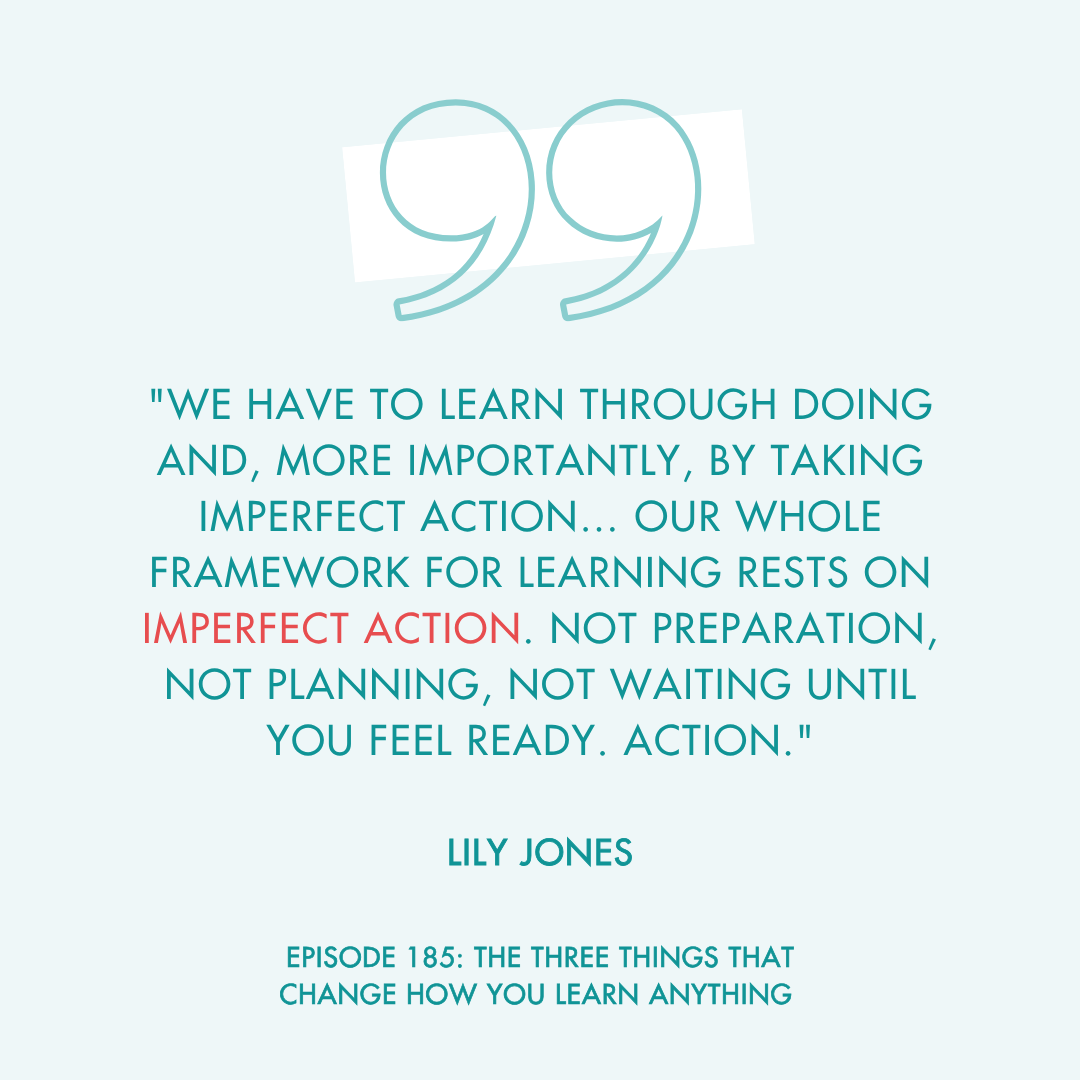
Let's start with the one that might be the hardest to hear: imperfect action is the primary mechanism of learning.
Not preparation. Not planning. Not waiting until you feel ready.
Action. Imperfect, uncertain, fumbling action.
And yet we live in a culture that rewards polish. That celebrates the finished product and hides the mess. So we think the goal is to skip the mess. But the mess is the learning.
Here's how I think about it: every attempt is data. When a kindergartner tries to write the letter B and it comes out backward — that's not a mistake. That's a data point. Their brain is building a model of what B looks like, testing it, getting feedback, revising. That's not failure. That's literally the definition of learning.
The research on deliberate practice confirms this. Mastery isn't built by thinking about something really hard. It's built through cycles of attempt, feedback, and revision. Over and over again.
So if you're waiting to start that business, or the project, or the new skill, or the creative practice — because you don't feel ready? I want you to hear this: the starting is the learning. The imperfect version of you doing the thing right now is the only version of you who becomes the capable version of you later.
Start before you're ready. That's not recklessness. That's the science.
And here's the other piece: there's joy in the doing. Not just in the getting-it-right. Kindergartners know this. They are delighted by the process. That delight is available to you too — but you have to actually be in the process to access it.
Okay, second idea: you cannot build your dream alone.
I know. Our culture loves the lone genius. The self-made person. The solo journey. But the learning science is unambiguous on this one — and my own experience backs it up completely.
Here's what I've seen again and again: when you say something out loud, when you explain it to someone else, when you have to put your half-formed idea into words — your understanding deepens in a way it just can't when it stays inside your head.
I saw this so clearly with adult learners. The people who grew the most were never the ones who went home and studied harder in isolation. They were the ones who were willing to be in conversation — to say "I don't fully get this yet" and let someone else's perspective fill in the gap. To build something together that neither of them could have built alone.
That's co-construction. That's learning as a social act.
And it's not just about efficiency — it's about inclusion. Different people bring different ways of knowing. Different cultures, different bodies, different experiences all produce different kinds of wisdom. When we learn in community, we get access to a much richer picture of what's true and what's possible.
At Educator Forever, this is foundational. Learning is not something we do to people. It's something we do with each other. And the dream you're chasing? It'll be bigger and better and more real if you build it in community than if you try to figure it out alone.
So: who are you learning with? Who are you in conversation with? Who sees your half-baked ideas and helps you make them whole?
If the answer is nobody — that's the thing to change.