
Episode 172: Working in EdTech Marketing with Kendell Hunter of Otus
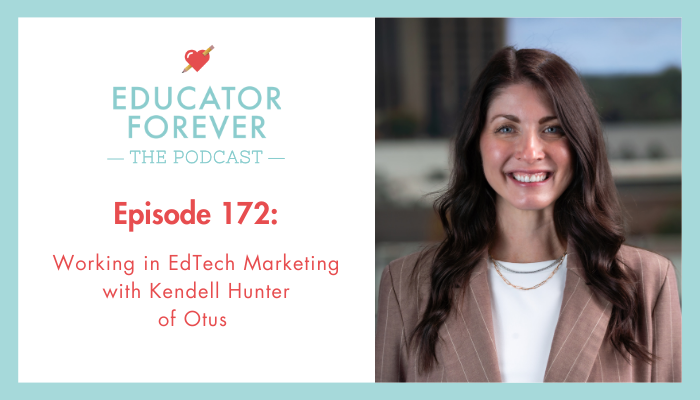
Kendell Hunter is a former special education teacher and reading specialist with a master’s degree in education and more than a decade of experience across K–12 schools and edtech. She is the Director of Marketing at Otus, where she has spent nearly seven years helping districts turn assessment and student data into meaningful, actionable insights.
Kendell and I discuss how she moved from teaching to ed tech, and how that’s led to her having an impact nationally. She also gets into her transition into marketing and what it takes to find a new job in ed tech today.
Topics Discussed:
Teaching in China
The importance of researching the roles
Being open to new opportunities
Resources mentioned:
If you’re enjoying this podcast, please leave a rating and review on Apple Podcasts.
Related episodes and blog posts:
Read the transcript for this episode:
Welcome to Educator Forever, where we empower teachers to innovate education. Join us each week to hear stories of teachers expanding their impacts beyond the classroom and explore ways to reimagine teaching and learning.
Kendell Hunter is a former special education teacher and reading specialist with a master's degree in education and more than a decade of experience across K through 12 schools and Ed Tech. She is the Director of Marketing at Otus, where she has spent nearly seven years helping districts turn assessment and student data into meaningful, actionable insights. Welcome Kendell, so nice to have you here.
Kendell Hunter 0:21
Thank you so much for having me. I'm excited.
Lily Jones 0:24
Yay me too. And I love hearing about people's different journeys outside of the classroom. I would love for you to take us through your own professional journey. You know, from the beginning till now, however, you want to take it.
Kendell Hunter 0:36
All right, let's do it. It's our journey. So I'm actually a former middle school special education teacher. I taught for seven years. I actually started teaching in, like, a suburban, rural area outside of Chicago where I grew up, but then moved to the city and started teaching in a school north of the city. So it was a little bit more diverse. We had, like, over 50 languages spoken in the homes of our students. 50% of students, like not non English speaking households, so it's really a special commuter to be a part of. And I spent the bulk of my teaching career there. But I always knew I wanted to pursue my master's degree, and when the time came when I decided, you know, I got my feet wet with teaching, and I was ready to add in the night classes, which is always fun after a long day of work, right? I decided I wanted to be a reading specialist and go into like a literacy coaching program. Reading, as I'm sure you know, is such a hard a huge part of every subject. And I was a co teacher through my work as a special education teacher, and I really got to see how the importance of like every teacher is a reading teacher. I would bring in different strategies and kind of share with my co teaching colleagues some of the things that we could do for differentiation and small group instruction. And it was really through that coursework and my time as a special education teacher that I realized I like working with adults, and I like sharing my knowledge, and I kind of, I guess, built my capacity to be in front of adults teaching strategies. Through all of that, it kind of gave me a little bit more confidence than I had just as a classroom teacher. And it was Yeah, through all that that I kind of started to explore adult teaching programs, or what that would be like I had, you know, that classroom coaching experience, and that's really when I started to look at other companies that were adjacent, or where I could kind of bring my skills as a teacher into another role. Candidly, I was also aware of, just like the pay gap between teaching and public education and coaching teachers through an ed tech company. So that was like a factor in my mind. But really, my thinking was okay, can I still work with teachers? Yes, can I still work with teachers who work with students? Yes, can I do all of this but do it across the country and have a bigger impact? And the answer to that is yes. So that kind of got my mind spinning as to, like, what could be next for me outside of a traditional classroom role. I should also mention this was all pre pandemic. I did not teach during the pandemic. I have so much respect for teachers who did I worked, obviously adjacent to many of them, but nobody was really doing this at that time. Like, I had no real idea how long it would take to get a job outside of the classroom. I knew I would have to resign from my teaching position at the end of that school year, just because I did not want to start a new school year. And, you know, mid year get a job like I just couldn't do that for my students. So I knew there were some risks, but at that point, I actually took, I guess I'll kind of call it a sabbatical, but I did work. I packed up my stuff and I went to teach at a private International High School in Beijing, China, and that's kind of where I kept teaching. But was looking for jobs in ed tech. I'd always kind of dreamed of living abroad, and I felt like that was the right time to do that before I started something new. So I kind of honed my skills as a classroom coach in public education, went to China, started doing some more coaching there at International School, and was hunting ed tech jobs at the time while I was out there. But funny enough, as I'm sure, you know, there's a very big time change. So I found myself like, interviewing, impressive, though, yeah, yes. So I was out there for a while, kind of just like researching ed tech, teaching work life balance there is a little bit different. I taught, like, one or two classes four days a week because of the role I was in. So I was able to, like, you know, have that travel and still explore roles. But as I kind of felt like I was getting closer, I guess I'll say to finding an ed tech job, like I said, nobody was doing this, I was just, like, researching, like on Google at all hours, like shortlisting companies. So I was like, they'd be cool to work for, like, they have coached me before. I as I got closer, I was like, Okay, I'm getting more bites. I'm getting more interviews. I must be doing something, right? I did move back to the US, and very shortly after, landed at Otus. But I do say now I'm like, if I ever lose my job in ed tech, I'll go back and teach abroad, because that was, like, such a great experience. And I can certainly tell you more thoughts on, like, the actual job hunt. But yeah, while I was interviewing out there, I kind of like, started, I just thought i. Was getting warmer, so I was like, Okay, time to come home, in case they asked me to come in person and just be like, will not be there. But I learned a lot about, like, the seasonality of hiring. Like, I had obviously moved out there in the summer after I finished my teaching job, and now I know being on the Ed Tech end of things that, like, there is a bit of seasonality in education technology. A lot of teachers are hired at the end of the year to move into positions, so I kind of got to figure all that out in real time.
Lily Jones 5:25
Yes, I appreciate all of this. And how interesting, you know, hearing about the windy path that I definitely also started in the world of Ed Tech, like many, many years ago, when I left the classroom, it also felt like, what is happening, like I don't understand any of this, you know, like I started working at teaching channel right out of the classroom, you know, like 14 years ago, and then like, just figuring out this whole world, where I was like, Well, where are the other teachers? Yeah, totally, absolutely. So I think just like normalizing that even now, you know, like when people are trying something new, there's a lot to learn. And I always say there's like this mucking about phase, which I think you did, like in China, right where it's just like exploring the new paths. Like, rarely does it happen that it's like, okay, this is the thing I want to do next. Like it's happening right away. And so embracing that of being like, Oh, I love that. You decided to go off and teach abroad in that phase too, because we also have to work during it, right?
Kendell Hunter 6:28
Like, I needed income, but I can't work for my typical job, so it's very hard to say goodbye. Of course, everyone thought I was crazy. They're like, you're gonna get tenure this year. Like, why are you leaving? Like, I don't know. I'm gonna pursue this adult working, like coaching adults path like, I knew I wanted to do this. I was like, All right, we'll just try it. But yeah, it was a Campbell. Probably thought it was a little nutty at the time. But fast forward seven years later, and worked out,
Lily Jones 6:51
yeah, that's great. I mean, there are things beyond tenure, right? We get so Lily school system, language and goals and all the things. And I think just some of, some of some of it is just allowing yourself to see all the different possibilities out there. And I love that you also tuned into your desire to work with adult learners. Because I think something that I have realized being a teacher and working with so many teachers is we often feel kind of like boxed in by our role and as humans, we're always evolving. So it's like, yeah, you may have liked, you know, working in middle school years ago, and then you may have changed a little, right? And that's totally fine. And so I think it's always this process of, like, uncovering what the next step is. So tell us a little bit about Otus. What do you do? There is what you do now. How did that transition?
Kendell Hunter 7:36
Yeah, so I actually fun fact, I used Otus when I was a teacher. So that is how I did specifically hunt roles at companies that I was like, I've worked with these people. They seem like good people, but smart, yeah, yes, I recommend that to anybody like working for a company whose tool, you know, works so important like crazy to say that, but you know how to work for a tool that doesn't actually do what it says it does. That's at least my my goal in this world, but how this is a K 12 assessment data and insight solution. And I guess what that means is we bring all the schools data into one place, not just data from like state or national tests, but also from assessments that teachers administer day to day. So kind of having that, like true touch point to where students are in the moment and what they need, we have, like an AI tool that helps them find students who have needs even more fast than it was to begin with. But we kind of bridge a variety of tools that exist in my own experience as a teacher, and bring them all into one place, from progress, monitoring, analyzing data, giving those assessments and then kind of looking at mastery, towards learning standards all in place. So Otus is a fun product to work for, in that sense, because we do so much, we can talk to people about so many different areas of education, like I was alluding to there, I truly use like 10 different tools that all did the same thing that Otus does in one place. So it's very fun to kind of see that all come together. But I'm currently the Director of Marketing at Otus. I did not start out in marketing. I started out as an onboarding coach, which was going to school districts across the country who had really just purchased Otus, and kind of needed help figuring out, like, Okay, this is how the tool works, but this is our goal for how it should work in our, you know, school community, with our goals and with our students and, like, our actual use case, and bridging that gap between product and actual implementation, which was so fun because I got to kind of be on the other side of a tool that I had used, but help others, from administrators to coaches different teams, like MTSS teams, I would sit with them and show them their data and, like, listen to them explore questions, and kind of said we need it to do this and help them find solutions. So that's where I initially started out, but in my role now, I lead a team of four marketers who we do, like national and regional campaigns across channels like email, our website conferences. We work with trade publications like Education Week or district administration, places where teachers or administrators might subscribe to get their information. We try to show up there. Yeah, we also do, like, paid media, organic media. We do everything. We have a very small team, but we are all scrappy, which is a really fun dynamic to be a part of. We also show up at conferences. So I go to conferences and get to talk to educators on the floor there now. So it's quite different than where I originally started at Otus. And I guess I'm very fortunate to have come into the company when we were really young, so I was able to kind of like grow my skill set with roles that were at Otus, which I don't think is the case for everyone. I think that's just was timing somebody so early that I was able to just see the growth happening and really apply my skills to just different avenues as I was learning more about the company, which is really cool, and being on marketing now, I kind of get to bridge that gap between the clients. The sales teams work with prospective clients who are interested in buying tools like Otus, and then also our product team, because product is so important to the marketing aspect of things like just accurately depicting how something works. So I really like where I'm at now, but it took many years of learning the industry kind of learning the different jobs, and honing in on, like, what I want to do long term, something important to take away for others, like where you start? Does that mean that's where you're going to be?
Lily Jones 11:14
I think that's great advice, though. And even going back to focusing on companies or organizations that you've used before, feel excited about, or feel aligned to, because, just like you started, and I've definitely had this happen too, like sometimes you start with one role, and then if it's a good fit company wise, then it can grow into so much more. Yeah, absolutely. And so I would love to hear a little bit about, how did you learn about marketing?
Kendell Hunter 11:38
Yeah, straight exposure truly. Obviously, we all engage with marketing in the day to day. You're scrolling on your phone, you see an ad right? Like we're all privy to various marketing strategy, strategies. I know I'm a quick buyer with Apple Pay when I see something online, but selling to school districts is very different. And I got exposure to marketing through on the job training. I started out on the implementation end of things. And actually it was kind of the perfect storm of being in a coaching role when everything had just gone remote for the pandemic. My role was to go work with schools, and now we're like, okay, we can't go work with schools. They are actually not in person. So my whole team was like, constantly creating videos, training videos for people, like we're each doing the same work, but duplicating it and personalizing it for the schools that we worked with, which was like very much, not scalable, but this was all new, and we had just entered this world like they had, and people needed new strategies for remote learning and different applications of the tool. So it's actually through that that I came up with this idea. It's called now called Otus live PD, where we offered weekly sessions on topics that anyone could join, not just my clients or your clients. Like any user of the product could join these open zoom sessions, learn about it, register if they couldn't join, and get the recording. And that kind of grew into this, like big it's now a huge part of our community marketing, and we have users joining every week to sessions or watching them, like, 1000s and 1000s of views. And that's really product marketing. And like, getting the product in front of your community is a huge part of that. So it was through starting that initiative, and kind of just like we built a website for it, we started to market the sessions. We were like, Come learn about this, instead of, like, waiting for somebody to send you a personalized one off video, join a sequence of videos. So it was through that initiative that kind of started working with the marketing team and, you know, telling them, like, hey, I want to get this, make this website more intuitive. I want to make filters for this so people can find PD. And then we started realizing that prospective clients would be interested in this too, because it's a little bit of that validation for how something works, right? Like, if I'm exploring a new tool, who better than to learn from a former teacher who's showing me, like, use this in your classroom, weighs X, Y and Z, and kind of get that quick five minute demo of it. So it's really through that initiative that I dip my toes into marketing. And as I mentioned before, there were also there was a lot of growth at that time, so I was able to kind of pivot into a new role that was carved out around that program, and also became, like very time consuming to manage the whole program. So I eventually carved out a new position at Otus, managing that program, and then ultimately grew into a product marketing role where I was kind of helping us position new features, which we would show in those live, non demand sessions and then share with clients who weren't using Otus yet. So it was kind of just like a domino effect for me. But it really was just such a special thing to grow that initiative, and knowing, like during the pandemic, so many people be like, thank you so much for this. Like, I needed this for my class. I can do this tomorrow. It was just like a very small thing that we were trying to do to help people get more information more quickly in a time when they needed it, like, write that in there to help their students.
Lily Jones 14:45
Yeah, learning through doing it. I mean, that's how we learn so many things. And I think as adults like especially doing something new, it can feel totally overwhelming, but I appreciate hearing how it's like, yeah, I love the domino effect, right where it's like, try one thing and then figure out that you need to learn another. Thing and really learn through this authentic process. And so how about your teacher skills? How did those come into play as you were learning these things?
Kendell Hunter 15:09
Teachers have so many skills. Is truly not even like I find current use cases of something that I'm doing that tie back to what I did when I was a teacher all the time, process documentation, having a clear strategy for something before you start it kind of reassessing when things don't work. All of that ties directly to like, what I do now on a daily basis. We, you know, map out a plan for something like a like a lesson plan would or a curriculum unit. We figure out what our goal is just like an objective, and then we look at the channels that we're going to do that on, just like a teacher would look for materials to support what they're teaching. So there's truly a direct correlation. I would say it does help to be detail oriented. I am a little crazy in terms of being anal about how things look and feel and what they're saying, and grammar being being able to produce a well crafted email still goes a really long way, but teachers are doing that with families and certainly with AI. There's no excuse for grammar mistakes these days, but so many of my skills just kind of naturally came over. And I will say, having started out in that onboarding role, I was really just helping people apply a tool, which is exactly what teachers are doing when they're helping students learn a skill. So that was a little bit more of a natural transition. I did have to take some classes to kind of supplement where my on the job training. I did, like a 1200 hour class through this company called simply learn. I've, over the years, just engaged in tons of self led exploration of YouTube, videos, podcasts, everything. So there was, I can't say everything was on the job. I put in a lot of time to kind of close the gap in terms of any, like, technical skills. Like, I did not, for example, know how to optimize something for a search engine when I came into the marketing team. But now I'm doing things like that and kind of helping our team do that. And that's all just through, like, research. There's truly so much available out there, and I think people are looking to make the transition. That's why it's so important to figure out where you want to start, because there are skills that are associated with where you want to start, and if you don't know what you want to get into, you can't really hone those specific skills and speak to them throughout, like, an interview process, which I know having just like teachers sometimes reach out on LinkedIn. Anyone here is welcome to reach out to me and say, like they want to chat or talk through options or talk about, like, what life is like after leaving the classroom. And I'd say that's probably, like, the biggest thing that I suggest to them is really research the roles, the responsibilities, and then look for the gaps that you have. Like, involves a certain level of self awareness. Like, no, I don't know how to optimize for SEO or AEO, but I can maybe learn something about that. So that's an element of it, too. I definitely did some training, absolutely.
Lily Jones 17:47
I mean, I think all of us are pieces of the puzzle, right? Where it's like, yes, for sure, teachers have transferable skills, like 100% and also we have new things that we need to learn. And also there are some that will learn on the job, right? So it's like, I think all parts of that where, yeah, I definitely had to take, like, skills based training starting to work in curriculum development. Now, we run our own curriculum training. You know, there are all sorts of different skills based programs or YouTube videos or whatever it is, but I think leaning into that, because sometimes folks, I think, are just like, well, I could do that, which is true, but we also need to have, like, the content knowledge, so I appreciate that,
Kendell Hunter 18:28
yeah, and I mean, the market is so much more competitive. I want to, like, sell myself short, but the market's a lot more competitive than when I entered the field. There are, I know, personally from hiring on my team that I would sift through hundreds of teachers who are looking to transition their resumes, and there really is an element of that, just like, honestly, like, Yes, I can do all of this, but there are some skills that I need to kind of hone my craft a little bit more to be able to speak to it. And then you're just going to interview better, honestly, if you know what you're talking about in terms of that, like, domain specific job description,
Lily Jones 18:57
for sure. So let's talk about that. Do you have advice for folks who are hoping to make that transition out of the classroom, or anything you've seen from hiring or speaking with teachers?
Kendell Hunter 19:08
Yeah, that's a great question. Now, of course, it depends how far along you are in the process, but I would say before you start the process, to really just do a lot of research on the landscape you want to enter, if you want to be in tech, or if you want to be in curriculum, there are different avenues within those industries that would make sense to where you want to go. So I think similar to like a teacher would, before you start the journey, you need to kind of figure out, like, what you think you want to do, what do you think you'd be good at? And it's that kind of self assessment. Like, do you want to be working with people all day? Do you want to be leading training? Do you want to be on a chat all day, chatting with people, and just be in a, you know, in your desk all day, nine to five, versus out on the go. Or a sales person who is like, working with schools, selling something, getting face to face time, going to conferences like, those are all different avenues. So the best advice I can give someone is to kind of think about, like, what do they want their new day to day to look like? And they travel, can they not? And then from there, figure out which vertical you want to be in. So, you know, do you want to be an ed tech? There's lots of tech tools. Do you want to work for, like, a traditional textbook company? Do you want to work with hardware like smart boards or Vimeos? I can't remember that. You know, there's so many different hardware, different tech tools that you can work with. And, like, kind of figure out which one of those silos Do you want to enter into, and then what jobs within that are applicable to you. So every pending, like tech tools have a lot of professional development coaches, but hardware may be more like sales folks. Like, it's pretty easy you plug it in, right? There's not as much training depending on the tool. So kind of looking at the full landscape your skill set, and then just truly, what do you want to do? The biggest thing that I see when I talk with teachers is, maybe I'm early in the process and they haven't thought about it. It's just like not really knowing. So it's really hard to give advice and help you build those skills until you do the research. So the biggest thing, I would say, is, do the research. Become an expert on the field. You're entering the tools you want to sell, is it, you know, like a data tool? Is it something for AI, like, you should have content knowledge around what you're going to be doing, and that's all. You just got to hit. You just got to hit the research. You got to start doing the research. Other things I would say is, do you know how few people send, like a personal LinkedIn note in addition to submitting their resume,
Lily Jones 21:23
I do know, I do know
Kendell Hunter 21:27
three LinkedIn messages, no emails, no but I've never really had anybody reach out to my email. And that kind of stuff, for me, sets somebody apart from, like, maybe just doing the bare minimum versus actually being interested. So I think there are easy ways you can stand out in a competitive pool. And it's that research, it's that thoughtfulness, sending someone a message, you know, look into the company that you want to work for, figure out who the boss of the position you want is. Send them a connection. So follow them, start to see what they're talking about. Kind of start to learn to speak their language. All of that will help you go further. But yeah, just a simple like, Hey, I applied for this job. Here's why I love this company, or I used your tool, or I've always admired something about it. Like a personal note doesn't have to be detailed for me. Like, I look for that stuff, because I'm like, okay, these are people who really want this job, versus people who just, like, auto applied. And there's hundreds of those too. So yeah, research, take the time.
Lily Jones 22:24
Yeah, it makes all the difference. I recently posted a role at educator forever too. And, you know, we teach teachers how to, you know, do things beyond the classroom. And there were so many, just like, generic cover letters that were about teaching jobs. And it like, I'm all for teaching jobs, but it made no connection between that role and the role that we were hiring for. And it's like, I can't do that mental work, right? Like, I don't know what these people's experience is and how it connects. So I think just being on the other side of it, you know, really thinking through, like, how does my experience connect to this particular role in the best way that you understand the role. And making that super explicit to you know, along with that connection really goes a long way.
Kendell Hunter 23:07
Yeah, and update your resume for when you were going to be a teacher. Just add a couple things that are relevant to the job, or change the objective. Like there's, I could I see a lot of, I have seen a lot of resumes. They're very clearly from when somebody first entered the teaching field. So it's really just the little things that go a long way to show that. You know, this is summary where you really want to be. This is where you show up and you've thought about how you fit into that world,
Lily Jones 23:32
that would be my suggestion. Yes, yeah, I think that intention and reflection really goes so far and again, going into that phase that phase that you mentioned at the beginning of like, just spending time thinking about this is a potential company, like putting in the time and the mental space, just wrap your head around, like, what does this company do? Let me try and take my best guess of that I think really goes a long way too.
Kendell Hunter 23:55
Yeah. I mean, the expertise of teachers at tech companies are working for all these organizations who have boots on the ground. Experience is invaluable. So absolutely, don't sell that short, like you being a teacher alone is valuable, but there's other things you could do to kind of speed up that process and stand out in a competitive landscape.
Lily Jones 24:11
Absolutely, yes, the foundation is there. It's just like making it super clear, connecting it and leaning into the lifelong learning that we all hopefully are doing. Yeah, awesome. Well, Kendell, it's so nice talking with you. Can you tell folks where they can connect with you, or where they can learn more about about Otus?
Kendell Hunter 24:28
Yes, you can learn more about Otus@Otus.com it's O T U S. We sometimes get confused with the elevator company. We are in a tech tool. So Otus, O T u s.com and then you can connect with me on LinkedIn, and pretty active on there. So I'd love to connect with folks who are listening to the podcast, and I'm happy to take a call with somebody or meet on a quick zoom if you're interested in exploring or transitioning. I've done that a few times with people who have reached out. I can tell you what I think about, what you're looking into, or help try to give you some helpful advice. But if nothing else, just connecting would be great love to meet more of your audience.
Lily Jones 25:00
Wonderful. Thank you so much.
Kendell Hunter
Yeah, thank you. Bye.
Transcribed by https://otter.ai