
Episode 183: Centering Educator Wellbeing with Monika Robinson of Reparations Ed
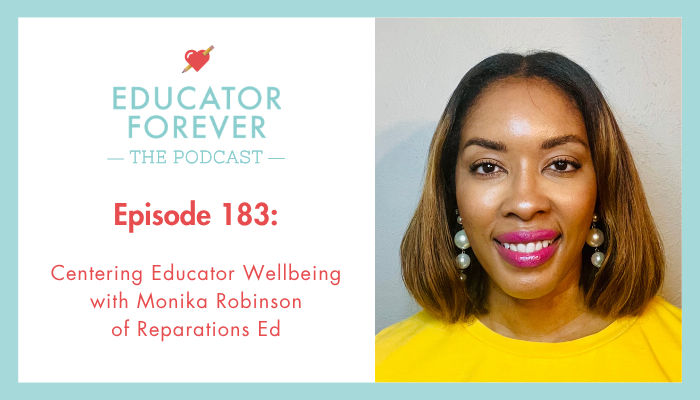
Monika Robinson is an Educator Wellbeing Coach with 17 years of experience across school systems. Her career includes roles as an elementary teacher, instructional coach, nonprofit director, and consultant, giving her a deep understanding of the challenges educators face and what it takes to thrive in demanding environments.
In our conversation, Monika and I talk about educator wellness and how she started her consultancy Reparations Ed in 2020, which initially focused on educational equity for black students but later shifted to educator wellness. We get into so many important issues teachers face, including teacher retention and the need for teachers to prioritize their well-being.
Topics Discussed:
Monika’s career journey
Teachers becoming entrepreneurs
School leaders setting the tone for teacher well-being
Resources mentioned:
If you’re enjoying this podcast, please leave a rating and review on Apple Podcasts.
Related episodes and blog posts:
Read the transcript for this episode:
Welcome to Educator Forever, where we empower teachers to innovate education. Join us each week to hear stories of teachers expanding their impacts beyond the classroom and explore ways to reimagine teaching and learning.
Monika Robinson is an educator, well being coach with 17 years of experience across school systems, her career includes roles as an elementary teacher, instructional coach, nonprofit director and consultant, giving her a deep understanding of the challenges educators face and what it takes to thrive in demanding environments. In 2020 Monica founded reparations Ed, a consultancy dedicated to supporting education leaders through workshops, group coaching and keynote speaking. Her passion is helping women in education navigate the pressures of the profession, recover from stress and reclaim their time, energy and peace while working in high pressure environments. Welcome Monica, so nice to have you here.
Monika Robinson 0:41
Thank you so much for having me, Lily.
Lily Jones 0:43
Well, I would love for you to start us off by telling us in whatever direction you'd like about your journey as an educator.
Monika Robinson 0:50
Yeah. So I think I always knew I was one of those people that, like, always knew I would be a teacher type of thing, like I would play school with my siblings, but I always had to be the teacher. So I kind of knew that I would be a teacher, but I had other interests too. I started off going to college for journalism. I thought, you know, that would be cool to be on TV in the nightly news or be your writer for a newspaper. But I ended up changing my major to education, and ended up becoming a kindergarten teacher. Kindergarten was not my first choice, but I did. I taught kindergarten for five years. I taught third grade as well. I was an instructional coach. So all in all, I worked in public schools for 10 years, and then after that, I worked in nonprofit work. So 2026 is my 17th year in education. So I've been around a long time, and I'm still on the journey of learning, because education has changed so much that I've always like trying to keep up with the new things and always trying to influence these systems to change. It's like things change, but the systems stay the same. And I know we're going to get into that, because I have a lot to say about that. Yeah, that was kind of my journey into into education.
Lily Jones 2:18
Yeah, I hear you on the systems front, too. I mean, I think that that is huge. And, you know, having worked with teachers for so long, too, it's like we internalize all these things that we think are our fault, or that we feel like we're not enough, or, you know, that are just so hard. And it's really on a systems level, right? Like there's so much that needs to shift there that I think we all start picking up, and I know we'll go down that path, but in our discussion later, yes, I agree, yes, yes. So tell us a little bit about how you started your own consultancy. Like, what is it? How did it come about?
Monika Robinson 2:57
Good question. So I kind of have always had this, like, entrepreneurial spirit. I've always thought about, how can I start my own business? And, like, I remember back when I was a teacher, like, to supplement my income, to have, like, extra money for clothes or whatever. You know, the fun stuff, I started selling Mary Kay, yeah, I sold Mary Kay for a couple of years. I made the teachers come into the teacher's lounge and like, look at the samples. Yeah. So I did that. I've always just knew that there was more for me. I loved education. I just knew that I probably wouldn't stay there forever. And so whenever I left public school and went into nonprofit, I was working. I began working at an education nonprofit, I found this like newfound freedom. I'm like, Wow, I'm not chained to a classroom. I can go to the bathroom, and I don't have to go ask my neighbor teacher to stand in the hallway, and keep an eye out for my class. You know, I can go to the bathroom. I can take lunch whenever I want to. I don't have to take lunch at 1055, when the kindergarteners will take like that. You know, it was just so much freedom. So when I got a taste of that, I'm like, Ooh, you know, I like this, and so I began building reparations Ed, really in 2020 and it was more so about educational equity for black students. I wanted to go into classrooms and into schools and teach people about how black students learn and teach them kind of some history of why we see these disparities in education, because when we look at data, we always see them at the bottom of data measures, but we don't really critically think about why. And so I started off in that realm doing workshops and stuff, and then eventually it evolved into a. Educator wellness. And I still do talk about equity, because that's really important, but now I talk more about about wellness, and so that's what we're all about, just helping educators be well and to protect their time, energy and peace.
Lily Jones 5:19
So powerful. And I think, you know, equity and wellness go together, right?
Monika Robinson 5:24
They do. I'm glad you named that Lily. You were so right about that.
Lily Jones 5:28
So tell us a little bit though. How did it shift, like, what made you feel called to go into educator wellness as a focus?
Monika Robinson 5:35
Yeah, well, you know, there's a lot of, like, anti Dei, right rhetoric, and, you know, from people who don't even know what dei is, couldn't tell you what it meant for real. We've seen it in real time. They can't tell you what it is. So with that, I think, you know, the schools kind of shied away from, like, equity focus, or even like talking about inclusivity. And so, you know, it's a cycle the wheels turn, and in a couple years, they'll be back talking about it.
Lily Jones 6:06
You know, I know....
Monika Robinson 6:08
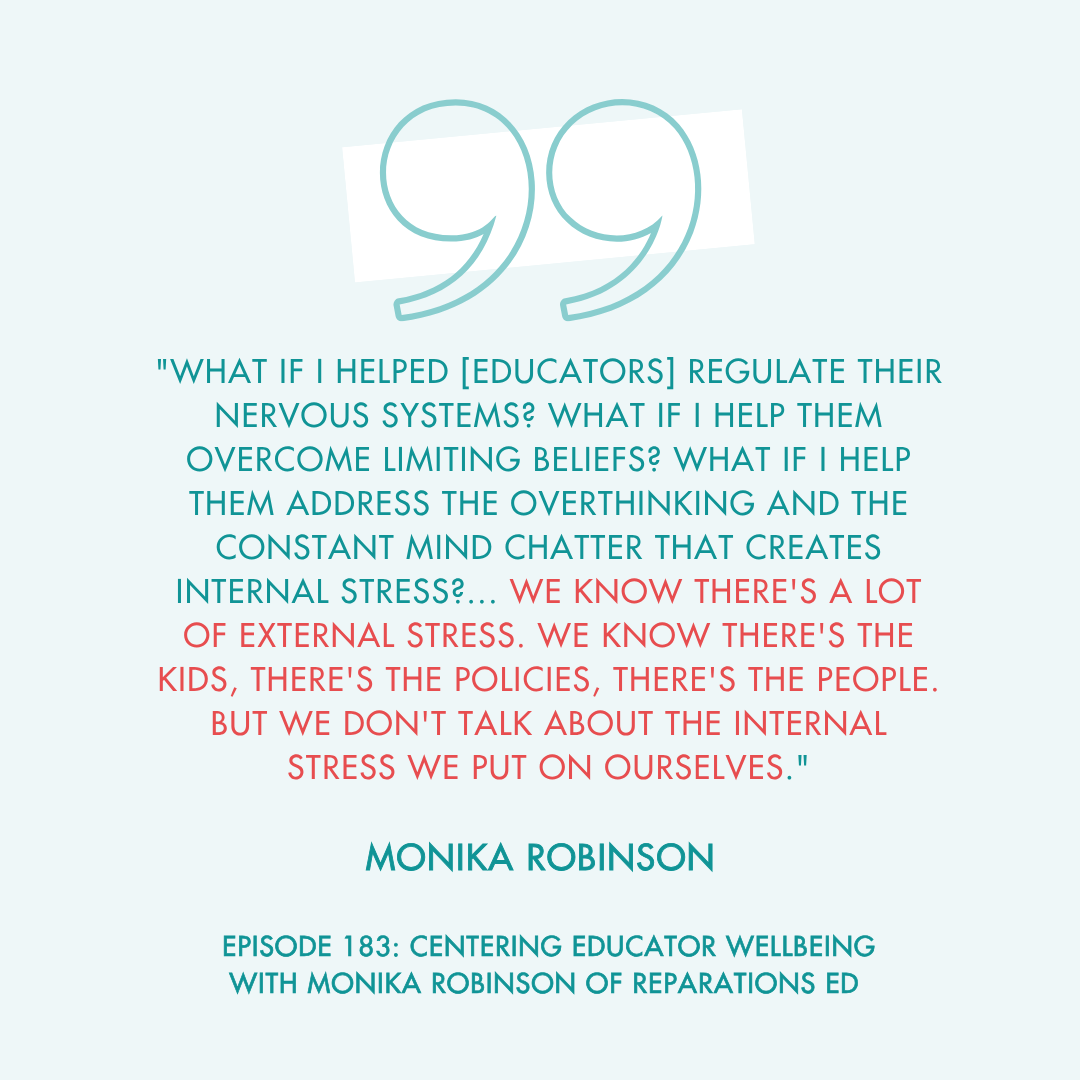
It's like, just sorry, yes, go, Yeah, I know, because I know you already know I've listened to your podcast, and I appreciate your point of view on these subjects. But yeah, so that that was that I really wanted to pivot away from that because of everything that was going on, and I thought I actually found out about something called Positive Intelligence. It's actually a book. It's a New York Times bestseller, and somebody had invited me to take a training that they offered to coaches. I was an instructional coach for six years, and so I considered myself a coach, and I loved the coaching that I did. And so I was like, I'll take this thing, this training course, and I absolutely loved it. And I'm like, what if I brought this to educators? What if I help them regulate their nervous systems? What if I help them overcome limiting beliefs? What if I help them, you know, address these, the overthinking and the constant mind chatter that it creates this internal stress, like we know there's a lot of external stress. We know there's the kids, there's the policies, there's the people, but we don't talk about the internal stress we put on ourselves. And so I was like, You know what? I can help women in education overcome this. And so that's what I've been doing, is I work with small groups of women. We meet on Saturday mornings for an hour. We have just like a community of support. Everybody benefits from the collective wisdom of the group, and we also go through the Positive Intelligence course. And so it's all about mindset development, and it's just really wonderful to see the change happening in real time. I know how much it changed me, and I just want to bring that to educators to help them hopefully stay in the profession longer.
Lily Jones 8:10
It's so powerful to really think about the internal and the external, right, and going back to how the external affects us all internally and all sorts of systems that we were all part of, right? And so, yeah, I love that work. I found myself, you know, doing similar work here at educator forever working with teachers. I didn't set off to do that piece, but found it was so important, right? Like so much of what we do in working with teachers is helping them examine their own self talk, and you know how they're supporting themselves, or maybe not supporting themselves, and where these voices in our heads came from?
Monika Robinson 8:45
Where do they come from?
Lily Jones 8:48
Why are they there, and can they leave?
Monika Robinson 8:51
Please can they go.
Lily Jones 8:53
So how awesome to have this community that you created. And I think that you know, I absolutely believe in the power of CO constructing, learning, you know, having communities that come together so that you can see things in other people that you can't in yourself sometimes. And it's easier to support other people than it is to support ourselves sometimes. I like this community that you've built too. It sounds so amazing.
Monika Robinson 9:17
Thank you, and it's a way for them to feel seen and heard as well, because a lot of times, working in schools, you feel isolated. You feel like no one's seeing your issue, your problem, you know you don't have maybe a lot of support, especially if you're new to a campus or something, and everybody knows everybody, and you're just like, Okay, I'm here and no one's helping me. I just I hear so many heartbreaking stories from teachers, and they tell me about how they're like in a classroom with dysregulated kids all day and nobody's supporting them. They've had chairs thrown at them like we have seen an increase in student challenging student behaviors. That is a fact since. Pandemic, and even probably a little bit before, as society continues to change, there's political unrest, there's economic uncertainty, there's climate uncertainty. People are just trying to survive, and that is trickling down to the kids, and they're showing up with behaviors that a lot of teachers are not ready for, aren't, haven't been trained to, to deal with, you know, and we're asking a lot of them, and so that's why I committed another reason why I created this community.
Lily Jones 10:32
We sure are asking a lot of teachers, and I think also it's like the kids are dysregulated, but other teachers are also dysregulated, and administrators are dysregulated, yep. So it becomes this place that could be so awesome, right? Like schools could be so amazing and supportive, yet so many times they're not, and become the cycle of dysregulation. And so I'd love to hear from you a little bit more about wellness and well being, and why it's not just self care, why it's a retention and a leadership problem.
Monika Robinson 11:01
I like that you said that it's not just self care. I think people start to think that it's just like, cute. It's like, oh, just do your self care and you'll be okay. And like, that's what they told us during the pandemic. And I don't care how many face masks you put on or how many times you color your hair or get your nails done, that is not going to create emotional regulation inside your body, like we have to do actualreal work towards that. And so we're seeing high rates of turnover, and it's some of it is because there is a lack teachers don't have, like, job and workplace satisfaction, like they don't enjoy being there because of the stress, because of, you know, the dysregulated students, the lack of support, like all of the things, there's just this lack of support in that area. I think a study just came out about that. I can't remember the study right off the bat, but I read it in a newsletter that I got from the Learning Policy Institute, and they were talking about, like, some of the main factors that go into teacher turnover, which is really something that's interesting to me, because, you know that informs my work, like, why are teachers leaving like we think we know, but you know, we want the research to be there. And I think it said it was three things, three main things, teacher salary, job and workplace satisfaction and effective leadership were three of the main, top reasons why people were leaving the profession, and so I figured, you know, I can plug myself right there into the job and workplace satisfaction by helping them cope with the stress and the burnout and the internal stress they're placing on themselves. A lot of times, we can't do much about the systems. I mean, they are pretty broken. We're still doing school like we used to do it. You know, 50 years ago, not much has we haven't evolved enough in the system of education. And so we we've just got to control what we can control. And I feel like teachers can control how they respond to the stress, how they recover from it. And so what I teach them is ways to calm their nervous systems that they could do in short increments during the day, and I teach them about their brain. A lot of us are operating from our ancient brain, the part of our brain that deals with fear that's in survival and keeping us safe. Some of us are literally in that survival mode all the time, fight or flight, and so I help them move out of that into another realm of an underdeveloped part of our brain that is responsible for empathy, creativity, curiosity, you know, all these wonderful positive emotions that we don't tap into enough, but they are there, and your brain is a muscle, and you can build that part of your brain, you can create these new neural pathways, and that's what really positive intelligence is all about. So they get to go through that research based program, and they get the support of the group and facilitation and coaching from me.
Lily Jones 14:26
So powerful. And it makes me think of like the intersection of these systems, and also exactly like you said, like what we can control. And so sometimes you think about school system as being kind of like what you're saying of this ancient brain right fear based right and wrong. Compliance, like, you know, also like it might feel safe, it might feel unsafe, and then thinking about all these things you just mentioned, right of this other way of being, of creativity, of empathy, how amazing is that when that's able to fully make itself into schools. And it starts with teachers. And so I think seeing this all start internally with teachers, I can imagine the ripple effect it could have in individual classrooms so that, you know, sure, we might not be able to change everything, but if we could change a classroom and the tone of it, and if students have access to their creativity and their empathy and all those things, How amazing would that be?
Monika Robinson 15:18
Yeah, and I wanted to add that you said it starts with the teachers, and I don't disagree, but I also want to add that it kind of starts with the leaders too.
Lily Jones 15:28
Yes,
Monika Robinson 15:30
What I found, though, Lily is that it's been difficult to get through to some of the leader the school leaders, to help them see the benefits of this type of wellness work, and I hate to even I don't use the term wellness with with them, because then they think it's just cute and self care. But they need it more than the teachers, because their attitude, their lack of emotional regulation, can trickle down to the whole building, because when they're stressed, that they pass that on, and then everybody stress. And so I really hope in the future that I can get more support from principals around this where they want to go through it first and get pieces of it and be able to do the work themselves, and then then do it with teachers, because it's, it's, yeah, I see a lot of stressed out administrators too.
Lily Jones 16:30
Yes, I appreciate you bringing that up absolutely. I mean, it sets the whole tone right. And so I think supporting those folks who have such a big impact, positively or negatively, you know, is so important.
Monika Robinson 16:44
yeah, yeah.
Lily Jones 16:45
So let's go back a little bit to the mindset shifts and the internal self talk that we all have in our minds. What have you found really helpful in supporting teachers to shift there?
Monika Robinson 16:57
Yeah. So one thing that they do, the first thing that they do, honestly is they take an assessment, and it's called the saboteur assessment. It's totally free. Anyone can take it on positive intelligence.com I have them take that first where they can put a name to their saboteurs. And there are 10 basic saboteurs that all of us have, some show up more strongly than others. So they have names like controller, avoider, pleaser, hyper achiever. And what I see in many of the women that I work with is they almost every time, I would say, 90 to 95% of the time, hyper achiever is one of their top three saboteurs, and so what they're doing is placing too much emphasis on achievements, on doing things, on getting it right, you know, like getting the lesson plans perfect. And they're spending like so much time like they need this external validation through achievements. A lot of these women have higher degrees. They have lots of certifications. They are in different organizations and clubs. They may be in a sorority, like they're doing all of these things because they think it just looks great on their resume, and they're just getting this validation from having all of these achievements, and they don't see the flip side of the that, that all of that's burning you out like, that's why you're exhausted, that's why you're up at 12 o'clock at night doing stuff when you should be sleep. Yeah, because you're, you're, you're doing too much, you know? And it, and it stems from childhood. You know, all these Saboteurs come from, stem from childhood, and they stem from fear, fear of rejection, fear of failure, fear of missing out, fear of abandonment. So they're all fear based. And so I help them discover their saboteurs. We talk about them, and usually when they see it named like that. They're like, wow, yeah, that that's me. They always agree, like, that's me, and they know that they are putting a lot of pressure on themselves. I was just talking to a woman yesterday, a young woman who is a teacher's aide in Philadelphia, who is has a bachelor's degree, is getting a master's degree. She is in a special education classroom working with kids who have autism in a high school. She's like, all day with a girl who's suicidal. It's like, she I'm like, How are you doing that? I'm like, Are they supporting you at all. And of course, they're not. And of course, her her saboteur, is hyper achiever, and she's just trying to do everything she can for her students. She's pouring herself into getting the master's degree. She just couldn't. She was beside herself just in the meeting. You could just see the anxiety just falling off of her basic. Lily, and it's just, it's it, you know, it touches my heart, like I don't feel sorry for her or anything like that. I just want to be a form of support for her. She's doing everything right. She just needs to dial it back up a little bit, pour more into herself. So I help people just learn how to pour back into themselves like, literally, you cannot pour from an empty cup like they've heard that they don't apply it to themselves like, right now you're an empty cup. So let's pour back into you so that you can be the best teacher that you can be and and be a model for your students a lot of the techniques that they learn, like nervous system exercises. They can use those with their students too. They could show their students how to do them. So anybody can benefit from this type of work. We all need this society has changed. You don't just get up and go to work and come home and be unaffected anymore, like that was maybe 2030, years ago, maybe,
Lily Jones 21:05
if we're lucky.
Monika Robinson 21:07
Like it's gotten worse, like people are work is adding to the stress that we already have. So yeah, so those are some of the ways that that I support them.
Lily Jones 21:17
I appreciate hearing about that and how powerful to be able to be able to identify these different parts of us. And I think that it's interesting thinking about teachers as this group of people, right, who often have these things in common, like you're saying that they, most of the people you work with, that have this high achieving tendency. And so I think it's just really interesting thinking about like, who's drawn to teaching and how that's amazing, right? Helps us help all these students and take on all these things, and then the flip side of that is we get lost in the process. Yes, and so I appreciate the naming of it as that first step of being like, hey. Like, I think everybody cognitively can understand, like, yeah, no, of course, we don't pour from an empty cup. But when exactly, like you said, right, when it comes to push, comes to shove, of all these people asking you things, I think teachers in particular, and women too, have been trained to always put other people's needs first.
Monika Robinson 22:12
Yeah, and in Lily who? Who are the teachers? In K 12, who are the teachers?
Lily Jones 22:20
Yeah, they're women Exactly, exactly.
Monika Robinson 22:23
That's why. And it's it's women's work, and that's why it's underpaid, it's undervalued, it's under resourced, and you've got women who are selfless and who are giving their all to something that is not giving back to them the way it should. The profession has not. It hasn't evolved enough.
Lily Jones 22:46
Yes, for sure, I read this, like very powerful essay several years ago called teaching as a woman, and it was about exactly that, like, I'll find it and send it to you. It was so good, you know, just of like, teaching exemplifies all these things that women have been socialized around, yeah, our whole lives, right? And so I've definitely found that, you know, in my own experience being a teacher and then working with so many teachers, that educator forever, it is so powerful to, like, unpack all these things that we've internalized and had validated by being teachers. You know, sometimes the wrong things are validated by being teachers.
Monika Robinson 23:22
Yes, unpacking and unlearning, that's part of the journey too. It's like, Who told you to be selfless and to pour everything into your job and to, you know, put your job before yourself. Like, where do we get that from? Like, why are we doing that, like, you know? Why? Why are we doing we have to stop doing that, you know? And I think part of it is the hyper achiever. We want to be seen as compliant as a person who cares about our job, who wants who does well. And that's great, and you can do all of that, but still put your well being first. People don't see that, and we learn that in school, like we learn that as little girls and in high school, and it goes into college, and when, yeah, we learn that, and we got to unlearn it.
Lily Jones 24:15
We sure do. I think it's like, I think about my own kids, right, and their teachers. I don't want their teachers to be selfless. I don't want their teachers to be overworked. I don't want their teachers to be dysregulated, right? I want their teachers to like have creative pursuits or things that they're doing outside of school. I want their teachers to be able to spend time with their families and their loved ones. I want them to live full lives, not only like for them, but also selfishly, because my children and all other people's children get to see that model.
Monika Robinson 24:45
Yeah, they'll benefit from an emotionally regulated, happy person that they're interacting with for seven hours a day, if it's Elementary School,
Lily Jones 24:55
absolutely, and that's what makes the difference, I think, right, like, you know. Well, my kids have all sorts of teachers, and some they're, like, more into than others, and often they're the ones who are happy. They're the ones who are living fulfilled lives. They're the ones who don't feel burnt out. Like, sure, they're they have a, you know, similar teaching styles and content knowledge and all sorts of things, right? And I think it's like, it makes so much of a difference.
Monika Robinson 25:21
Yeah, I'm glad you're naming that from a parent perspective, because parents need to be really concerned about the issue, the issues that are going on in education and with especially with Teacher, Teacher turn turnover, teacher burnout. I think they hear that sometimes, and they don't make the connection. It's like, No, we're talking about your child's teacher. You know, like, your child's teacher could potentially be burned out. Your child's teacher could potentially be an uncertified teacher that they put in to fill a vacancy who has never been a teacher before, and it's just there, you know, trying to survive. So, like, parents need to really be aware of everything that's happening in education so that they can be advocates for teachers, we need more voices that are advocating and advocating for school transformation. We can't just keep doing the same thing over and over and expecting a different
Lily Jones 26:18
Absolutely and so for our teachers listening out there who are like, I want to prioritize myself. I want to lean into my well being. I don't know how to get started. Good question. What would I say?
Monika Robinson 26:37
Stop overworking. Turn it off when it's time to go leave. I was that teacher that at 330 I taught elementary school, so it was like 330 when the contract time was up. I went home, and then there was those teachers that would stay there until six o'clock at night, and they would wonder why they were so burnt out, tired and cranky. So leave at your contract time you the lessons will be fine. You can read them later. You can set aside time to figure it out. You may have to do some digging into your schedule. Look at when can I, you know, rehearse the lesson plans or do the lessons, because I know that sometimes their planning time gets taken away. I totally get that. But at the same time, you have to protect your time, your peace, your energy. So leave on time. Don't be a martyr. Don't be there to stay late just to show the administration that you're a hard worker. Those days are over because, you know what they're going to do? They're going to exploit that and give you more work. They're going to give you more work, and they're going to think they're going to well, you know, Lily is the one who always stays late, so let's just ask her to do so no. Set your boundaries and stick to them. Put yourself first, your kids first. Your hobbies first. And please have hobbies. Don't just work and go home and lie on the couch or all your time at home to your kids. I get kids need time and attention, but where, where are you pouring into you? Where have you set aside some time for you that doesn't include just watching Netflix? Because there's, yeah, you know, we need some more, you know, than that. And I'm a big fan of yoga. I wish they had yoga in schools, like, I wish everybody had like, a mandatory, like, yoga class. It has changed me so much. I'm not as reactive anymore. I feel more calm. I feel a sense of peace, even when challenges arise, when things aren't going right, because that's, that's life right, there's always going to be something not going right, sure. And sometimes you just gotta let it be, and sometimes it'll work itself out, you know. So, get some yoga, get some Pilates, go walk on the treadmill. Definitely get exercise. I feel like teachers don't get enough exercise. And yeah, you're walking around the school building all day, but I'm talking about real exercise that is just going to support your well being. So those are some of the things that I would say, hobbies, yoga, workout, set boundaries, do things that are important for your well being, and that that means, like, do you need to stop at McDonald's every morning? Or could you, you know, pack a healthy breakfast? Don't kill me. Y'all, I get it. It's convenient. Don't kill me. But the food, the types of food you're in, taking affect your mood, mm hmm, and affect how you show up. And if you're you know that that hash brown and McDonald's, it's good. I want to eat it too, but eating that every day isn't going to set me up for success.
Lily Jones 29:50
Yes, absolutely. And so that's all great advice for educators to start thinking about how they can start moving down this path of prioritizing. Practicing their well being and practicing it, right? It doesn't have to be all at once. It's just little move after little
Speaker 2 30:05
move. Yeah.
Lily Jones 30:06
And so I'd love to ask you one last question in a different vein, because a lot of our audience are educators who want to build something of their own. You know, maybe they have this passion or something they want to change in education. And do you, I know, you know, you've started your own consultancy. You've done all these interesting things in education. What advice would you give for those educators?
Speaker 2 30:26
Do it. Do it. Do not talk yourself out of it. And that's something that we work on in the cohort that I run. Is not talking yourself out of things. And when you feel an inkling of something. Just take action. And so we learn how to do that through the Positive Intelligence coursework and through some of the mindset development that we work on, because a lot of it is just that inner critic and that negative voice in your head telling you you can't do this. It's not going to work. It's going to be too hard. Let me tell you something. It's not hard. It's unfamiliar. It's not hard, it's unfamiliar, just like when you had to learn to ride a bike and it was so hard and you kept falling off, and you skinned your knee and you needed the training wheels, but you learned right, because you kept so that's how business is. You just learn, you go through it. So I would say, do it and don't give up because it's hard. Or, you know, no one liked my posts on Facebook. I mean, I've gone through all of that posting stuff and gotten two likes, or had had events and two people showed up. Or, you know, it just, just do it. Just go through it. Because the greatest people in the world started small. They started small. They had events where people didn't show up. They, you know, went through all the hard times where, you know, no money was pouring in. So don't expect you're going to be a millionaire by tomorrow. But, and I would also the last thing I'll add is get you a good coach or mentor. You need help and support in this area, there are a lot of coaches and mentors out there. I'm one of them. So joining a community like mine, whether it be mine or somebody else's, get in community with other entrepreneurs, with other people in education who have some of the same who also maybe want to be entrepreneurs, or, you know, kind of working towards the same goals
Lily Jones 32:29
Great advice. So, yeah, I often give say, many of the same things that you did. You know, I think it's so important that for people to realize that it's just like little kids learning things, right? Like, I always tell the story of, like, I taught kindergarten too, kids showing up and, like, trying to read, right? And they would always try to read for like, six months, and they would struggle and be like, I don't know what the sound is. And then they would walk away, right? And then they would show up again the next day, and they would struggle and they wouldn't get it, and then they showed again the next day, and like, five months later, they'd be decoding a word, yeah, right. And same thing for us, like starting a business, I definitely felt that of being like, alright, like it has to be all these awkward moments, but like you show up and you're actually learning through that, like you're learning through the awkward moments and the doing it and the persevering. And I think that's where you build true confidence, like committing to what you want to build through all those ups and downs. But it's easier said than done. You know, as we've said throughout all this, right, like our brains get in our way, and just realizing that, you know, realizing that we shouldn't self reject and we should really just take those steps, like you owe it to yourself to take the steps to follow it through.
Monika Robinson 33:36
And you owe it to the people who might be benefiting from that thing that you're selling or that idea that you have. So if you shut yourself down or decide not to do it, you're depriving them of like this wonderful opportunity to engage with whatever it is that you that you have to offer the world you know. So think about that too. Think about the people that are missing out on what you have.
Lily Jones 34:00
So, yeah, that's a great point. Yes, they need it, right? We need to hear from people about whatever they're passionate about, whatever their gifts are, whatever they want to do next. Put it out there. There are people to help for sure, yes. So Monica, it's been so nice talking with you. Can you tell folks where they can connect with you?
Monika Robinson 34:18
Yeah, it's been great to talk to you. Lily, so I am the LinkedIn queen, and so I'm on LinkedIn at Monica Robinson, I also want to say something about LinkedIn for educators. If you're an educator and you're not on LinkedIn, and you're like, I don't need this. You need it because you need to start building your network now. Don't wait until you need a job. Don't wait until you're so burned out you quit over the summer. You have nobody to ask. You know, to know where to turn. Like all of these people, these hiring managers, HR people, CEOs of like ed tech companies and other types of education adjacent organizations, they're on LinkedIn like. That is how you communicate. So get on LinkedIn, like, do your profile and like, don't be scared of it, because it does. It is helpful for educators. And then I also created a page recently on Facebook, and it's called the soft life for educators
Lily Jones 35:16
Nice.
Monika Robinson 35:16
So if you want to go find me on there and follow me, I'm building up my Facebook presence so
Lily Jones 35:22
wonderful. Thank you so much, Monica,
Monika Robinson 35:25
thank you, Lily, for having me.
Transcribed by https://otter.ai