
Episode 177: Running for Congress with Pia Dandiya
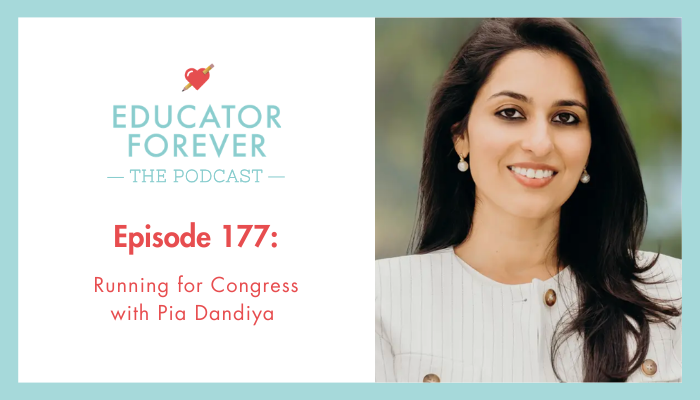
Pia Dandiya is a first-generation American educator running for Congress in the district where she was born and raised to fight for kids and expand opportunity for every Floridian. She began her career as a teacher in low-income schools and went on to become one of the youngest high school principals in the country, founding a school where every graduate earned college admission despite most students living below the poverty line. She later served as a White House Fellow working on education and domestic policy, and worked at the intersection of technology and education at Apple.
Now that she’s running for Congress, Pia and I talk about why she ran in the first place and how her experience in education motivates her to work on a national level. We also get into how she wants to fix our education system.
Topics Discussed:
Teaching in Harlem
Need for more teacher support
How India inspired her to work in high-poverty schools
Resources mentioned:
If you’re enjoying this podcast, please leave a rating and review on Apple Podcasts.
Related episodes and blog posts:
Read the transcript for this episode:
Welcome to Educator Forever, where we empower teachers to innovate education. Join us each week to hear stories of teachers expanding their impacts beyond the classroom and explore ways to reimagine teaching and learning.
Pia Dandiya is a first generation American educator who is now running for Congress in Florida, in the district where she was born and raised. Pia began her career as a teacher in low income schools and went on to become one of the youngest high school principals in the country, founding a school where every graduate earned college admission despite most students living below the poverty line. She later served as a White House fellow working on education and domestic policy, and worked at the intersection of technology and education at Apple. Pia is running to be part of a new generation of Democrats in Florida focused on putting kids first and fighting for a future worthy of them. Pia is the only former school principal running for Congress this cycle… Hi, Pia, so nice to have you here.
Pia Dandiya 0:45
It is so wonderful to be here with you, Lily and with a group of educators. So thank you for having me.
Lily Jones 0:51
I'm so excited that you're here with us, and I always start with the same gigantic question, which you can talk to us about in whatever direction feels good to you. And it's about telling us about your journey as an educator, and particularly, you know, you've done so many interesting things, but I think I would love to hear you talk about how you became one of the youngest principals in the country.
Pia Dandiya 1:11
Absolutely, So, my family is originally from India, and my parents have lived in South Florida for the last 40 years. And I mentioned India because growing up, I would go visit India often, and it was my first touch point with the idea that not all democracies are created equal. And so in college, the summer after my freshman year, I was given the opportunity to work with an organization that supports children who live in slum communities. And so I went to India for a summer and worked with 717 students who were age range, seven to 17, who were living in the slum community. And we initially had planned to teach them English, but one thing led to the next, and we realized they, in fact, knew English, but we needed to help them build confidence. So I ended up writing this play about how they could, you know, basically the best of stories like Snow White and the Seven Dwarves and Cinderella with Bollywood music interludes. And we thought we'd perform it in the community center. And one thing led to the next, and it became a huge performance that the organization wanted to show to the city of New Delhi to say, look at what these young children are capable of. And CNN India was there. We had the Chief Minister of New Delhi, who's a very, you know, renowned politician, and we packed that theater fully. So it became almost like a Lifetime movie of this experience that was just starting off to be English lessons in this in the community center. And the day of the play, we had a huge success. And after the play happened, I was backstage with the main character of the play. Her name was Bharathi in real life, and she was 14. Incidentally, it's my mother's name, and she was a firecracker, so I was surprised to see her crying. And I said, Why are you crying party? And she said, in tears, I'm I this morning, I was told by my father, as I left the house to come for the play, that I should not come and make a fool of myself in front of the wealthy people. And I told him that I did not care what he thought, and that I would come anyway. And we had reserved the front row of the play for all of the parents of the performers, and she said she saw him in the front row with tears streaming down his face during the entire play.
Lily Jones 3:29
Amazing. I love that.
Pia Dandiya 3:32
And in that moment, I looked at parthi, and I looked at everybody backstage, and every single child and every single adult was in tears experiencing the bigness of this moment. And I remember in that moment in my life, and I was 18 years old, I had never felt more alive, and I knew exactly my purpose in life, which was to help, especially young people get the dignity to see who they can become. And so that is what started me on this journey of knowing that I wanted to be a teacher, and I wanted to work in schools, and so I ended up becoming a teacher in high poverty schools after college. I thought I'd do that for a few years and then move on to policy work, but I just deeply fell in love with the work on the ground. I felt like there was no better place for me to be. And so I ended up teaching for a couple more years, and then got the fire into my belly to say, what if I led an entire school, could I change trajectories for kids living below the poverty line? So at the age of 28 I opened a high school in Harlem.
Lily Jones 4:27
So amazing. I mean, I love all of this. It's so inspiring. And I really love how you put it. I'm gonna kind of butcher these words, but, you know, giving all students the right to have the dignity to become who they want to be, or who they are. I think that really is the purpose of education beyond, you know, learning, you know, in terms of subject areas or textbooks or things like that, it's learning who we want to be and how we want to make the world a better place, and how we can get along with each other. And I think those inequities that we see of who has access. To that, and the support to do that are vast. And I love how that experience like, first off, so inspiring being 18, creating this amazing experience.
Pia Dandiya 5:11
Well, I'm almost more grateful for what it gave me, and that I got to meet, to meet my students, and then it took me on this journey which was so unexpected, and the best possible thing I feel like I could have ever done. So I feel really grateful that I had that opportunity.
Lily Jones 5:25
And it's really cool when it's like our missions become cemented early in life. Sometimes it's obvious and sometimes it's not. But I love how you took this and thought about where you felt most alive, too. Because I think we all have those experiences too, of being like, Oh, this feels like me, right, like for ourselves and for students and so turning into that and being like, Oh, this feels like me is so powerful.
Pia Dandiya 5:48
Absolutely, and so I'd love to get I used to tell my students to say, Look, you have to find something that you so deeply love, that you are willing to go through all of the challenges that may come your way, because your love for that thing is so much more powerful than anything else, and that is what has really guided me through my career. And you know the idea of starting a high school in a place like Harlem and making a promise to families, 86% of families who attended our school lived below the poverty line, and we made the promise that if they came to us, 100% of our students would get into college, and that was a very big promise to make, and this was in the 2015, 2016 timeframe. We started off with a ninth grade, 100 teachers, 10 kids. Next year, opened up a new grade, got 100 more kids, 10 more teachers, until we became a fully grown school. But in the vein of loving something so much that you're willing to do anything for it. As a principal, I did everything from coaching teachers to breaking up fights. If gangs were waiting for my students after school. And when you believe in something that deeply, you will do whatever it takes. And four years later, with our first class all off to college, therefore, was just one of the happiest days of my life.
Lily Jones 6:57
So impressive and inspiring. And so thinking about this school, I mean, what an accomplishment, getting all graduates offers of going to college. Can you tell us a little bit? What about what that experience taught you about what kids need to succeed.
Pia Dandiya 7:13
Absolutely, So I would often say as a principle, that students need an environment where there are high expectations, but also high support to get there. And when you mix those two, that is when the magic happens. And when I say high expectations, I mean that we don't lower the bar on a student's performance or on their effort, but instead that we believe that our students are capable of true excellence. And of course, that may look different from every child for every child, but that we are willing to tutor them after school to check the data, figure out who needs to come in on Saturdays, to figure out how we can celebrate with their families when they meet those goals. When we say high expectations, we mean that, yeah, the bar is high because we know that our students can get there, but the support and the celebration is high too, and we think we used to think about that in granular ways, whether it was which students are teachers going to go circulate to when students are doing their independent work, because they know they could use a little nudge, and which students are we going to call after school and tell their parents they did a great job because they finished all their homework the week before? Which students are we inviting to the progress breakfast and the honorable breakfast? And how can we come up with a great goal for all of our students to come into school on a Saturday so that they can do Saturday school before the SATs and so, really, the the nexus of support and expectations is something I have become really, really convinced of, and was a really important way that we accomplished our goals. And, you know, the second thing is, I've also become very convinced that teachers are the biggest influencer, certain that the more we can remove barriers for teachers, the more we can improve the professionalism of teaching, and the more that we can help our teachers be successful in their craft of writing lessons and executing them, the more we are serving our students excellently. And that is something that I want to be a big advocate of on the campaign trail and hopefully in DC one day.
Lily Jones 9:10
Fantastic. Yes. I mean, I could talk about the teacher support forever. And I think going back to what you said with students, you know, it comes down to me, like, really, it's about love too. Like loving students. Like people asked me the other day, like, what do you think the best classroom management strategy is? And I'm like, love loving students, you know, seeing them truly for who they are, being who you are as a teacher. And I think systemically, that could be a lot harder than it should be, and supporting teachers, you know, working with teachers for the past couple decades, you know, it's like teachers want to do their best work. They want to support students. They're amazing and brilliant in so many ways, and they're given a pretty impossible job. And so I love that you're, you know, advocating for teachers as well as students, because they really do go hand in hand.
Pia Dandiya 9:59
Absolutely and something I often talk about with voters now on the campaign trail is that, you know, we as a country need to center every conversation around the fact that three out of five children by the time they enter the fourth grade are reading at grade level in the United States across socio economic status. So that means that by the time my son, who's three right now, becomes eight, two out of five of his classmates will be behind. And we must center every conversation on this statistic and also acknowledge that, in addition to families, the number one group that this gives heartache and keeps up at night is teachers, because they are a part of a system that sometimes is not allowing them to reach their goals or allowing them to be as effective as possible, and that is something that we need to put front and center in this conversation about education in this next generation.
Lily Jones 10:51
100%. I think one of the things when I was teaching years ago that was most frustrating is knowing what my students needed and not being able to give it to them. You know, not having the resources, not having the time, not having the support, and that was incredibly frustrating, you know, not having the agency, or the ability to be able to, like, adapt my instruction in the way that kids need it, or give them one on one support. And so I think that is really something to look at. And I absolutely agree, and we have so many areas of improvement of education, and I appreciate you know, going back to the set statistic, because I think we can get so far away from what really matters, too. I mean, like, oh, this new ed tech tool, or, oh, you know, this new initiative, and it's like, but if two out of five kids can't read. What does that mean, not only for schools, but for society?
Pia Dandiya 11:46
Exactly. And I think that the implications are so severe as we think about preparing students for lives beyond high school and to be contributors to the economy, and in my worldview, to get ready for that moment where they start pursuing their version of the American dream, and I think the more educators get deep into this work, the more so clearly we all see how the seeds are planted as early as pre K, if not before, and our system can be doing so much more to help change those outcomes and give people the dignity to see who they can become in a country that has so many resources and a country that gave my family an American dream in one year that so many families who have been here for generations have yet to experience.
Lily Jones 12:29
So going back to your experience, I know you know, you worked in schools. You started this amazing high school. You also worked at the White House on educational policy. You worked with apple at the intersection of technology of education. I'd love to hear a little bit more about those experiences and what they taught you about what students need and shaped your perspective on education.
Pia Dandiya 12:50
Absolutely. So I was what's called a White House fellow, and I had this amazing opportunity to work on education and economic mobility policies in the White House. So thinking about the intersection of education with healthcare and housing and food access. And I became really passionate about this idea that, of course, the services that our students and families rely on are intersectional, and that we should be thinking about how to meet their needs across the board. And I really wanted to continue that work at Apple, and so I worked at the intersection of technology and education, as well as some work in healthcare and mental health and even areas like law enforcement, to figure out, how can we better use technology to solve some of the challenges that these industries may face. And you know, all of these experiences have made me remember that in my view, schools and community institutions are the most powerful unit of change, and if you talk about school specifically and think about it, there is no other institution that any American goes to for eight hours a day for 12 years and is connected to their entire family. That is a big responsibility, and it is also a big opportunity for us to use it as a vehicle for the changes that we want in our communities. And so I also have noticed that another a theme that is in common, whether I was working in schools, working in policy, working in tech, is that every single parent wants more for their child than they had for themselves. I think that is a universal dream that connects us all in this country, across race, religion, creed, even political alliances. And they believe that schools can be a place that can give that to them. And I think that you know that, to me, is the most sacred belief that we should honor with every single decision that we make in education. And I really believe that schools can be a place for rigorous and joyful learning experiences, and that our system needs to incentivize that at the school, the district, the state and the national level. I know what it takes to create what I think was a rigorous and joyful single school, but we need to do that at every scale, at every scale of this. Industry. And that leads me to my last point, which is, I think we need more practitioners in all sectors making decisions. Obviously, our world is changing with how technology is changing the world, and we can have practitioners be at the forefront, helping to navigate those changes, getting into states and districts, whether it's from the national level, whether it's with tech companies to help prime leaders for the changes ahead and to be thought partners on how to execute those changes, whether it's in lesson planning, in differentiation, in teacher training. And so, you know, the dreams are universal, and I think similar to what I hear you talk a lot about in your podcast, that we can have teachers and educators represented in all of these different sectors to be that voice that can help us create that truly rigorous and joyful learning environment across the board and across the country.
Lily Jones 15:56
I think that's so key. I mean, really, that is what we've been trying to do here at educator forever, of like, elevate the teaching profession, right? Like, show teachers and everyone else that teachers are education experts, and that their expertise is needed in so many different ways. So I truly appreciate that push, because I think you know, above just elevating teachers, it makes everybody better, right? It takes teachers brilliance out of the classroom where it's rarely seen by anyone else and shares it, and we can all work together and collaborate to solve some of these pressing problems. And so often, I think the frustrating thing is, like the problems are solved without the people who actually are impacted by it.
Pia Dandiya 16:35
Correct. And I think we could really use practitioners. In addition to many brilliant policymakers that I was able to meet. We could really use both around the table, and we need more practitioners around the table. And I am the only past school principal across the country so far this cycle running for Congress.
Lily Jones 16:54
I'm so glad you are.
Pia Dandiya 16:56
Thank you
Lily Jones 16:56
We can do more, right?
Pia Dandiya 16:58
We can have more. So I totally agree with you,
Lily Jones 17:01
Yes. So yeah, and just the power of teachers in so many different settings. I mean, that's been so fun about doing this podcast, so seeing like all these educators doing amazing things in so many different areas, but always drawing on their education experience. And so let's go back to policymakers. And like you said, you know, there's brilliant policymakers out there, but many, maybe all I don't know. Many of them have not been in the classroom. And so thinking about, what do you think policymakers often misunderstand about what's happening in the classroom or school, in schools.
Pia Dandiya 17:24
You know, I think we have to start looking ahead and put this chapter of our political moment behind us, and we really need to think about how we're going to legislate for the future. And in that vein, you know, when we think about nation building, if we're going to look ahead, if the military is our defense, education is our offense, and all of the decisions that we make in DC need to reflect an understanding of that priority. And I think that, you know, last year, we spent $850 billion on the military in our budget in the federal government, and we spent $85 billion in the federal government on education. And I think we really have to put this issue front and center and give it the air time it deserves, and look people like you, and I probably can agree that we believe that it is morally right to create excellent schools across the country that give every child the dignity to see who they can be and give them a shot at the American dream. But I would also argue that even if somebody doesn't share our belief system, there is a strong argument to make that it is economically smart to invest in the next generation, that the more we prepare our students for the future workforce, the more contributors we have to the economy, the more folks who are self sufficient, the more folks who are involved in thriving careers versus getting caught in the crosshairs of crime. There's a world in which, even if you may not share our worldview, it is one that sets our country up to be stronger on so many dimensions. And so I think that we really need policy makers to put that front and center in the decisions we're making, whether it is in education, whether it is in food access, in healthcare, in housing, to give young people and working families a real shot at living their version of prosperity and having self sustenance. So I think that's one thing that policymakers should really reprioritize. And the second thing I would say, which I think is a misunderstanding I come about often, is that most people who have not worked in a school or worked in a hospital or worked on the front lines, have a hard time understanding what deeply interpersonal work this is, and what it's like to work in an environment where there are so many unpredictable outside influences. So for example, when I ran a school on any given day, I had a I had hundreds of students, any of. Could be in a given moment, going through a crisis. I was in a building where things like the heating could go off on a cold day, unexpectedly, I had families who may be going through very difficult circumstances, or teachers who are struggling to be effective. We need more practitioners around the table, along with policymakers who understand those realities, because you know, when you read policy that is being written for schools, whether it was written by someone who understands your lived experience and who doesn't. So that's the second thing I would say. And the third thing I would say is the professionalism of teaching is something that has to be a big focus area. Florida is 50 out of 50 in the country for teacher pay, and I think that we need to have a serious conversation about even whether the state that is first out of 50 is compensating our teachers enough, and whether we are allowing them to be successful in getting the skills they need to be effective with their students getting constant professional development and being paid at least a fraction of what they are worth. So those are the three things that I think policymakers need to reprioritize or sometimes misunderstand,
Lily Jones 21:05
That's so powerful. And I appreciate, you know, all that you shared, and I appreciate how you're taking this viewpoint forward with you on a much bigger scale, and really thinking about, I mean, just what you said about like, education as the offense, I think is so powerful and just it invites the question of what it could be. You know, I think sometimes we get stuck in what it is and really reimagining what education could be to really set up, but not only individuals, but our country for success is a really powerful invitation. And so you're going forward, and you decided to run for Congress. And congratulations, amazing. Can you talk to us a little bit about how you made that decision?
Pia Dandiya 21:52
You know, I'm running for Congress because I want to fight for a future that is worthy of my students and worthy of my son. And I'm also running for Congress because we are in an existential moment as a country, and we need leaders who are ready to roll up their sleeves, legislate for the future, cut through the noise, and be brave enough to write a new chapter of what it means to serve communities. And that is exactly what I has gotten me out of bed every day when I was a teacher, when I was a principal, when I was in DC, and I want to bring that same spirit now to writing a new chapter of our politics. I was very affirmed in working in the White House for a year to see how well received my perspective as a teacher and principal was taken in conversations in DC and and to realize that there was sometimes a practitioner gap, and that's what planted the seed in me of thinking of wanting to do this one day. And I decided that now is the time, because of this existential moment, and because we need to start legislating for a future that's worthy of all of our children. And so that is really what I want to create. And I really also want to write a new chapter that, you know, it's focused on our party not being seen as just a party of good intentions, but a party of good solutions, and we need a new generation of pragmatic, common sense leaders who are ready to win back families trust, even after this tumultuous political time with good solutions to the problems they are facing. Sometimes they're not the sexiest solutions, but they are the solutions that are going to change outcomes for families, whether it is making sure that we have more housing supplies so that it is not so expensive for families to settle their lives here, or to make sure that health care is within reach, or that the water in Florida is clean enough for our kids to kayak on, and our economy to continue Using for tourism purposes. But these are the everyday issues that are keeping families up at night. And in addition to education, are the ones that I want to be on the front lines of, saying I've lived it, and we've got some better ideas that we're going to start legislating on, and we'll even work across the aisle to do it.
Lily Jones 23:55
Fantastic. I love how you started, too, by being like advocating for the world your students deserve, even though you haven't been in the classroom for a bit. You know, I think of my students like that too. I haven't I left the classroom when my daughter was born 14 years ago, and I still think about like, Oh, I'm creating this world that, like Daniel needed, or, you know, like these kids who are now 25.
Pia Dandiya 24:18
Yes, I feel the same way. And, you know, it's funny, you say that, because so many of my students are now my friends on LinkedIn, which is very mind boggling, isn't it? And so they've been. Some of them have been cheering me on on the campaign trail, which means so much to me. And I committed to myself the day I started this process, I said my students need to be in my heart every single day of this process, and they give me the conviction to really want to fight harder and harder, to build a dis build a campaign that makes my hometown proud. And the second it stops being about that is the second that I should stop doing this. And every day they've been in my heart.
Lily Jones 24:56
It's such a beautiful sentiment. And I think many. Any teachers can relate to this as being like the like, you said, the interpersonal part, right? Like the people that we work with are our fuel. Like, you see the power that education can have, and you see the inequities that many students are facing and really using that. I mean, I thought about my students in so many situations where they're giving talks at conferences, you know, being like, like, I gotta do it with this kid who is now in their 20s.
Pia Dandiya 25:24
Exactlt, who are adults themselves now. But I find that is what is so magical and challenging about working in education, is that it engages you with your heart and your mind every single day. And in retrospect, I would have it no other way. The highs are high and the lows are low, but it's because you are doing work that is so deeply connected to other people around you, and bigger than any one person. And in my view, there's nothing more important. And I feel I feel good on the campaign trail, feeling like this too is engaging my heart and mind in that same way, and that in some small way, I hope that I can, you know, right, the ship, to help give my students the world that they deserve and so much more. So that's what I'm trying to create.
Lily Jones 26:11
And it really goes back to what you shared at the beginning, of feeling most alive, right, like having that heart centeredness for yourself, but also advocating for everybody to have the opportunity to pursue what makes them feel most alive and feel most heart centered, for themselves.
Pia Dandiya 26:28
Absolutely and you know what it looks like when a child you know looks at a test that they did better than they thought they would, or they're performing something they were nervous to perform in a town hall that look in their eyes When they have surprised themselves by something they've accomplished. That is the feeling that I want so many more young, young people and also families to have, because that is the best of our country, and I think that we can build that. It's going to take a lot of hard work. It's going to take a lot of commitment to data. It's going to take a lot of not falling down nine times, getting up 10, leaning on each other, building excellent teams, and that is exactly all of the things it took to build a high school that got every single child to college. So I believe that we can do it at a bigger scale.
Lily Jones 27:09
And yes, I believe that teachers, educators should be the ones leading that, you know, for those exact reasons. And so can you talk a little bit about, you know, our audience is mostly educators still in the classroom beyond, you know, trying new things, and if they're interested in getting into politics. So what advice would you give them if you are interested in getting into politics?
Pia Dandiya 27:29
Well, first of all, that is awesome, and I hope you do, and I recommend that you get involved in your local politics in your area, find out what candidates are running for, event, for a local office and get to know them. That was truly the first way that I ripped off the band aid after moving home to get involved more locally. I hosted events for candidates. I door knocked for other candidates, and I will say that it almost reminded me of the feeling of being a first year teacher on the first day, where you're a little bit nervous and excited about the unknown, and I encourage you to embrace that feeling, because when you rip the band aid off, you won't your gut will not fail you on whether this feels like the right thing to explore for yourself or not, and it will also kind of mellow out any stress you have, because it'll give you the confidence to keep going and keep exploring. And so take those baby steps and see how they feel. And similar to the world of schools, politics is a big, wide world, and perhaps where you'd like to be is on the front lines running for office. Perhaps you find that you'd like to be an advisor behind the scenes. Perhaps you'd like to be a volunteer coordinator or help in fundraising. There are so many different ways that you can be an advocate for candidates, to be a candidate or to be an advocate for the community, and getting involved locally with these small steps like door knocking or hosting events, was the way that I really got started in my district, and I think would be a wonderful way for anybody, whether you're an educator or not, to do the same and then reach out to me and tell me how similar or different it feels to working in a School, because you might find that there are a lot of similarities to working in a school, because most people are not used to working with a few 100 people every single day you have had a master class in human personality that most people have not. And I bet you'll find some really heartening similarities to school life when you get involved in politics step by step.
Lily Jones 29:22
I want to hear too. Please reach out to both of us. Yeah, that's amazing. I mean, I think that, again, teachers have such amazing skills. Their expertise are needed, and sometimes we don't even realize the things that we've learned. And so I appreciate your reflections on what's the same, what you're taking forward, what we need. And I'm so excited for your campaign. I'm so excited to see what you do next. Can you tell folks how they can connect with you?
Pia Dandiya 29:50
Absolutely. Well, we would love to hear from you. You can find us on Instagram or Facebook, at Pia for Congress, PF for Congress, and you can also go to the. Same address to see our website, Pia for congress.com, or on Instagram. Find us on Facebook as well and send us a message. If anything that I've shared here resonates with you, I would love to hear from you, and I'm proud to share that we have a tiger team of past school principals who are involved volunteers in the campaign. And I just love getting the educator spirit in any way I can as I'm building this race. And so don't be a stranger. Feel free to reach out with reflections or questions, and I'd love to talk
Lily Jones 30:31
Wonderful. Thank you so much,
Pia Dandiya 30:32
Of course. Thank you very much.
Transcribed by https://otter.ai