
Episode 202: Building the Nation’s Largest Free Music Education Program with Sammy Gonzalez Zeira of Young Musicians Unite
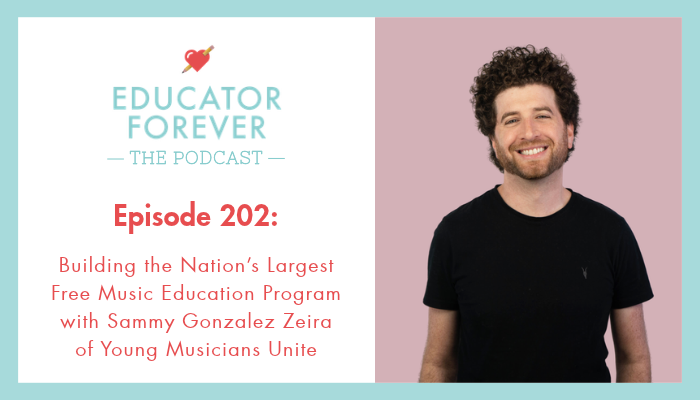
Sammy Gonzalez Zeira is the Founder and CEO of Young Musicians Unite, the nation’s largest provider of free music education. Since founding YMU in 2013, Sammy has grown the organization to serve 21,166 students weekly across 131 partnering schools in Miami-Dade County, reaching more than 71,400 students to date. He has also personally raised more than $35 million for music education and continues to lead YMU’s mission of transforming lives and communities through music.
In this episode, Sammy gets into how teaching guitar and his love for his music teachers led him to start YMU. He also breaks down all the services YMU provides and gives some great tips on how to be a successful fundraiser.
Topics Discussed:
Raising millions for a non-profit organization
Increasing funding by decreasing tardiness
Following your passion
Resources mentioned:
If you’re enjoying this podcast, please leave a rating and review on Apple Podcasts.
Related episodes and blog posts:
Read the transcript for this episode:
Welcome to Educator Forever, where we empower teachers to innovate education. Join us each week to hear stories of teachers expanding their impacts beyond the classroom and explore ways to reimagine teaching and learning.
Sammy Gonzalez Zeira is the Founder and CEO of Young Musicians Unite, the nation’s largest provider of free music education. Since founding YMU in 2013, Sammy has grown the organization to serve 21,166 students weekly across 131 partnering schools in Miami-Dade County, reaching more than 71,400 students to date. An educator since 2004, Sammy’s students have gone on to attend institutions including Juilliard, Harvard, NYU, Georgetown and Cornell. He has personally raised more than $35 million for music education and continues to lead YMU’s mission of transforming lives and communities through music. Welcome, Sammy. So nice to have you here.
Sammy Gonzalez Zeira 0:02
Thank you for having me, Lily.
Lily Jones 0:04
Well, I'd love for you to kick us off by telling us a little bit about your professional journey.
Sammy Gonzalez Zeira 0:10
My professional journey, you know, it started off at childhood. I have to say that I was able to see the most amazing rock band perform when I was in fourth grade at North Beach Elementary, and I wanted to pick up the guitar. I was able to do that for free in the public school. And as I continued to get older and older, and have one amazing teacher after another, I was able to meet the man behind that band in high school. His name was mr. Burse, and mr. Burse had MS. He was confined to a wheelchair, yet was the happiest man in the world. Taught rock and roll and classical guitar to 1000s of people, and really, really cared. And it was amazing to spend every single day with him after school, playing music, going to different states, competing. And I didn't know that, but in that moment, I was setting up my future, my life. Music allowed me to get full rides to college and go to school and travel and open every door. And in 2013, I started to look around. I realized that the music programs that changed my life are now being cut. The teachers that were there for 3040, years are now there for two to five years, and that in that transition, and all of that, and the budget issues, that if I didn't step up and do something, or at least do my little part, that many of the programs that I was a part of wouldn't be here today.
Lily Jones 1:35
So powerful, and so powerful to think about you in fourth grade seeing this awesome rock band, yeah. I mean, how cool, and how cool that this was this like guiding moment in your life. So, tell us a little bit more about how you went from this point being like, all right, these programs don't exist anymore. How do we get those into schools? Founding Young Musicians Unite. You know how did that come about?
Sammy Gonzalez Zeira 2:02
I was in-I like to call it my quarter-life crisis. I was-I was over touring. I didn't want to do it anymore. I was tired, but I fell in love with teaching. I would teach private guitar whenever I was in town, and there's something special about that. So I was like, I want to go back to school, but for music performance and education, how do I do that? And started college again, and just put a band together of a bunch of students I was teaching. And after one year, we raised $10,000. And the families wanted to give the money for cancer research, and that's important. But I was like, I'm a product of free music education. Let's do something different. Let's adopt this school, and they all said yes. And Jeffrey Miller and Karen Fry, which were friends, and Virginia Carr, they picked a school, Young Men's Preparatory Academy, which is an all-male school, public school, Title One outside of Winwood. And I remember going there. I'm going to teach these kids classical guitar. I'm going to work with them. They're going to get to New World School of the Arts. It's going to be so easy. And then reality hit after two classes. I was just like, "What am I doing? What I'm doing? Like I'm failing so hard at this right now. And I just like thought to myself, you know, when I when I strum the guitar Spanish style kids loved it. Like, so I made them a promise and I said, "I will teach you how to read Spanish style. Write you music for you if you learn how to read the first two strings because you have to read. Then I'll teach you 'Holy Grail' by Jason Justin Timberlake and Jay Z. And they smiled and I said, "Okay, deal. Two weeks, they were ready to go. Started teaching them the song. Realized how many curse words there were in it, but I kept my promise. I just changed the words. I mean, went for it. And when they performed, the parents were excited, and they were dancing, and the kids were dancing. And I was like, okay, we we found something. And it's just meeting the child where they're at. It's meaning yes, reading's important. Like that's important to me. You have to learn the language of music, but like you can do that in a different way. You don't have to do it in the way of you know they don't have to read classical music. They don't have to read when the saints go marching in. So we're able to do that, and it was just the beginning. And I, I was not like there was nowhere in my mind that it would be anything that it is today, but I was lucky enough to stick around with those kids. And you fast forward, and four out of those eight kids ended up going to one went to Berkeley, the other one went to University of Michigan, the other went to Manhattan School of Music, another one to FSU. Like they became musicians. There's something special about them, so I was able to be around long enough. But one of the fires, the thing that if this didn't happen, I probably wouldn't be doing this today. After a year of teaching at the school and working in an after-guitar club. The in-school teacher left, and when he left, all the instruments were stolen from the school. And in the turnover, the advanced kids were all put in different classes. So I realized, okay, instruments stolen, so no inventory. Advanced kids not being shepherded or taken care of; they're just put in different classes. New teachers hired. He's a classical teacher. Like this is a drumline jazz performance. Okay, and I remember the principal came to me and he said, "We're going to have to probably shut down the program because we can't afford to buy the new instruments. And I said, "I will help you. I will help you fundraise and buy the instruments. But, and I did that with a few people. But you have to allow me to teach one class in school with the advanced kids. You have to allow me to keep inventory, keep track of these instruments, and work with this new teacher who like doesn't understand the style of music. And they said yes, and that was the big turning point in teaching and being part of the school day, not just the after school, and that was a big turning point in Young Musicians United and like the fire. And you fast forward now, we're the largest free music education nonprofit in the nation, focused just on Miami, over 131 schools, 21,000 kids every single week part of the school day,
Lily Jones 6:22
So fantastic! I love hearing about that, and congratulations on how far it's come and the impact that it's making as well. So, thinking about going from that one class and getting a little bigger and a little bigger, I know there was fundraising involved. You know, can you talk about that? Did you know anything about fundraising before? Like, how did you figure that out?
Sammy Gonzalez Zeira 6:42
A few things. So I didn't even know what a nonprofit was. And Virginia Carr one time like just shouted at me across the room, "Hey, I'm gonna do a 501c3. You know, like 501c. What's like? It'll be good for you. Don't worry about it. So that was me becoming the leader of a nonprofit, and I remember we would do these concerts at the end of the year, and one of the concerts was at the Jackie Gleason, the back room, and it sold out like 500 people. It was a great event, and one of the board members walked up to me. It was J.B. Alleman and Michael Schwartz, Michael Schwartzman, Michael's genuine, and they're like, "Wow, this is amazing! Like, how much money did we raise? And I was just like so excited. I'm like, "We raised $2,000, and and they looked at me with the saddest face, and they're like, "No, Sammy, no! Like, what are you like? All of this work and tooth? Like, no, okay. Let's. I remember they pulled me aside, showed me this like golf pamphlet, and it had, and they was like, we're doing this golf thing for Columbus, and you have you get sponsorships, like sponsorship, like for what? I'm like, like people pay money just to go in this magazine and be a sponsor. I learned what a sponsor was, and then we put a committee together, and they they they they told me make a deck. So we started to do that, and that next concert in the same place the next year, you raised $38,000 in sponsorships.
Lily Jones 8:15
Amazing.
Sammy Gonzalez Zeira 8:16
And overall about $50,000 for the whole concert. Raised the ticket prices, did everything correctly, so that was like my first dipping my toes into this hand, and from there, like we just raised $1.8 million at our gala, and what I've always learned is that one, you have great people around you in the board, and if you can get great people that believe in it, they're teaching you great things because usually board members are people that own their own business and so on. So I was just lucky to be a sponge and to listen, but also being able to tell your own story is the most important thing about a leader. I remember we had a grant writer, someone helping us, and then when I decided to do YMU full time, and I just pulled the trigger. Hardly had any money to do it. It was me and was Zach, our COO, and Melanie, our CFO. We just all like went for it at the same time. And I just I remember like saying I got to write the grants. I have to do this myself. And I started writing them myself. And then when six months we raised over $200,000 because we're able to tell the story correctly, and I realize like that's really important. And just over the years, learned how to pitch, learned how to tell the story. It's not about me; it's about the kids. I'm not asking for myself, and it's made such a big change. And I think at this point, I've raised over $35 million for our arts education, and invested so much money into kids, and over 70,000 kids impacted it over the years.
Lily Jones 9:47
Fantastic! And how powerful and how important that, like all that fundraising, has made this free for kids, and what a great impact that can have there. I also appreciate how you shared about your own. Kind of figuring it out that you didn't know right off the bat, and I think a lot of our audience, you know, are educators who are trying to figure out starting their own thing or doing something beyond the classroom, doing something they really believe in, and sometimes it just feels so overwhelming. So I appreciate how you're like, I started small, only raised $2,000, got advice, got feedback, you know, got support, and then slowly grew from there and got better over time.
Sammy Gonzalez Zeira 10:23
It's power in numbers. Like I tell people, it's a lot of things. Wanting to tell your story and be eloquent about it-that is the grant writing piece. But then there is the your board. We have over 23 board members, and we have very amazing board members. Some of the best, and it's the power in numbers. And then we created a community board. People are like my age, are a little younger, but kept asking like, "How can I help? And I just felt weird saying, "Well, come to our gala once a year, and that is it. So gave them power, and then they started to create their own events, and then creating committees. And now between our student ambassador program and community board and committees. There's over 150 people that care about YMU and that talk about YMU and fundraise for YMU, and it's everything from in kind to hard ticket sales to sponsorships to family foundations. And it takes a village. And as a CEO, like your job is to inspire, and your job is to make people like excited to join. But the hardest part is that when people keep asking you, "How can I help? and you don't have an answer, that's the hardest part. And when you can cross that bridge and it feels genuine, that's where you're going to see a huge change in your organization in a positive way, and as a leader, you you change too, right? Like you're going from like I went from the teacher to writing the curriculum to teaching at three schools to then hiring teachers to then and now I'm a fundraiser, storyteller, and but I have I have like the business knowledge, right? Like I've held every job, so I'm able to like see things in a different way. So that's another part that a lot of people don't talk about being a leader. It's not consistent. Your role will change, and your team will need something different from you depending on what stage you're in in your growth as a company,
Lily Jones 12:22
I appreciate how you said all those things that you used to do. You know, when the team was smaller, that now you have people doing. I think that is valuable. Like I was the same way starting a company. Like I did all the things, right? But then when I had to hire people, then it's like, all right, it makes me a better manager because I've done all those things. And so each step of the way, you're just learning, and that learning can like expand and build on each other as you grow as well.
Sammy Gonzalez Zeira 12:47
You do, then you have to learn how to manage.
Lily Jones 12:50
Yes.
Sammy Gonzalez Zeira 12:51
And then you have to learn how to coach, which is where I'm at right now. It's not managing; it's coachingdifferent. And I have to remind myself when I act as a manager, it's it's just it's not elevating to the team, so like it just keeps changing.
Lily Jones 13:09
I appreciate that part too because I think that's realistic and the best, right? Like this idea that like we always have things to learn. There's never going to be an endpoint. There's always going to be a next stage of evolution and leaning into that learning and evolution along the way.
Sammy Gonzalez Zeira 13:24
Yeah, yeah, and also depends what kind of leader you are, right? Like, are you obsessed with growth? I'm obsessed with growth. I want to just breadth and depth, so I want quality and quantity. So it's that's difficult to to manage that.
Lily Jones 13:37
So let's talk about a little bit of like where is YMU right now? You talked about how many students have been impacted and how much money you've raised. But what are the offerings that y'all have for schools and kids right now?
Sammy Gonzalez Zeira 13:50
So in-school music education, we're the only in-school music education nonprofit in Miami-Dade for grades five to 12. So we'll go to a school like Carroll City Middle School. We visited them in 2018, and I visited an empty music room with boarded-up windows. I was like, "What happened? And because I remember being a kid and seeing these groups, Carroll City High School, and it was they were phenomenal. And I looked at the plaques in the wall, and Superiors with Distinction ended in 2008, and it just cut the program. So we brought back, we call it phase one. We brought back two classes, two different kinds of classes into an instrument petting zoo. We have eight different curriculums to pick, like the two classes that are right for the school, and 50 kids. And then took those kids and marched them around to seven feeder elementary schools. They're getting like 2325, kids a year. That was it. Like new kids from seven schools. No one was going there, and it was. I'm Derek Mccrone. I'm the new principal at Carroll City Middle School. You can be part of this program. Kids are like honking, squanking away, like literally playing for two weeks and just taking them on this tour to every open house. And from that spring to that fall, we had an. Enrollment increase from 20 something to 70 something. It's huge. So phase two is the school buys in. They now pay for part time teacher. We're paying for two. They're paying for four, and then eventually they pay for full time teacher. We'll continue to oversee the program, help with the curriculum, make sure the teacher is not the CEO of their classroom. They don't have to fundraise. They don't have to buy instruments. They don't. When something breaks, they hit up a survey, and someone comes and just drops it off like the tooth fairy, and that's our goal. And like you should focus on teaching. That is so difficult. So in school music education, that's like where we have thrived. And we went from middle school and first, and then didn't want the kids to outgrow us, so went to high schools, and then we're having disciplinary problems, behavior issues, teachers not wanting to stay in the middle schools. So then started fifth grade, which was a game changer. One feeder patterns, but two the kids learning how to read rhythms, and that was the game changer. And now all of a sudden, teachers are staying. So everything wasn't oh we should do this. It was where are the kids going? What is the energy telling us? What do we need to do? We have eight curriculums. Why? Because different ethnicities lead towards different things, and because it would be fun. It's actually difficult to create curriculum and then modern songs for that too. So that's our main pillar, and then our second pillar, the kids just started getting really good. So this after-school professional career development path, which now we put on over 200 shows a year.
Lily Jones 16:33
Amazing.
Sammy Gonzalez Zeira 16:33
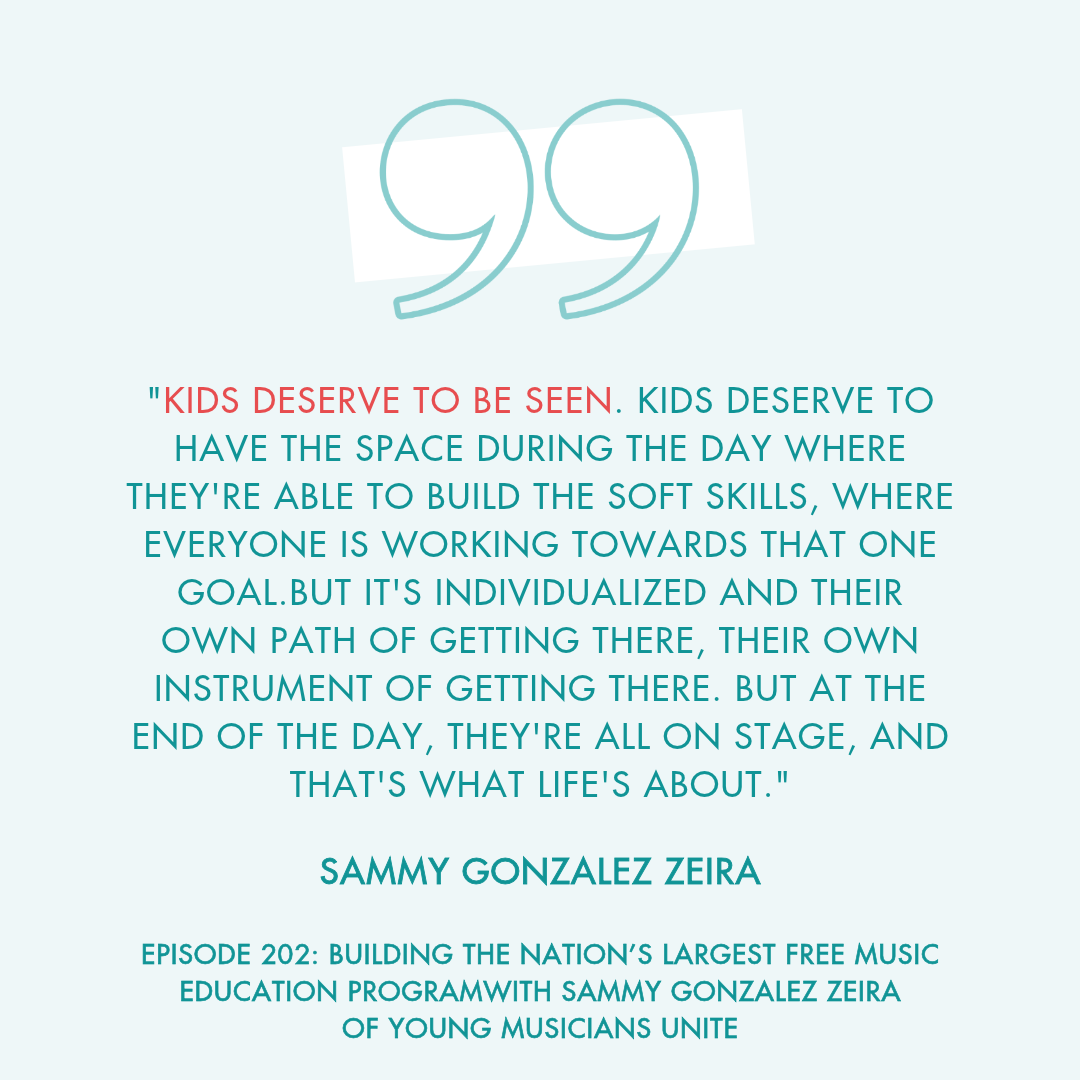
We have about 12 after-school programs, very small, and I would like to do more, but it's just it's it's very much focused on you doing it in school. Now let's take you to the next level. I call it the badass. It's like they want to perform. They want to be on stage. So that has grown, and we do over 200 shows. We have a free recording studio called the YMU Studio. Kids own the rights to the music. They learn split sheets, all of that. They're recording. They're doing videos. We're doing their art for them. Everything. We're actually going to work work with Walshy Fire from Major Laser. They just headlined Ultra, and he's going. He picked one student that he wants to work with. He loves her album, and he wants to like take three songs and like redo them. So it's just opportunities, internships over 20 different internships. I have one manager working under me, intern. These are high school kids, studios, marketing, all of it, like real world experience, and not just getting coffee and pushing papers to sound engineering. So we're seeing 2030, kids get four rides a year from our programs because they're taking the time to go deep, and we're investing in them. And the purpose of YMU wasn't to create professional musicians, but it's just been a byproduct. And more people have come in and helped, and like helped provide private lessons for some of these kids or SAT tutoring for some of these kids, so there's some wraparound services that I'm not responsible for, but people will fall in love with certain kids and say, "Well, why don't they have like I can afford for my son to get someone to come and help them with their essays for college? Like, what about these kids? Like, I don't have money for that. All right, great, I'm going to create a program for that, and it's it's just been so amazing to see the growth in YMU and the and the love, and I can keep going. Like we have two other pillars, like we do a lot, but it's like very focused. So in school, after school, we're we're we're leading a project as organizational backbone called Arts Access Miami, and we're partnered with Miami Foundation over 30 other arts education organizations. And the idea is that not one org can scale the whole county. No one can do it alone. What happens when we work together? Happens when we strategize. What happens when we have conversations, hard conversations? What happens when we actually say instead of the two of us going to the same school by accident, the school down the street has no program. How do you go there? We've been fundraising around this, and it's called collective impact. It's like the notion of like everyone under one thing. And so this Arts Access Miami project is really successful, and it's the largest collective impact project in the country, and it's here in Miami once again. And we're in the north, the south, and now the central just launched. And I have a five-region expansion plan, and just looking to be able to serve every single child that wants to have an arts education. And this takes it up to not just music, art, dance, theater, and encompasses. And every kid should be able to express themselves. Kids should be able to have opportunity, and the haves and have-nots are the divide is larger and larger. And what about the kids that are in the public school that can't go to the private school? They their parents can't drive them, even if they have a waiver. And then the fourth thing is data advocacy. I know that sounds boring. But it's making the case for the arts. the the The arts isn't. It's not just a music class. It's education. You have math, science, English, and arts education, and people don't see that, and they just think, oh, it's just a music class. And I'm just like, kids deserve to be seen. Kids deserve to have the space during the day where they're able to build the soft skills where everyone is working towards that one goal, but it's individualized and their own path of getting there, their own instrument of getting there. But at the end of the day, they're all on stage, and that's what life's about. That's how work really is.
Sammy Gonzalez Zeira 20:33
It's not a it's not a line, and they're building friendships and building confidence and and terrified of getting up there, and then they do it over and over, and then you're seeing the parents show up in the community, and they can't believe, and they make remarks that that's my child. I can't believe that you got him to sit still, her to sit still, like they're performing, or the kid that never heard him say a word, yet belt a song on stage, and I've just seen the transformative impact of music. And then when you go to hard stats, we're seeing 20% reductions in tardies and absences of music and art students compared to non. So they're bought in. They're excited to show up more. So they're doing better in school. So their reading scores are better. Their math scores are better. They're showing up more, so we're making that case for the arts, and we actually won an appropriation from the state. We have a governor that you know is not the most supportive of arts arts organizations yet. This one he let go through. He allowed it $600,000 appropriation because he saw it was for teachers, he saw it was to help the inner city schools, and he saw that we are making the statement in the case study of the 20% reductions. So we're seeing that, and I'm thankful that he didn't veto it. And it was like $1.4 billion in veto. Like it was one of the largest. So it's it's important to get the buy-in from government. It's important to get the buy-in from everyone and to be neutral and to walk down the middle path because you have kids on both sides of the aisle. So we have a lot going on here at YMU, in school, after school, working with other organizations, and then putting the facts on paper about how transformational music is for a child, the whole child.
Lily Jones 22:27
So inspiring, and I appreciate you know the holistic approach that you're taking too of being like, oh, it's not just music, it's arts, and it's not just arts. It has this bigger impact. It's like these concentric circles, and I'm curious a little bit about just how you think arts education sometimes goes wrong. You know, is there are there things that you want to change about the general approach to music or arts education?
Sammy Gonzalez Zeira 22:56
No, like like we just need more of it. We do. Like, like, like, everyone will have a different viewpoint, right? It's just like, are you going to take your math? Are you going to go take physics? Like, you don't have to take physics. Like, you don't. Are you going to play music? Are you going to play classical music? Like, that's physics of music, right? So you can debate that all day, but for me, it really is about the whole child and it's the experience. And people need experiences. Kids need that. You go to a private school. No one's going in and going, "Oh my God, let me see the math class. I have to see the science teacher. Like I had to make so I can make a decision. They say, "Show me the pool, show me the tennis courts, show me the football field. So it's all about the social experiences. It's all about the kids they're going to be around, and they just know that that that environment will allow them to thrive. And everyone is education is an important piece. And when you wrap around the experience, and kids are getting along and excited to show up for something, the education follows, and it works.
Lily Jones 24:09
Yeah, the environment matters, and the whole approach matters, and the kids matter. You know, following what they're interested in, and following what they're engaged in, and just the exposure to, so
Sammy Gonzalez Zeira 24:23
But but think about it. Like, if you're in school and they say we took all the funding and cut all the experiences and we're doing double math, science, English, like take all the joy out of the school day and go, why are you not doing well? We're telling you all day that you are doing bad, so we're going to give you more of the thing that you're bad at, and give you no relief, no release, no place for expression, and going. Why isn't this working? I'm so confused. And that's what they did in 2008, and they learned that that was a mistake, and now that you have your public dollars and you can take them. Them wherever you want in the free marketplace, people are looking for experiences. They're going, "Oh, I want to go to Mac. It's an arts charter school. People assume they're going to get a good education.
Lily Jones 25:11
Absolutely. And so, Sammy, I know we talked about this a little bit of kind of our audience out there of teachers who maybe want to build something of their own or start a movement of their own, or something's just kind of calling them to do it. What advice do you have for them?
Sammy Gonzalez Zeira 25:29
Follow your passion. Like, I most people that do this, if they're building it from the ground up, they're not doing it because, like, oh, I want to start a nonprofit and do this full-time thing. Like it's, I'm really passionate about X, and I want to make my difference. And it has to be all about that. If you have the opportunity to transition into full-time, it means like the business model works, but it'll never work unless you are passionate and ooze it and figure it out and become an expert at this thing and figuring out your niche. And if everything perfectly aligns and the people around you want to be part of this, then you can do great things. But you shouldn't lead with. I want to run a really large nonprofit. It's all about passion and purpose and people, and you're just scaling that. And like even now, like if you have an office of 34 people, and I tell my team, like, do we need operational efficiency? Not so we can just be just tight ship, which is important because working for me is a marathon. But it's the goal is is that we're such an operational efficient machine that we can do our job, which is look outward, which is spend less time in spreadsheets and more time with people, and that's how you. That's a test of if your team is if you're running a good team or not. If you're doing good work, is if your team can face outward.
Lily Jones 27:07
Yeah, beautifully said. And Sammy, it's been so nice talking with you and learning more about YMU. Can you tell folks where they can connect with you and YMU? Of
Sammy Gonzalez Zeira 27:17
course, we have a lot of amazing events coming up. So anything from student events and kid events. We're doing stuff at the band show, Halloween at Lakeview. We're doing youth music festivals, and then for adults, we have a Halloween masquerade at Sacred Space on the 22nd. We have wellness and paddle stuff at reserves. We have our gala. So ymu.org. Join our email list. We do a lot of great activations and great experiences and opportunities, and everything that you are part of helps not only get to see kids perform, but also goes back into the classroom.
Lily Jones 27:52
Wonderful! Thanks again.
Sammy Gonzalez Zeira 27:55
Thank you.
Transcribed by https://otter.ai