
Episode 201: Creating Resources for Teachers with Paul McKee of FreeWorksheets.com
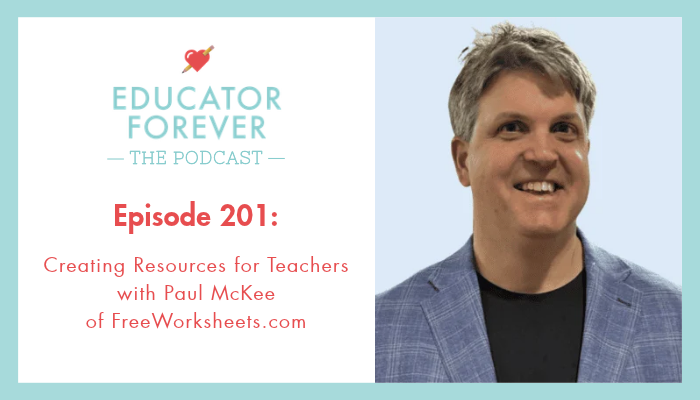
Paul McKee is a former K-12 teacher turned education entrepreneur who has spent more than 20 years building and growing online education businesses. He is the founder of FreeWorksheets.com, a free resource platform created to help teachers, parents, and homeschoolers access classroom materials without memberships or paywalls. Along the way, Paul has worked extensively in SEO, digital publishing, and ad tech, while remaining closely connected to education.
In this episode, Paul and I discuss how his history in the tech world led to him starting his Free Worksheets business and what he’s learned about entrepreneurship over the years. He’s got some great advice about running a business, so tune in!
Topics Discussed:
Paul’s career journey in teaching, tech, and entrepreneurship
Building and growing an online business
Advice for entrepreneurs
Resources mentioned:
If you’re enjoying this podcast, please leave a rating and review on Apple Podcasts.
Related episodes and blog posts:
Read the transcript for this episode:
Welcome to Educator Forever, where we empower teachers to innovate education. Join us each week to hear stories of teachers expanding their impacts beyond the classroom and explore ways to reimagine teaching and learning.
Paul McKee is a former K through 12 teacher turned education entrepreneur who has spent more than 20 years building and growing online education businesses. He is the founder of FreeWorksheets.com, a free resource platform created to help teachers, parents, and homeschoolers access classroom materials without memberships or paywalls. Along the way, Paul has worked extensively in SEO, digital publishing, and ed tech, while remaining closely connected to education. He is also a husband, father of two college athletes, and longtime hockey and lacrosse coach who enjoys sharing the lessons, mistakes, and unexpected turns that have shaped his journey. Welcome, Paul. So nice to have you here.
Paul McKee 0:39
Ah, thanks for having me. It's a wonderful day to be here.
Lily Jones 0:42
Wonderful. Well, I would love for you, in whatever direction you'd like to take us, to walk us through your professional journey.
Paul McKee 0:50
Sure. It's completely non-traditional, put it that way, as far as teaching goes, and I think pretty much everyone on your channel is is non-traditional for teaching, but I started out as a teacher in the late '90s during the.com phase. I fully taught for 10 years as a science teacher, both at middle school and high school level. As I was coming up, the TV was telling us, much like the TV is telling us a lot of things about technology now, it was telling us that if we made a website, we'd become millionaires. So I was like, "Oh, that's a that's a great idea. And I quickly learned through a bunch of funny stories that teachers and educators and homeschoolers were looking for resources online in mass droves. So I was like, "Oh, let me create the first educational website. It was called Teachnology. I have nothing to do with it, and haven't for a long time. So, but but back then it was pretty much one of the steady platforms for most teachers for the 2000s into the mid 2000s, and then I kind of moved on. But I built that out. Like I said, I taught for 10 years. Towards the end, I eventually transitioned to just working on that, and I went transitional into other websites, and I built a large catalog of websites. About five years out of teaching, I got a call from a large media company, and they said we'd like to purchase you. And you know, I long story short, I did that. Ended up working for them for a few years, and like any company that gets bought, they eventually management changes. They eventually worked me out of the picture. I had enough money when everything was done to like say, "Oh, I can retire. You know, I'm not going to have a yacht or a private plane, but a comfortable retirement, right? And so I started doing that for I don't know two weeks and realized that I needed purpose and I needed to do something, and one of my friends, she's a reading teacher, retired. She was starting to build a website, and she said, "Hey, listen, would you help me? It's called ReadingDuck.com. It's just starting to catch on a little bit now, but that's out there. And I worked with her for about a good six months getting that going, and I now I still work with her twice twice a month, and we we did that, and I I was enjoying that, and that was fun, and then eventually I came to like said, oh you know I could probably use my own thing, and and then I AI started coming out, and it became I was I want to say a less than proficient programmer back in the mid mid mid 2010s, and because of AI, I'm I guess a somewhat competent 2020 programmer by today's standards. So I started developing a lot more websites, and I just started right now. Our first full site out is freeworksheets.com, and it's out for a reason to kind of keep it free, and it literally stands for the name, free free worksheets. And I did it in a different way than pretty much anyone else is doing it. Made it people first, and the reason I did it is really to give me purpose. It's not about the money. If anything, it's front on the front end. It's free, so it's free for teachers, anyone who wants to use it, but it's also giving purpose to a lot of educators I used to in the in the past use for my websites to write for. They write all the worksheets and whatever advertising money I get, I pretty much give to them, and I keep just enough to pay for the coffee bills. We have like a meeting every quarter, and I that's basically all the money that I keep is just to cover that bill, but it's it's been very rewarding. We've only launched it in March, and that's kind of kind of where I'm at now. And once I get that process, like anything else, when when I build businesses, I get them stable, and then I put somebody else in charge. Eventually, hopefully, it'll grow enough so I can get a second like a lieutenant in charge to kind of manage that, and I'll move on to my next project, which I kind of have like a whole bunch laid out for myself. Some involve people, and some are just programming. But at the end of the day, everything I'm going to build is is free and helpful for the universe. So, like a while from now, I can look back and say, "Hey, I did something good in the world."
Lily Jones 4:57
Absolutely, how cool! And why worksheets? You know, talk us through what made that decision to starting there.
Paul McKee 5:04
So I, my wife is still a teacher to this day. hasn't changed a lick. She's a special ed teacher here in New York, and she has in our in her district. Well, two things, and it's something I wanted to mention about your. I haven't heard anyone mention it yet. My district, when I was leaving gave me the option since I had tenure. I had a two-year leave option, which was great because they held a spot for me. So it was like a real safety net to to be able to to move out. But I had a my wife also is another program in that district, and she she mentors younger teachers, so if you're a new teacher to the district, either brand new teacher or just a new teacher to that district, they require you to have a mentor for a year, and then they're there to just kind of you know spitball things off of. But she had a few young ladies that were having trouble with their finances, and I'm no finance guru, but I have been burned a bit by the finance industry, so I tend I tend to like to help people, especially teachers that have problems, and so so they brought home their finances to me. And long story short, we helped them get get. It was been a full year now. Helped them get back on track, and they're all back in the green. But in the process, I realized that all these platforms that I built back in the day, Teachingology being one of them, they're costing them up to $1,000 a year, and these aren't like millionaires. You know, these are these are people struggling to pay the pay the rent, let alone the mortgage, because they can't afford a house. So I was like, you know what? If I can get, if I could build something that takes that off of their plate, that'll make me feel pretty good, and and that's why I I really kind of did what I did with this, and I hope to do more so that like that $1,000 right now. Maybe we can get it down. Worksheets was was the biggest topic. I mean, you asked me why you pick worksheets. They basically, I would say, 30% of their bill was worksheets. That was the highest number, and then games came next. So I'm going to move into games, Lily. I'll get there, but but right right now we'll start with the highest highest interest one for now.
Lily Jones 7:03
Yeah, when I was at Education.com for five years, I was their learning design manager, and I worksheets were always number one. Depending like anything we do, you know, like oh, we want to come up with this flashy game or all sorts of units and things like that. There's always worksheets as like above and beyond because I think I know as a teacher, you know that's what you need tomorrow. Yeah, you do something, and you're like, all right. Or even with my own kids, right? Like they need extra help on this. I'm googling worksheets and printing something out so they can do it at home. So absolutely valuable, and I love the focus on keeping it free. I mean, teachers need more of that, and how awesome that you're not only creating this kind of career option, you know, or supplemental income option for teachers, and giving it away to other teachers for free.
Paul McKee 7:49
Yeah, yeah, it's it's pretty it's pretty fun. At the end of the day, I just look at it's it's I mean it's great to be a teacher and come home and feel good about yourself, but it's when you when you're done and you're out of that, this gives me that feeling again, which is pretty pretty remarkable.
Lily Jones 8:02
It really is. Do you have a full scope of like K 12 all the subjects, or do you narrow in?
Paul McKee 8:09
So for free worksheets, we're starting with that. I this is as far as and you might learn this from education.com. It's horrible business practice to focus everything by grade level because the way that machines work, they don't interpret that well or understand that. I mean, they're getting a little better with LLMs and all this, but they're still not there. But I built it human first, and my concept was: listen, I'm gonna teachers teach by grade level, and there and there's things that spiral over. So, like, if let's say you go to one website and they have worksheets on cause and effect or something, well, it's really different if it's third grade versus seventh. Hugely different. And so what I did, and so what I did is I started building it all out by grade level, and it's we know about spiral curriculums, how you're basically using the same thing as you move up in grades. Well, I'm going to have five levels of cause and effect worksheets because that's what teachers need, and machines don't understand it, and machines can't give it to people. But I'm going to build what they need, and so like one thing that we're also doing, which is a lot different, is I'm like every teacher that submits these things to me. I have a group of probably about 60 of them now, but every teacher that submits to me, you have to try them out with kids, and they have to become radically different. I don't want to see this. I don't want like I'm I'm trying not to name out websites, but there's certain websites where it's like one of 50 of the same worksheet, couple of words, couple of numbers change, but it's all the same thing. I want something where a teacher can go and be like, okay, this one's way different than that one. Oh, this one's way. So that's that's what we're doing, and and I think we're doing a pretty good job of it. I know everyone who's been involved in using our worksheets with with the kids. The kids seem to really like it because over a set, we initially launched with always with a dozen worksheets. They we probably only throw out two of the 12. And we try to build up to to 28 from there. It's kind of like what what our goal is, but that's kind of kind of what I've been doing, and it's been a lot of fun.
Lily Jones 10:07
So cool, and I think you know, having been in curriculum for many many years now, you know, so often it's not created by teachers, and so I appreciate that not only you're like I'm having teachers create this curriculum, but also they have to test it with actual kids, which also surprisingly and disturbingly doesn't always happen. Yeah, and so I appreciate that focus and a focus on like let's make it different, let's make it actually helpful for teachers because I think if a teacher goes to a website and sees a bunch of worksheets that are all the same, of course it's not as compelling as having variety and lots of different options.
Paul McKee 10:40
Thank you. Yeah, that's I having been on that arm of it and worked for a large media company. I see how these things are cranked out, and you're like, wait, that person not only has they have they never taught, they they don't even understand what they're doing. You know, it happens a lot of the time. So like, I mean, my my job on I built I've built an AI that basically puts the website together, but I edit everything. I sit down with a big cup of coffee on Saturday morning, and by Sunday we have that batch ready to go. That's kind of how it goes.
Lily Jones 11:08
Yeah, great. That's awesome. Awesome. So thinking about like your transition to back in the day, you know, being a classroom teacher, and then starting these websites, and it's so cool seeing the variety, you know things that you've done, and kind of the way that you think about this. I'm curious how you learn how to do these things.
Paul McKee 11:28
Well, I say, okay, I wasn't originally trained as a teacher. I I went to my undergrad was engineering, and quickly understood about 3030 minutes after I graduated from an engineering degree, that that's not what I want to do, and I sat there and looked at my father, and he says, "Yeah, but son, you know how to solve a lot of problems, and I was like, "Yeah, you're right, Dad, and that made me feel really good. And that's basically what I do all day. I just solve problems, and I, you know, and honestly, in business, that's what you do, right? Like you're always going to run into. I always say entrepreneurship is like, and I've never heard this before, so let let's coin it on the Lily Jones show. Is I I feel entrepreneurship is like being in a corn maze, and there are two kinds of entrepreneurs. There's one that'll hit the wall and just sit there all day and just oh man, I'm a wall, and that's why they say 80% of businesses fail because only 20% of them get back up, go back the other path, and and try to find the opening, and that's kind of how I've always run. When I run into a problem, it's usually when I look back at it. My son's starting an entrepreneurship. He's he's an entrepreneur himself. He's he's young. He's early 20s, and he he'll have these all the time. And I'm like, son, when I look back, my biggest mistakes were my best lessons, and they were so cheap. I mean, well, some of them, some of them not so much. But yeah, I mean, like you make a mistake, you turn around and you say, okay, and you learn from it. Like a lot of people will make their mistake and just sit back and be like, oh, I'm I'm not the best. I'm not the. You got to take your ego out. When you're an entrepreneur, you're gonna run in the walls, and that's a good thing. That's a that's almost a great thing. You know, like sometimes you'll you'll get into a position where you have no business being in, and but you look back and be like, oh well, this is this. I've helped mentor a lot of young people in the in the online entrepreneurship space, and the biggest problem is they'll fail, and they'll be like, "Well, now I have to get a job. And I'm like, "Yeah, but here's the thing: you've got some serious, serious skills. Like I always use the the the line from Taken with Liam Neeson. It's like I've got a serious set of skills, and that's what you get when you're an entrepreneur. You're basically sharpening your skills, and eventually you'll hit. You just got to keep trying. That's that's the biggest thing. Is like you you you have to walk in willing to fail. And honestly, failing is usually a good thing. Not not in the immediate situation, but a year later you look back like, if I didn't fail, I wouldn't have gone to this.
Lily Jones 13:54
Absolutely no. I taught kindergarteners for many years, and I would always tell them like mistakes are how we learn. And then when I started a business and found myself doing exactly like what you're saying, failing and making mistakes and running up against problems, I was like, okay, yeah, not as easy as I flippantly said it to these five year olds. Still so true, right? Like, absolutely, mistakes are how we learn. And I think just what you said, like I see all the time with teachers too, trying to do something new or taking risks and being confronted with it not going right the first or second or third time, they start to make it about themselves and their identity. And I think that just from the beginning, like you're saying, being like entrepreneurship is solving problems and it's making mistakes. It normalizes that and this idea that like there is a way through. We just have to keep working at it.
Paul McKee 14:41
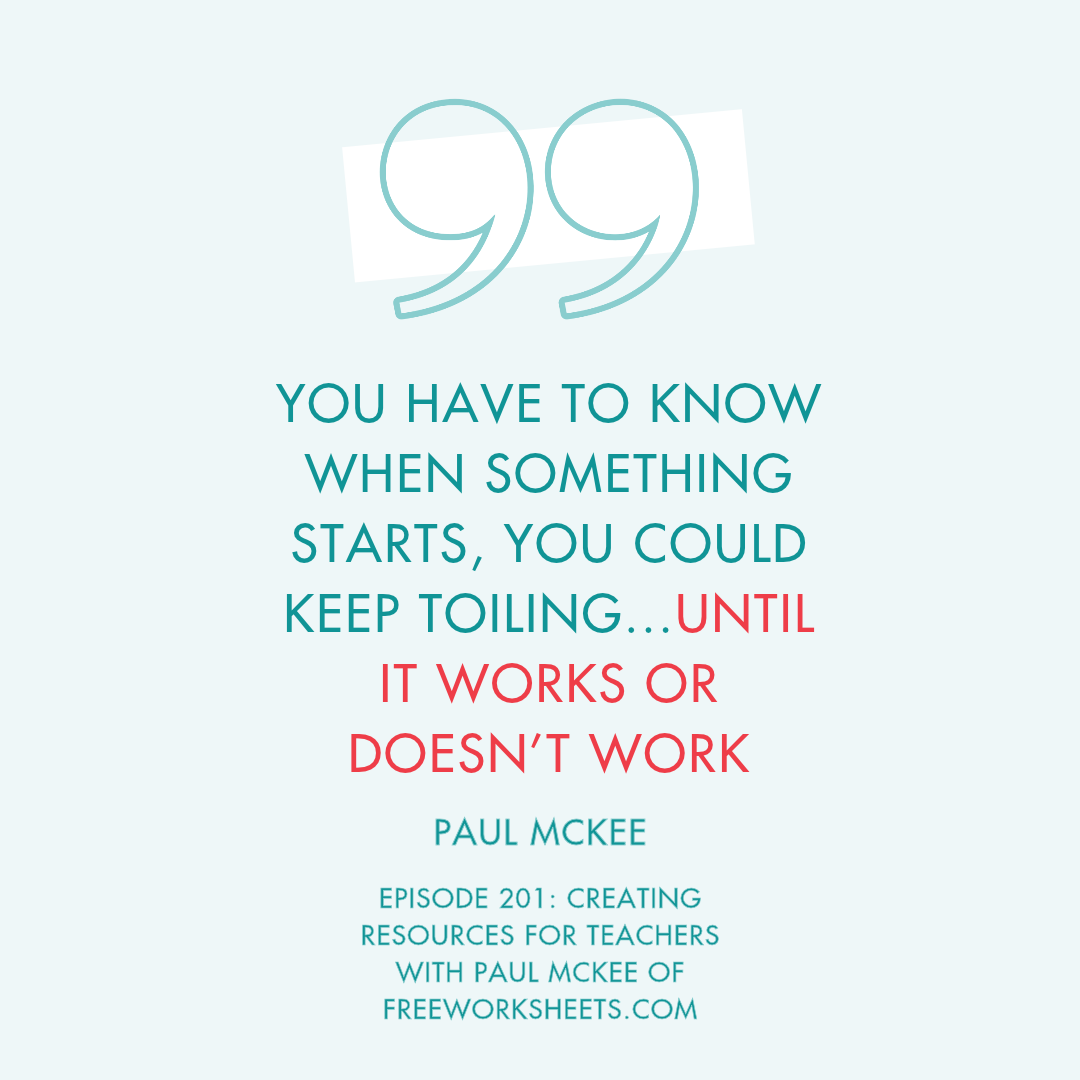
Absolutely, I have to say too. Like being a teacher, and teachers don't get this. I got it because I went through it. But being a teacher is the best. They call it incubators. I'm not sure if you're familiar with incubator. So like it's the best incubator there is because you have a lot of leeway. You have to know when something starts, you could keep toiling around with some. Until it works or doesn't work, and when it works, you you have the summer to really push it, and then see if it somewhat works. And if it somewhat works, well, maybe I can go to the next step. But not many professions have that ability. So the one thing I always say to a lot of teachers that are leaving the thinking about leaving the classroom is just when you're doing it, don't don't look for the outcome. Start small and just pick away at it, and and just pick away and think about. Like I have a friend who who eventually he owned a series. He he was an he's a shop teacher, and he he eventually started buying electrical firms. And he's like, I don't know how to do this. I was like, well, take a decade. You have a decade to figure it out. You know, you you don't have to transition tomorrow. You could transition over three years or two years. Just be you have that safety net. Teaching is literally the best incubator there is, hands out.
Lily Jones 15:49
Yeah. So thinking about those mistakes, I'm curious if in your career building education businesses, are there any mistakes or kind of reroutes that you took that stand out to you?
Paul McKee 16:01
100%. Now you might be familiar with the website Kia Q U I A, which I have nothing to do ever with, but a lot of teachers use it, and it basically is a little platform that allows you to make flashcards and games with words that you give it. Well, I built that 15 years too early, because because teachers just wanted to consume in the early 2000s, right? They just wanted to consume, consume. But I thought I figured out Kia. Everyone's gonna love it. I have this engineering brain. I I even asked my wife, and she's like, "Yeah, I don't see that working. Like she said this, and I was like, "What if I just bet our whole financial future on this? Because this is at the time we weren't really that guy. Just I I was doing well, but not like really killing it. So I put a. I want to be honest, Lily. I put like $200,000 in this whole, like basically the cost of my first home into this thing, thinking, oh yeah, this is going to be it, right? Well, I don't think I made 1000 bucks total off. But looking back, every time I hit a wall, that was the best lesson I've ever got. And now it did cost me a college education by even today's standards. But but really looking back at it, I'm like, you know, I I and and the biggest lesson I got from that was that I didn't listen to my customer. I didn't I didn't go in and say, hey, teachers, do you want this? What if I built this? And I could have built it on the on the on the short end for like let's say under $50,000 and had a prototype, but I didn't do that. I was just like, I knew everything. I know what people want. I I think I was listening to Steve Jobs too much at the time when he's like, you have to build what people want, not what people think they want, you know. And I was like, yeah, those those think different commercials caught me a little off guard, I guess
Lily Jones 17:44
So interesting, and I think the idea too that it's like, and it was recoverable, right? Like you learned skills through that, even if it didn't succeed in the way that you wanted it to, and you were able to recover from it and move on. You know, didn't mean going in a full different direction, or changing your path completely, and so I think seeing it all as the journey is so important.
Paul McKee 18:08
Oh, 100% Yeah, you have to, you have to give yourself, you know, you have to give yourself grace all the way through this. If you're gonna, if you're gonna do something out on your own and not collect a paycheck every Friday, I'd say you're really an entrepreneur when you got when you got to make payroll, the first time you got to because once yeah you you could feel that right like I don't care like my wife at the end of the day she's like how much me I'm like I don't care my people have to get paid like they get paid first I get paid last there's years where like we were taking out loans just to cover payroll and you have to when you start doing that and you stop making the business about you and your and your and your focus, and you make it about people. People buy into you, and they-I mean-they fought for me like ninjas back in the day. I can remember just because I always treated them well. I made sure that everything they needed was taken care of. They had health care. They had this. They had that. Yeah, treat anyone that you bring on. Make sure you treat them well, whether they're an offshore worker or live sitting next to you, either way.
Lily Jones 19:04
Absolutely, it becomes the culture of your company, whether those people are client facing or not. You know, I think it really does kind of shine through one way or the other. And like you're saying, those people become your biggest advocates.
Paul McKee 19:17
100% Yeah, I still have a team of three people that I've had for 20 years, that I I don't know how I was paying them for two years, but we got it done.
Lily Jones 19:24
I feel you. I feel you. So I know that you also you know are a parent yourself and have done a good amount of coaching for hockey and lacrosse and raised two college athletes. And I'm curious if that experience led anything to your business building?
Paul McKee 19:42
Yeah, absolutely. So, yeah, my daughter is still at Queens College in Charlotte. She's a swimmer, and my son-he's-he just graduated recently, played lacrosse in college in Florida. I mean, that experience. I think that. I was an athlete myself, so reliving their experience helped me relive the lessons that I learned growing up. And that you have to just kind of be resilient. There are going to be days where the coach doesn't want to put you in. There's going to be days where business is tough. There's going to be days where you get a bad email, and the last thing you do first focus on what you can control. And as I tell the kids, and you just you can only worry about those things. Like right now, I guess I'm in an ad business, if you would. So the RPM goes up and down, and you know, could be one day where you're like, "Wow, I'm making $100, and then the next day you're like, "Why did I even make 10? You have no control. These are things I can't control, but what I can do is position myself as best I can, and and really, you have to in in entrepreneurship what get ready to weather storms. You know, you have to have a hard shell, and you have to realize there's going to be good. It's a roller coaster. It's like just like life, but there is you know being an entrepreneur, being on your own is is non what's what's the word I'm looking for? I'll just I'll just go back. So yeah, when I'm when I'm thinking about what I'm doing and and what I'm going to do next, focus on what I can control. From there, I move on to what what else what else can I do to make my business grow? And then you have to get rid of your ego. That's the biggest thing. The biggest problem I find from business owners is ego. Like, oh, I did this, so either I'm a failure or I'm only a success by one metric, or all I'm you know I'm only maybe there's two metrics that I keep. No, you can't focus on metrics. You just you have to like build yourself a timeline. You also have to be ready to initially. You're gonna be unprofitable for a while. If you're, if you know, unless you're doing a service, you're going to be unprofitable for a while. And there's going to be periods that are completely out of your control. Focus on what you can control, and just get ready for for the hard trail. But I can promise you that if you stay consistent and you stay level, is what I tell my kids. You got to be level. There's going to be highs. There's going to be lows. If you could stay in that middle, you're going to be successful. There's no doubt about it. It's really hard not to be successful as long as you stay level.
Lily Jones 22:10
Yeah, that emotional regulation piece I find to be crucial. You know, because just like you're saying, there is going to be big ups. There's going to be big downs. You never really know what's going to come at you. So being able to stay steady, stay level, absolutely. I have a high school athlete, my daughter now, and I see the similar lessons with her. Of like, yeah, sometimes you're not put in the game, sometimes you lose, right? Sometimes it's a tough call. Or last night when the ref didn't make a good call, all the all the big feelings that come up, and yet you still show up. You know, you still go to practice the next day. You still go in when the coach puts you in, and you're able to learn that skill of like weathering the ups and downs. And I appreciate you know thinking about those parallels.
Paul McKee 22:56
Oh yeah, yeah. It's in sport. I think in today's screen-driven zombie society of children. Our only defense as parents is having athletics. It's really the only true thing there is anymore because everything we see on our screens, God knows if it was made by AI or you know somebody in a media department somewhere. So, like, it definitely sports levels the playing field for a lot of things, and just you have to stay consistent with your kid, and you can't get too much. You can't be too big of a fan. You kind of have to remember that they're they're you know they're there to experience it, and the goal is to kind of push the decisions over to them. If you can slowly over time help them become better better decision makers and pull yourself out of the equation, you're gonna have a. They're going to be very successful.
Lily Jones 23:43
So you've given a lot of great advice for education entrepreneurs. You know to consider. Do you have anything else you'd say to a teacher, maybe who has a dream of something they want to create? What would you say to them?
Paul McKee 23:56
So right now, I mean, if it's the online space, because that's the world I completely understand. There's two. There's two things that like COVID was a horrible thing for 99% of people, but there are some good like anything. Just like failure, there's a lesson out of that, and the lesson is people are like just thirsting for act events, and people are thirsting for acceptance and community. If you can, everyone tries to do what they're professionally trained to do, and I found that if you if you could find something adjacent, something that you're very passionate about, like right now, I'm very passionate about websites, or in this case, worksheets. Right? If you're if you could find something that you're very passionate about and you think that others have it, you should lean into that heavy, and then eventually, if you once you build a big enough community up, attach an event to it. That's where you go from. So the community will make you be able to have a salary, and then the event will be able to make you rich. I've seen this time and time again. I think I can. I can't say her name, but my daughter ran into someone who who. Created her and her husband have created events professionally for over 50 years, and they own one of the largest showcases of expo events in the country. And that that business is blowing up unbelievably in every facet you could think of. I know my my cousin's wife is huge into nails, and she just started a nail event, and it sold out within hours. Of course, she built the community to get to that level, just like you're building a community here, right? Like your listeners are-you know-you're building this slow community. Eventually, you could pivot this to an event, you know, like where ex ex educators came. I'd buy your first ticket.
Lily Jones 25:45
Yeah, that's great advice. So tell us. I know you mentioned a little bit. You know, you're working on free worksheets.com now. What do you see coming next after this?
Paul McKee 25:54
Okay. Well, I'm I'm still working with with my friend Becky doing reading.com. The next, and this is just comes from friends asking and asking and asking. After I believe I kind of have a plan about 18 months. I think I could get to be profitable enough to hire a lieutenant for FreeWorksheets.com. That point, I'm going to try to tackle the ESL world because I have not seen that done well. I just haven't.
Lily Jones 26:20
I've done a lot of work on the curriculum side there. Yeah, I I've seen
Paul McKee 26:24
Yeah, I I've seen it, but I just I haven't seen it done super super well. So there's some, but they're not free. No, exactly. Definitely, definitely not free. And and this is you know the that population really needs free. I mean that that's yeah. So that that's my next journey. I know I'll probably be starting that in like late 2027, and then from there I'm also like I said I'm big into AI and just the the coding part of it. I'm trying to build ultimate teacher tools. So like there's been over the years, I'm literally trying to build something that like every teacher opens the first minute they get in the classroom, and I'm just playing around with a ton of ideas right now, I figure I have my next project ready. That's ESL, and then and you know the next ones in the chamber. I'm just playing. I play around. It's kind of like with the ADHD I have going on. I play around with that third idea, and then eventually I'll make the teacher tools, and then there'll be a fourth idea. The idea is like maybe five years from now, put enough out in the world that I feel pretty good about you know, I've contributed as as a as a person because education's given a lot to me on both ends.
Lily Jones 27:26
Well, I think you could say that now. You've had a lot of great contributions, and I appreciate your passion and drive to keep creating these things and keep doing them in a way that really helps teachers and students. So, Paul, it's so nice having you on the show. Can you tell folks how they can connect with you?
Paul McKee 27:41
Sure, easiest way. I mean, go to my website freeworksheets.com. If you if you have a resource page on your teacher page, please throw it on there. And Paul at freeworksheets.com. I'm on LinkedIn. I check it twice a week. But if you if you shoot me an email, I'll I'll get back to you right away. Yeah, I'm not a. I I try to stay off of social media as much as possible.
Lily Jones 28:03
I understand. Well, Paul, thanks again.
Paul McKee 28:06
Thank you so much, Lily.
Transcribed by https://otter.ai