
Episode 179: Bringing Dignity & Hope to Youth in Foster Care with Rob Scheer of Comfort Cases
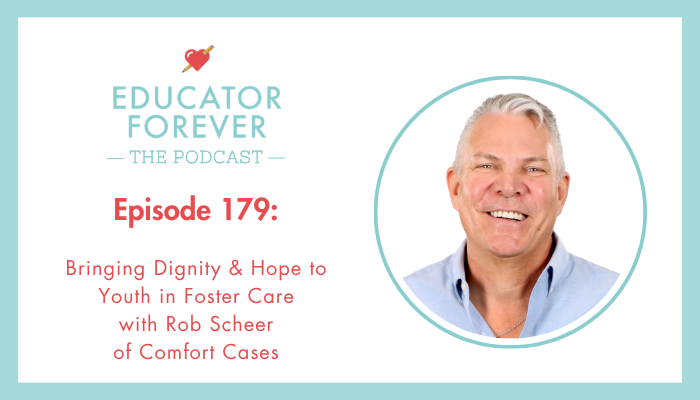
Rob Scheer is the founder and CEO of Comfort Cases, an international nonprofit dedicated to bringing dignity and hope to youth in foster care. His and the organization’s mission is clear: to eliminate the heartbreaking and dehumanizing practice of children being handed a trash bag to carry their belongings when entering the foster care system.
Since founding Comfort Cases in 2013, Rob and his team have distributed more than 300,000 backpacks and duffle bags filled with essential and comforting items to youth in every U.S. state, Washington, D.C., Puerto Rico, and the United Kingdom.
In this episode, Rob and I discuss Rob’s journey and how he came around to start Comfort Cases. We also get into the importance of education in the lives of foster children and how a teacher’s kindness helped him in a difficult time.
Topics Discussed:
The importance of dignity
Going from the corporate world to non-profits
The collective impact of small actions
Resources mentioned:
If you’re enjoying this podcast, please leave a rating and review on Apple Podcasts.
Related episodes and blog posts:
Read the transcript for this episode:
Welcome to Educator Forever, where we empower teachers to innovate education. Join us each week to hear stories of teachers expanding their impacts beyond the classroom and explore ways to reimagine teaching and learning.
Rob Scheer is the founder and CEO of comfort cases, an international nonprofit dedicated to bringing dignity and hope to youth in foster care. His and the organization's mission is clear to eliminate the heartbreaking and dehumanizing practice of children being handed a trash bag to carry their belongings when entering the foster care system. Since founding comfort cases in 2013 Rob and his team has have distributed more than 300,000 backpacks and duffel bags filled with essential and comforting items to youth in every US, state, Washington, DC, Puerto Rico and the United Kingdom. Rob's passion for this mission is deeply personal. He was once one of those children, a youth who was given a trash bag when he aged out of foster care at 18 and became homeless as a senior in high school. His journey from foster care to homelessness to becoming a successful businessman, advocate, father and leader is nothing short of extraordinary. Hi, Rob, so nice to have you here.
Rob Scheer 0:56
Lily. Thank you so much for having me.
Lily Jones 0:59
Well, I love what you've built at comfort cases. And can you tell us, what is it and how did you start it?
Rob Scheer 1:05
Well, first of all, I just want to say thank you. Thank you for giving us this platform. I say this quite often. No matter where I have the opportunity to talk about foster care, I'm going to take that opportunity. You know, my journey started actually in the 70s, when I actually entered foster care. I'm actually the youngest of 10 kids, and so, you know, knowing foster care as a young child, it had already been in our family, you know, teenage pregnancy, drug addiction, incarceration, you stick the F word in front of kids, and I'm not talking the dirty word, it changes their whole trajectory of the where they're going, and that was happening to me. And then in the fall of 84 I turned 18. I was a senior in high school, and I remember when I came into my home instead of them greeting me and saying happy birthday. Instead, I was handed my trash bag, and I literally became homeless. And you know, understanding that kids in foster care, we've only been given three choices. And choice number one, we give up. Suicide rate is higher than we have ever seen in foster care. Choice number two, we give in. We do exactly what you expect of us. We commit the petty crime. We fill the penitentiaries you know, Lily, as you and I are talking here today, we have close to 80% of our death row inmates were in foster care. If that doesn't tell you that that is a system that is completely shattered, nothing else will. Or we take choice number three, and that's give it all we got, and that's what I did. I joined the United States Navy. I became a very successful businessman, and I never looked back until 17 and a half years ago. These amazing kids behind me on the wall. They entered our home. All four of our first kids entered with a trash bag. And at that moment, I thought, as a society, we've got to do better. We've got to do better. So that's how comfort cases came to birth.
Lily Jones 3:09
It's so inspiring. And I appreciate how you took something that not only was your experience, but the experience of so many people, and really centered it around improving, you know, improving the experience, giving dignity, giving care, and I know so much about comfort cases, is about dignity. I'd love to hear from you just like, what is the impact of having dignity, having the lack of dignity when adults deal with youth.
Rob Scheer 3:34
You know the thing is, is that for me, as I watch my kids arrive, carrying that trash bag and seeing my daughter, who was four years old at the time, she's now 21 and she did not even, you know, have a decent pair of pajamas. And I remember that very first night Lily she had, Reese, had lied on the bed three night gowns that he had bought at Target, and she had walked over to her new bed, and she picked up one of the nightgowns, and she tore the tag off of it, and for the very first time that day, she turned around and she smiled at me, and I remember I said to her, I said, Maya, why are you smiling? And she looked at me and said, Mr. Rob, I've never owned a new pair of pajamas before. Not acceptable. It's not acceptable that kids come into a system because of a choice that someone else made, and we can't even give them brand new pair of pajamas. But for me, I wanted that to be different. I wanted children to enter the system and know that we see them, that we know that they're there, and that we understand that the small, little things that we take for granted are so impactful, and let me tell you something that people don't even think about. I met a social worker. She'd been a social worker for over 25 years. She came to me after I gave one of my talks, and she was crying, and she said, I've been doing this for over 25 years. She's like I thought I'd given all the love I could to these kids. And she says, and I'm so sad that I didn't think about the one thing that you brought up. And I said, what is that? And she said, the bar of soap. See, the fact is, Lily, I know for a fact how that bar soap makes me feel. I walked into a house of strangers. I was expect to use that bar soap. People expect kids in foster care to assimilate like that, and nobody understands what's going on in our mindset. You know, people that are watching this and your listeners, they go to hotels all the time. They walk into those new hotels and there's a brand new bar soap lying in that bathroom. And you know, as well as I do, if there was a used bar soap, they call the front desk and have their room move to a new room. It's called dignity, and that's what I want kids in foster care to have. So all of those essential items, their stuffed animal, their toothbrush, their activity, it's all the things that I just want kids to know I see them.
Lily Jones 6:03
It's so important all these implicit messages that we get right from the bar soap to the nightgown or the pajamas to the trash bag. And I think that kids, everyone internalizes these, you know what to expect, what their worth is.
Rob Scheer 6:20
Yes,and worth is, and that's something really we have to understand. First of all, people need to listen, there's no such thing as a bad kid. It's only a kid that needs to be redirected. That's it. They need to be redirected. And let me tell you something. As a dad of five and in 2019 I had we had met our fifth child. He was 18 years old. He had been in foster care since he was five. He'd been in 11 homes, six schools, and I met him giving a talk. Three months later, my husband and I asked him to move in with us, and a year after that, my husband, I legally adopted him. I say this quite often, every single child deserves a foundation. Every child deserves to know there's someone there rooting them on. Every child deserves to know what it feels like to be loved unconditionally. See, I never felt that, and I know that there are kids who are flounder floundering through the foster care system who have never felt unconditional love that has to change.
Lily Jones 7:27
Absolutely and I think bring this back to you know, I was a teacher. Most of our listeners are teachers. And as a teacher, I always thought that love was the most important thing I could ever give my students. You know, people ask about classroom management or instruction or anything. It's just love. It's just love and seeing kids for who they are, yes, and that they're valuable as they are.
Rob Scheer 7:49
And let me tell you something those teachers, people ask me all the time, how did I make it teachers? You know, I remember my memoir had come out, and I'd gone back to my hometown. Hadn't been back to my hometown since I was 18 years old, and I remember when my agent told me that I was going to my hometown to sign my book. And I was like, and I was like, I hadn't been back there since I was 18 years old, and he and so we pull up, and there's this long line. I was like, What in the world? And they were like, they're here for you. And I was like, so I go in, my heart is pounding. I'm like, I can't believe I haven't seen these people since I was homeless and and all of a sudden I hear this woman say, Robert, I always knew you would amount to something. And I looked up and there was my teacher, the teacher that she was my teacher when I was a senior in high school, she always had extra food, and I was homeless, and she she said, you know, we knew you were homeless, and we just didn't know what to do. And I remember she was crying and I was crying, but, yeah, it was a teacher.
Lily Jones 8:57
That's so beautiful. I mean, teachers are, I'm biased, but they're the best. The teacher instinct to help people and to see people and to take care of people when we can is so inspiring. I'd love to hear a little bit from you just about your experience growing up. You know, where education helped you and maybe even where it failed you?
Rob Scheer 9:19
Yeah, I have to tell you that education failed me. I don't know the difference between there, there and there. And I felt like, all right for you, though, yeah, I felt like that because I was a kid with a label that they just were trying to push me through school. They weren't really more. They weren't concerned about educating my mind, as much as they were concerned about just getting me through. And I think that that was a fail, you know. I think that, you know, maybe I should have failed, and maybe I should have been held back, or maybe I should have, you know. But I think so many people felt sorry for me that it was the reason why, you know. So even though I had great teachers. Years, I just didn't have a great learning experience. So, yeah, you know. And I say it to my kids now, you know, I tell my kids all the time, they have one job, that's it, and their job is to get an education. And I don't care whether that's through a trade school, through a college, they just have to get an education. And you know, that is their main job, and so, and then my husband. My husband is so opposite than me. We're celebrating. We just celebrated 21 years my husband freeze. He has his masters. He's like, all like, he's like, one of those people that his life is just all about education and and. But 16 years ago, he gave it all up to be a stay at home dad, and he's been at a stay at home dad raising our kids. And, but, yeah, you know, yeah, education, it's, let me tell you. I say this all the time. The way we're going to make our foster care system better is that we open up the education pathways for our youth who are in foster care. We must understand that education is truly what separates each and every one of us. And I think it's very, very important that we cannot wait till these kids are 17 to start talking about what their future is. We need to talk to them at the beginning. And their future has to be education based, it has to be the fact that we are not in the times when we could graduate high school and not have to worry about something higher when it comes to education, whether it's a trade school or something, we don't walk out of there like I did and was able to walk into the corporate world. So education.
Lily Jones 11:38
Yes, education and the seeing of possibilities, you know, I think getting kids to see that they have multiple possibilities, that there are so many things they can do. And I think that, to me, education is not just in schools, right? Education happens all over. And when you have this power of being able to learn, you have the power to really direct your own life.
Rob Scheer 12:00
I agree.
Lily Jones 12:00
Which is the best thing we can give students.
Rob Scheer 12:03
I agree. And I tell people all the time, you know, you have the opportunity to write your own life book. You get to write those pages. And so, you know, take that opportunity when you're in doing education that you really you know, I look at my daughter, my daughter's 21 years old now, and she's just now deciding what she wants to do, and that's okay. You know, she's just now deciding to go to community college. That's okay. I just want people to know that the world goes around not because of the axle that they tried to teach us. It's because of the doers that push it every day. Go out there and be a doer.
Lily Jones 12:42
Absolutely, I love that. And so thinking about teachers, you know who I think you said it very well too, of like you had these amazing teachers, and yet still felt like education failed you. I believe that, like our whole system needs a revamp, and that there are many well meaning, amazing, passionate, inspiring individuals working within this very flawed system. And so for those people you know who are out there teaching and maybe have students in their classroom who are in foster care, do you have advice for them?
Rob Scheer 13:13
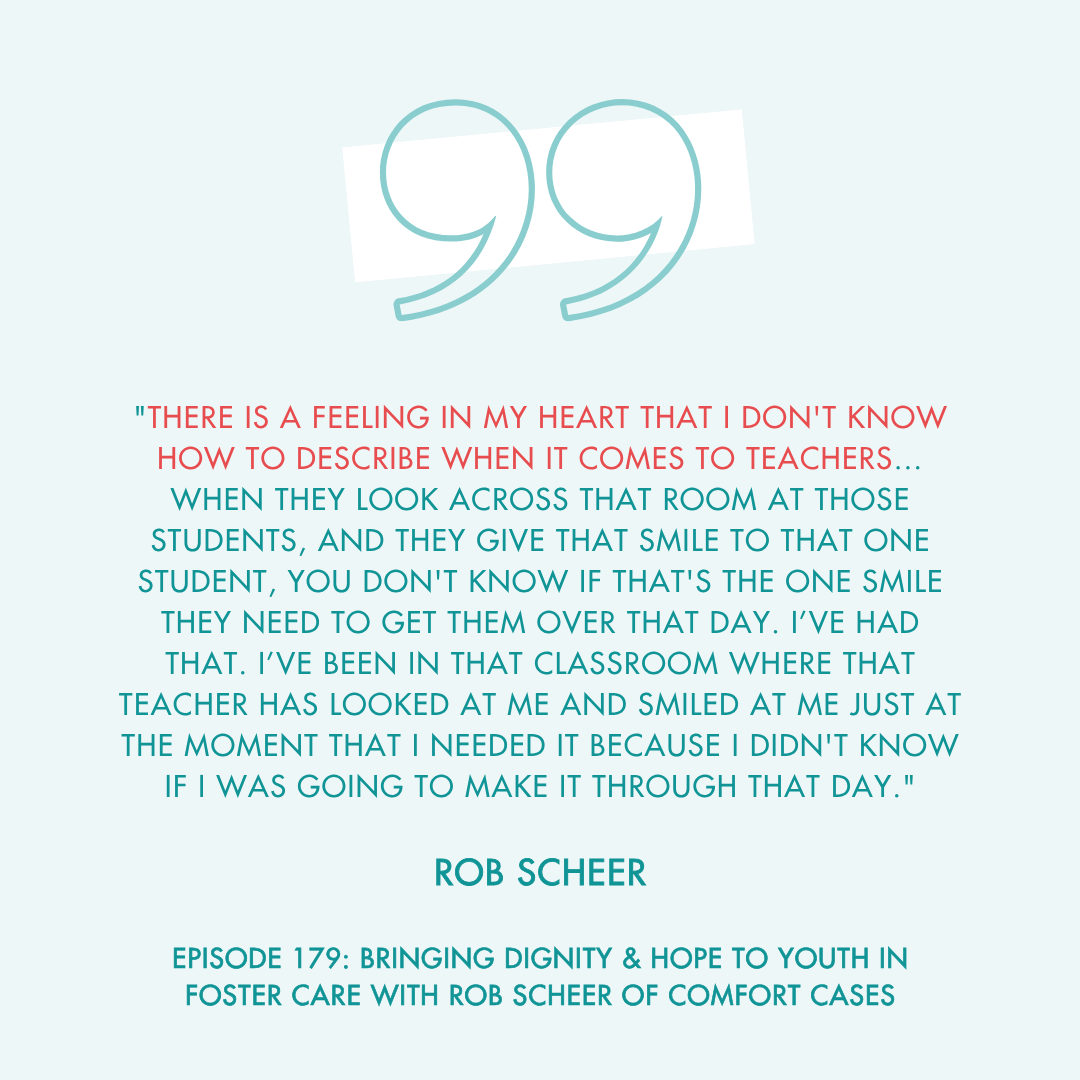
Yeah, I have to say this all the time, don't give up. You know, I will tell you there is, there is a feeling in my heart that I don't know how to describe when it comes to teachers, but I have to also remind those teachers is when they look across that room at those students and they give that smile to that one student, you don't know if that's the one smile they need to get them over that day I've had that I've been in that classroom where that teacher has looked at me and smiled at me just at the moment that I needed it because I didn't know if I was going to make it through that day. So again, you know, teachers first, they have to give themselves grace. Okay? They have to give themselves grace. We have been a society that have not supported our teachers the way we should. They are underpaid, under appreciated. But the thing is, is that's way it's always been. And but I have to say, teachers have our future in their hands. And so for that, I thank them.
Lily Jones 14:17
Yes, for sure. And so I want to shift gears a little bit. I love hearing about the your experience. I love hearing about your experience with teachers. Now I want to hear about your experience building comfort cases. No been Tell me.
Rob Scheer 14:33
So I come from the.com world. I'm a taker, and so being in the.org world, where we're givers, has been night and day, but so rewarding. I will tell you, I tell my kids all the time we don't do those European vacations as much as we used to, and, you know, you don't go to private schools anymore like you used to. But I will tell you, your hearts are full, and that's what it's all about. You know, I have realized, though, in the nonprofit world, that. Whoo, I thought banking was hard. Nonprofits just don't work well together, and that's sad, because I'm a true believer that if you pick that low fruit, your tree will grow taller, you know. And it's just sad because that's not what we're seeing with nonprofits. But yeah, it's definitely been a great eye opener, but it's also been so rewarding. And the greatest part, I don't have a job, I don't have a job, I have a purpose.
Lily Jones 15:29
Yes, yes, absolutely. And so thinking about that, we have a lot of educators out there who they feel like they have a purpose, and maybe they have something they want to build out of an experience that they've had, or they've seen a student have, and what advice do you have for them?
Rob Scheer 15:59
You know, I say this quite often to people, you know, follow your dream. Seriously, follow your dream. I can't even imagine if someone actually told me that I was not going to have a memoir, or, you know, have a an HBO documentary. I would have never said, yeah, right, that ain't happening. But now look at it. It's like, you know, follow your dream and realize that each and every one of us have an opportunity to make tomorrow brighter than it is today.
Lily Jones 16:30
Yes, and then following our dreams. I think sometimes it can feel so inspiring and often also daunting, right? Like I work with a lot of educators who are like, I have this dream, but I also need to pay my rent, and I also have this job that I have to show up with tomorrow. So do you have any advice about those first baby steps? Of like you have it in your heart you want to do this. You can't blow up your life tomorrow. What do you do?
Rob Scheer 16:53
So first of all, I will never forget when I walked into the house and told Reese that I was going to be a public speaker. And he was like, wait a minute, you do know that you're the breadwinner of this family? And I had been a corporate guy, and I had owned businesses and but I will have to tell anybody that's getting ready to make that change. And by the way, I made that change in my 50s. Okay, so we're talking this isn't somebody who was in my 20s and was like, Look, I built my career. I'm 28, years a successful banker, and now I'm walking into a room where I was not the, you know, know it all. I wasn't the the expert. And what I have to tell people, do it. Do it. Because I will tell you, it is the best rush. It is the most unbelievable feeling. And now that I look back, you know, last year, I spent 210 nights in hotels as a public speaker. So if that doesn't tell you, I mean, I'm on the road a lot, and I'm talking a lot and but you know, I don't I'm not bored. And, you know, I love it. So yeah, what I have to say, do it.
Lily Jones 18:13
I love that you said you were not bored too. Because I think there's something about mastery, of course, right? We do these things. We get really good at them. I'm sure you were an amazing banker, as you said, right? You mastered it in some ways. But that mastery sometimes is also boring, very boring. And so I think the fact of doing something new in your 50s or 60s or 70s or eight, you know, any, anytime, right, is inspiring. And something about being a human learning something new really gives us life.
Rob Scheer 18:44
Yes. And also, I think, you know, and maybe this could be for teachers too. I never thought about this until now. The thing is, is that with teachers, there's new students every single year. Okay, so there's something new for them, um, you know, even the US, they're teaching the same math and they're teaching the same English, but they're receiving new individuals, new, you know, blank pieces of paper, I should say, with these young people, same thing in my with my industry, is the fact that every day I meet new people, people that I didn't meet the day before, and people that, you know, I love it. Love it.
Lily Jones 19:26
It's so cool to hear about how this has transpired and what it's becoming. Do you have any visions for comfort cases in its next chapter that you'd like to share?
Rob Scheer 19:37
Yeah, you know, again, as I said earlier, education is truly the success for me when it comes to kids in foster care, and so we're going to continue to grow that in comfort cases. This year, we're giving out five scholarships to kids who are aging out of foster care. So visit comfort cases.org. Find out how you can be a part of our scholarship program. But we're also going to be expanding into cancer. Canada. And you know right now we're in the UK. We're in all 50 states, DC, Puerto Rico and the UK, and we're going to be expanding in Canada in 2027 we just got approved for our charitable license. Yeah, there's lots of expansion.
Lily Jones 20:15
Congratulations. And it's been so lovely talking to you. Can you tell people where they can connect with you
Rob Scheer 20:21
Sure. Go to comfort cases.org, you can learn about how you can be a part of this wave. And by the way, we're all pebbles, and if we throw ourselves in the water at once, the wave is so big, and that's what it is. The wave to eliminate trash bags and foster care.
Lily Jones 20:36
Fantastic. Thank you, Rob.
Rob Scheer 20:38
Thank you, Lily. Have a great day.
Lily Jones 20:40
You too Bye. Bye.
Transcribed by https://otter.ai