
Episode 168: Restorative Justice in Schools with Nicholas Bradford of the National Center for Restorative Justice
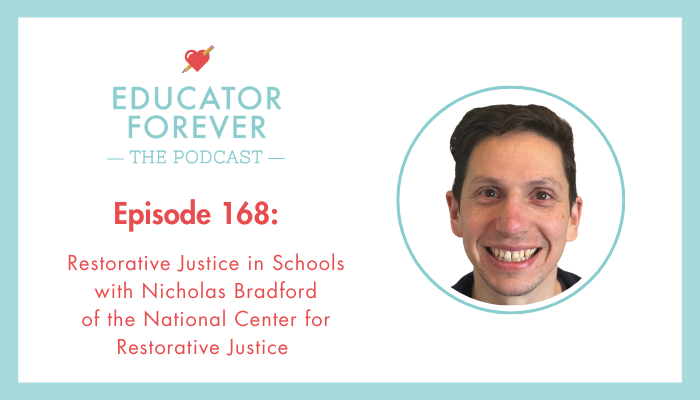
A lifelong educator with extensive experience in challenging students inside and outside the classroom, Nicholas Bradford started his restorative justice education in 2009 working in therapeutic settings. Having worked with hundreds of schools and districts, he has built a robust program that delivers a comprehensive Restorative Justice framework
Nicholas and I talk about how he began teaching restorative justice and the successes he’s seen in the classroom after providing it, especially in discipline rates. He also gives some good tips on starting a consultancy!
Topics Discussed:
Writing a book
Properly providing Restorative Justice education
Providing time for students to socialize
Resources mentioned:
If you’re enjoying this podcast, please leave a rating and review on Apple Podcasts.
Related episodes and blog posts:
Read the transcript for this episode:
Welcome to Educator Forever, where we empower teachers to innovate education. Join us each week to hear stories of teachers expanding their impacts beyond the classroom and explore ways to reimagine teaching and learning.
A lifelong educator with extensive experience in challenging students inside and outside the classroom, Nicholas Bradford started his restorative justice education in 2009 working in therapeutic settings, schools after school, programs and justice settings has shaped a skill set that delivers a comprehensive restorative justice framework. Having worked with hundreds of schools and districts, Nicholas has built a robust program that gives schools, educators and students the skills and structures they need to create a culture of belonging and success in spite of conflict. Welcome, Nicholas, so nice to have you here.
Nicholas Bradford 0:31
Yeah, great. Lovely to be here.
Lily Jones 0:33
So I would love for you to start off answering the same giant question I ask everyone, which is to tell us about your journey as an educator.
Nicholas Bradford 0:42
My journey as an educator, I mean, really starts as a kid my mom, I was, think I was in fourth and fifth grade when she was well. Before that, she was going to school, she went to went to get her teaching license as a, you know, a parent of two little children, and my mom started teaching at my school, in elementary school. And, you know, a lot of kids sort of just grow up in that sort of space with, like, what, what are the jobs that you can do, or the jobs that you see around you? My mom was great, and she really enjoyed her work. And I spent a lot of time after school in schools, you know, in her classroom, and looking, you know, as a middle school student, looking at her elementary classroom, and sort of just seeing the kind of interesting things. And then, yeah, I sort of had the idea. I was like, I want to be an educator. It's like, sort of the thing that I was going to do for a really, really long time. And I moved to Montreal, Canada, unbeknownst to me, a French speaking area of Canada, different rules, all kinds of different things. So I was commuting across the border into upstate New York and Vermont to obtain my teaching license. After after spending a while in school and some deployments, I was in the Coast Guard Reserve, and had some really great educators there, actually, who were kind of reservists, and nobody was really influential in my life, both professionally in the Coast Guard and also as a as a teacher, as an educator, but I ended up getting my certification in Vermont and worked with kids who have some, you know, behavioral challenges, alternative setting, some kids who, yeah, just struggled, and in many ways, you know, kids that weren't that different than me as a kind of a kid, with some special learning challenges and some health challenges as little as a little guy. And yeah, so that was in 2008 I got my license. I've been teaching, substituting beforehand, sort of doing the process to get licensed in New York and in Vermont, but really working with those kids, that's where I got sort of connected with restorative justice. And outside of the school, I got connected with restorative justice. And those two things sort of marrying at that time, 2008 29 2010 really, sort of galvanized my work and sort of my trajectory, sort of moving out, out of the classroom into this work, and really focusing on on schools as a place where we can be better with conflict, we can sort of be more engaged as both in the classroom and in the school building and sort of in the broader community. So that's what brings me here.
Lily Jones 3:20
Yeah, so interesting. So talk to us a little bit about how did you get introduced to restorative justice, what resonated with you and how you started bringing it into the classroom.
Nicholas Bradford 3:30
I just saw kids who were really struggling to do the right thing, and also as an alternative setting, we didn't have a good system that allowed or encouraged or kind of maybe lightly demanded that young people take responsibility for our actions and so us as alternative educators. Generally speaking, the people that I run into, I work with a lot of comforts of high schools as well and traditional sort of settings, but the alternative educators that I have met across the country are just really profoundly caring about students and and how do we do that in a way where we're recognizing the harm that young people have caused in their sort of previous environments, or whatever happened to get them to an alternative setting? That was my my struggles, like I care about these kids, and that thing that you did was wild. Thinking you did was like, real scary for some people. And so that was a hard thing for me. And so when I started volunteering in a justice setting, these were kids who had charges like tickets and very low level stuff, very low level stuff. And I saw a way in which we could do the two things at the same time, which is really like, care about kids and nurture the relationship and make space for accountability. Those are the sort of the grappling things that I was struggling with. And then I saw a system in the. Justice system. I was doing that really, really well. I met a really a bunch of really interesting people, Don Kidd, Don mcfarter, some other folks in the in the community in Vermont. And this is really great. How do I then I just started continuing to think, like, how do I do this more in my classroom? How do I do this more in health program? And I came out to Washington, you know, moved back to Washington, where I'm from, and got my master's in education policy, really focused on restorative justice, and then doing this work since, ever since, since 2012.
Lily Jones 5:30
So cool, and that's great to hear. You know, the inspiration for and how you took it and transferred it, and I know that you've taken it even further now and started the Center for National Center for restorative justice. Can you tell us a little bit about why you decided to found that and what it offers?
Nicholas Bradford 5:46
Yeah, we're actually at 10 years now. This is our 10th year. October will be our 10 year anniversary. So I'm very excited about that. My wife and I sort of met at the same time, so it's serendipitous. Anniversary. Yeah, exactly double anniversary in that sixth year. Yeah, I just found that there wasn't a lot of work happening in the school in an organized way. So restorative justice kind of comes from the justice system. There's a lot of systems and organizations and folks doing really powerful, interesting work in the justice system, whether it's kind of juvenile, you know, kind of diversion programs, peer mediation programs, to some degree, and it kind of happened inside schools, but kind of even the bigger stuff, what we call victim offender dialog, where you have people who are incarcerated spending, you know, the case that I'm working with right now, if A guy's been in for 25 years and murdered somebody, and we're trying to facilitate the connection and healing of the family member, his sister of the man that he had killed. And it's 25 years later. So that big stuff really well served. There's, like, lots of state organizations, there's lots of other kind of groups, and the training is really organized, but I didn't see it happening in the education system and being educator and then so just right in 2012 getting the classrooms working with teachers that I probably shouldn't have been working with, principals who gave me a lot of trust, that I really Like look up to and have relationships still today from 10 years ago, they really Yeah, set me on a path and but quickly I realized that the traditional restorative systems are insufficient to deal with sort of the classroom challenges, because the vast majority of harm that happens inside of school, inside a classroom, isn't the fight, isn't the kid who brings a gun to school, isn't the kid who makes a threat, the bomb threat. You know, those happen, and we need systems to deal with those things. And I think it's like schools partnering with external organizations is the best approach for those things, but the vast majority of it's really like kids being mean to each other, kids not turning in their homework and coming to class late, having their headphones in, not responding when the teacher is asking, Hey, could you put your phone away? Could you put your phone away? Could you put your phone away? Like that kind of stuff. And so while we have the big systems of a restorative conference for fights, for, you know, gang violence and bomb threats, those are important, but we also have other systems in place for classroom misbehavior, the little stuff, big group conferences that don't take a lot of time, but can really be a really good reset, and then what detention could look like in a really important, what we would call restorative, relational kind of approach, that that kind of batches, this mid level stuff, this sort of like repeated misbehavior, that kids aren't getting the class on time and are like, how many times they're going to tell you in the hallway to get to class before you we do something about it. And so that's where we come in. Is like, yeah, we've got systems to help folks, yeah, address the little stuff and the mid level stuff, and also the big stuff too, whether kids are getting expelled for 20 days or, you know, half a year and they're coming back like, yeah, totally, yeah.
Lily Jones 9:10
It's so helpful. And I think thinking about our educators out there who might want to start using restorative justice in their classrooms, it can feel overwhelming, and it can feel like, how do I even get started, especially if your school maybe isn't aligned to it. Do you have any advice about how they could get started?
Nicholas Bradford 9:24
I think, I mean, well, the easy stuff is like, hey, come to us. We've got some, like, really simple online courses. We've got some workshops that happen, like, you know, hour and a half kind of after school conversations that happen online. Those are great. We have big trainings, and we've got like a five, five day graduate level course. So if you want any of that, like, go to our website and do that kind of stuff. But I think when I talk about implementation, I think about as a school and even as a classroom, like, where are your frequent problems and then what things are easily accessible? Like, what things are actually like possible to kind of get the things moving in the right direction. So when I look at like, the the ease of the system, drugs and alcohol, those are harder, for sure, they're just way harder to understand, for young people to understand that their actions are impacting other people in the community. It's way, way harder for them to get that than it is for like, a fight, super easy. Like, there's obviously, like fights, like, give me fights all day long, because they're so simple for us to, like, really grapple with. These two middle school boys have gotten to a fight in a in a classroom, and the assistant principal, she was great, and she walked me through this process where they sort of understand the unpack, I didn't want to fight you. My friends told me that you wanted to fight me, and I had to fight you first. And he says, I didn't want to fight you. My friends told me that you wanted to fight me and I had to fight you first. Like, this is little middle school logic, right? It's like, but that kind of stuff is so powerful when done with a restorative lens, and then you can really have meaningful, actionable pathology, like you can do the work that not just kind of captures it for those two boys in the office, but actually translates that learning to other spaces in my classroom, hopefully in the school, hopefully certainly that classroom and that teacher, but also like, yeah, where else can we send these boys To talk about peer pressure? Because that's what we're talking about. That's where they got, you know, kind of off track, is the peer pressure. And so how do we help them, kind of teach other kids?
Lily Jones 11:31
So yeah, that's great. That's super helpful. And I think thinking about all those great resources that you have, I know you also have a book that you wrote, a real world guide to restorative justice in schools. I'd love to hear more about the book, and then after that, I want to hear about the process of writing it.
Nicholas Bradford 11:49
Yeah, the book the real world guide to restorative justice in schools. Yeah, it was a journey. I'm not a great writer, and a lot of credit to my co author, David LaSalle. We met in he was one of the first people that I really connected with in 2013 maybe he was at a Big Picture school. And the big picture schools are kind of alternative settings, schools of choice. He and I got along really well. He was doing this work. He actually moved out from from Washington, moved back to to New York, with a dean of a sort of Dean out there. And together, we collaborated, kind of, taking the training that I have been offering folks to some degree in the framework that we offer, translating that into the written process, the word that people can just like, read and pick up. And then we also incorporated, so there's the theory piece, and then there's the practice, which is like, this is what you can do. This is how these things actually, like both work, kind of by the numbers. And then why those things work? Why those systems work to improve school culture and climate and reduce the frequency and severity of harm. And then the third part is the real stories. So David was amazing and interviewing a bunch of different educators and teachers to kind of learn hear their stories about you know, this incident happened, and this is what we did, and this is how, you know, we both could have done it better, but also, these are the positive outcomes that we do have from that. And I always think, like, I get on ourselves, like, as you know, facilitators, all of my my team and the people that I work with in schools, like we could have done it this way and differently. But while I'm always, like, trying to do or sort of justice better, like, I really want to think about, like, yeah, we are really improving, like, school culture and climate, this school that I'm working out in Minnesota, like, just, just an amazing group of folks, really rural community, small school, small high school Of like, 900 students, but their discipline rates, their frequency is dropping over the last year and a half. By I can't even remember the numbers. It's like 80% it's remarkable. They have, they have almost no hallway challenge, like behavioral challenges, of like pushing kids into classrooms. Kids are actually in the classrooms. They're not paying out in the bathrooms anymore. Some of their security staff, and they're sort of culture people are really, like, trying, like, Yeah, I mean, it's, it's remarkable. We're like, walking through the hallways, and, you know, two, three minutes after, after the bells run, and then kids are in. This is, this is really amazing. And some schools over here in Tacoma that we worked with, you know, big drops, 50% drops in, out of school, suspension, year over year to like, this is not just a single year. This is like, year over year. And then you get to a point where you're like, great. Now we're now, we have the bandwidth to really sit in conference with kids. Place to really engage in some really bigger work. So, yeah,
Lily Jones 15:05
that's so cool. I mean, what great outcomes too? I'm asked a really big question, which maybe it's hard to answer, but maybe it's not about what what do you attribute those outcomes to? I mean, I know the power of restorative justice, but when you think about these things, of like, the hallways clearing out, or suspensions going down. Those are outside of, like, some of the moments where we might think about working with students directly. So what, how is the culture shifted? I guess is what I'm asking from restorative justice.
Nicholas Bradford 15:29
I mean, a lot of it is, it's right, it's like, about the culture. And this is what we do here, the US. Are we language that restorative justice can really embody, like our expectations. What we do here, how we handle our problems. What we do is we take responsibility for action. We all make mistakes, and we try to repair those mistakes, having so one of the things about the hallways is that young people really, you know, like, rightfully so, like, developmentally properly so, like, absolutely care about their friends, and they want to talk with their friends. They want to, like, spend time with their people and without the sort of adult like, kind of pressure, like, do this thing. And so when we give young people opportunities in classrooms to talk to with each other, curriculum aside. When we can give them the opportunity to talk with each other, they don't have to take it from class, right? Then they know, like, I can say, like, really authentically to kids, like, absolutely. I know you validate the experience of like them wanting to talk to each other. I understand this is important for you. I get it you are going to have time today in this class, or the next class, or whenever, to talk with your friends, right? So, like that, really kind of and actually having those circles in practice in school, like they need that reassurance that they're going to have time. And I think one of the things my experience, you know, historically, has always been in high schools and middle schools, but having worked with some elementary schools in the last five years or six years, it's really interesting to see kind of the pressure that we put on young kids, second, third and fourth graders to transition from their desks to the carpet for a circle to do that transition quietly, and when, in fact, like, we can actually use that time as a way for young people to connect. So we don't have to either both put thumbscrews on kids to, like, keep them quiet, or just like, yeah, they want that time. And so it damages the relationship. If we're so intense about Be quiet all the time, Always follow directions. If they don't have that sort of extra time, that extra space, they sometimes will just demand it, right? There's just like, so, so intense about that, and that's that's a struggle. And so I think that that's part of why the schools that we work with and schools that implement well, to have a kind of a kinder, more engaged climate. And that's really what this is about, is like that from from my perspective, like we have to drill down on the expectation that the mission and vision of schools is that this is a place of educational excellence for everyone, and we're here for that. And if we can dial up the engagement through restorative practices, that's great. That's a win.
Lily Jones 18:37
100% Absolutely. Yeah. I mean, that all makes total sense to me. And I think it's like, you know, so many things about schools are just compliance based, and they don't honor kids or teachers, you know, in their full humanity. And so I think a lot of it is also like looking at these practices just like you're saying, like kids want to connect with their friends. There's nothing wrong with that, right? They just need an outlet and a place to do that. And so looking at these things through a broader lens, and thinking about, how can we actually see these people, students, teachers, and get their needs met in a way that works for everyone? So So thinking about, I want to shift gears a little bit to starting your own organization. Can you talk to us about just what that process was like, I know for me, like going from a teacher to running a business was like, what's happening? You know, so many things to learn, right? I taught kindergarten very different. Love to hear from you about how that experience was for you and any advice you could have give to educators who might want to start their own thing.
Nicholas Bradford 19:37
Yeah. I mean, I meet with folks regularly who are, you know, kind of on this journey of restoring, starting a restorative consultancy and things like that, and other smaller, medium sized organizations that are doing this work. It's, it's challenging. You know for sure, it's easy to sort of to kind of get the first 20 to $40,000 in contracts, but to. How do you scale? How do you get health insurance? Those are, those are harder things. Those are much, much harder things. Some simple advice, like, start to collect emails. I mean, emails are like, precious. It's remarkably like, yeah, you've just got to continue, and you're just doing a bunch of outreach, trying to collect, connect with people who are similarly situated, who are kind of interested in doing this work. I think the challenge is for teachers who are getting out of the classroom. I mean, it's certainly a very different style of work. It's just kind of a constantly on, sort of like, I'm all up, I'm doing new things all the time, which is really, really interesting and frustrating in its own right. So they're very, very different in kind of the churn of getting new people in, new connections, new relationships. But yeah, I think the thing that I think has helped our organization is really having a pretty laser focus on K 12 education in conflict. So we don't, you know, we don't do social emotional work. We don't do a lot of equity work. There's a touch point there that we do. We're not writing curriculum for reading lessons or anything like that. You know, in the sort of work, we're not doing direct service with kids who have adjudication, you know, like, we are really focused on schools. Me and all of the people that are on my team are former educators or have been very closely related with schools for a very long time. We have one person who's amazing but never was actually a teacher in a classroom, and it's like, oh, man, but so whatever your sort of Jan is, right, whether it's like, literacy and then reading coaching, like, Great, let's stay there and you're going to get pulled. I think people often get pulled. There's like, a little bit of like, Oh, hey, could you do this thing too? And you're like, Oh, sure, I could do that too. And that's actually, like, sort of detrimental both to your brand and the efficacy of your work.
Lily Jones 22:02
Yeah, great advice. And I think it's hard, yeah, especially if, like, when you're starting off and being like, Sure, I'm saying yes to everything, and then you're like, Wait, what is my business? Right? Like, it's so scattered. So I love that focus, too, and it's good for everybody, right? Like, it's not good for a person to feel scattered in their business as well. Yeah, totally. So Nicholas is so great to talk with you. Can you tell folks where they connect with you?
Nicholas Bradford 22:25
Yeah, LinkedIn is great. Nicholas Bradford is my handle, I guess, or the National Center for restorative justice.com and see for rj.com on LinkedIn. We're on LinkedIn as well Facebook. We have a small presence on Facebook, but really our two best spots are LinkedIn or our website. You can join our newsletter. We do have a new network through mighty networks. So if you're interested, if you're on a mighty network already, just search for us and see for our J network. We'd love to get folks who are really either educators who are interested in restorative justice or restorative justice, or restorative justice folks who are doing education type work. That's our sweet spot. We've got a lot of principles on here, and yeah, we're just trying to have these daily conversations about what's the implementation look like. Where do we start? How do we sort of troubleshoot this, this situation that happened? So that's where you can find us.
Lily Jones 23:18
Awesome. We'll put the links to in the show notes as well. Thanks so much.
Nicholas Bradford 23:22
Thanks, Lily, you.
Transcribed by https://otter.ai