
Episode 189: From Antiracism to Abolition with Abby Emerson
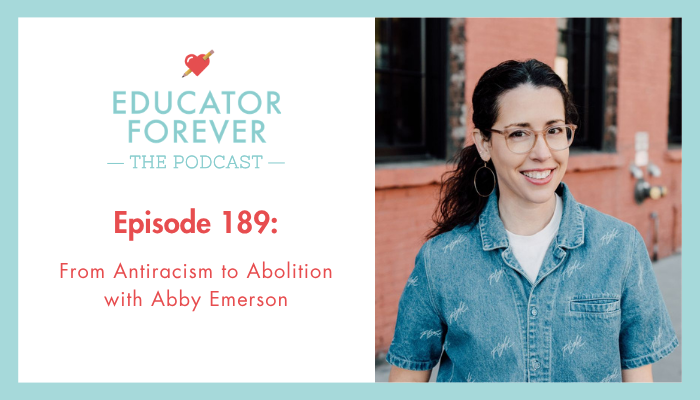
Dr. Abby Emerson is a former fifth-grade teacher and now an assistant professor of childhood education at Hunter College at the City University of New York. She is the author of the book From Anti-Racism to Abolition: Professional Learning for Liberating Schools, coming out this fall for educators who are curious about how to better use professional development to work towards racial justice in schools.
Abby and I take this episode to discuss seeing structural racism in our education system, among many other deep topics. If you want to see racial justice in education, you’ll want to tune in.
Topics Discussed:
Revising curriculum to be anti-racist
Individual practices versus systemic change
Starting with small changes in the classroom
Resources mentioned:
If you’re enjoying this podcast, please leave a rating and review on Apple Podcasts.
Related episodes and blog posts:
Read the transcript for this episode:
Welcome to Educator Forever, where we empower teachers to innovate education. Join us each week to hear stories of teachers expanding their impacts beyond the classroom and explore ways to reimagine teaching and learning.
Dr. Abby Emerson is a former fifth-grade teacher and now an assistant professor of childhood education at Hunter College at the City University of New York. She is the author of the book, From Anti-Racism to Abolition: Professional Learning for Liberating Schools, which is a book coming out this fall for educators who are curious about how to better use professional development to work towards racial justice in schools. Welcome, Abby. So nice to have you here.
Abby Emerson 0:24
Thank you for having me. It's nice to meet you and see you here on this beautiful day.
Lily Jones 0:30
Yes, same to you. And so I always start with the same gigantic question, which you are free to take in any direction you want, which is to tell us about your professional journey.
Abby Emerson 0:41
Yeah, yeah, so let's see, I'm, you know, as a kid I grew up very interested in, I was the older sister in my household, so I grew up very interested in, I guess I would say, quote, quote, leadership of certain kinds in education, so I did you know, babysitting and camp counselor kind of stuff when I was younger, but I wasn't so sure about education. I was, you know, it seems kind of maybe something teaching was maybe something I was interested in, but then when I was in college in Philadelphia, I started to kind of think critically a little bit more, and think about how education could be used as kind of a tool for liberation, or I, you know, specifically got very interested in racial justice, as you know, a possibility through education in college, and then I moved to New York City right after to do a master's in elementary inclusive education, and then I taught in elementary school in New York City for 10 years before both in charter and public schools, based on hiring freezes and whatnot, and yeah, as always, there's always something going on with education budgets, and then I left the classroom after about 10 years to switch into higher ed because I was, I think, interested more at that point of working with new and future teachers, and you know, thinking about the big questions of what is teaching, what is education, and you know how to support the people that are trying to also think about those questions, too.
Lily Jones 2:24
So, interesting. Yeah, I appreciate that. I definitely had a phase after teaching, too, where I coach teachers, and it was so interesting having that lens of being like, oh, what have I learned as a teacher? And so, what was that transition like for you, moving from classroom teacher to then moving to higher ed and working with beginning teachers.
Abby Emerson 2:43
Yeah, I mean, some.. I think parts of it surprised me. So, coming from elementary, I never thought I could teach middle or high school. That seemed just.. I don't know, it just seemed too specialized, you know, content area wise. It just wasn't quite my interest, but what I, what surprised me was that so much of what I learned about teaching as an elementary school teacher absolutely carries over into older grades, or now working with, you know, young adults, basically young people, you know, of course, certain, you know, pedagogies are going to change, and whatnot, but that, like, the underlying beliefs of how do we learn together that that holds up for me, even you know, even when working with young adults. So that was kind of one of the big surprises, and a pleasant one in that jump.
Lily Jones 3:37
Yes, amazing. And so I know that you wrote a book, Congratulations, from Anti-Racism to Abolition: Professional Learning for Liberating Schools. Can you talk to us about what the book's about and what led you to write it?
Abby Emerson 3:52
Yeah, so during my teaching years, I mostly taught fifth grade. I worked at a few different schools, and I think a couple of the schools I was going to say all, but it wasn't all, a couple of the schools I worked at have were providing us teachers with, you know, I guess what we could call, and what I mostly call in the book is anti-racist professional development, so it's basically PD that talks about race and gets teachers to think about, you know, how does race show up in our school? How does race show up for our students and for us as educators and whatnot? But what I found is that the schools I worked at, and what I heard from other friends at other schools, is everyone was approaching this in a different way, right? It was kind of like the wild wild west, I, you know, I kind of joke a little bit, where people were just kind of trying things out, because usually there was, you know, one or two passionate school leaders, maybe, that felt like, oh, this is something important for us to talk about as a staff, and sometimes it went really well, sometimes it went quite poorly, you know, so I found myself. Self, just really curious of like what's the good, bad, and ugly of like what's happening in schools, and I just noticed that, you know, colleagues responded in really different ways. Some people were so like rejuvenated and felt really excited to talk to their colleagues explicitly about like how race and racism show up in their school settings, but for some educators that was like a very new and scary conversation too. So I just found that whole orbit like very interesting and fascinating, and so yeah, that's why I ended up kind of going into research and ultimately writing this book based on what I learned of what are schools doing.
Lily Jones 5:44
So through the process of writing the book, you talk to educators and leaders at different schools to kind of find out what they were doing?
Abby Emerson 5:52
Yeah, exactly. I spoke with, I believe it was in the end, 28 educators, and many of them, you know, had been in different schools, so I ended up learning about more than 30 schools, and just kind of was like, what did the PD look like? What did you talk about? You know, who led the PD? How did people respond to the all of that kind of just to get a feeling of what work was happening, and what work was feeling really helpful for people, but also what work maybe was feeling less helpful too.
Lily Jones 6:26
Yes, I can imagine the wide range you came across, and I'd love to hear more about your findings. I mean, I'm particularly interested in what was working well, but I guess also that's like a warning sign of this may seem like a good idea, but didn't work so well.
Abby Emerson 6:42
Sure, yeah. So I found that basically three things were happening, and this is, you know, kind of in one of my, like, I believe chapter two of the book, but there were three things first in these sessions, and it might not be all at once, right? And some schools did some of these, more than others, some schools didn't do one, and then their teachers were really critical of that, like, why are we not doing this, right? But the three things were, the first was, they were getting educators to understand structural racism, right, in this country, too often people think of it as like an individual bad apples thing, right, but getting them to understand, like, no, it's bigger than just you and me, and our good intentions with students, but we're in this system, right. So that was like kind of one of the first goals. The second was there was space for that individual piece. Yes, there's the systemic piece, but also, you know, who am I, and like who are my students, and what does that mean when there's maybe a racial difference between us, right? What are our interactions? How am I interacting with families? How did I grow up, and what were the values I was taught in my community, right? And how is that maybe different or similar to my students? So there was space for that individual kind of reflection. And then the third piece, which happened sometimes, but not all the time, but if it didn't happen, teachers were not happy in places, was curriculum revision, where you know, okay, we've learned about structural racism, we've thought a little bit about who we are, but now let's actually make these, make some changes, right. I'm going to update my units to be reflective of my students, or I'm going to, you know, change, you know, the book we read during, you know, XYZ unit. And so that sort of curricular change work was kind of the third, the third piece, and all of them proved to be important, you know, for sure, but educators also had two pretty big critiques as well about the PD, which the first was they felt a lot of the teachers I spoke with, in particular, felt like, okay, we're having this PD, we have those three things happening, I'm learning stuff, my colleagues are learning stuff, but at the end of the day, the relationships we have with students are not changing very much, and specifically around kind of behavior, discipline, you know, they still felt like teachers are still interacting, or or administrators too, not just teachers, right? We're interacting with students in pretty punitive ways, so they're like, okay, I learned about, like, you know, the history of structural racism, you know, in my community, but now at the same time we're still kicking so and so out of class every day, so what are we doing in those, you know, relational moments to kind of do something different, so that was a big concern from people, and so a space for the PD to grow and do otherwise, and then the second big kind of concern that basically everyone expressed was that the PD was not really like we. Know that, as I said, we know that racism is a structural, a systemic kind of concern when it comes to schools, but the PDS were very about individual teachers and individual practice, and you know, my individual curriculum, and there wasn't as much of a structural look at the school level or principals echoed that same concern, where they said, oh, at my school we're doing cool stuff to, you know, be anti-racist or whatnot, but my district is doing nothing, right, and so there was this very individualized approach at the end of the day, and so people had some, you know, real concerns about that kind of limitation of what the way PD has been enacted.
Lily Jones 10:49
Yeah, that all feels relatable. Teachers being like, I need some time to actually implement this into the practicalities of my classroom and the curriculum and my individual students to grappling with, which I think there are so many things, you know, that on a structural level really need a lot of work, and then individuals doing great work towards these things, and grappling with, you know, how much you can change individually versus on a structural level.
Abby Emerson 11:20
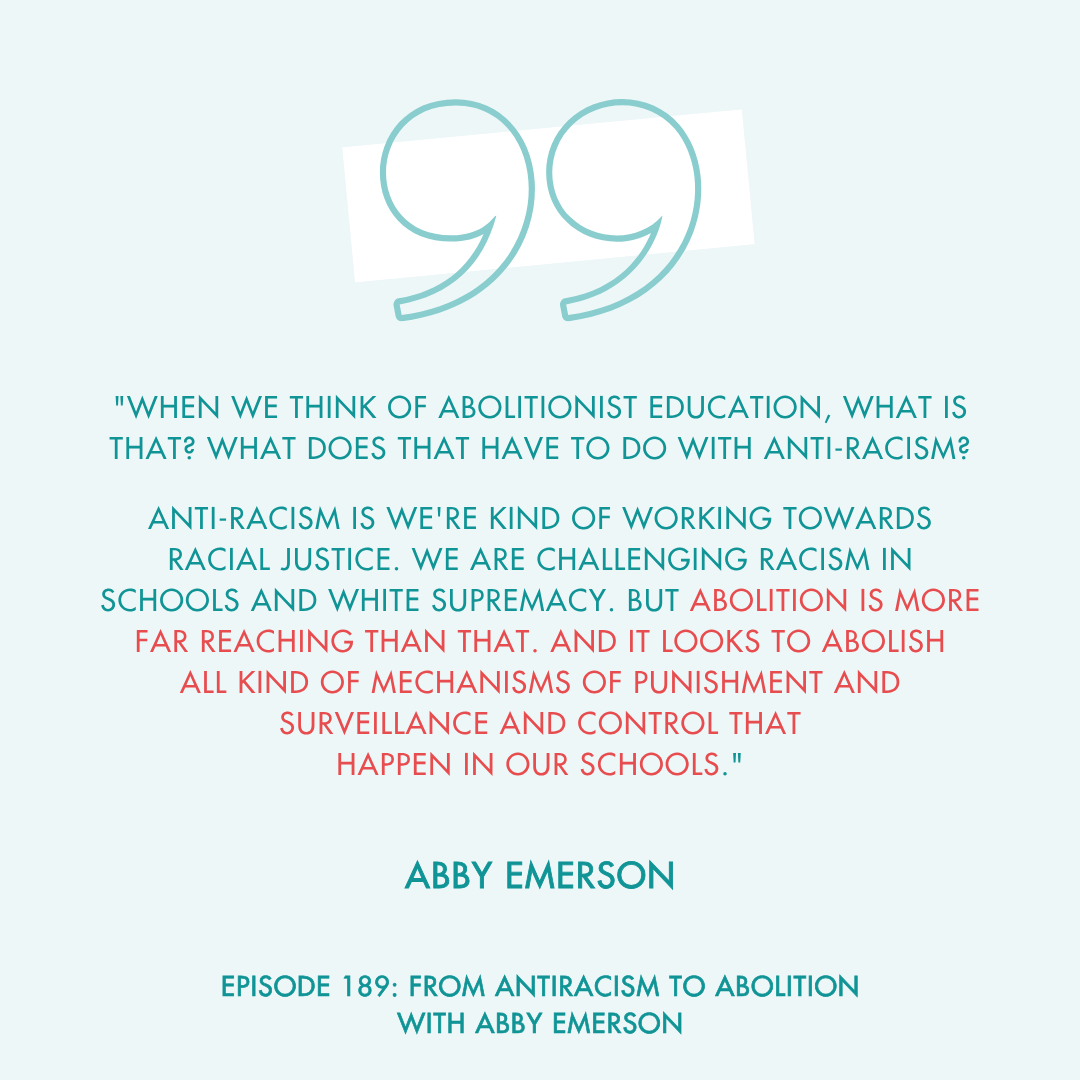
Yeah, exactly, exactly, and so I did find you mentioned wanting to hear about some, you know, hopeful moments. Unfortunately, they were outliers, but there were a couple schools that I would say were tackling those two kind of concerns in different ways, where they were saying no, we want to relate to our students differently, you know, we want our students to have a different experience with us as educators in that day to day interactions and whatnot, and we also, we want to make change within our school that's far reaching and is not reliant on kind of, you know, an eager or well, you know, good intentions, you know, teacher as an individual, but something that as a school we are collectively working towards, and so in the book I've found the the concepts of abolitionist education really very generative and supportive with that, and so in the book, kind of, that's what I suggest, is this idea of anti-racism is maybe one star in the constellation of kind of abolition, and abolition is a broader idea, right, which many, you know, it stands on the brilliant minds and organizing of many, many different people, but, but Tina Love is kind of one of the bigger names that has kind of brought some of those ideas a little bit more into, into schools and classrooms, and the vocabulary of teachers, and but she also stands next to and works with, and you know, stands on the shoulders of many other folks, right, who also have shared those ideas, and so when we think of, okay, abolitionist education, and what you know, what is that? How does that, what does that have to do with anti-racism, right? Anti-racism was, we're kind of working towards racial justice, we are challenging racism, right, in schools and white supremacy, but abolition is more far-reaching than that, and it looks to abolish all kind of mechanisms of punishment and surveillance and control that happen in our schools, so when we have a classroom, you know, I heard about a school where they did actually really cool stuff, where they had a, they had a room in their school that was called the responsibility room, and it was meant to be a space where kids could go if they needed a break, they needed like a moment to kind of, you know, recalibrate before they rejoin the learning, but what they found over time, which is maybe not a surprise, right, is that the students that were being sent there were the students with disabilities. It was the black and brown boys who were being sent there, and that started to not sit right with the school, and they said, you know, we need to do something about this, and so they really took up the abolitionist education framework and said this thing, we need to dismantle, we need to get rid of it. They actually, on their path towards abolishing the responsibility room, did take a little pit stop at reform, where they tried to make it like kind of a more like mindfulness space and rebrand it a little bit, but they realize what many abolitionists talk about is that even if you do it in a gentle way, if you are still constantly excluding and punishing the same kids, even if you have a smile on your face, and you're using, like, oh, you're just taking a break at the end of the day, it's the same result, which is that that kid is not in class learning, and so they about. Abolish the responsibility room, but at the same time, and what abolition asks is they built up other alternatives, more humane, supportive alternatives, though, so that students and teachers in the classroom could thrive, right? So they built up, you know, it's not novel to do calm corners, or, you know, all of those things anymore, but they really invested a lot of kind of effort to make those something that actually worked, because I think sometimes those things don't really work, so they're like, How do we make it so these work, so that we don't feel a need to send a kid out of the classroom to go to the responsibility room, and so they really were trying to, you know, they did do some cool stuff by, you know, building supports and getting rid of the harmful stuff in their building by relying on these abolitionist ideas.
Lily Jones 15:52
That's so inspiring, and I appreciate that example too. I also appreciate how you lad as, like, anti-racism as a star in the abolitionist constellation. Like, what a nice way to think about it, and yeah, thinking about all the ways that we have exclusionary practices, and you know, basing schools on compliance, and all the many things that come from that. I mean, I think there's just so much to unpack there, and so I want to go back to our individual teachers, though, you know, who are maybe trying to do some of this anti-racist work or abolitionist work, and within schools, maybe that don't even have PD or a focus on this. So, do you have advice for them?
Abby Emerson 16:35
Yeah, so one of the things that I asked a lot of educators, because I was curious of, like, well, how did your school start this work, like, what you know, and whatnot, and quite a few of the schools told me about how it did start with, like, one or two educators, you know, classroom teachers who kind of, you know, planted some seeds in different ways, right? I heard about one school where it was, I think, just two teachers who were, I think, were friends, and they were like, "Hey, let's read this book and talk about it, and they, you know, they met in one of their classrooms, and then one day another teacher friend was like, "Oh, what are you guys doing? and then, and then slowly they kind of created this little book club, and then it, so it really grew in a very grassroots organic way, and you know, within maybe a year or two, the school leader said, "Hey, you guys have that book club, right? Like, or something? Like, what's going on there? Like, is it something you guys might be interested in leading our whole school with, or whatnot? And so it started with just a couple people, and then the teachers kind of turn keyed it to the rest of the staff, and then eventually the school leaders hired an outside facilitator to really deepen the work and whatnot, but there was, you know, they're definitely examples of it very much can start small, right, by just finding a book that maybe is around equity or around anti-racism, there's plenty of them. I already mentioned Bettina Love, but her book, right, We Want to Do More Than Survive, is, you know, a lot of educators really like that one as a great starting point to start thinking of, as Ruth Wilson Gilmore says, like, where are the spaces of unfreedom in my classroom, and how could I make.. well, she doesn't say the classroom part, but she says the unfreedom part, right? I'm just applying it, and so, how do we make freedom, right? How can I make freedom in my class, and that doesn't mean freedom without accountability, or freedom that kids get to just do whatever they want all the time, right, but freedom, that they feel like this is a place that I belong, this is a place where I matter, this is a place where I can learn, this is a place where I can contribute, and you know, freedom, and in that sort of capacity, where there is, as you said, less of less of an emphasis on compliance and doing it in this rigid way, but what is what's the student's way of learning, and how can we make space for that, and so yeah, teacher, individual teachers also told me about how they can, they would update their units, where they said, you know, oh, I'm supposed to teach it like this, you know, I'm supposed to do a first grade unit on community helpers, and the book says, okay, fire department, you know, doctors and police, and this and that, and they're saying, you know, how could I approach this in a, in a different way, a more critical way, because I have students who, you know, some interactions with police have not always been the most enjoyable for them in their family, and so, how can I, in my classroom, approach it, you know, from a more kind of critical standpoint that acknowledges their, their lived experiences in this world too, and so, you know, and then the last thing I would say is that many, many teachers. Are maybe working at a school where you know the term abolitionist education is like quite abstract, very theoretical. We're like, what does that mean? You can, there's absolutely abolitionist and racial justice work happening that might not be explicitly labeled that, and that's totally great too. And so we all have to find our ways to make this work happen in our settings, you know. However, it can, right. The first abolitionists in this country were those who were working to abolish slavery, right. And slavery was a national institution. It was like a huge structural force in our country that dehumanized so many people, so yeah, going around talking about, oh, we get rid of slavery, was like very radical, right? But abolitionists found very creative and subversive ways to do that, right? And so that's kind of what abolitionist education asks us to do is like, sometimes we need to do things, perhaps in the word we would use is a more fugitive way. I'm not going to go around the school and being like, I'm doing this, I'm doing that, but I'm going to find the ways to creatively make this school experience really a place where my students, especially my black and brown students, my disabled students, my queer students, spaces where they can thrive.
Lily Jones 21:26
I appreciate all those suggestions. I mean, I think that the inquiry and the bringing that lens to our teaching feels doable, right? No matter what situation you're in, being able to ask yourself those questions, and like anything counts, you know. I appreciate that too, of like, even if you're not at a school that has a big push for this, you can still take these actions to think about your teaching to make these small changes and go in that direction.
Abby Emerson 21:52
Yeah, yeah, absolutely. I think sometimes when I first started to kind of engage and think about abolitionist education as an idea, it did seem a little bit daunting to me. I'll be totally forthright, but I think that there are there are steps that we can make that move it forward, and you know, if we're thinking about, okay, how can I shrink the harmful practices in my classroom today? Like, what can I do? Right, maybe that means I need to take a deep breath before I respond to someone, right. And so that I don't lash out and maybe speak to them too harshly, or you know, there's lots of those little micro punishments that teachers enact on students all of the time, right. Oh, I'm gonna, you know, hand out your paper last, and give you a stink eye for a moment, you know, like those sorts of things that I think we can in those moments they add up, and if we can kind of tackle those too, I think there's something, there's space for us to move in that direction.
Lily Jones 22:57
Yeah, I think it's so much about reflection too, like we take going back to the, like, systemic issues, right? Like, as teachers, we're working within these systems, and we often take on these practices that, when we examine them, we're like, "Oh no, that actually doesn't align with what I believe. And so I think, you know, doing that reflection with some grace of being able to unpack. I see this with teachers I work with, with curriculum development, you know, they've internalized a lot of these practices that they actually don't believe in, and so they're writing this curriculum that actually perpetuates some things that they want to disrupt, and the first step is just realizing that, and so I see that in what you're saying, though.
Abby Emerson 23:33
Yeah, exactly, exactly. No, I agree. Another thing that I think about is that I think a lot of times in schools when we're talking about anti-racism, or you know, working to make schools racially just places, sometimes people can be a bit competitive about it, right? And, like, oh, you know, you didn't use the right terminology, right? We're not using that word anymore, it's this or that, but there's, you know, abolitionist organizers outside education who write about how that's very unproductive, right. We need to learn to work together, and that means we're going to learn. We need to learn to work with people that disagree with us. We need to learn to work with people that, you know, a lot of times, both in, you know, K through 12 ed and higher ed, I have seen many people that are one degree away in terms of how, you know, what they believe about math pedagogy, or whatever it may be, but they see that like degree of difference, and then they really hang on to, and they're like, I can't, I can't work with them. We see things so differently, but I, a lot of what I've learned through thinking about abolition is how we have, we have to work with these people, right? If we're going to kind of collaborate and, and make change,
Lily Jones 24:57
Absolutely. And so going back. To thinking about your own journey, you know, being a classroom teacher, then working in higher ed and creating this book. We have a lot of our audience who are classroom teachers who are wanting to do something outside the classroom, maybe also writing a book. And so I'd first like to hear kind of what you learned through the process of writing your book, what that process was like, any advice you have for folks who may be wanting to write a book.
Abby Emerson 25:29
I have learned, I learned so many things writing my book, both in terms of, you know, when I was in the classroom, when I was, you know, researching and interviewing and talking with educators about the classroom, or just after, in the, like, the actual writing, writing part as well, and I think that through all that, all of that one thing that is sticking with me right now is that learning is supposed to be a little bit scary and inherently a little bit risky, and I think that we keep that in mind when it comes to students, right, like young people, where we say, okay, you need to take intellectual risks, right, or you know, raise your hand and try to participate, or we teach them about how that mistakes are part of learning and growing, right? Like, don't get bogged down in, like, perfectionism. It's okay, you'll, you know, we hold on to all of that with kids, but I don't think we always hold on to that when we think about our own learning, whether it's in professional development or the learning that happens when you pursue a new step in your career or a new path or you're writing a new book, right, and so it's trying to think of, okay, what, what are the steps I can do that, yeah, maybe they're a little bit risky or they're a little bit like scary, but that's how we learn and grow, right? I can't remember, I feel like that makes me think of that phrase, where it's like nothing changes if nothing changes, right? Like, you need, you have to kind of step, step into that a little bit, and I think, I think that's the other, the part of abolition that is so inspiring to me is that it's all about creatively just trying stuff out, and so it's like, oh, okay, like I'm just gonna try this, I'm gonna, you know, do this and see what happens, and maybe it will work, and I'll be like, great, okay, that worked, you know, whether that's like trying out a coaching position, or you know, applying for that district, you know, opening, or whatnot, or you try and it doesn't work, and now you are all the wiser, and now you've learned through that. So I'm very much of, I live my life of just, okay, just do the thing, try the thing, and see what happens, and you know, give it a shot.
Lily Jones 28:08
I love it. I absolutely relate. I mean, so many things, I'm shaking my head so much because I often think about these things and talk to our community members about them, where it's like the things that we teach our kids, right, of taking imperfect action and failing and taking risks are a lot easier to say to kids than it are, it is to ourselves, and it's still how we learn, right? And figuring out exactly like you're saying, like I'm doing it and just jumping in, like not waiting to be ready. I think really is something great to remember that I know that when I think about teaching little kids, like of course, right, they're showing up and they're quote unquote failing and they're persevering and they're not thinking about what they're going to do, they're just diving in.
Abby Emerson 28:49
Right. Yeah, exactly.
Lily Jones 28:52
So, for our audience members who want to work beyond the classroom, do you have advice for them?
Abby Emerson 28:59
Yeah, I mean, I guess similar to what I talked about when I transitioned from elementary to higher ed, I found that the values and beliefs I have around education, no matter who you're teaching or you're working with, really held true, and I think that that is something that if you can establish that core of this is what I believe, and this, you know, these are the values that I hold when it comes to kind of education broadly, then from there you can pivot in different directions, right? So, you could, you know, well, I really am passionate about equitable literacy practices, right? Like that's not mine, but that could vary. I know that's many people's, right. And so you're like this, you know, this is what I believe, this is what I want to work towards and hold on to, is like literacy. And so then you can start to kind of focus and hone, be like, if that's what I'm working to. Words like what are the positions and what should I seek out that will set me up so I can pursue that, and yeah, so just getting that really clear on your values, I would say, because I think I hear sometimes about from teachers that are saying, oh yeah, I'm thinking this or I'm thinking that, or I don't know, I might want to do this or I might want to do that, which is totally fine. Like, we should be in that kind of sussing things out, feeling things out phase, but I think that if you don't know what your core is, then then you won't find the path, because you're a little bit, you know, wishy-washy.
Lily Jones 30:43
Start with the values. Absolutely, yeah. And Abby, it's been so great talking with you. Can you tell folks how they can connect with you and learn more about your work?
Abby Emerson 30:53
Sure, yeah. So, let's see, I have a website, Abby emerson.com I'm also on Instagram, Abby C. Emerson, and on both of those, there's link to my book, or you can come and just say hi. I'll be around.
Lily Jones 31:11
Yay! Well, thank you again. It was so nice talking with you.
Abby Emerson 31:15
Yes, thank you so much for having me.
Transcribed by https://otter.ai