
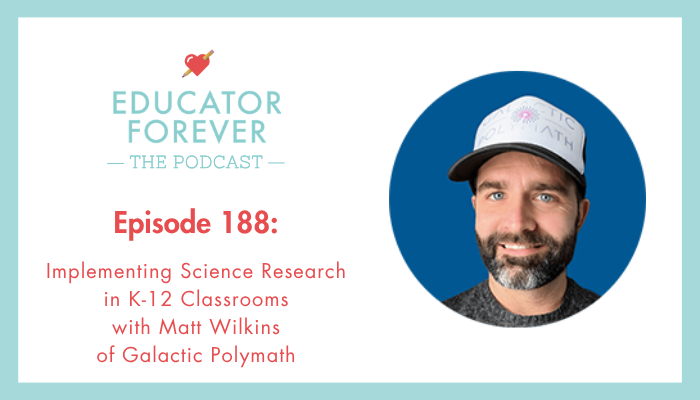
Matt Wilkins is a former middle school teacher, scientist, and founder of Galactic Polymath Education Studio. He has spent the last 10 years trying to translate cutting-edge research into engaging videos and fun, standards-aligned lessons that a non-specialist can teach.
In our discussion, Wilkins shares how his work focuses on translating cutting-edge research into accessible lessons for K-12 classrooms. He highlights the disconnect between scientific knowledge and public understanding, emphasizing the need for interdisciplinary education.
Topics Discussed:
How academics led him to pursue a career in science communication
Being frustrated with the status quo in education
The concept of an education studio
Resources mentioned:
If you’re enjoying this podcast, please leave a rating and review on Apple Podcasts.
Related episodes and blog posts:
Episode 187: From Regulation to Liberation with Dr. Niki Elliott
Summer Jobs for Teachers: Flexible Ways to Earn Extra Income and Explore New Opportunities
Episode 149: Creating Products that Support Teachers and Students with Alexandra Walsh of Amplify
How Language Proficiency Testing Informs Curriculum Development
Read the transcript for this episode:
Welcome to Educator Forever, where we empower teachers to innovate education. Join us each week to hear stories of teachers expanding their impacts beyond the classroom and explore ways to reimagine teaching and learning.
Matt Wilkins is a former middle school teacher, scientist, and founder of Galactic Polymath Education Studio. He spent the last 10 years trying to translate cutting-edge research into engaging videos and fun Sanders-aligned lessons that a non-specialist can teach. Hey, Matt, so nice to have you here.
Matt Wilkins 0:17
Hey, Lily, thanks for the invitation. It's great to be here.
Lily Jones 0:20
Absolutely. Well, I always start with the same gigantic question, which you get to take in whatever direction you want, which is to tell us about your professional journey.
Matt Wilkins 0:28
Okay, I'm a scientist, so I tend to be long-winded, but I'll try to keep it short. So, yeah, so my background is actually as a biologist, and so I did my undergrad in biology and Spanish linguistics, and then I ended up getting a PhD in ecology and evolution, so studying basically how animals communicate, like how particularly birds, barn swallows, basically how they communicate with to choose mates, or you know, fight competitive competing males, especially bird song was one of the main focuses of my research, and so then I started doing like a postdoc, a traditional academic path, so it's sort of like residency, if after you get an MD, if you're more familiar with most people, more familiar with that pathway, so the idea is that you do a postdoc for a while, get more papers and stuff, like more publications, and then you become a professor, and I just, during the three years of that period, I got really disenchanted with the traditional academic path, and the more I learned about like what we know about the world, like I wanted to communicate to the public, because I saw there's just this ever widening gulf between what we know about the world and what the public understands or believes, and then you know something happened in 2016 that seemed to continue to widen that gap more rapidly, and so that basically kind of informed my decision to pivot out of academia and figure out how can I communicate with the public, like what does a science communication like pathway look like, and it's sort of a choose your own adventure. It turns out if you don't want to go into traditional journalism, there's like really no framework to, like, for example, just working in, like, outreach at museums and stuff like that. I, you know, I saw that I was talking. I mean, it's really fun, right? I'm talking to very excited kids who drag their parents there every weekend, like everybody knows, you know, Simon, who comes around, you know, knows everything already. But in many ways, I felt like, you know, doing those kind of outreach events, you're preaching to the choir, if not other preachers, and so I was like, Where is everybody that we can connect with? And it's clearly K-12 classrooms where we sent everybody across all demographics, everybody in society goes to K-12 at a period of time when they're learning about the world and how they fit into it, and what we all experience there, I know I did going through public school in Alabama, where I grew up, like it has no relation at all to what science and practice is like. It's not a bunch of set facts, like first of all, a lot of the facts trail at least 30, sometimes 100 years, depending on the field, right?
Lily Jones 3:26
That's depressing.
Matt Wilkins 3:27
Yeah, so it's all science is just also it's one of the most beautiful, most collaborative things that we have, you know. It spans all geopolitical boundaries. In my PhD, I worked in six countries, so working in the US, worked with, I worked, I did field work in Israel, Romania, I worked with collaborators in Czech Republic and the UK. We did a field expedition across Russia to look at Birdsong, so, like...
Lily Jones 3:58
cool,
Matt Wilkins 4:00
Yeah, so I mean, a lot of these places you might know are in the headlines daily for a conflict, but you know, the researchers are motivated to learn about the world, and you know, and just like push the edge of our knowledge, like students don't get a chance to, to, to see that, right, to see that collaboration, I mean, it's inspiring, and so I am sorry, I haven't done a good job in keeping this short, but no, I love it. I mean, this is great, keep going. So, basically, you know, I found this postdoc at Vanderbilt in Nashville, and it's highly unusual. I've never heard of anything like it anywhere else in the country. So I was a postdoc at Vanderbilt, but I was technically a resident scientist, like day to day, five days a week at a middle school. So I was working at two different middle schools for the three and a half years that I was there. So at a middle school for five, five days a week, just kind of a free -floating scientist.
Lily Jones 5:01
Amazing.
Matt Wilkins 5:02
Yeah, like every school should have that.
Lily Jones 5:05
Yeah, absolutely. Can we have a mathematician, you know?
Matt Wilkins 5:08
Yeah, I mean, right? You know, or just like a rotating, like a rotating postdoc position at a school, right? So, fascinatingly enough, like it's funded through Metro Nashville Public schools, yeah. So I could get into how it's funded, but, like, I mean, if a community saw the power of that, they could make it happen. But...
Lily Jones 5:30
So cool.
Matt Wilkins 5:31
....they haven't... universally. But for me it was really transformational experience. It's one of the coolest things I've done in my life, and you know, basically, I worked with, you know, at the time Nashville or Tennessee had middle school with fifth grade was lumped in, so it's grades five through eight, and I worked with basically teachers from every subject, from ELA, maths, social studies, and science, as well, even band, and we could just form collaborations, they're like, I I'm teaching a unit on social studies on King Tut, how he died, like, can we bring something into that, and so, like, I worked, you know, I had the flexibility to do a lot of deep research, find the primary literature on forensic archeology, and figure out, like, what do we know about how King Tut died, and it's actually really fascinating. And then design this kind of student inquiry-driven mystery that they're solving, they're taking pieces from actual scientific journals that I've, like, you know, clipped out, and to basically test hypotheses that have been proposed, some people thought, like, he died in a hippo attack, or a hippo attack during a hunting expedition. Others had proposed that he died in a chariot accident, because there were all these chariots in his tomb. Turns out his parents were siblings from modern DNA testing, and he had malaria, and he had a club foot, so they think it's some combination of that. Anyway....
Lily Jones 7:05
Interesting. Okay.
Matt Wilkins 7:06
Yeah, I mean, so, so I was able to have the flexibility and to partner with teachers and learn from them about, like, what you know, what they needed to accomplish, like what their learning objectives were, and like how classroom routines work, what the constraints are with teachers, with, you know, when the rubber meets the road, so to speak, you know, with, I mean, I think we all know there are a lot of challenges in the classroom that most of the public has no clue about, they don't know, they don't know, sure, and so it was really eye opening for a lot of different reasons, and, but one of my frustrations was like, I'm building these like cool experiences, and, and, like, I, you know, the students that I'm immediately in contact with are the only ones who really benefit from it, and so I was like, why, like, we should be, like, you know, providing these resources at scale, and there wasn't a lot of sharing within the district that I was working in, and I just, it just goes to what I've seen with, like, the disconnect between classrooms within a school, and then across schools, like, how often do students in one grade ever interact with another, or how often do teachers have the flexibility to like co-teach?
Lily Jones 8:25
Yeah.
Matt Wilkins 8:25
Like we talk a lot about interdisciplinary teaching, but like teachers don't have - they get robbed of any free time or planning period all the time, and we don't, and the publishers don't provide materials that are that lend themselves to those kinds of collaborative opportunities, right? So, it's always a teacher who goes way above and beyond in their weekend, they're, you know, dwindling spare time, especially if they might be doing Lyft driving on the side, like they have two jobs.
Lily Jones 8:57
Sure, sure,
Matt Wilkins 8:58
I mean it's insane. So, yeah. yeah, I just basically, I just got really pissed at the status quo.
Lily Jones 9:07
Yes, I hear you,
Matt Wilkins 9:10
And I just wanted to, I guess I decided that, like, I didn't see jobs that would, like, help me let you know do this work more at scale, and so I decided to start a company. So, after three and a half years of that position, and then teaching at a homeschool tutorial, I was teaching biology to, like, seventh grade homeschool kids. His parents didn't like know biology well enough to teach it, so I kind of did that as I was starting the company back in 2021 and so I founded Galactic Polymath. So the name is a bit of a barrier for some folks, but the first lesson of Galactic Polymath is what a polymath is. The polymath is an interdisciplinary expert like Da Vinci. Or Hedy Lamarr, who was an actress who invented the fundamental basis for modern Wi-Fi, people who think across disciplines to solve problems. Galactic is meant to be like sort of what's the system we're operating in, so like just imagining an ambitious vision for what we should be preparing students for to be cross-disciplinary problem solvers who are comfortable across domains, like, oh, I don't do this, I need to learn it, I'll learn it, and then I'll solve this problem. That's all real-world problems are like that, they're not just like having narrow expertise is not as useful as they used to be. So that is why I picked that name.
Lily Jones 10:40
That's awesome. Yeah, I love that. I mean, I love so much of what you said, and relate to so much of it too, of just how you started off realizing that so much of the things we teach in school are not really the best ways, right? And really not like, I mean, I'm so interested and simultaneously frustrated by the structures that schools are built on, right? Like that teachers can't necessarily teach interdisciplinary and really collaborate with people, or really have the time to do that, and that kids can't, you know, really dive into these projects, and so I appreciate that you're like, "Hey, this isn't what we know about the world, right? Like, and I feel like that as a learning scientist, like, this isn't what we know about learning, like, why are we doing it this way, right? Like, yeah, so how can we, within this structure, create opportunities for teachers, and I love, you know, what you've created at Galactic Polymath.
Matt Wilkins 11:40
Thanks, means a lot.
Lily Jones 11:42
Yeah, totally. So, I know we've had the pleasure of working with Galactic Polymath on curriculum projects, and seeing your amazing projects, like, so engaging and inspiring. Can you tell folks what you offer at Galactic Polymath?
Matt Wilkins 11:57
Yeah, so essentially, it's as far as I know, it's a pretty novel business model, so I've been pioneering this term of education studio. We're familiar with movie studios, game studios, but those are entertainment, right? Like, we spend hundreds of probably billions of dollars a year trying to like escape from reality, and what production value do we have in the, the, the fundamental curriculum that we use to prepare every member of society to function in it? So, I mean, I think we.. so that's where the studio concept comes in, like, I mean, and also I got really disgusted with the amount of capitalism that's crept into our public schools.
Lily Jones 12:45
Yes.
Matt Wilkins 12:46
Everything is paywalled. We, there's not good estimates, but I, as far as I can tell, I, the closest estimate I could get was like, I think as a nation we spend about $8 billion a year on like textbooks and subscriptions across K 16, that's 8 billion that we just, just throw out into the corporate world, and it, and then do it again next year.
Lily Jones 13:09
And if you ask teachers how they feel about these textbooks and materials, or if they even use them, then it really becomes ridiculous.
Matt Wilkins 13:17
Yeah, and the whole thing is built on, you know, a few, you know, the McGraw Hills and Hottent Mifflin, and you know Pearson of the world, you know, they have an outsized market share, and it makes it really hard for like small curriculum companies to get in there, and they basically like make the sale at the high, you know, superintendent level or whatever, and then you know the district buys a bunch of subscriptions that teachers may not even know they have them. I've seen that, like, where a million dollar subscription was paid, and then teachers did not know they had access to it.
Lily Jones 13:54
Yeah.
Matt Wilkins 13:56
So imagine a world where we spend 6 billion in one year, just to make open access materials that anybody can use thereafter.
Lily Jones 14:09
Yes.
Matt Wilkins 14:10
As soon as I tell people I have an education company, they're like, How much does it cost? And I'm like, initially it's free for everybody, because we, we flipped the model, because I come from academia, where you know I'm a motivated scientist who has spent his entire career trying to build connections with the audience, like connects, you know, here's my Barnswell research, you know, sitting on airplanes, or you know, giving informal talks at a bar, or whatever, I want, like, and a lot of scientists really want the public to understand their topic better. They just don't have a good mechanism to do it, particularly at scale. And so there's actually a funding mechanism in National Science Foundation. This is going to get a little wonky, but it explains how we're making this stuff free, is like the National Science Foundation, which funds basically all of the. The US is domestic basic fundamental research about the universe and how it works, that's not like health, that's where NIH comes in, stuff like that. So NSF has a budget of like $9 billion Well, they're trying to cut it in half, but anyway, since the 90s, they've had intellectual merit, which means that when you write a grant proposal, you have to demonstrate that you're doing kick-ass science, you're doing really cool, cutting-edge stuff, but you also have to do broader impacts, which shows how you're connecting it to stakeholders, and so that's where we come in. So we wrote a bunch of grants, so we had, in five years, we had 14 NSF grants that were funded, so we worked with professors doing really different kinds of research across the country, so doing things from like bio acoustics, we're working on a project currently with Educator Forever on called Balancing Act, that's working with a researcher who studies frogs and, like, how their calling behavior relates to, like, you know, their metabolic rates, and it's, it's just really cool. It, like, goes into field work in Oklahoma and the wetlands at night, so we're like doing using video to, like, kind of give students like a virtual field trip as they dive into real data, and like looking at how do we visualize and measure sounds, which is something that I think most of the public, for as much as you know, like our vision dominates a lot of our experience, and so like it's a really powerful lesson, so we, but we've also worked with researchers who do like all kinds of engineering, chemical engineering, mechanical engineering, optics, just really diverse research, and we help those scientists, we work with them for a period of three to six months for each phase of development, so we like meet with them, we bring in illustrators, you know, really experienced film producers to make cool, engaging videos that, like, connect with the authentic science, the cool science that these researchers are doing, make it easy, as easy as possible to teach, and aligned from the beginning to learning objectives and NGSS standards, as well as Common Core math, ELA, and the c3 framework, which is the closest thing we have to national social studies standards.
Lily Jones 14:58
So awesome. I mean, yeah, I've never heard of anybody, I mean, before me to you, doing something like this, right, like having this research translated into a way that classroom teachers can use it, because I think many teachers want to do this, right? Like, many teachers are like, "Yeah, I want to know what's going on out there, I want to stay current on research, but I don't have the time or the skills or the ability to like translate that, and so having that packaged up for teachers is so cool, and it's cool for the researchers too.
Matt Wilkins 14:10
100% 100% Yeah, and I mean, the biggest thing that the biggest learning for scientists immediately out of the gate is like they're like, "Oh, I don't, so you know, I don't know when we're going to be done with the research that we proposed on the grant, and I'm like, it doesn't matter at all, like the public is at least 30 years behind you, so yeah, so we basically take this complex area of research and we distill it to just like what is the most exciting part that is connected to students' lives, that there, that's going to help them look at the world differently, that's going to help them leave the classroom changed in some way, in some way, right? Like to, and hopefully get them excited about a topic that they had no idea about, and just go home and not stop talking about to their parents, like that's what we want, and so, and we, but we're also keenly aware of the constraints of the classroom. So, what we produce is not a full curriculum, so it's not open science, right? Like, we do each unit that we're working with these researchers, you know, for a period of time, it's just going to be one lesson, which is like class period, usually designed to be 45 minutes, so like one to five lessons, typically. So it's meant to just plug into your existing curriculum to enhance it, either when you're introducing a topic or want to, like, really, you know, dial in on something to bring it to the real world and really concrete fashion, so it's meant to be very flexible and modular, and you can also just kind of like pick one lesson, and it's meant to be fairly standalone, so you know educators are education DJs, so I mean, you know, you're free to and encouraged to remix it.
Lily Jones 14:10
Yeah, I love that. I mean, I think that is one thing we know about effective teaching, that like curriculum gets remixed by teachers, ideally, and adapted, and if we give them high-quality materials to start with, then that really changes the game, and also the teachers having the autonomy and skills to be able to change it up and really adapt to their kids.
Matt Wilkins 15:42
Absolutely, yeah.
Lily Jones 15:42
So, walk us through a little bit more of the Galactic Polymath site and the resources you have for teachers.
Matt Wilkins 15:42
Yeah, so we have now released 21 units. The first one is Females Sing, and it's based on my research on the first description of Female Barn Swallow Song, and that it's an interdis interdisciplinary math and science lesson, three lessons in that unit, but we have a total of 200 resources, I think we've developed, so that's lessons, videos, we've developed, you know, applications, we've done some custom simulation simulations on a sustainability unit, where we were working with a Maori group. Actually, we have three projects that are connected with New Zealand collaborators at University of Christ of Canterbury and Christchurch, and so they're basically students will probably have never heard of Maori at all, but it's an amazing introduction to indigenous folks who are kind of at the leading edge of sustainability and creating sustainable, independent kind of community centers and stuff like that in New Zealand, and so around that we built a really beautiful visual that like helps students think about energy mixes in a really specific way that's will be very memorable, like how you provide renewable energy for a small community, so we did that. We did a choose your own adventure water purity water purification lab, which is the challenge was to get to make cleaning your water through kind of like ways that are feasible in a classroom interesting. There's like so many people. I've seen a lot of projects where you're like, okay, pour it through sand, pour it through, you know, active charcoal, etc. It's not that it's just kind of limited, right? And like, how interesting. So, like, we did a lot of storytelling around this, and like, brought in like Pacific Island narratives that connect this to the real world, and like climate change is hitting Pacific island nations first, and so they have like salt water intruding on these aquifers that they depend on for fresh water, and so that's all kind of infused in this like choose your own adventure, where basically, and it's meant to be as easy as possible for teachers to set up, so you set up solutions where you know what's in there, and then they are meant to take different roles and basically like be a chemist, be a chemical engineer, and be a project manager, and like make different decisions, you know based on like kind of a classroom currency and all this you're tracking with an app that we built for this, so it's meant to be as easy as possible, and it's just such a rich experience as like nine different endings, and your students will be completely engrossed in this, so this is the kind of thing we do, and you know it's it's meant to be like exciting and connected to something new and current, but also interdisciplinary, so it's like you can do a PBL out of pretty much any one of our units, it's just out of the box, and it's meant to be, you know, easily collaborative because it's already aligned to standards, so you can just find a teacher to like co-teach it, and yeah, I mean, they're just meant to be rich, flexible learning experiences that hopefully make your job more fun and easier, rather than like an extra thing you have to do.
Lily Jones 14:10
Yeah, absolutely. I mean, I think guaranteed to make it more fun and more interesting. I mean, all the projects are so fascinating, and so I think even just like I'm not in the classroom, and it's fun to just see all the projects. I know I learned myself, I've learned so much by doing these projects, right? Like, it's fascinating. Yeah, yeah, so awesome. I mean, it's yeah, again, it's just really cool having that opportunity for scientists and researchers to be able to share at this scale too, and for teachers, so like having that that loop going.
Matt Wilkins 14:56
Absolutely, yeah.
Lily Jones 14:56
So, I know you also have Job Vis. Can you tell us about that?
Matt Wilkins 14:56
Yeah, so Job Vis actually predates the company. It was kind of like a side project I started in a. At Vanderbilt postdoc, where I was the resident scientist, I just thought we don't, we tell, we tell kids all the time, like, you can do anything you want if you just try hard enough, but you don't say, like, what is anything, right? Like, and most of us don't know, right, like, you know what your parents do, you know what you see on TV, or you know, it's pretty limited, it's like a diminishingly small proportion of the available careers, and this is particularly important for, like, you know, smaller rural communities, right? students just don't know what's possible, and so my dad, you know, grew up on a dairy, for example, had no role models, and he went to school for business, just because he thought business is where the money is, but I became a scientist because he was always talking science to me, because he had, you know, was fascinated, he, you know, had Scientific American, that kind of thing, so I think in a different life he would have been a scientist, and I think that so many people have that kind of experience, right. And so, job is is a way to browse and explore the true diversity of opportunities. So, the Bureau of Labor Statistics has like 830 different jobs. They categorize their website, it's there, it's just not that explorable, really. You kind of need to know what you're looking for to go there. So, what we've done is just like taken that data and then just made it much more visual and interactive, and also kind of plucked the most important things that we think students are interested in. So, this is not like a comprehensive like career path finder, it's more like explore what's possible, and just like let that be the starting off point for like your journey, right? Just knowing a search term, like pharmacologist, I had, you know, or like nuclear physicists, or whatever, like, or yeah, some something more arcane, like you know, drafter or something like that, like, and so basically, like, students can just type in engineer and see, like, there's 20 options, I thought it was one job, it's actually like 20 jobs, and then start to filter through, like, what's the median wage for this, like, what are the, what's the predicted income, like, what's the predicted change in the market? Is this this is a key one, and I think a lot of other resources don't provide this. Is like, how many people total do this job, and what is a big number? Because you know, there's like just under 400 million people in this country now. Like, if three, if 30,000 people do it, that might seem like a lot, but it's actually a very rare job, right? So this is meant to not just be something that, like, picking your career shouldn't be something we just wait until high school to do, right? You should be like spending, like, earlier, you know, middle school, and, like, you know, early high school, like just building your sort of economic worldliness and awareness of, like, how does the world function, and what jobs are involved. Right, this this actually connects to all of our units. Now, there's a built-in career tour with every one of our units, so after you've taught the unit, you can just make a simple assignment that, like, here are six jobs that are associated with this unit, and just have them rate them thumbs up, thumbs down, love. Yeah.
Lily Jones 28:30
Yeah, that's great. Yeah, I appreciate the focus on possibilities. I mean, I think that's underrated, and a lot of learning, you know, it starts with seeing the possibilities and really knowing what's out there and I think sometimes in many ways we just jump to like and now what are you gonna do, it's like, well, I only know two things, or I thought I had just this option, and so much.
Matt Wilkins 28:52
I pushed to be a doctor, but like that's a huge right things too,
Lily Jones 28:57
Absolutely, absolutely, and it gets oversimplified, and I think it's just so interesting seeing, and all the ways that people can work and work together, and seeing all the options out there. I appreciate that, that part of your project, and so, Matt, it's been really interesting hearing about how you took this like frustration that you had and created something to fill that gap, and I know many of our audience members are out there feeling frustrated about something in education, and maybe have a desire to create something of their own to try and solve that in some way. And do you have any advice for them?
Matt Wilkins 29:34
Yeah, well, I will just say that entrepreneurship, and particularly education, is like unrelentingly difficult. Knowing this business has been like way harder than getting a PhD. Yeah, it's, it's very challenging, and education is, I mean, it's it's it's in rough shape. So, but that said, like, this is, I will never regret any, you know, spending this time and this effort to build these free resources. I think people need reasons to, to be optimistic and inspired more than ever, so I mean, if you see a problem and you think you are uniquely prepared to, or equipped to solve it, I say go for it. But if you know, if you're just looking for opportunities, I will say this: teachers are ghosts on the internet, so having a LinkedIn is really important, especially after you leave. I mean, I think it can create all kinds of opportunities, and just try to build your net, your professional network. I think it's quite important.
Lily Jones 30:54
Yeah, and one thing I heard you say over and over through our conversation is, like, how beautiful some of the things you've created are, and I would say to teachers, too, as you were talking, of like, you know, feeling inspired, like if you're inspired to create something that you find beautiful, like that's so rewarding, and so really having that as a guiding light of like creating something beautiful can be so inspiring.
Matt Wilkins 31:17
Absolutely, yeah, something that you'll be proud of.
Lily Jones 31:20
So, Matt, it's been amazing learning more about Galactic Polymath, Piga, and of course collaborating with you. Can you tell folks how they can learn more themselves?
Matt Wilkins 31:32
Go to GalacticPolymath.com that's our main landing page. We have a separate teaching portal that is linked there that has all of our stuff, and we also have a YouTube channel. We'd love if you can like and subscribe as an educator, as a small education studio like YouTube really feeds people, you know, pure entertainment stuff. And so it's been really hard to break through the algorithm, so liking is and commenting on our videos is like a great way to support what we're doing.
Lily Jones 32:05
Awesome, and we'll put the links to all that down below. Thanks so much, Matt.
Allegra Johnson 32:08
Thank you.
Transcribed by https://otter.ai