
Episode 200: What 200 Conversations Taught Me About Learning
Wow! 200 episodes. It’s been such a pleasure hosting this show over the past four years.
Today I'm doing something different — no guests. Instead, I want to talk about a framework I've been developing for a long time, one I built out of my own experience as a teacher, a curriculum designer, and now as I’m getting a doctorate in learning design. It's eight ideas about how learning actually happens: finding your truth, envisioning possibilities, imperfect action, confronting perfectionism and shame, developing agency, co-creating learning, being fully you, and reflecting and repeating.
Topics Discussed:
Learning begins with resonance
Hope isn't just a feeling
Failure is the move and not the mistake
Resources mentioned:
If you’re enjoying this podcast, please leave a rating and review on Apple Podcasts.
Related episodes and blog posts:
Read the transcript for this episode:
Welcome to Educator Forever, where we empower teachers to innovate education. Join us each week to hear stories of teachers expanding their impacts beyond the classroom and explore ways to reimagine teaching and learning.
LILY (VO):
Hi everyone, welcome back to Educator Forever. Episode 200. Wow! 200 episodes. It’s been such a pleasure hosting this show over the past four years.
Today I'm doing something different — no guests . Instead, I want to talk about a framework I've been developing for a long time, one I built out of my own experience as a teacher, a curriculum designer, and now someone getting a doctorate in learning design. It's eight ideas about how learning actually happens: finding your truth, envisioning possibilities, imperfect action, confronting perfectionism and shame, developing agency, co-creating learning, being fully you, and reflecting and repeating.
I didn't get this framework from the podcast. But here's the thing — once I had language for it, I started hearing it everywhere in these conversations. Not because I went looking for guests who'd confirm it, but because it turns out this is just what learning and reinvention look like, whether you're aware of the framework or not.
So today I want to do two things at once. I want to show you where each piece of the framework showed up in the stories you've heard on this show. And I want to be honest about the second thing, which is that these conversations didn't just illustrate the framework — they pushed back on it, complicated it, and in a few places, changed my mind about what it even means. This kind of ever-evolving approach to learning is actually the framework in action too.
1. Find Your Truth
LILY (VO):
Here's how I originally thought about this piece of the framework: learning begins with resonance, something clicking with who you already are. I thought of it as mostly a private, internal moment — you feel a spark, and that spark tells you something true.
Then I talked to Dr. Niki Elliott, who now directs the Center for Embodied Equity and Neurodiversity at the University of San Diego. She didn't choose that work — it chose her, in her first years as a fourth-grade teacher in Teaneck, New Jersey.
[CLIP: Dr. Niki Elliott — Ep. 187, "From Regulation to Liberation" — timestamp 0:58]
"I started off my career as a fourth grade teacher in Teaneck, New Jersey, and at that time... veteran teachers could cherry pick and offload students that were non-preferred to the new teachers, and so that happened to me in my first few years of teaching... it was the blessing that really set me on the trajectory that I'm on now."
LILY (VO):
And Matt Wilkins, who now runs Galactic Polymath, didn't set out to translate scientific research for classrooms either. He got there through years of frustration with the gap between what scientists know and what the public understands.
[CLIP: Matt Wilkins — Ep. 188, "Implementing Science Research in K-12 Classrooms" — timestamp ~9:07]
"I just basically, I just got really pissed at the status quo."
LILY (VO):
Neither of them had a spark moment in the way I'd imagined. They had friction. Something kept bothering them, for years, before it turned into truth they could act on.
That actually changed how I hold this part of the framework. I used to think "finding your truth" meant waiting for resonance to arrive. Now I think it's just as often built out of irritation you refuse to ignore.
2. Envision Possibilities
LILY (VO):
I've always described this piece using hope theory — that hope isn't just a feeling, it's a cognitive process of setting goals, finding multiple pathways to reach the goals, and sustaining the motivation to keep moving. Before this podcast, I mostly applied that to individual goal-setting. One person, one gap, one plan.
Rob Heller, who founded the Boost Program, has an exercise where he asks teenagers to picture themselves ten years out.
[CLIP: Rob Heller — Ep. 192, "Teaching Success Skills" — timestamp 15:05]
"We put up on a board. Okay, you're 14 now, 10 years from now you're 24. What's that look like? What do you want? They always start with all the material stuff... Then we go deeper. I want friends, I want a family, I want to be viewed a certain way in the community."
LILY (VO):
That fit what I already believed. But Matt Bowman, founder of OpenEd, pushed the idea further than I'd taken it. His argument is that most families default to whatever their zip code assigns them, not because it's actually the right fit, but because nobody ever told them there were other pathways to even consider.
[CLIP: Matt Bowman — Ep. 145, "Personalizing Education" — timestamp ~12:29 (part of one unbroken answer running to 15:57)]
"We always say, if the default public ed is the right fit for your child, great. We're not bashing on that, nor criticizing it, just be intentional about that decision, and if it's not working, know that you have options, and know that there's support, there's there's paths, there's all kinds of things that you can do."
LILY (VO):
That reframed something for me — envisioning possibilities isn't just an internal exercise in hope. Sometimes the actual intervention is exposure. Showing someone the menu before you ever ask them what they want to order.
3. Imperfect Action
LILY (VO):
This is the piece of the framework I thought I understood best going in — start before you're ready, every attempt is data, failure is the move and not the mistake.
What the podcast added wasn't a new idea here, it was scale. Jean Lee, who founded the Academy of Chaos and now directs the Midwest Homeschool Expo, called over sixteen hundred people to get sixty-three yeses for that first expo.
[CLIP: Jean Lee — Ep. 159, "Teaching Homeschoolers" — timestamp 16:52]
"My oldest asked me the first year, she said, Mom, did anybody tell you no?... I said, Honey, I called over 1600 people, and guess what? The first year, 63 said yes. So that's a lot of nos, but that's okay."
LILY (VO):
Hillary Summerbell, founder of the reading-technology company Summerbell, built and rebuilt her software on a private promise to herself.
[CLIP: Hillary Summerbell — Ep. 178, "Supporting Students with Visual Dyslexia" — timestamp 3:26]
"I decided that I needed to teach myself how to read because nobody else was able to do it... I just made a pledge to myself that I wouldn't stop developing it... unless I hit like a huge wall, you know, like a wall that you couldn't get through... but it does, so I didn't stop."
LILY (VO):
And Ben Somers, founder of Recess, made the biggest leap of all of them in a single afternoon.
[CLIP: Ben Somers — Ep. 152, "Creating Community for Homeschoolers" — in the long answer starting at 0:26]
"My last task was figuring out how to fire 500 teachers in a weekend, and I basically decided not to do it, and got in a big fight and got fired for that. And that day, decided to go start this new company called recess."
LILY (VO):
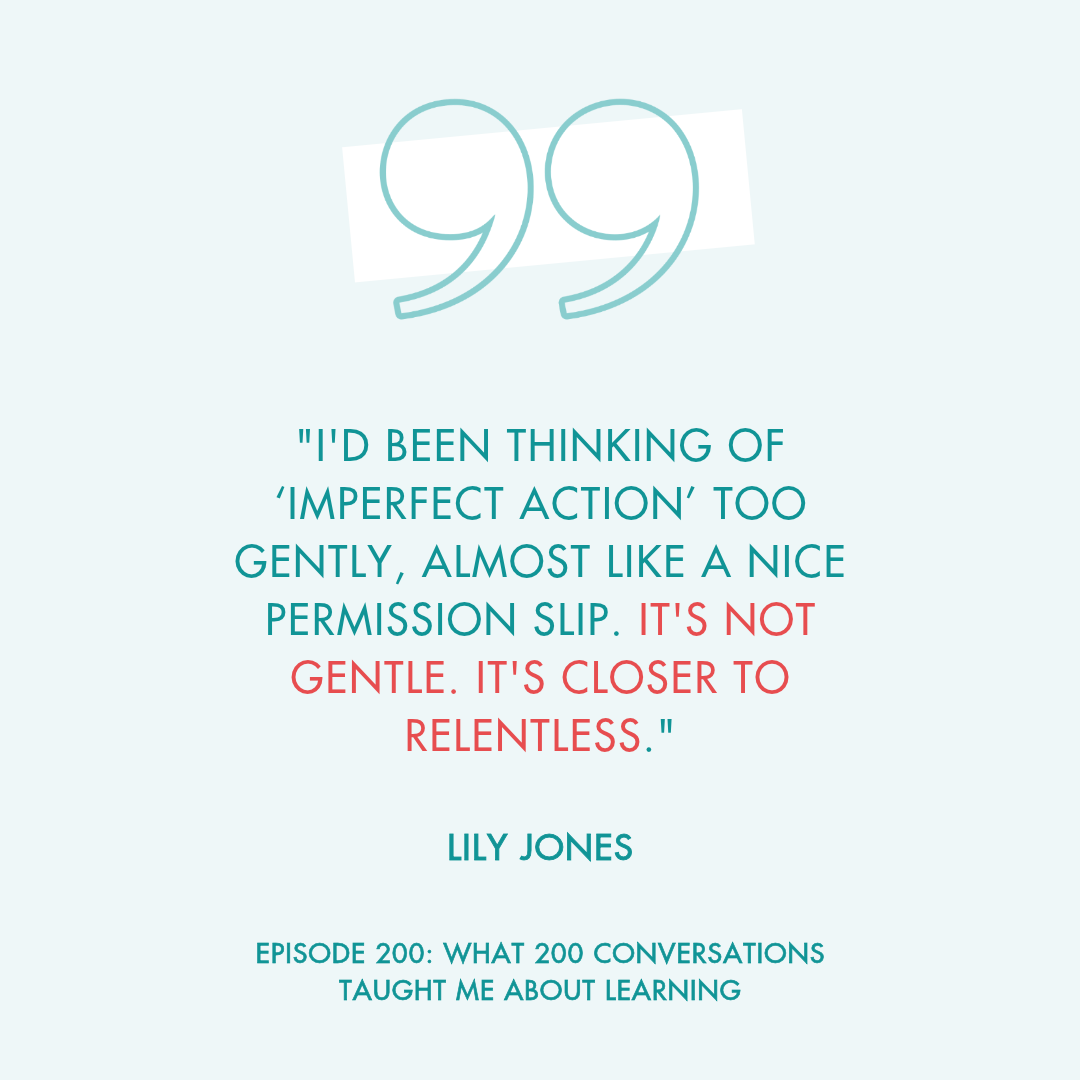
Hearing the actual numbers — sixteen hundred calls, years of daily tinkering, a decision made in a single afternoon — made me realize I'd been thinking of "imperfect action" too gently, almost like a nice permission slip. It's not gentle. It's closer to relentless.
4. Confront Perfectionism & Eradicate Shame
LILY (VO):
I built this part of the framework around a specific claim: perfectionism and shame are neurological and psychological responses, not character flaws, and the move is to use them as fuel and choose growth over compliance.
Monika Robinson, founder of Reparations Ed, uses a saboteur assessment with the educators she coaches.
[CLIP: Monika Robinson — Ep. 183, "Centering Educator Wellbeing" — in the long answer beginning around 16:57]
"Hyper achiever is one of their top three saboteurs... it stems from childhood... it stems from fear, fear of rejection, fear of failure, fear of missing out, fear of abandonment. So they're all fear based."
LILY (VO):
That gave me a concrete mechanism I didn't have before. But it was Hillary Summerbell who actually shifted my thinking. I'd been framing this principle around what the person struggling with shame needs to do — reframe it, use it as fuel. Hillary flipped the responsibility.
[CLIP: Hillary Summerbell — Ep. 178, "Supporting Students with Visual Dyslexia" — timestamp 31:20]
"There's nothing wrong with you. Like we are meeting the reader where they are, right? We're not telling them that they need to read linear."
LILY (VO):
That's a different move than "confront your shame." It's closer to refusing the frame that produced the shame in the first place.
5. Develop Agency: Embrace Curiosity & Persevere
LILY (VO):
My original framing here was that curiosity is a learnable skill and wonder is the engine of progress, and that perseverance gets built through humor, play, and clear intention.
Leah Ellis, founder of the Society of Child Entrepreneurs, has a story about her daughter wanting to sell paintings at four years old.
[CLIP: Leah Ellis — Ep. 162, "Teaching Entrepreneurship" — timestamp 4:55]
"I didn't have a logical reason why the answer had to be no other than her age, and that's technically a form of discrimination, so I couldn't use that against her."
LILY (VO):
That's almost a pure demonstration of curiosity left alone, unblocked by an adult's habitual "not yet." Dr. Coral Hoh, founder of Dysolve AI, complicated the perseverance half for me, though. Her path there wasn't playful — it started with genuine anger at a system that wanted two thousand dollars just to evaluate a friend's son.
[CLIP: Dr. Coral Hoh — Ep. 171, "Supporting Students with Dyslexia" — timestamp 23:55]
"It takes persistence, resilience, because you have to bounce back. And you have to bounce back immediately. You can't mope for one day, because then the day is gone."
LILY (VO):
Her version of perseverance was less "humor and play" and more refusing to accept an answer that didn't satisfy her, for years.
6. Co-Create Learning
LILY (VO):
I've always framed this piece around the idea that you can't build your dream alone, and that externalizing your ideas and learning in community accelerates everything.
Marcus Deveso, co-founder and Chief Program Officer at C3 Community, built a framework around three C's — cared for, capable, connected.
[CLIP: Marcus Deveso — Ep. 160, "Cultivating Connection" — timestamp 10:06]
"What if we took all this time and effort and invested it in making the teachers, the adults, feel truly cared for, truly capable and truly connected. What would the trickle down effect be in the classrooms?"
LILY (VO):
That reordered something in my thinking — co-creation has to include the people doing the teaching, not just the people being taught. Jean Lee's story about mentorship added another layer.
[CLIP: Jean Lee — Ep. 159, "Teaching Homeschoolers" — timestamp 13:21]
"I reached out to all of the other conference organizers... and only a couple called me back, which was kind of a bummer, but I will tell you the ones that did, I am an absolute champion of."
LILY (VO):
Co-creation isn't guaranteed just because you ask for it. It has to be chosen, on purpose, usually by people willing to break from a scarcity mindset that's very easy to default into.
7. Be Fully You
LILY (VO):
This piece of the framework was originally about identity through learning — committing fearlessly to your dreams, bringing your body, culture, and history into how you know.
Emily Cadiz's story is the clearest example I've heard on this show. She founded Prelude Early Learning after a traumatic brain injury left her needing to relearn how to talk — and she used a skill from a previous life to recover.
[CLIP: Emily Cadiz — Ep. 163, "Teaching Early Literacy Skills Through Music & Storytelling" — in the opening answer starting around 0:47]
"I was also in a previous life, before I became a teacher, a professional musician, so it felt really natural to use it for this recovery process."
LILY (VO):
Christina Pipkin, who founded the Texas microschool FAYE Learning Center, named it after her grandmother.
[CLIP: Christina Pipkin — Ep. 146, "Founding a Microschool" — timestamp 7:44]
"Faye stands for fostering and advancing youth excellence... it's very important to me that t his is grounded in family and community."
LILY (VO):
That commitment to family isn't abstract for her. Later in our conversation, she told me where her long-term vision is actually headed, and why.
[CLIP: Christina Pipkin — Ep. 146, "Founding a Microschool" — timestamp ~26:24, near the end of that same long answer (close to the 29:00 mark)]
"I would even want to — my real niche and passion would be to have it where it was low to no cost for children and families that are suffering from incarceration, and that's a very personal story and connection for myself... to be able to incorporate including that incarcerated parent into that conversation, without the stigma, without all of the negative judgment, that's my ideal situation."
LILY (VO):
And Karen Meyer Cunningham, known as the Special Education Boss, became an expert after a personal crisis, not a degree program.
[CLIP: Karen Meyer Cunningham — Ep. 165, "Navigating Special Education Systems" — timestamp 1:05]
"I was thrust into this space. It was sort of baptism as fire... my son was identified with a disability when he was two and a half... about a month after he started school, the teacher called Child Protective Services on us."
LILY (VO):
I'd always framed "being fully you" around integrating parts of an existing professional identity. Karen's story made me realize the principle has to include people who never had that professional identity to begin with.
8. Reflect & Repeat
LILY (VO):
This is the piece I described as a loop, not a line — making learning visible through documentation and metacognition, because reflection is what makes learning permanent and transferable.
Maya Smart, author of Reading for Our Lives, revised her book for its paperback edition because the world it launched into had already shifted.
[CLIP: Maya Smart — Ep. 154, "Raising Readers with Maya Smart" — timestamp 9:27–9:30]
"The original edition came out in August of 2022, and then more recently, I had the chance to revise and update it for the edition that you mentioned... I really wanted to emphasize that there are things you can do with infants... but what we realized when it came out was that a lot of the content applied to kids who were older than six because of pandemic learning loss and other challenges."
LILY (VO):
She treated the need to revise as expected, not as a failure of the first draft. Lori Woodley-Langendorff, co-founder of All It Takes, builds actual journaling into her trainings for exactly this reason.
[CLIP: Lori Woodley-Langendorff — Ep. 151, "Building SEL Muscles" — timestamp 6:03]
"In 2020, during the pandemic, I wrote a curriculum that started with these five muscles, and now there's six in this published book."
LILY (VO):
And Marcus Deveso put it best.
[CLIP: Marcus Deveso — Ep. 160, "Cultivating Connection" — timestamp 20:55]
"I know a million things that don't work. That's important too. That's why I know what does work."
LILY (VO):
But honestly, this episode itself is the best example I have. I built this framework, then spent two hundred episodes testing it against real stories without fully realizing that's what I was doing. Writing this out is me closing the loop.
Closing
LILY (VO):
So that's the real relationship here, at episode 200. The framework didn't come from the podcast — it came from years of my own work before most of these conversations happened. But the podcast has been quietly stress-testing it this whole time, showing me where it holds, where it needs more nuance, and a couple of places where I'd gotten it a little bit wrong.
Thank you for two hundred episodes of helping me think this through, whether you knew that's what you were doing or not. Here's to two hundred more.
Transcribed by otter.ai