
Wondering what jobs teachers can transition to? Explore careers that value your teaching skills, from curriculum development to edtech, plus how to make the switch.

Jobs Teachers Can Transition To: Careers That Value Your Classroom Skills
If you’re considering jobs teachers can transition to, you may be looking at job descriptions and thinking, I could probably do that… but how do I prove it?
When it comes to your teacher career transition, remember that you’ve spent years developing incredibly valuable skills. But when a job description starts talking about project management, stakeholder communication, content development, facilitation, implementation, or data analysis, it can feel like you’re entering an entirely different professional world.
Often the work, though, isn’t as unfamiliar as the language makes it seem.
Teachers manage complex projects. We:
communicate with multiple audiences
analyze data and change our approach based on what we learn
create content
lead groups
solve problem
coach people through challenges
become experts at figuring things out when Plan A doesn’t work
These in-demand skills can translate into many different careers.
If you’re considering a career change, the goal is to understand what your teaching experience has actually prepared you to do and then learn how to communicate that value beyond the classroom.
Below, we’ll explore 15 jobs teachers can transition to, the classroom skills that transfer to each career, and practical steps you can take to make your transition.
Why Teachers Are Exceptional at Transitioning Careers
Before looking at potential jobs, it helps to stop thinking about your experience only in terms of your job title.
“Teacher” is one title, but underneath that title, you’ve probably been doing the work of a writer, facilitator, project manager, curriculum designer, mentor, data analyst, presenter, problem-solver, relationship-builder, and more.
Consider an average week in the classroom. You might:
Plan and manage several projects at once
Create lessons, assessments, presentations, and resources
Explain complicated information in ways different people can understand
Facilitate learning for groups
Analyze performance data and use it to make decisions
Manage deadlines and competing priorities
Collaborate with colleagues and administrators
Communicate with families and other stakeholders
Learn new tools and systems quickly
Mentor students, colleagues, or new teachers
Adapt plans when circumstances change
Give and receive feedback constantly
These skills matter far beyond schools.
For teachers transitioning to new careers, the challenge is often learning to describe those skills in language that employers outside the classroom immediately understand.
For example:
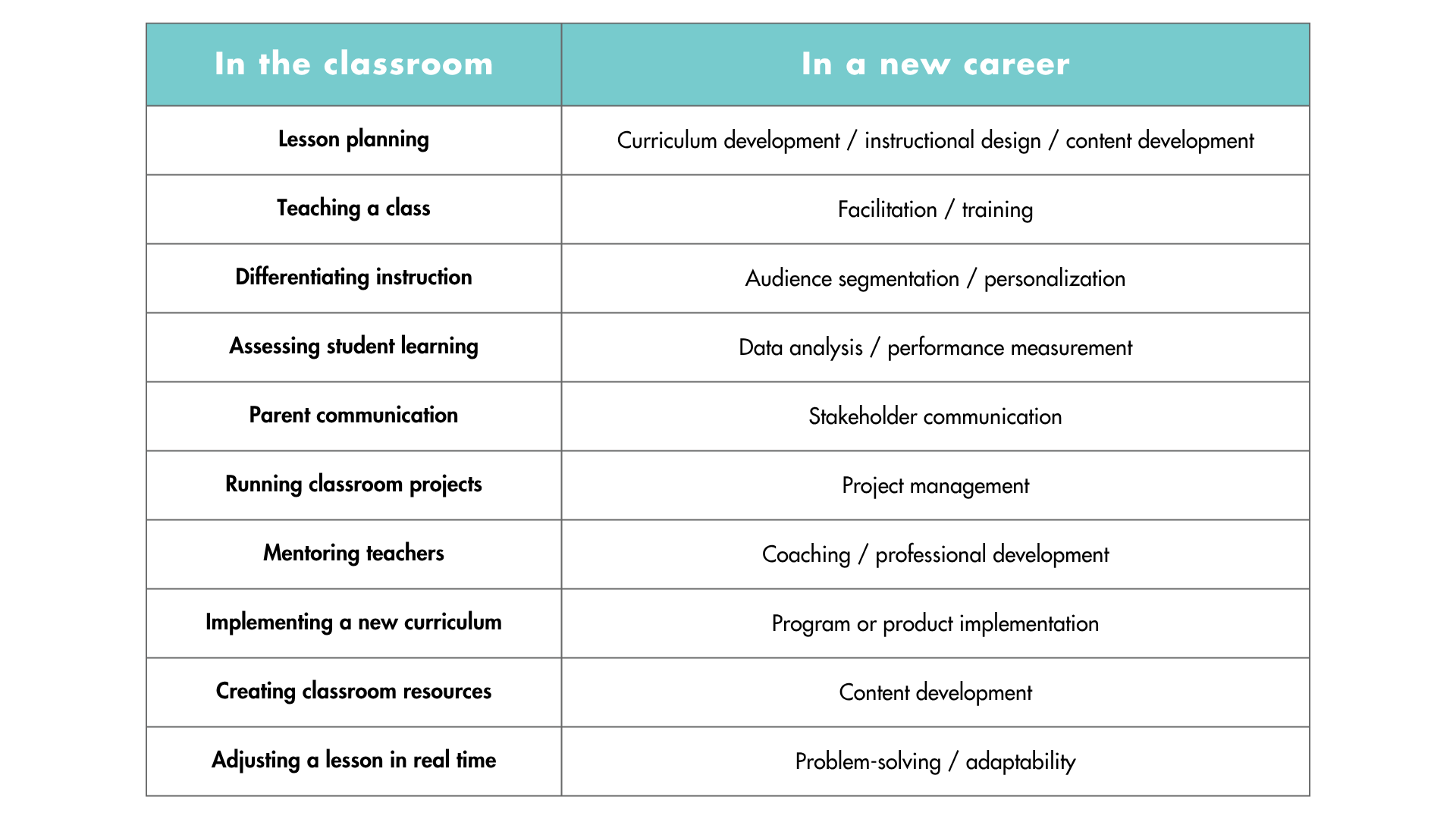
That shift in perspective can make a huge difference during a teacher career transition.
Rather than thinking, “What am I qualified to do besides teaching?” consider, “Where else are the skills I already use needed?”
There are so many possibilities.
15 Jobs Teachers Can Transition To
If you’re wondering what the “best jobs for transitioning teachers” are, the right career depends on what you want more of and what you’re ready to leave behind.
Do you still want to create learning experiences? Do you love working with other educators but want to step away from classroom management? Do you want to write? Work remotely? Train or coach adults? Solve bigger-picture education problems?
Consider the careers below as possibilities to explore:
1. Curriculum Developer
For teachers who genuinely enjoy creating lessons, units, activities, assessments, and other learning materials, curriculum development can be one of the most natural career transitions.
Curriculum developers create educational experiences and materials for organizations such as education publishers, EdTech companies, nonprofits, online learning platforms, curriculum agencies, museums, and school systems.
And you already have an important foundation for this work.
As a teacher, you understand how students learn. You know how to scaffold a complicated skill, align learning to standards or objectives, create assessments, differentiate instruction, and design something that actual teachers and students can realistically use.
The transition involves learning how to take those skills beyond your classroom and design materials that can work across many classrooms and contexts.
Your teaching skills that transfer: lesson planning, standards alignment, assessment, differentiation, learning science, educational writing, creativity, and content expertise.
If this sounds like your path, explore our guide on how to become a curriculum developer to learn more about building the skills and portfolio employers look for.
2. Instructional Designer
Instructional design is another popular career path if you’re wondering, “What jobs can teachers transition to?”
Instructional designers create structured learning experiences. Depending on the organization, that might mean designing online courses, professional learning, employee training, onboarding programs, digital lessons, or other educational experiences.
Teachers are already skilled at thinking about learning outcomes and asking:
What should someone know or be able to do?
What experience will help them get there?
How will I know whether they learned it?
That mindset is at the heart of instructional design.
The biggest adjustment may be designing for different learners, including adults, and becoming familiar with the tools and processes used to build digital learning experiences.
Your teaching skills that transfer: learning objectives, scaffolding, assessment, facilitation, presentation design, learning theory, differentiation, and learner engagement.
Explore more about instructional design vs. curriculum development and discover what this work involves and how to begin building relevant experience.
3. Education Consultant
Are you the teacher people come to when they need help solving a problem?
Maybe you’re especially knowledgeable about literacy, special education, curriculum, assessment, classroom technology, early childhood education, multilingual learners, social-emotional learning, or another area.
That expertise can become the foundation of an education consulting career.
Education consultants use their knowledge to help schools, districts, nonprofits, education companies, EdTech organizations, or other clients solve problems and improve their work.
You might review educational content, advise a company developing a new product, create professional development, help implement curriculum, coach educators, or provide strategic recommendations.
Consulting can be full-time, contract-based, or part of your own education business.
Your teaching skills that transfer: subject-matter expertise, problem-solving, communication, facilitation, collaboration, analysis, instructional knowledge, and leadership.
Learn more in our guide to becoming an educational consultant and identifying the expertise you could bring to consulting projects.
4. Education Writer
If you’re the teacher who loves writing, explaining ideas, sharing resources, or reflecting on what you’ve learned, education writing can be an incredibly flexible path.
Education writers create content for education publications, companies, nonprofits, curriculum organizations, EdTech companies, blogs, and other organizations.
The work can include articles, blog posts, newsletters, instructional content, teacher guides, website copy, thought leadership, grant writing, or other education-related materials.
Teachers bring something especially valuable to this work: firsthand knowledge.
You understand the audience because you’ve lived the work.
Your teaching skills that transfer: writing, editing, research, storytelling, explaining complicated ideas, audience awareness, subject-matter expertise, and educational knowledge.
If you want to explore this path, read our guide on how to become an education writer and start identifying the topics you’re uniquely qualified to write about.
5. Instructional Coach or Professional Learning Facilitator
If the part of teaching you love most is helping other educators grow, instructional coaching may be a great transition.
Instructional coaches work with educators through observation, feedback, goal-setting, professional development, curriculum support, and collaborative problem-solving.
Professional learning facilitators similarly design and lead learning experiences for educators.
This can allow you to stay connected to teaching and learning without being responsible for your own classroom every day.
Your teaching skills that transfer: mentoring, observation, feedback, facilitation, curriculum knowledge, communication, relationship-building, and instructional expertise.
This path can be especially strong for teachers who have already mentored new educators, supervised student teachers, led professional development, chaired committees, or taken on teacher-leader responsibilities.
6. EdTech Implementation Specialist
Have you ever helped your colleagues figure out a new learning platform, curriculum system, or piece of technology?
That experience is more relevant than you might realize.
Implementation specialists help schools and organizations successfully adopt a product or program. In EdTech, that often means onboarding customers, providing training, answering questions, troubleshooting challenges, and helping educators use technology effectively.
Classroom experience can be a major advantage because you know what implementation actually feels like from a teacher’s perspective.
Your teaching skills that transfer: training, problem-solving, technology integration, communication, facilitation, relationship-building, and change management.
If you like education, technology, and helping adults solve practical problems, this can be a strong transition job for teachers.
7. Customer Success Manager at an Education Company
Customer success may sound very “corporate” when you first encounter it in a job posting, but the day-to-day skills can feel surprisingly familiar.
Customer success professionals help clients get value from a company’s product or service. At an education company, those clients might be teachers, administrators, schools, universities, or districts.
You might build relationships with customers, answer questions, identify challenges, provide training, monitor engagement, and help customers successfully use a product over time.
Teachers are used to building trust, communicating with different people, anticipating needs, and helping people work through challenges.
Your teaching skills that transfer: relationship-building, communication, problem-solving, presenting, organization, data interpretation, empathy, and follow-through.
For teachers who enjoy people more than content creation, customer success can be worth exploring.
8. Learning and Development Specialist or Trainer
You know how to teach, and adults need teaching, too.
Learning and development (often shortened to L&D) focuses on helping employees learn skills and improve performance inside organizations.
An L&D specialist might create professional learning, facilitate workshops, design employee training, develop onboarding materials, evaluate training effectiveness, or manage learning programs.
While the subject matter may be different from what you taught in school, the foundation is familiar: understand your learners, create an effective learning experience, facilitate it, assess what worked, and improve the next version.
Your teaching skills that transfer: instruction, facilitation, instructional design, presentation, assessment, communication, coaching, and learning theory.
9. Academic Advisor or Student Success Coach
If working directly with learners is something you want to keep, consider roles in higher education, online education, or student support.
Academic advisors and student success coaches help learners make decisions, set goals, navigate requirements, access resources, and stay on track.
Teachers already have extensive experience helping people persist through challenges while balancing accountability and empathy.
Your teaching skills that transfer: coaching, relationship-building, communication, goal-setting, organization, progress monitoring, problem-solving, and student support.
These positions can be especially appealing to teachers who enjoy the relationship-building side of education but want to move away from lesson planning or classroom management.
10. Assessment Developer or Item Writer
If you’re fascinated by assessment or data (yes, those teachers do exist!), there are careers devoted specifically to creating and evaluating assessment content.
Assessment developers and item writers may create test questions, performance tasks, rubrics, benchmark assessments, formative assessments, or other tools used to measure learning.
Teachers understand not only the content but also how students might interpret a question, where misconceptions are likely to arise, and whether an assessment actually measures the intended skill.
That classroom perspective can be extremely useful.
Your teaching skills that transfer: assessment design, standards alignment, content expertise, data analysis, writing, editing, attention to detail, and understanding student thinking.
11. Education Program Manager or Coordinator
Schools aren’t the only organizations running education programs.
Nonprofits, foundations, museums, universities, community organizations, government programs, and education companies all need people to organize and improve educational initiatives.
Program coordinators and managers might manage schedules, track outcomes, communicate with partners, coordinate events or training, oversee resources, and keep complex projects moving.
Sound familiar? As you know, teachers manage an extraordinary number of moving parts every day.
Your teaching skills that transfer: organization, project management, communication, leadership, planning, data tracking, collaboration, and adaptability.
12. Project Manager
Project management is a broader transition path that can take teachers into education organizations or entirely different industries.
Project managers keep a defined body of work moving toward completion. They coordinate people, timelines, resources, deliverables, communication, and problems that arise along the way.
Teachers may not have had “project manager” in their title, but many have significant project management experience.
You’ve managed long-term units, school events, curriculum initiatives, testing schedules, student projects, committees, clubs, field trips, and countless other moving pieces with hard deadlines.
Your teaching skills that transfer: planning, organization, prioritization, stakeholder communication, risk management, leadership, problem-solving, and deadline management.
While you may need to learn some formal project management terminology and/or software, don’t discount the experience you’ve already developed.
13. Online Teacher, Tutor, or Course Facilitator
Changing careers doesn’t have to mean giving up teaching itself.
Maybe you love actually teaching, but you just don’t love everything that has become attached to being a classroom teacher.
Online teaching, tutoring, test prep, small-group instruction, and course facilitation can give educators different ways to work directly with learners.
Depending on the opportunity, these jobs can offer smaller groups, more schedule flexibility, a narrower subject focus, or remote work.
Your teaching skills that transfer: pretty much all of them!
For some educators, this makes online teaching a useful bridge while transitioning. For others, it becomes a long-term career that offers a better fit than traditional classroom teaching.
14. Education Nonprofit or Community Partnerships Specialist
If your biggest motivation is improving education, consider looking beyond schools to the organizations working alongside them.
Education nonprofits hire people to manage programs, build school partnerships, train educators, develop resources, support communities, manage grants, coordinate volunteers, and lead initiatives.
Teachers bring firsthand knowledge that can help these organizations build programs grounded in what educators and students actually need.
Your teaching skills that transfer: relationship-building, program management, communication, education expertise, facilitation, leadership, and community engagement.
This can be an especially meaningful option if you want your next career to remain mission-driven.
15. Education Business Owner or Freelancer
You can also create your own role.
Some teachers transition into self-employment through tutoring, curriculum development, education consulting, writing, coaching, professional development, online courses, educational products, or another area of expertise.
You don’t necessarily need to leave teaching one day and launch a full-time business the next.
In fact, many teachers start by experimenting with freelance or contract projects alongside classroom teaching. That gives you a chance to learn what you enjoy, develop your skills, create a portfolio, build relationships, and make money before deciding whether you want to pursue the work more seriously.
Your teaching skills that transfer: expertise, communication, creativity, organization, relationship-building, problem-solving, teaching, and resourcefulness.
For the right person, entrepreneurship can provide flexibility and autonomy that a traditional job cannot.
Remote Jobs for Transitioning Teachers
For many educators, leaving the classroom is about finding a different, more sustainable way to work.
You may want to eliminate your commute. You may need more control over your schedule. You may want to be able to work quietly without being responsible for 30 people simultaneously. Or maybe you simply want a job that exists primarily on your computer instead of requiring you to be “on” all day.
Fortunately, many of the careers above can include remote opportunities.
Some of the most common remote jobs for transitioning teachers include:
Curriculum developer
Instructional designer
Education writer
Education consultant
Assessment developer
EdTech implementation specialist
Customer success manager
Learning and development specialist
Online teacher or tutor
Education program manager
Remote work isn’t automatically easier, of course. A remote role can still involve a packed meeting schedule, strict working hours, travel, or a heavy workload.
So when evaluating remote jobs for transitioning teachers, go beyond the word “remote.”
Ask:
Is the role fully remote or hybrid?
Can I work from anywhere, or only from certain states?
What hours am I expected to be online?
How meeting-heavy is the job?
Is travel required?
Is this salaried, hourly, contract, or freelance work?
How much independent work is involved?
What does a normal week actually look like?
The goal is to find a way of working that fits the life you’re trying to build.
If remote work is one of your biggest priorities, explore our guide to the best remote education careers for teachers for a further look at remote options.
How to Actually Make the Transition
Finding jobs for transitioning teachers is only part of it… If you want to make a career transition out of teaching, you might be wondering: How do you actually become a competitive candidate?
It’s tempting to think of it as throwing away everything you’ve done and starting all over again, but you’re really building a bridge between your existing experience and the role you want.
1. Decide what you want to keep from teaching
Before opening another job board, think about your current work.
What do you still enjoy? Maybe it’s:
Creating lessons
Writing
Helping individual students
Mentoring teachers
Solving complicated problems
Facilitating learning
Collaborating
Using technology
Designing systems
Building relationships
Then ask what you’re ready to do less of. Maybe you want less:
Classroom management
Grading
Emotional overload
Constant interruptions
Rigid scheduling
Parent communication
Commuting
Work that comes home every night
That combination gives you useful information. Instead of choosing your next career based only on what you’re escaping, you can choose one based on what you actually want your work to contain.
2. Complete a skills audit
Take a blank page and divide it into three categories:
What I’m good at
What I enjoy
What I have evidence I can do
Start listing everything. Don’t limit yourself to formal responsibilities.
Maybe you redesigned your grade-level curriculum. Trained your department on a technology platform. Led a committee. Created resources other teachers asked to use. Mentored a student teacher. Managed a school-wide event. Analyzed benchmark data. Wrote grant applications. Coordinated a new initiative.
That is valuable experience, and these are valuable transferable skills.
Once you have your list, compare it with several job postings in your target career. Look for overlap. That overlap tells you what to emphasize, along with where you may have a legitimate skill gap to fill.
3. Translate your resume (without hiding your teaching experience)
One of the biggest mistakes teachers can make during a career transition is either using the exact same resume they used for school positions or trying to make their teaching experience disappear.
Neither is necessary. Your teaching background is valuable, and you need to make its relevance obvious.
For example, instead of:
Taught seventh-grade science and created weekly lesson plans.
You might emphasize it this way:
Designed and delivered standards-aligned learning experiences for 120+ learners, using performance data to adapt instruction and improve engagement.
Rather than thinking of it as loading your resume with corporate buzzwords, the goal is to clearly communicate the scope, results, and transferable skills behind the work you actually did… And tailor it to the position you’re applying for using keywords from the job description.
For instance, a resume for curriculum development should emphasize different accomplishments and keywords than a resume for customer success.
Your cover letter gives you another opportunity to connect those dots. Read our guide to writing a cover letter for teachers transitioning careers for more help positioning your experience.
4. Build evidence through a portfolio
For many careers teachers can transition to, a portfolio can make your application much stronger.
That’s especially true for:
Curriculum development
Instructional design
Education writing
Assessment development
Learning and development
Consulting
Content-focused EdTech roles
Your portfolio doesn’t have to contain paid client work.
Create a sample.
If you want to become an instructional designer, design a short learning experience.
If you want to write curriculum, create a polished curriculum sample.
If you want education writing jobs, publish or create several strong articles.
A portfolio helps an employer move from “This teacher says these skills are transferable” to “I can actually see what this person can create.”
5. Learn the gaps (if there are any)
Career transitions can make very capable people suddenly feel like they need 17 certifications and another master’s degree. Usually, you don’t.
Study actual job descriptions for the role you want.
Which requirements come up repeatedly?
Which do you already have?
Which skills could you learn through a small project, course, workshop, certification, volunteer experience, or freelance opportunity?
Focus there. You don’t need to become qualified for every career. You need to become a strong candidate for the career you actually want.
6. Start networking before you need something
Networking doesn’t have to mean messaging strangers and asking them for jobs.
A much better place to start is curiosity.
Find people who have transitioned from teaching into roles that interest you.
Look at how they describe their experience. Follow education companies and organizations. Join professional communities. Comment on conversations you genuinely care about. Ask thoughtful questions. Tell people what you’re exploring.
You’re learning a new professional landscape. Relationships make that landscape easier to understand and can lead to opportunities you wouldn’t have discovered through job boards alone.
7. Focus your job search
Applying to curriculum developer, HR specialist, recruiter, project manager, customer success manager, copywriter, instructional designer, consultant, and nonprofit coordinator roles all at once may feel productive.
But it makes it hard to position yourself well for any of them.
Try choosing one or two target careers first.
Learn the language.
Study job postings.
Build relevant samples.
Tailor your LinkedIn profile and resume.
Then apply strategically.
Once you know the kind of role you want, you can also explore companies that hire former teachers and focus your search on organizations that already value education experience.
8. Give yourself a transition timeline
You don’t have to make one giant leap. Your transition might happen over a semester, a summer, or several years.
You could spend the next few months developing a portfolio. Take on one freelance project. Start networking. Apply to several positions each week. Experiment with a summer opportunity.
A career transition becomes much less abstract when you turn it into a series of concrete actions.
If you’re ready to plan your exit more intentionally, read our guide on how to transition out of teaching for additional steps.
What Jobs Can Teachers Transition To Without Going Back to School?
A lot of them. You typically do not need another degree to transition into careers such as:
Curriculum development
Education writing
Education consulting
EdTech implementation
Customer success
Professional learning and training
Assessment development
Education program management
Project management
Online tutoring
Education entrepreneurship
Many instructional design roles
That doesn’t mean you’ll never need to learn anything new, as a career change almost always involves some learning.
But there’s a difference between building a specific skill and earning an entirely new degree.
For example, an aspiring instructional designer might need experience with common e-learning tools. A future project manager might benefit from learning project management frameworks. An education writer needs writing samples. A curriculum developer needs a strong portfolio demonstrating curriculum development skills beyond planning for one classroom.
Those gaps can often be filled much more strategically than enrolling in another multi-year degree program.
So before committing to a new degree, ask:
Is this degree actually required for the jobs I want?
Do employers consistently request it?
What evidence of ability matters most in this field?
Could I build that evidence through a portfolio or real-world project?
Is there a shorter, more targeted way to develop the missing skill?
There are careers that do require specific degrees or licenses, of course. If you want to become a licensed therapist, attorney, school psychologist, or enter another regulated profession, additional education may be necessary.
But many of the jobs teachers can transition into are looking for capabilities you have already spent years developing. Your job is to recognize those capabilities, strengthen any true gaps, and make your value obvious to the people hiring. In many cases, your next career can build directly on everything you’ve gained as a teacher.
So if you’re exploring good jobs for teachers to transition to, don’t start by asking which career sounds most impressive or which job appears on the most “former teacher” lists.
Start with yourself.
What are you unusually good at?
Which parts of teaching still give you energy?
What do you want your days to feel like?
And which career would allow you to use your expertise in a more sustainable way?
You don’t need to map out the next 20 years. Choose one possibility that feels interesting enough to explore and take the next step from there.
Ready to Turn Your Teaching Skills Into Your Next Career?
Knowing what’s possible is an important first step... But figuring out which path is right for you and then actually landing the work can feel a lot harder.
That’s exactly why we created the Educator Forever Network.
The Network is designed for educators who want to expand their careers beyond the classroom without leaving behind their passion, skills, experience, and expertise.
Inside the Educator Forever Network, you’ll get:
Step-by-step career guidance to help you explore your options, identify the right path, and turn your teaching experience into a compelling new chapter
Hundreds of flexible education job leads every month through our private jobs board
Weekly live group calls for career guidance, job-search support, accountability, and encouragement
Skill-building workshops and resources to help you strengthen your resume, navigate applications, grow your network, and build the skills you need for your next role
A supportive community of educators who understand what it’s like to imagine a career beyond the classroom and are building their next chapters right alongside you
You’ve already built valuable skills as an educator. You don’t have to start your career over, and you don’t have to figure out your next step alone.
Join the Educator Forever Network now to start building a career that gives you more flexibility, fulfillment, and room to thrive in education.
Frequently Asked Questions About Teacher Career Transitions
-
Teachers can transition to many careers without earning another degree, including curriculum development, education writing, education consulting, EdTech implementation, customer success, learning and development, assessment development, program management, project management, and online tutoring.
You may need to learn a specific tool or build a portfolio for some roles, but that’s different from going back to school for another degree. Start by looking at job descriptions for the career you’re interested in and identifying the skills employers consistently request. You may already have more of them than you think.
-
A teacher career transition can take anywhere from a few months to a year or more, depending on the career you’re pursuing, your existing experience, the job market, and how much time you can devote to the process.
Some teachers find an education-adjacent role relatively quickly because their classroom experience transfers directly. Others spend several months learning new skills, creating a portfolio, networking, and applying strategically before landing the right position.
Rather than giving yourself a deadline like “I need to be out of teaching by June,” focus on milestones you can control: choosing a target career, translating your resume, building relevant work samples, making professional connections, and submitting strong applications.
-
The easiest job to transition to from teaching is usually one that closely matches the work you already do well.
For a teacher who loves lesson planning, that might be curriculum development. Someone who regularly trains colleagues may find professional learning or EdTech implementation a natural fit. A strong writer might transition more easily into education writing, while a teacher who loves mentoring could pursue instructional coaching or student success roles.
Instead of looking for one universally “easy” career change, look for the role with the smallest gap between your current skills, interests, and the skills employers need. That’s often where you’ll have the strongest story as a candidate.
-
Some transitioning teachers take a temporary pay cut, but a pay cut is not inevitable. Compensation varies significantly depending on the career, organization, location, experience level, and whether the position is full-time, freelance, or contract-based.
It’s also important to compare more than salary alone. Consider health insurance, retirement benefits, bonuses, paid time off, remote-work flexibility, commuting costs, schedule, and opportunities for future salary growth.
Before accepting a lower salary simply because you’re changing careers, research the typical compensation for the role and evaluate the value of your transferable experience. Being new to a job title does not necessarily mean you are starting your professional career from zero.
-
Explain your transition by focusing on what you’re moving toward, not only what you’re leaving behind.
You can briefly acknowledge your teaching background, then connect your experience to the position you want. For example, you might explain that teaching helped you discover how much you enjoy curriculum development, facilitating professional learning, working with education technology, managing complex projects, or creating content, and that you’re now intentionally pursuing a role where you can use those strengths more fully.
Keep your explanation positive and specific. You don’t need to pretend that teaching was perfect, but an interview usually isn’t the place to give a long list of everything that frustrated you about your school. The strongest answer creates a clear bridge: Here’s what I learned as a teacher, here’s what I’m especially good at, and here’s why those skills make this next role a logical step.