
Episode 173: Confronting Teacher Burnout with Erin Sponaugle
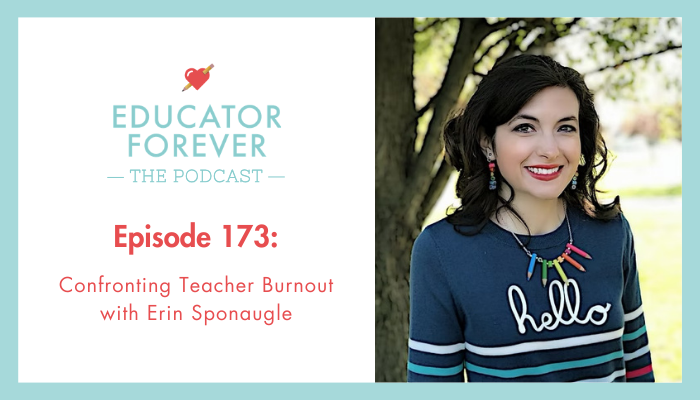
Dr. Erin Sponaugle has been teaching for 23 years. She’s a national board certified teacher and a former West Virginia Teacher of the Year. She’s also the author of two children's books and recently published Teachaholic, a book about overcoming teacher burnout based on her own experience. Erin is also the host of the Next Chapter for Teachers podcast.
In this episode, we talk to Erin about her educator journey, writing books, and most importantly, how teachers can avoid burnout.
Topics Discussed:
Not being aware of burnout
How the education system contributes to burnout
Being open to new opportunities
Resources mentioned:
If you’re enjoying this podcast, please leave a rating and review on Apple Podcasts.
Related episodes and blog posts:
Read the transcript for this episode:
Welcome to Educator Forever, where we empower teachers to innovate education. Join us each week to hear stories of teachers expanding their impacts beyond the classroom and explore ways to reimagine teaching and learning.
Dr Erin Sponaugle has been a teacher of students in grades three through five for the past 23 years. She is a national board certified teacher and a former West Virginia Teacher of the Year. Erin is the author of two children's books and recently published Teachaholic, a book about overcoming teacher burnout based on her own experience. Erin is also the host of the Next Chapter for Teachers podcast. Welcome Erin, so nice to have you here.
Erin Sponaugle 0:25
Thank you for having me, Lily.
Lily Jones 0:27
I always love to start with the same gigantic question that you can take in whatever direction you like, which is to tell us about your journey as an educator.
Erin Sponaugle 0:37
Okay, so I have at this recording, taught for 23 years in the classroom. I have taught third grade, fourth grade, fifth grade is what I did for the longest I taught 15 years of fifth grade, and I currently teach art to students in grades three through five. It has been a journey. I've been the new teacher that has taken on the long term substitute role to get my foot in the door to being a State Teacher of the Year, to experiencing burnout and almost leaving the profession, to now being in the in a place where I can share what I've experienced and how I can or how I have overcome certain things, to help other teachers find their way in the classroom and to also realize that they have a voice and knowledge that needs to be shared with others. So I'm very happy to be here with you today to talk about my new book. I'm also an author, and I recently published my book teach a Holic, which is about developing the mindset to overcome burnout and find a way to love teaching in spite of the obstacles that exist.
Lily Jones 1:56
Yes, congratulations on the books, on the years of teaching, on finding your way through burnout, all of that is cause for celebration. And I know in a lot of my work with teachers, teachers come to us really burn out, and they feel overwhelmed, and they really want to work in education and just aren't sure if they could stay in the classroom anymore. And so I'd love to hear a little bit from you about your experience. With burnout. How did you know you were experiencing it, and how did you find your way through?
Erin Sponaugle 2:28
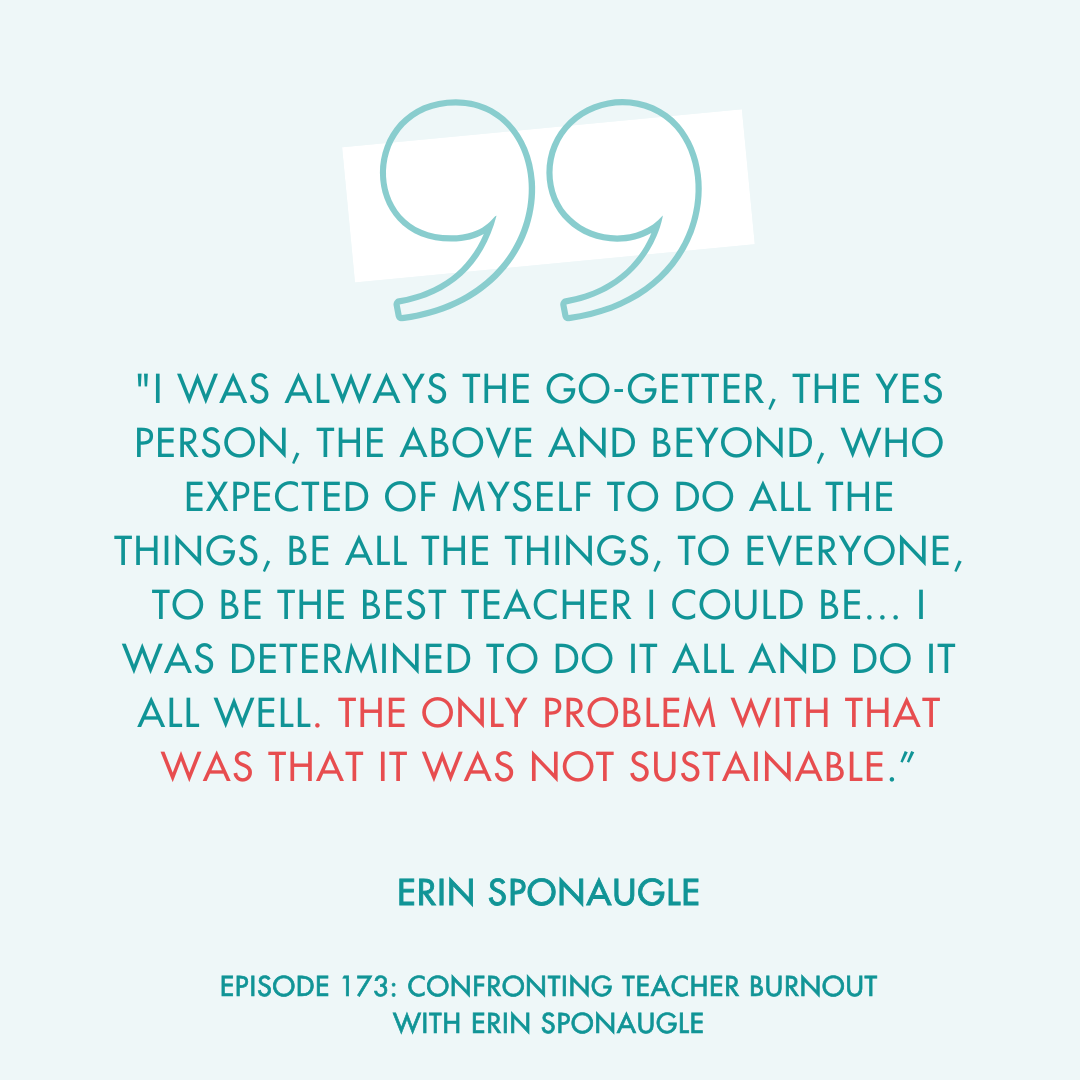
Well, I think the most important thing to start out with is I did not know I was in burnout. I was always the go getter, the yes person, the above and beyond, who expected of myself to do all the things, be all the things, to everyone, to be the best teacher I could be. I was really tied to the idea that I could do something that could change the lives of kids. And that doesn't mean that if you are looking at things through a healthier mindset, that you still can't change the lives of kids. But I was determined to do it all and do it all well. The only problem with that was that it was not sustainable. In addition to all the expectations of the classroom and what's expected of teachers and what keeps getting added to our plate. You know, I wanted to be super teacher, and eventually I got to the point where super teacher was running out of steam. I was feeling exhausted. I was disassociating from my job and from my relationships, I was almost like I was watching everything, and it was kind of scary to to feel that way, to feel that I just couldn't get in the groove, couldn't get it together and be as involved or be as enthusiastic about the things that I loved anymore. I was also experiencing like brain fog, almost where I couldn't or not, almost it was for real. I just couldn't focus, and I was just always rethinking or having a hard time motivating myself to do the simplest things that I had done for years. And worst of all, it started to come out in my classroom and how I interacted with my students, I don't. I wasn't, I wasn't the most effective teacher that I could be, and that was probably the most gutting of all, that I knew that I wasn't providing them with the best version of me, and I just I couldn't make that happen anymore. I couldn't be that best version of myself anymore. And it all came to a head one evening on the couch after a really bad day before spring break, I was scrolling through Instagram, looking at all the perfect classrooms and just realizing that I didn't measure up. And then there was this one quote that a teacher posted about, if you're not giving your best effort, don't expect your students to give you theirs. And I. Don't know what had happened that day in the room, but that was it. That was just a point where I crashed and realized something had to give. So I did not have the the word, the word burnout at that point, but I was definitely at rock bottom, and it took doing a lot of rethinking that following week during spring break, and the neck and the following summer break to get to what did I need to change? What did I need to have more to stay in the classroom, and it was a hard look at myself and the habits that I had developed over time that weren't sustainable. And what did I need to change to be happy and to be able to come back to the classroom and be an effective teacher and also be happy with myself again.
Lily Jones 5:49
Yes, all so relatable, and I appreciate you sharing that story. I think that so much of teaching is based on this idea of like teachers as martyrs, or a lot of caring professions, right? We give and we give and we give, and that's what celebrated and rewarded and even culturally, right? It's like, oh, teachers, thank you so much. Which, like, yes, of course we should be thanking teachers all the time. But I think it just gets so ingrained in us that we give and we give and we give. And you're right, it's not sustainable. And I actually really don't think it's a good model for kids. And so even going back to that quote where it's like, you know, you're giving your best to yourself, is actually what's going to help students do their best as well, right?
Erin Sponaugle 6:29
And kids need to see their teachers happy and well adjusted too, because they need to see that modeled in adults. And also our future teachers are in our classroom, you know, and these kids are watching us, and they see how their teachers feel and act, and if they come back year after year, and that's teaching them whether or not they want to possibly be a teacher. And if teaching never looks like a career that gives you a life that is you want to wake up to every morning, then you know that's going to make more people not want to come into the profession, because they'll have those memories as a child of, oh yeah, teaching. Don't want to do that. She was not happy.
Lily Jones 7:14
It's so important. And I appreciate that lens too. That is modeling for future generations, too. And I know we've talked about a lot of the reasons why teachers experience burnout. Are there any others that you'd like to add?
Erin Sponaugle 7:28
Well, nothing ever gets taken away. That is something that is very unfortunate about the teaching profession, is that more gets added to your plate every year. It's almost like going up a nearly vertical incline and it's raining and it's mudslide, you know, you just can't ever seem to get over or get past the next thing that's added and that just accumulates. And on top of that, the reason why often it seems like there's more added year after year, or even month after month, is that teachers get the message, either directly or indirectly, that they are not enough, that you're not doing enough. Their scores are not high enough. They need to do more. We need to do better. We're not supporting here. It just it feels like a bottomless pit and that. And you can be that person who is going to go, you know, deep, and say, Ari, I'm going to do whatever it takes, but usually it's going to land you in burnout, or you're going to feel defeated, or you're going to just walk away, because you're going to feel like you cannot be the person that you're supposed to be, even though you're probably already giving more than enough and doing Amazing things for your classroom. There is just the perception when more is added in, more autonomy is taken away from teachers who have gone to school and want to personalize and be creative in their classrooms. They want to be the good teacher, they want to share what they know and their talents with their students, but they're unable to because of restrictions and curriculum. You know, over time, it just makes you feel defeated, and the demands just make you feel like you can't go on. And it's understandable.
Lily Jones 9:16
Yes, the job of a teacher is truly never done, and so it feels like this hamster wheel sometimes, right? Of being like, Okay, if I could just finish this, but then there's always more to do. And so it feels like there's no end point. And the Yeah, I mean, I think so much of this is also systemic, you know, whereas, like, this system that's not set up for teaching to be a sustainable job, and then teachers internalize this, experience burnout, experience all these, you know, things that they don't need to and feel like it's their fault. And so I appreciate you know, thinking about all the many parts that go into teacher burnout, and so thinking about our listeners out there who might be like. Oh, I'm in burnout too. Maybe they had words for that. Maybe they didn't. What advice would you give them?
Erin Sponaugle 10:06
Well, the most important thing I think you do is you take a step back and you look at what you need, because we get so we're at the point this is being recorded in February, where we get halfway through the year and we get into that, you said, the hamster wheel, where you're just kind of stuck in motion, or you're you're stuck in motion, you are in constant motion, and you lose sight of what your needs are. And we can often put what we need, physically and emotionally on the back burner, because we get so in the groove, or that momentum builds up of what you need to do in the classroom each day, and then coming home, getting some rest, sometimes not very much, and then it just repeats and till the school year ends. So the first thing is, you have to take a look at what you physically and emotionally need, because your health is paramount to doing anything in the classroom and beyond. If you don't have your health, you don't have much of anything, and we can't ignore that from our about ourselves. We can't put that on the back burner. Another thing that matters is that you have to, like, ask yourself, What? What do you want? Because we can get so used to doing the same thing every day that we forget. You know that we're a human being too, and people change over time. People grow, people learn. You know what they need and what they don't want and who they want to become like. What do you what do you need to be happy and successful and to be be fulfilled as a teacher and to be fulfilled as a just a human being, and something that I have in my and teach a hawk is just setting some goals for yourself, and they don't necessarily have to be tied to the classroom, just what you need to feel healthy, happy and whole, because when you look at what you need as a whole person, not just, you know, being stuck in that groove of, what do I need to do as a teacher? How do I need to improve as a teacher that really puts some things in perspective and helps you slow down and think about how you've been internalizing your job, and it's how it's affected your life, or how it impacts your life.
Lily Jones 12:19
I appreciate so many things about what you just shared. I think this idea of teachers as constant learners, as humans, as constant learners who evolve and change over time can be really hard for us as teachers to realize that's true for us, that we don't have to do the same thing in the same way over and over and over again. And I know for me, teaching became kind of like Groundhog Day, where I was like, Okay, I've done this before, and I think it relates a little bit to the agency, which I think is also a systemic problem that teachers aren't given the agency or respect that they deserve and treated like the professionals that they are to be able to make these decisions and have the freedom to adapt. And so all of that you know goes back to what you were sharing about reflection, and thinking about what do I really want, like what's not working for me, and even that, I've realized over the years of working with teachers that is hard. It's harder than it seems like it should be. Oftentimes, folks are so entrenched in working in schools and entrenched in their own burnout and doing this unsustainable job that it's hard to even answer, what do I want?
Erin Sponaugle 13:21
Well, we also don't see examples. The Internet has changed us a lot of what else is out there, or how else can you have an impact if your needs change, or if you want to pursue different things, or if you want to have a different impact. In education, we kind of get our our teacher tunnel vision, and we, you know, we're in the school building, day in, day out, and there's a lot of ways that you can impact education and change the lives of kids that don't involve the standard classroom environment. And in education, it seems like you can be a teacher or you can be an administrator. There's two there's two boxes within the traditional school system in the United States, and there's not a lot of room to move around or to experience other aspects of education unless you really stick your neck out there and look for other opportunities and take those opportunities on on your own to explore. They won't be done for you necessarily, or won't be presented to you as, hey, this is an option.
Lily Jones 14:28
For sure. And so I'd love to hear a little bit more about the books that you've written. Can you share about the books, and also just what was the process of writing like?
Erin Sponaugle 14:38
So in the midst of my burnout, or coming on the other side of it, I really thought about what, what I would need to feel fulfilled as a teacher, what's something that I could do that was not necessarily classroom related? Because a part of me that was part of me that led to the burnout, or part of the part of it was. Like causing me to become burnout was that I was just stuck in that hamster wheel of always being tied to the classroom. It's like my whole life revolved around teaching. And I had to ask myself, what do you really want to do? What would you like to do that would be out of the box. That's not what traditionally everybody would expect you to do, because I really didn't have an interest in being an administrator or impacting education that way, and I really wanted to write a children's book. Now I had, during my tenure as the State Teacher of the Year, I had this bear. Hold on. Here. It gets bad. The story gets better. Here I had this bear, and I took him around wherever I went in West Virginia to teach the kids about different parts of the state. And he the bear had a blog, and he wrote to the kids. I took him to the different schools. I went in and talked to them about West Virginia, Virginia and the different state symbols, different parts of the state. So I wanted to write a book about a bear. No, okay. It's like, okay, well, how are you going to write a book about a bear? Well, then it got better. I thought, you know, I want to draw the pictures too, because I hadn't drawn for a long time, and I really liked drawing. So it's like, well, I hadn't Okay, so how do you, number one, write a children's book? And number two, how you go and draw the pictures? Aaron, because you haven't touched your colored pencil since high school. So, so it was a learning it was YouTube in Google University. For me, I just started looking things up, watching videos, because I couldn't really find anybody else that was in this, you know, track that wanted to do these things. So I learned how to format a book, how I practice drawing, and I picked it up, back up again. I drew a couple different versions of Berkeley, the bear. He didn't always look like a bear. He kind of looked like a hairy turtle at some points. But I got, I got better. And it took a cup. It took about two and a half years to really bring it together. But my first children's book, The Adventures of Berkeley the Bear, was published in 2017 and it was, it was like, like, that song, suddenly I see, it's like, I kind of saw, like, you know, another pathway or another way to educate, maybe in addition to being a teacher, which is through writing books. So because the book that I wrote is teaches kids about the different parts of West Virginia and the state symbols and all the things that you can, you know, learn about West Virginia. And also the theme of the book was experience, you know, had been brave enough to try new things, so I got to go to schools and talk about my book. I met people in the community that were authors as well, and I ended up writing a second book that the publication got delayed because of the pandemic, but it's Berkeley is a rocket bear where Berkeley learns about science and space, and it was great. I found it's like I found an outlet that I didn't know I needed to be plugged into. So back to back to the pandemic, or right before the pandemic, I had a student teacher, and we were on a field trip where the kids hadn't had an instructor, and we were sitting there while the kids were getting there, going through the lesson, and I was with my student teacher there, and I'm just remember looking at her, I think, man, what do I wish I knew when I was her age, or when I before I became a teacher? And I just was thinking while sitting there, because it was getting kind of boring, just sitting there watching the kid having a good time while we're just, you know, supervising that, you know, what? If I wrote a book for teachers, and this was like, 2019 this was like, right before the pandemic hit. So I had a notebook there, and I started writing up, what would I write in this chapter? What would I write in this chat, next chapter? And about maybe 10% of what I wrote down ended up actually being in teach a Holic, because, yeah, the pandemic changed a lot of things, but the seed was planted, and I kind of left the idea alone for a while, because after right around the pandemic hit, I had the opportunity to take The art teacher position at my school, and that involved getting certified to teach art, learning how to be an art teacher. I will say that part of breaking completely free of my teacher burnout was becoming an art teacher because I needed the complete change from teaching fifth grade. So that was a a good a good thing. But anyway, teach a Holic. It's kind of stayed in the background of my mind until I had a medical event in October of 2024, where I ended up on the floor of my very filthy heart room. Oh. And it was really scary, and it was a I'm fine, but it was kind of like a a moment where made me start thinking about, Okay, what do you want to do? Because life is short and things can happen in an instant. So that's when I really got serious about bringing teach a Holic to life. And this past summer, I just really got down to outlining formatting I had, you know, I I'm pretty good on the computer, so I'm thankful that I'm blessed to be able to do certain things that I didn't have to hire out. But I did find someone who would do my cover that was that was very that's good. You have to hire out for some things. But anyway, I was able to put it together. And I guess I should back up here and say, along with becoming an author, I set up next chapter press, which is my publishing in print, which is where I put I publish my books through. So I learned a lot about publishing, in addition to the writing, formatting, marketing part of books in the process as well. But teach a Holic was published in October of this past year, and I knew the topic would resonate with teachers. I didn't expect it to do as well as it did. Right off the bat, it went to number one on several in several categories. It got a very good reception. But while it's sad that we have to have a book about teacher burnout. I think that it's important for teachers to realize that people want to hear from other teachers, that your voice matters, and you are the expert, that we are constantly inundated with people who are the experts telling us how we need to teach, what we need to do, but you have the knowledge inside of you already, and the knowledge doesn't necessarily have to be curricular or academic. It's a lot of lived experiences that help connect teachers and help people make sense of this crazy world in and out of the classroom and help us, help teach us how to be congratulations.
Lily Jones 22:30
That's amazing and such a fascinating story too. I mean, as you were talking the first part about creating the children's book was so interesting to me, because I feel like there must have been part of that too that helped you with your burnout, you know, having this creative pursuit, creating something that was yours and doing something that was hard. I think that when it comes to learning, you know, we often think that learning shouldn't be so full of struggle, you know, or things like that. But it's like, I think that the most engaging learning experiences for humans, kids or adults, are challenging, and so I'm curious you know about the process of learning how to or relearning how to draw? You know, getting into the process of building a book, how that maybe helped you with your burnout?
Erin Sponaugle 23:17
It did help me, because I needed something that was not tied to the classroom, because having to have the discipline to write and draw and put a book together was going to require me to have a hard and fast boundary between school and home, and I could not be doing certain things up to midnight for school if I wanted to have the bandwidth to also write a book. So that gave that required me to forced me more so to create the space to do that. And that was important, and that is something that has carried with me that if you know you can leave school at school, and you can do a great job at school and be there for the kids and have a great rapport with them, and do wonderful things for your school community, and then you can take go home and take care of yourself and the things that light you up. So along with that, the creativity that had to go into that, like you said, with having something difficult to do or to work towards, that has helped me become a better teacher, not just because I'm an art teacher now, but it just helped me change how I think and how I I'm able to approach things we can be so overwhelmed in the classroom with underwhelming tasks, it's I call them pennies. They just keep adding pennies, and the pennies get heavy. So having something that is not necessarily overwhelming, but it's something that it's. It sparks your curiosity and your interest and you're motivated to try something new. That's important in that that kind of lifted me up to a point where it's like I could get through the school day because I had something to look forward to, had I had my challenge at home to look forward to when I walked in the door.
Lily Jones 25:20
But yeah, yeah, yeah. It's so interesting. I mean, just the idea of a challenge to look forward to, I think it's so inspiring. Rather than I think many of us, when we're tired, we're like, okay, we look forward to laying on the couch and watching TV.
Erin Sponaugle 25:35
I still look forward to that too. And some weeks, some weeks, more than others, because this time of the year is exhausting. They're at full force, especially ever after Valentine's Day or at Valentine's Day. Yeah, it's a lot.
Lily Jones 25:47
I think the other thing that stood out to me in your story is really just this identity piece. You know, we start off as being teachers and feeling like we're teachers. You know, it's so core to our identity. And through your story, you were also creating different versions of your identity, right? Being an author, being a book publisher, now being an art teacher, it made me think about, at the beginning, how we talked about having that agency. You know, even though, of course, you're still a teacher, and I think that, you know, teachers become State Teachers, no matter what they do, these different versions of yourself emerge through the process?
Erin Sponaugle 26:22
Yes, well, you know, I think we're meant to be many different things. We're meant to be multifaceted, and we kind of get put in this box, if you will, as as a traditional teacher, classroom teachers, where it seems like you can't expand or you can't pivot, if you will. But we're we're meant to be many different things throughout the course of our lives. And how many times do people in other fields change jobs or transfer within a building or within a company, and then teachers, we kind of stagnate, and that's that's not a bad thing. I mean, there are people that can teach the same subject or the same grade level for for 30 years. It's it happens, it can't. It's not a bad thing. But it doesn't have to be your thing if you don't feel that it's meant for you. And there's no shame in that, and there's a lot of possibility to be explored when you choose something different.
Lily Jones 27:27
So my last question has to do with exactly that, which is our teachers, who maybe I think they want to leave the classroom. What advice would you give them?
Erin Sponaugle 27:36
Well, I don't think we need to make people feel that they have to stay if they are ready to go. So I know that we are in a teacher crisis, where I know some people say there's not a there's not a teacher shortage, or just a shortage of people that want to be teachers. Well, it's kind of the same thing. But there we are. We are filling positions with people who are either not qualified or that are not permanent, because we are lacking in professional people who are there to do those jobs. They're way that way. So I know there's a there's a lack of people that are there to do those jobs, but you know that needs to be addressed in different ways. That needs to be addressed by we need to change things, not just that. We need to make people stay when they don't feel that they're meant to be there anymore. So there's a lot of there's a lot to think about. If you're choosing to to leave the profession, you know it's not an easy conversation to have with yourself or have with your family. There's lots of things to consider, but before you go, you know I would, I mean, it's not that years anything wrong with wanting to go, but it's important to think about what you can change. If that thing that you need to change in order for you to want to stay can be changed, and if there are other avenues within the education profession that you'd like to explore now, there's no, nobody's saying that you can't come back. You don't, if we're short on teachers, you're always welcome to come back in. But you know, we can't. We can't put a moral tag on teachers that, oh, you have to stay. It's for the kids, or Oh, you need to stay because you're so good at it, because you are meant to be many things within your professional career, you have the capacity to do those things. And instead of being she wants to leave us. Oh, well, what could we do to help people who are ready to expand or are ready to see what's out there? Because it's easy to feel that there's nothing else that you are stuck where you're at and I would like to see more people use their voice or use their experience. Audience, to share with others what they've learned and to also help work to create a sustainable practice for the people that are currently in the classroom and for future teachers as well.
Lily Jones 30:15
Wonderful advice. And thank you so much, Aaron, it's been so nice talking with you. Can you tell folks connect?
Erin Sponaugle 30:22
You can learn more about me on my website. It's Aaron spinogle.com you can learn more about Teach a Holic and my podcast, the next chapter for teachers podcast, where we talk about a lot of teacher mental health issues, classroom management, teacher burnout. You'll find all of that at Aaron spinogle.com you can also connect with me on Instagram at next chapter for teachers. And I, recently, within the past couple weeks, have set up a YouTube channel. I don't have very many videos up there yet, but it's at Aaron spinogle, and I'm going to cover different issues with teacher burnout and classroom management there as well.
Lily Jones 31:08
Wonderful. Thanks again Erin.
Erin Sponaugle 31:10
Thank you so much for having me, Lily.
Transcribed by https://otter.ai