
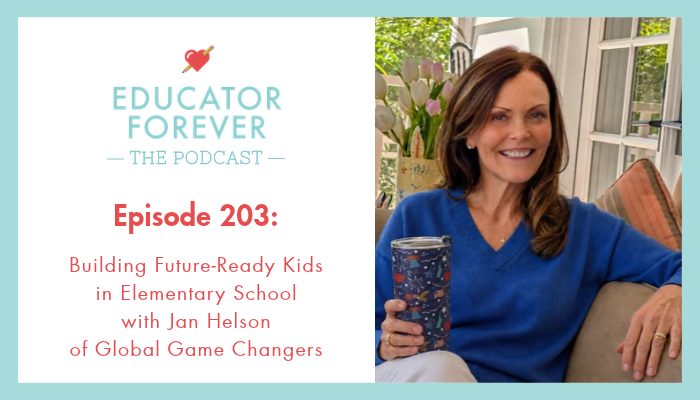
Jan Helson is a business leader and education innovator who spent more than two decades helping build Golden Foods and Golden Brands, her family's niche food manufacturing company, into a $200 million global business. In 2013, two years after selling the company, Jan co-founded Global Game Changers, building on two award-winning children's books that she co-authored with her daughter Rachel. Today, Global Game Changers provides free, evidence-based Pre-K to 5th grade character, leadership, and service learning resources designed to help children develop confidence, empathy, resilience, problem-solving, and a belief in their ability to make a difference.
Jan and I have a pleasant conversation about her success in business and why she jumped into the non-profit world. We get deep into her thoughts about education and child development, and she also provides some great business advice.
Topics Discussed:
My talent + my heart = My superpower
How focusing on employees helped her business
Staying flexible in business decisions
Resources mentioned:
If you’re enjoying this podcast, please leave a rating and review on Apple Podcasts.
Related episodes and blog posts:
Read the transcript for this episode:
Welcome to Educator Forever, where we empower teachers to innovate education. Join us each week to hear stories of teachers expanding their impacts beyond the classroom and explore ways to reimagine teaching and learning.
Jan Helson is a business leader and education innovator who spent more than two decades helping build Golden Foods and Golden Brands, her family's niche food manufacturing company, into a $200 million global business. After selling the company in 2011, Jan began a second chapter focused on a question shaped by her years in business: What if we started developing the human skills people need to succeed in the workforce long before they enter it? In 2013, Jan co-founded Global Game Changers, building on two award-winning children's books that she co-authored with her daughter Rachel. Today, Global Game Changers provides free, evidence-based pre-K to five character, leadership, and service learning resources designed to help children develop confidence, empathy, resilience, problem solving, and a belief in their ability to make a difference. Welcome, Jan. So nice to have you here.
Jan Helson 0:52
Thanks, Lily. I'm thrilled to be here.
Lily Jones 0:54
I always start our podcast with the same gigantic question that you can answer in whatever direction you'd like, which is to tell us about your professional journey.
Jan Helson 1:02
Okay. Wow. Okay. I I am an entrepreneur, but I'm innately an entrepreneur. My entire childhood and career has been built on entrepreneurship. Come from an entrepreneur family, so so business has always been kind of a natural segue for me. We've owned multiple businesses over the course of the year, everything from fertilizer to mail order dessert businesses, all sorts of different career paths and businesses, real estate development extensively, and ultimately, my husband and I took over our family business, which was a food manufacturing business that processed specialty fats and oils for the industrial baking industry. And so my journey there was that's the core part of my career. My professional life was spent running that company. Along with him, we had you know multiple hundreds of employees throughout the years that we had the company. We ultimately sold our company in 2011. Started running it right around 1990, where we took over the reins, and and it was a you know it was a very everything I had done previously in my businesses really led to that being a success. So we were able to take all those successes and all those failures and all those mistakes and all those good things that happened, and roll them into what became Golden Foods, Golden Brands, and and have a really great career there. However, we when we sold our business, and I will talk a little bit maybe more about that in terms of like my segue to Golden Foods, but some I mean into Global Game Changers. But my career path there was something that just set the the footprint for the rest of my life, or my second act, so to speak.
Lily Jones 3:01
So fascinating. I love hearing about all the different things that you've done, and I'm so curious about this transition that you've alluded to. You know, you sold the manufacturing company, and you transitioned into creating resources for elementary classrooms. How did that happen? Yeah.
Jan Helson 3:16
So going back to my career with Golden Foods, Golden Brands. One of the things that we encountered over the years were, you know, we had employees that did everything from commodities trading to chemical engineers to finance to production workers on the lines and to to forklift drivers to warehouse individuals, logistics, and so one of the things that we noticed throughout our tenure was that we started, or we didn't start, we had a high turnover rate, particularly in our production level of employees, those that came straight out of high school or sometimes GEDs that entered the workforce, and there was just an excessive amount of turnover, and you know, as you as a business person, you're going to immediately try to root cause what is causing that. There's a high cost to it, and obviously, we were in business, and so we assessed, started going deep dive into this root cause analysis of why are we having this high turnover rate? And ultimately, what we found out after going to the floor and talking to the individuals that were there and saying, you know, what possesses somebody to come to work, leave at lunch and never come back, and you know, or get their paycheck and never come back to work. I mean, what are we doing wrong? What what would make them want to do that? And so, ultimately, we found out that so many of these individuals who had become adults in the workplace just were not equipped to hand. The pressures, the understanding didn't have the confidence to speak up when they didn't understand what was happening. They went through trainings that maybe they didn't fully understand for whatever reasons, and didn't have the confidence to ask questions. And you know, it was like a light bulb. It was like we. It's so hard to believe that somebody could get to that place and not be able to feel confident enough or have the skill sets to where they felt like they could. And so as we dove deeper into it, we realized that there's a multitude of reasons. They come a lot of them come from very at risk backgrounds. Some of them just hadn't had those core competencies nurtured at home. Maybe school didn't come easily, so they didn't feel like speaking up, and they felt inadequate. Whatever the reason, and there were so many different ones. But but ultimately, it came back to the fact that they just didn't really have the core social emotional skills to To be successful in the workplace, and we didn't know what social emotional skills were. I never heard that term until I got into education post Globe and Foods, Golden Brands, right? So I mean, it was after the fact, but that's what it was. They ultimately didn't. So so we spent some time internally with all of our teams, helping you know people in finance and people in sales come down to the floor and interact with each other. Having people on the floor come up to the offices and understand most importantly everybody's value. That everybody within our organization had an incredible value, and that we couldn't do what we did without all of them. I mean, we we as the owners and we as the leaders couldn't be successful without every single person doing their job, and particularly for the individuals on the the line that were doing the work, touch you know working the product, putting it into the boxes, making sure it got ready for the customer, and they were really touching what was most important to the customer, right? And and they didn't really even recognize it. We were providing products to companies that made biscuits and pies for like McDonald's and KFC and you know all over the country. These these major chain products ingredient that went into these chain products, where many of our employees were going to eat, and we're like, you know, if you didn't do your job so well, that that the product wouldn't have the quality when it goes to the customer that makes this product for whether it's McDonald's or KFC or whoever it was, Pillsbury, and and so you are so important, and what you do is so important, and so long story short, we really changed the culture. Another word we didn't really use in the workplace in the 90s and you know 1990s and and 2000s. I'm going to say, but it's what we were doing. Is and we ultimately reduced our turnover rates, and but more than that, we also created a culture where people felt heard and that they belonged, and and helped to be part of the team and understood their value. And you know, which was a really great thing, not only for us at the company, obviously, but as a personal thing to know that we could bring everyone together in that way and help help stabilize those individuals' lives, and so we sold our company in 2011, and I was 51 years old at the time, and I was at a place we had other businesses, but none that we were consumed with on a day to day basis, like we were with the food manufacturing. So I have a lot of time on my hand, and being an innate entrepreneur, it's like okay, you know, I don't want to sit any longer than a couple days, and then I'm ready to go, right? So we went on a big family vacation, and I came home like, okay, what's next? And so I really had to kind of assess, you know, what we want, what I wanted to do. Did we want to start another business? Did we want to keep the ones we had and and and pursue other things? Ultimately, I really was, I guess, intrigued and also felt compelled to say, how did these individuals that we worked for so many years for us, and over the years, get to the point that they did without the confidence and the skill sets to be successful in the workplace. So, fast forward, going through a lot of other things that maybe we can go through. But you know, ultimately, we we I was I felt compelled to do a lot of research, do a lot of talking, talking to a lot of people far brighter than I am, and far more informed, and educators, and brain scientists, and and really trying to curriculum people. And along with my niece Ann Walker and my daughter Rachel, who is part of the story in another way that. We'll talk about down the road. We ultimately co-founded Global Game Changers, and with the goal to hopefully make sure that someday we'll get to the point that no child grows up without those really innate understanding of who they are and their value and how they can make a difference in the world.
Lily Jones 10:20
Fantastic! Yeah, how fascinating. I mean, I think about this like I was a kindergarten and first grade teacher, and then have spent the past 15 years writing curriculum and supporting teachers. And I always think about this from the teacher side, right? Of like these tiny kids growing up, and then hopefully going out there in the world with these skills. And it's so interesting hearing you talk about it from the employer side of like, hey, this is what I'm seeing in the workforce. How do we get there? And kind of doing the same thing, but in two different directions.
Jan Helson 10:48
Yeah exactly. Those two collide. I mean, you know, as a as a kindergarten and first grade teacher, you are building the foundation, and it is it is what makes them who they are down the road. And I don't know if you have children, but I have two children, and and you know from the day they're born till the day you know they're adults, everything you do in between is makes them who they are. And so if you don't lay that really strong foundation, and I'm super blessed that you know my kids are great and have successful lives and well adjusted, and but you know, so many so many kids for whatever reasons just don't don't have that. And I think that you know, education. I I didn't feel like I could make a difference from that day one to preschool because that's entering a whole different, you know, world of someone's life, but that, but that this was something missing in education, and and and there are others out there, obviously, certainly doing social emotional learning programs, but our approach and to it is a little different, I think than most of the programs out there, and so we we really took it from a very positive strength-based approach because I believe that's how you raise kids. And to be honest with you, I approached it as if I was raising children, like if they they were my own, and that's how you did it, and you you you teach them to be strong, and you teach them to be confident, and you teach them, or at least I did, through action. So not only modeling my actions, but also allowing them to have actions, not telling them all what to do, not telling them what those outcomes were going to be, but letting them learn through their actions. And our curriculum is developed in that exact same way. It's very strength based, and ultimately, it culminates at the end of each school year in a very action oriented culmination for the the program.
Lily Jones 12:57
That sounds wonderful. And so, let's talk about that a little bit more of what the resources are that you offer to educators.
Jan Helson 13:04
So we have a full pre-K by grade level, pre-K through fifth grade. It's elementary level curriculum. We have a short form and a long form. It is. It's we say it's social emotional leadership based because it is really teaching those those core competencies that is you know helping to build the children for for who you want them to how to become successful. The structure of it is all online though. So we have a educator portal. It is completely free. It's one of the commitments that we made as a nonprofit and through our resources to be able to ensure that this now and forever that the curriculum, no matter what what teacher, what educator, what after school program, what in school classrooms, it's it's intended as a very robust in classroom curriculum. It is an everyday curriculum. It's taught every day. However, it's also very nimble, and something that I believe in in everything you do, whether it's business or you know nonprofit world or everything, is that you have to learn to be nimble. And teachers know that better than anybody, and so it is. It is nimble in that you can. I'm going to say tiptoe in depending on where you are and what you know what your needs are and what students' needs you're trying to meet. And so this, you sign up on the educator portal. You do have to put your school and some information that we collect and that we stay in touch and and but they have full access. There are videos and there are powerpoints and there it's all downloadable or it can be used on the through through the portal and it has professional development. There are professional development videos, but we also send. Every educator who uses our program that wants one a full educator like a tangible kit. It includes some books. It includes an emotion management guide book. It because everything that as an educator uses isn't always want to be on a smartboard. They they like to you know have some of those those paper some paper content type things like these books and like the emotion management tools to use from time to time and to take with them and carry with them, and so and then we also of course we our curriculum is built the entire framework about it is built around an equation. It's a proprietary equation: my talent plus my heart equals my superpower. It sums it up, right? So it's all about helping children, you know, identify what they're good at or what they like to do, and to to understand that we're not all the same, and we all have different strengths, and we have different weaknesses, and we have different goals and desires. But everybody has a talent, and everybody has something that is is important to them. So we help them identify that, and then throughout the year, they are using that particular talent in order to build on their curriculum as they go through the school year, we have 12 heart badges where they learn about 12 different causes, from you know veterans to animals to elderly, you know, and a litany of of badges, education, and they ultimately identify at the end of the school year, or not? Excuse me, at the end of completing those units, what their superpower equation is. So they identify what their talent is and what their heart is, and they put an equation together. And the goal throughout the curriculum is to put that into action. Like I said in the beginning, it's not just about saying I care about this, but it's also to put it into action. And a really core part of our curriculum, which makes it a very robust, it's not always if you take it through full fidelity. It is. It is. I'm not going to say an easy curriculum, but it is an evidence-based curriculum, and so the you know the proofs in the pudding, so to speak, and and so it's really important that that the children have the opportunity to ultimately put their their super their equation into action and say to you, you know, Miss Lily, I or mrs. Jones or whatever it is, you know, I'm thrilled. You know, I'm I'm Jan, and I'm a fifth grader at X Elementary. And my superpower equation is this. And I made this because I really respect you as an educator, and I love you know education of my teachers. And to look you in the eye and to build those skills, and you see them gradually, you know, go from year to year to year, from the kindergartners all the way through the fifth grade, it's a you know they're invaluable skill sets. They don't build overnight. You know, you know that's one thing I think that I tell educators who we work with a lot because districts tend to look for quick results. Unfortunately, sometimes, and I know why. I mean, they want quick. You know, I understand their their goal, but let's be honest. You know things don't happen overnight. They didn't get to a certain place, and they don't get solved in that way. So if you don't give something the time to really be embedded into the core of who a person is, without pulling the rug out year after year with a new curriculum or a new program, then you're not really giving them a chance to succeed, and so we we tell districts straight up: if you're looking for that, you know, quick fix or just a checklist of things that you have to check off because that's you you have to say this during the day and you have to ask about this during the morning meeting, we're probably not the curriculum for you because we really look for impact. I mean, I do it for a very core reason, and and it's to solve the problem that I ran into in the workplace. And you know, I want to help build the next generation of employees that I wish I'd had in the workplace. You know, and and and that I know my employees wish they were at the time, and so so it's available. It's a you know our website, and we have a special portal, and it's accessible to everybody.
Lily Jones 19:28
What a wonderful resource, and how great that it's free for teachers too. And I love that you're saying you know the online resources plus the resources that can be sent and used in person. And yes, I agree that like it's not a quick fix, right? It's something that that builds over time, and I appreciate how your curriculum spirals and builds on each other year after year. And why elementary school? Why is it so important to start with workforce development with young kids?
Jan Helson 19:56
You know, I think because if you that that's the. If you don't start at the very earliest ages, then they miss out. I mean, I think that you know children start to form who they are well before even elementary school. Like you know, I said previously, I think that if you don't, you know, a lot of programs are geared towards middle and high school. Okay, I've hit high school. Let's start to develop these skills. Well, that's way too late. I mean, you know, they are way set in their ways. I'm not saying that you can't make a difference. I'm not saying that you can't nurture. But I, but generally speaking, the earlier you start to develop something and the practice that they get, you know, the adage that practice makes perfect. You know, you're always looking to to practice over and over again so that they can become more proficient and more confident. I use the word confidence a lot because I think it is really the branch to all of building all the other skills. If you have the confidence to try something and put yourself out there, it builds the resilience and it builds the communication skills in it, and so understanding and trying to build that confidence at a very young age. And if you don't have it starting at a young age, it's it's it's difficult to overcome. I think as people get older, and so so we believed in starting with preschool, and we really are focused on having them, you know, go from year to year because we also believe that you have to be repetitive in understanding that, but see the growth. I mean, we see enormous growth. We had just completed last year a QED, which is quite, which I'm sure you know, but a quasi-experimental design evaluation, and that had very positive results with our intervention school. We did a second-year follow-up, which also had a very strong, you know, continued growth within that, and we just recently, literally two weeks ago, so you're hearing it for the first time because it hasn't been announced yet. Were accepted by or accepted by Castle, which is the Collaborative for Social Emotional Learning, and they have given us the distinction of their Castle Select, which is their highest distinction for curriculum that shows impact, and through you know these through a rigorous evaluation process. So we're like we just feel that, and to be honest, the the evaluation isn't important for the process of for like just that we we got it. I mean, it's important that because we we know what's working and what's not working. Because even no matter what we're doing, there is that process of continuous improvement. And I, you know, of my two really core business takeaways, whether it's with business or global game changers or or life in general is is continuous improvement and really root causing what you're trying to solve. Because if you don't get to the root cause, you know you're you're never you're putting band aids on. You might be making a difference, but you're not really changing the trajectory and the core of of what you're trying to do,
Lily Jones 23:22
That's great advice, and leads into my last question, which is that we have so many teachers in our audience who maybe want to become entrepreneurs, and you have such extensive experience, you know, building businesses and now working in education. What advice do you have for educators out there who want to build something of their own?
Jan Helson 23:40
Wow, I think I think more than anything, I would tell them to be flexible, be nimble, even with what they might start out thinking is the trajectory that they're taking with their business and what they want to do because you know there are so many jagged roads and things that you run into and some of them are barriers but some of them are opportunities and and so you might think you wanted this but you might have this amazing opportunity through conversation or or just starting your setup for a business that you might realize that you know if I went this direction or another direction might be able to accomplish more than what I wanted to do and so it's where those two things come together. You know, we at Global Game Changers is you know being a nonprofit, we do a lot of grant writing, we do a lot of donation type things, and I have always, I mean, I'm incredibly grateful for the amount of amazing people who have supported our organization, but long term, I've always known that that's no way to run. An organization and and you know and or a nonprofit because those you know when as a as a owner of a business you are whether you're borrowing money or using your own money you're looking you're building equity and you are looking for a return on that as well and so when you're so you're building for the future by building equity whereas when you have grants, you don't you don't have that. They're one off type things. So I tell you know I've known a lot of educators who want to go like an entrepreneurial route, but many of them somewhat through the education and nonprofit route as well. And so I I really encourage them to to find number one what they're passionate about, what they love, what really makes them happy, but then also be willing to know that there's a lot of ways to get somewhere. You know, it really is. We at Global Game Changers have you know are at a place now where I'm putting back on my entrepreneurial hat and have created this amazing online way to to create. It's called Everyday Heroes, and we're we're creating a custom gift shop where we are trying to build some sustainable stem of income. You know, I mean, we want to ensure that I want to ensure, from my perspective, is that that this will always be here and always be endowed and always have a successful route for getting there. So Everyday Heroes provides that sustainable business put back on the business hat to support Global Game Changers owns it. It's fully you know Global Game Changers initiative social enterprise. But to me, it gives it a long term trajectory that grant writing and donations can't always, you know, provide, and I want that security. And I, I would encourage anyone to really look at the long term trajectory. How do you get short term what you want to accomplish, and how do you want to look at something from long term?
Lily Jones 26:57
Wonderful advice. And Jan, it's been so nice talking with you and learning more about global game changers. Can you tell people where they can connect with you?
Jan Helson 27:05
Yeah. So globalgamechangers.org is our website. Check it out. Would love for you to teachers to use it if they have questions. We're available. We do all kinds of professional development. Like I said, happy to just have calls and talk about their needs, and then check out everydayheroesco.com because that's our social enterprise. So we'd love for them to check it out. And I appreciate the opportunity. It was great to talk with you.
Lily Jones 27:32
You too. Thank you so much.
Jan Helson 27:34
Thanks. Take care.
Lily Jones 27:35
You too.
Jan Helson 27:36
Bye.
Transcribed by https://otter.ai