
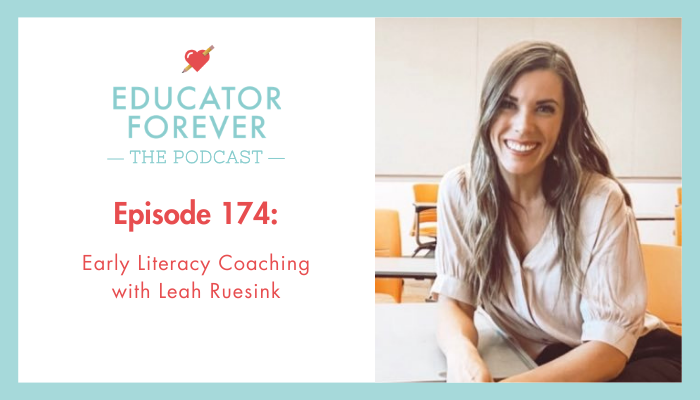
Leah Ruesink is an early literacy coach and adjunct professor based in Michigan. She supports K-3 teachers in implementing research-aligned reading instruction and provides science-backed literacy guidance to educators, coaches, and families. Through her work in schools, writing, and online, Leah helps bridge the gap between literacy research and everyday classroom practice.
In this episode, Leah and I talk about the importance of early literacy intervention to ensure students stay on the pace they need. We also get into the need for systematic, explicit phonics programs and business owners building their brand.
Topics Discussed:
Working as a literary coach
Dealing with imposter syndrome
Preventing the Matthew effect
Resources mentioned:
If you’re enjoying this podcast, please leave a rating and review on Apple Podcasts.
Related episodes and blog posts:
Read the transcript for this episode:
Welcome to Educator Forever, where we empower teachers to innovate education. Join us each week to hear stories of teachers expanding their impacts beyond the classroom and explore ways to reimagine teaching and learning.
Leah Ruesink is an early literacy coach and adjunct professor. She supports K through three teachers in implementing research aligned reading instruction and provides science backed literacy guidance to educators, coaches and families through her work in schools, writing and online as at the early literacy coach, Leah helps bridge the gap between literacy research and everyday classroom practice. Welcome Leah, so nice to have you here.
Leah Ruesink 0:24
Thank you so much for having me. I'm happy to be here.
Lily Jones 0:27
Well, I would love for you to start us off, but in whatever direction you'd like by telling us about your journey as an educator.
Leah Ruesink 0:34
Sure, absolutely so. My name is Leah Ruesink. I am an early literacy coach, so I support teachers in preschool through about fourth grade, but I began my journey as an educator, teaching and directing a preschool program. So right out of college, spent two years doing that, and then moves to teach young fives, which I think in other states, is known as transitional kindergarten or DK, but in Michigan, we call it young fives. So I taught that for a few years, loved it, and then also taught kindergarten. So really, the earliest years are kind of where my teaching experience is. But of course, as a coach, I spent time in kindergarten classrooms, first grade, second grade, third grade and beyond. So yeah, that's a little bit about my educational history. I also am an adjunct professor, so I teach some college classes to future teachers, which has been really fun to see education from that perspective, a little thing that I do on the side, and then coaching as well, has just been so powerful to see from that lens, right? I used to be in the classroom, and I had my four walls of my classroom that I could control, but being able to expand and to be able to influence so much more in education has been powerful. And I loved the classroom. I loved being a teacher, but I really wanted to just see what else was out there. And I think many teachers feel the same way. We're just curious, you know, what other roles can I have in education, and how can I make an impact in other ways? So it's been really fun. And I'm also working with a company called Secret stories. I've been with them for a couple of years, supporting and that's been really fun, too. So lots of different aspects of education, wonderful.
Lily Jones 2:16
I love hearing about that. And absolutely, I mean, I think many teachers feel stuck by being like, I just feel like I can be a classroom teacher or an administrator or leave education. And really, that's, you know, not true. There are many things you can do in many different directions. And I also related to what you said about being an instructional coach when I left the classroom. I also did coaching for several years, and it was so fascinating being able to see in people's classrooms. You rarely get a chance to do that as a teacher. So I love hearing about that part, too.
Leah Ruesink 2:48
So you have this bird's eye view of the school all of a sudden, and things from such a different perspective. And I had a ton of imposter syndrome, I'll say, which I know a lot of teachers experience when you go from teaching to any other profession. So I got over that with time. But that's definitely a common feeling.
Lily Jones 3:06
Yes, real talk. I mean, I think we all do right? So I think normalizing that is so important that we can't let it stop us from taking the next step. It's really like doing it while feeling the imposter syndrome. Is how you actually get through imposter syndrome?
Leah Ruesink 3:22
Yes, you just got to kind of make your way through it, experience it right?
Lily Jones 3:27
Absolutely. So tell us a little bit more. Why did you choose to focus on literacy?
Leah Ruesink 3:31
Yeah, you know, I remember this conversation I had with my mentor teacher when I was still in the classroom and we were just talking about how when kids can't read, everything else becomes so much harder, and not just academically, but emotionally. So we were talking about a couple students in her class, she taught second grade, who were just really feeling, you know, beat down by not being able to read. It was affecting their confidence, their identity, and it just that conversation really stuck with me, and she kind of helped me think through grad school what that might look like for me. I was already excited to continue learning, but I wasn't sure what direction to go. So I just remember that conversation really steering me in the direction of literacy. And I also always felt like something was missing when I was in the classroom. You know, I I learned how to teach reading, sort of in college, but there was a lot of gaps, and essentially I was just kind of figuring out, figuring it out as I went along, and using whatever resources my mentor teachers gave me. So I just wanted to keep learning. I knew there was more to the story. And you know, of course, I've learned, I'm still learning, as a coach and a literacy leader, that there's so much out there, and literacy is so complex, so I'm really glad that I went into all that we also know, you know, like 30 to 35% of students are reading proficiently in our country, which means almost 70% are not, and that's the majority. So I think there's just a real. Big need for literacy leaders and just educators to continue learning and growing.
Lily Jones 5:07
There's a huge need and such an important pursuit. And I know I taught kindergarten in first grade too, and when kids are behind in k2 and those early years, you know, often that impacts them later on. Can you talk more to that point, absolutely.
Leah Ruesink 5:22
Yeah, there's a quote that's based in research that a student who's behind in first grade has an 88% chance of still being behind in fourth grade. It's quite the statistic. It's not a research study, but to me, that kind of makes sense, right? It just shows early intervention and early instruction really matter, and putting our time and attention into those grades, because our kids don't have endless years to catch up, right? We we have to kind of spread out the code through kindergarten through second grade. That's how it usually works. And if kids don't get it, you know, they tend to struggle. So I really think the reason that many students fall behind is because they weren't given access to the code soon enough. Sometimes wait too long, or we think, Oh, kids aren't ready yet, right? Or they'll be developmentally ready later. We'll give them the code later. But what I've seen in my own classroom and as a coach is our kids are ready for more. You know, they're ready to read and write. We just have to give them something to do that with. I think that's one of those reasons that kids tend to stay behind. I'm working with a student right now. He's a third grader now, but when I started working with him, he was in second grade. He had so many gaps in his phonics skills, he could read, you know, basic CVC words, but when it came to phonics patterns like er, IR and you are, he was struggling, and that prevented him from reading text at his grade level. And those gaps just kind of compound over time. Right that map where the rich get richer and the poor get poorer, and he was stuck behind. So as his tutor, I really had to work to give him access to the code and give him tools that could catch him up quickly. And one of the things I mentioned secret stories earlier, that's one of those supplements that has been so, so helpful for a kid like him, to catch him up quickly. They're just these short, brain based stories that help explain tricky phonics patterns. And you know, for a kid like that, it's been so helpful to instantly give him access to to the code.
Lily Jones 7:30
Yes, that sounds super helpful. And so thinking about curricular resources and supporting kids in the early years, where do you think you see gaps in terms of phonics or morphology, or How can teachers start thinking about the way that they present the code, or when they present it to any insight there?
Leah Ruesink 7:49
Yeah, absolutely. I mean, our language is hard, right? English is everyone kind of knows that, but the more photomic language, so we have the phonics side of things, where teachers have to help kids make connections between tricky phonics patterns and sounds. But we also have morphemes, which are those meaningful parts of words, like prefixes and suffixes. So that's a lot. And then we have etymology too, which is the history of where words came from, is does it have a Latin or Greek origin, and that can change pronunciation. So I could go on, there's, there's a lot that makes our language complex, but we also have to think about how we're spreading out the code. So we tend to think of kindergarten through second grade as those years where we're teaching kids to learn to read, right? So we put a little bit of the code in kindergarten. We teach some of those phonics skills, a lot of it in first grade we found and then second grade, we put some more of the code, so it's kind of thinly spread out across those grade levels. And then you get to third grade, and in most schools, it kind of stops after that, phonics is basically over. If you didn't get it, you're out of luck, because now it's time to read to learn, right? So I think it's important that we rethink how thin Lily we stretch it out, and we do have resources like secret stories that give kids that early access. I think it's really still important that we have, you know, a systematic, explicit phonics program in place that systematically gives kids access to all those phonics skills, but we don't have to wait so long, so I think it's important that we recognize that right absolutely.
Lily Jones 9:30
And so we've talked about lots of great advice for helping teachers with teaching literacy. Do you have anything else you'd add for our teacher listeners out there wondering how they can maybe enhance their literacy programs?
Leah Ruesink 9:42
Yeah, I mean, like I just said, I think don't be afraid to give kids access to the code. Don't be afraid to for coaches, you know, help your teachers out with some resources that give give kids access to the code earlier. You know, phonics skills and morphology skills can be taught earlier. There. Some programs for morphology where you orally introduced morphemes to kids, so before they're able to read. You know, prefixes and suffixes. You can do some oral activities with those morphemes. For littles, is one of them that I really like. But if we do it in a way that aligns with the brain, we can really prevent the Matthew effect, which is that when the rich get richer and the poor get poorer. There's an example I want to share from last year. I was working with a first grade team, and we had just adopted Acadians, which is a reading assessment diagnostic and or I'm sorry, screener and I had been working with that team, and they saw the winter benchmark for first grade, and it was an oral reading fluency passage with a ton of complex words, a lot of phonics patterns in there that they hadn't introduced yet in the scope and sequence. So the teachers came to me and said, Listen, our phonics scope and sequence hasn't covered these yet. Kids aren't going to learn some of these phonics patterns until later this year or even next year. So what do we do? And that's a perfect example of if we're assessing our kids, you know, on these things, we have to be able to give them earlier access. So I think that happens often. That's something I've talked to a lot of teachers and coaches about. So yeah, I would just say, don't be afraid to give kids access to the code and keep the goal in mind, which is always teaching kids to read. Sometimes we get so focused on just teaching phonemic awareness for the sake of teaching phonemic awareness, right? Or the goal is giving our kids a list of sight words and for them to learn every sight word, but no, the goal is really helping them become independent readers and writers, and everything that we do should kind of lead to that point. So that kind of helps you, when you're looking at different reading trends, to figure out which 1am I going to focus on, right and which trends do I need to ignore?
Lily Jones 11:57
So important to keep our eyes on the prize and think about the bigger purpose of why we teach these things, absolutely. So I want to shift gears a little bit to your own experience, kind of building your own business and coming out of the classroom. Can you tell us a little bit about your building this brand as the early literacy coach? You know what inspired you to do that?
Leah Ruesink 12:17
Sure, absolutely. So I remember I started kind of building my account on Instagram, and it was called something else back then. So change the name a little bit, but I was in the classroom, and I was just starting to get excited about connecting with other educators. I was feeling isolated at the time, so I got an Instagram, I started to make some friends, pretty quickly, virtual friends, and we just started sharing literacy ideas. I followed other teachers and other coaches, and it was exciting. I started sharing things I was learning from the research and books I was reading, and podcasts I was listening to, and it just became kind of this little community. And then I also was creating resources in my own classroom, and I was able to share some of those through that platform. So it just became a really fun way to share knowledge with other other teachers, and I was seeing a lot of confusion and overwhelm out there, so just a really fun way to kind of have my own business, but also continue growing and learning.
Lily Jones 13:20
So cool. And I appreciate how you heard that you changed the name. You know, sometimes we feel like we have to do everything, and it's like, set in stone forever, right? Or I work with a lot of teachers who are starting their own business, and they're like, I just want to get my logo totally right. And it's like, for right now, right? Like it probably will change and grow and evolve. And so I love hearing, you know, that you went into it and it just kind of evolved over time. Yeah?
Leah Ruesink 13:45
That is so relatable. I definitely have made lots of changes over time.
Lily Jones 13:50
Yeah, and you don't, it's like we were talking about with imposter syndrome, right? It's like the way to figure it out is by doing something and then through the process of doing it, being like, oh, maybe that's not completely what I want to do, or maybe this tweak, or whatever it is that I think so often we can stop ourselves from doing things because of this, like, perfectionism, right? Of being like, it has to be totally right?
Leah Ruesink 14:11
That's exactly what I was going to say. I think I've become less of a perfectionist just through having this business, because I've learned, you know, it doesn't always have to be perfect, and I learned from every little mistake that I make. So yeah, anyone who's looking to start a business or an Instagram page or whatever it is, just just dive into it. It won't be perfect. I think my first year on Teachers Pay Teachers, I was so excited to start this business, to start selling things. And I think I made like, 20 cents my first year, I was so excited. You know, you got to start somewhere.
Lily Jones 14:46
So absolutely, absolutely. So thinking of teachers who maybe want to expand their impact beyond the classroom, whether they want to stay in the classroom and do something on the side, or leave the classroom and do something else in education, what advice do you have for them?
Leah Ruesink 14:59
Yeah. I would say, you know, my journey really started with going back to grad school, and that was my own journey. But before I did that, I started getting involved in the school. So I became a mentor. I think just taking more of a leadership role where I was was kind of the first step. So I remember, I got a mentor. I met with the reading specialist, because I had a million questions on how to teach reading at the time. And then I also asked my principal, can I, you know, have a couple half days to just observe in classrooms? Because at that time, I really had not spent any other time in classrooms since, like my so I started to kind of see, you know, what else is going on in other classrooms? Do I like this was coaching, something. I'd even enjoy sitting in classrooms, observing and being a part of that. So I started there, and then grad school was a huge next step for me, because it just started me on this spiral of learning more, listening to new podcasts. Yeah, so I think just continuing to learn, but also getting involved where you are now, you don't necessarily to leave your position to make an impact in education.
Lily Jones 16:13
Yeah, there are ways to experiment, and so I love the advice of going and seeing maybe you can just go see another teacher's classroom, or maybe it's talking to somebody who's doing something that you want to do, or maybe it's thinking about a class you know, that you might want to take, but just taking the small actions again, you know, they can compound, and they can also give clarity. Because maybe you take a class and you're like, well, not that thing, but just really, yeah, taking that first step and figuring it out. Yeah, absolutely awesome. Well, Lily, it's so nice talking with you. Can you tell folks where they can connect with you?
Leah Ruesink 16:48
Sure? So you can connect with me on Instagram. My handle is the early literacy coach, so and I would love to connect with anyone there. I share, share tips for coaches and teachers and parents around literacy.
Lily Jones 17:04
Wonderful. Thank you so much. Thank you. Bye.
Transcribed by https://otter.ai