
Episode 169: Aligning Neuroscience with Learning with Lisa Riegel
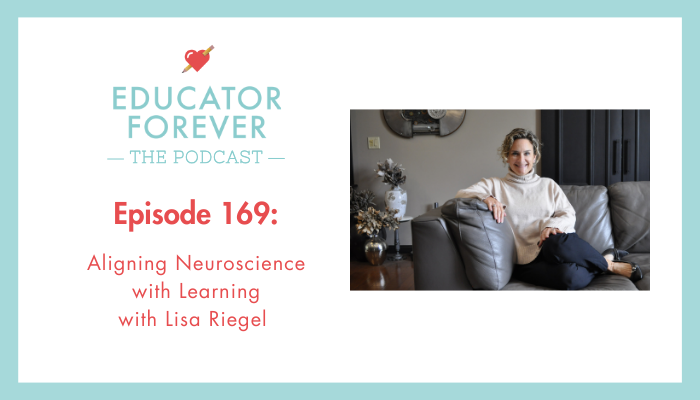
Lisa Riegel is the creator of the NeuroWell Framework and the 8C Commitment Framework, which are brain-based approaches to engagement and change. She holds a PhD from Ohio State in policy and leadership and is a former educator and school reform specialist turned leadership strategist. She is known for turning neuroscience into practical tools that help people gain happiness, health, and more success.
In this episode, Lisa and I talk about her journey from tech sales to education and the PhD work that drove her evolution. She also told me about how she integrates brain science into educational practices and the importance of emotional and intellectual safety in schools.
Topics Discussed:
The impact of technology on cognitive functions
Lisa’s 8C framework for leadership
Emotional regulation skills and self-management in workforce development
Resources mentioned:
If you’re enjoying this podcast, please leave a rating and review on Apple Podcasts.
Related episodes and blog posts:
Read the transcript for this episode:
Welcome to Educator Forever, where we empower teachers to innovate education. Join us each week to hear stories of teachers expanding their impacts beyond the classroom and explore ways to reimagine teaching and learning.
Lisa Riegel is the creator of the neuro well framework and the 8c commitment framework, which are brain based approaches to engagement and change. She holds a PhD from Ohio State in Policy and Leadership, and is a former educator and school reform specialist turned leadership strategist. She is known for turning neuroscience into practical tools that help people gain happiness, health and more success. Welcome Lisa. So nice to have you here.
Lisa Riegel 0:23
Thank you so much.
Lily Jones 0:25
So I would love for you in whatever direction feels good to you, take us through your professional journey.
Lisa Riegel 0:31
So I started..., I actually have a very crooked journey, so I started in technical sales right after college, and then after a couple years, decided I really didn't care if I sold anything. I was selling, and so I decided I really wanted to work with kids, went back to school, got my teaching certificate, and then I got a job in Columbus, Ohio, and I was teacher for nine years at a high school. I taught ELA, and I also taught journalism, and then I was an administrator at a career center, and I was in charge of kind of business partnerships and career pathway development, and I did that for two years, and then I had an opportunity to do a fellowship at Ohio State for my doctoral work. So I left that and did my doctoral work, and my doctorates in leadership, and I really was focused on the idea that a lot of the policies and the strategies that we put together can guide change, but people really, actually make it happen. And I also did a lot of work in sort of the workforce development phase. I ran an economic education summit for the state for a couple years where we really talked about, like, what, what do people need to be ready for the world of work? And interestingly, what kept coming up were emotional regulation skills, self management skills, all of those kinds of skills that schools aren't really systematically teaching and assessing. So then I have been consulting for like 15 years with leaders. I work with teachers. I help them to engage students. How do we transform our instruction? And about five years ago, I really went into the neuroscience place, because my doctoral work was really more around social science theory, like motivation theory, hope theory, things like that. And I was like, you know, the change starts in the brain, so, like, what's going on in our brains? And so I really did some deep diving into that. And then I have started I was a mental health coordinator for the state of Ohio for a couple years through a hospital and and then I wrote a book called neuro well, and it's really designed to help teachers understand the brain, because I feel like you know any kind of behavior is the intersection of biology and context. So if we understand the biology, we can reframe the problems and align solutions better, and then we have ultimate control of the context. So if we control both sides of those, we can help students and staff be happier, healthier and more successful.
Lily Jones 2:50
So interesting and so important. And I love hearing about kind of the twists and turns and how things led to one another. I'm particularly interested in just your focus on motivation theory is that we called it motivation theory, uh huh. And then the intersection of that and neuroscience, how do you see both working together?
Lisa Riegel 3:09
Yeah, so motivation that it's called the expectancy value theory, and it basically means I expect to do well, I value what I'm doing. I'm motivated. And it's a math equation that is multiplication. So if either of those factors is negative, then you have negative motivation. So for example, you know, like, I love gardens and they're beautiful, but I kill everything that I grow. And so my expectancy is really low, my motivation is really high. It's a lot easier to start to say, well, I guess this isn't that important than it is to learn how to garden. And we see this in schools all the time. We see that students come in and they don't believe they can do it, or they don't get the appropriate remediation and support, and so they don't have what's called intellectual safety. And when you don't feel intellectually safe in the classroom, then you end up, from a biology standpoint, you end up with a dysregulated stress system, which then shuts down your executive function, which then makes it harder to learn and think, and it becomes this whole rabbit wheel that causes more problems. Yeah, so fascinating. And I know that you've developed some really great frameworks, so I'd love for you to take us through what is the neuro well framework, and why did you develop it? So the neuro well framework is, I've been, I've been in the business long enough to know that information is interesting, but the real, the real meat of it is, what do I do with this? So when I wrote neuro Well, I the first chapter of the book really goes into Why are kids so different when I'm in schools today, people are like, this is just a big difference in students, and it's wearing people out. So the first chapter goes through all kinds of context, things that are going on in the world that have actually changed our brain. So I'll give you an example. Technology like you and I don't memorize phone numbers anymore because we don't have to.
Lily Jones 4:58
Sure don't.
Lisa Riegel 4:59
You just don't have to, which is great, and it's wonderful that we don't have to do those things. But the negative impact of that is we're not using our executive functions that we used to use, and we develop those through repetition, over time, in different contexts. So, um, so basically, the first chapter kind of goes through that, and there's like 10 different factors that are impacting our our brain, and how we learn. Then the second section really goes into that brain science, and it talks about how we form perceptions. You know, you think about like, there's reality, there's perceptions. And I always there's a part of our brain called the thalamus that's kind of like a data manager, and so it takes in all of the information from the environment, and it goes into our sensory memories, which are not conscious, and it decides like is this experience similar to another experience you've had? So if you have repeated experiences of failure in school, that's going to be a filter in that thalamus. So anytime you're facing a challenge, it's going to come up and say, You're not going to be able to do this. It's going to fail, you're going to feel terrible, and it will push the button on your stress system. And so it kind of goes through how we form perceptions and how our stress system works. And then the third section is all about, so what do we do? So it's, how do we set up the culture and and the framework is basically, we need safe, supportive and proactive. So the safety is not just physical safety. That's how we think of safety a lot of times, but it's emotional safety and intellectual safety in a school, the second is really around relationship, building power, sharing, building agency and kids. So a lot of schools feel like it's, I'm the boss, you're the subordinate. You do what you're told, you know, complete comply, turn in. And kids are tuning out to that anymore, and they're just not engaging for that reason. The third is really proactive. And I I work with some elementary schools, and I'm like, okay, can can you predict that kids are going to roll around on the carpet and poke each other? And it's like, of course you can. So then, why are you angry when it's happening, like, how do we actually, you know, help replace that behavior with something appropriate. Knowing that kids need to move, we can't change the need, but we can change the context to address that need in a way that makes sense. And then the last part of the book is for parents. How do you how do you help parents create a more positive context in their home, so that, you know, ideally, everybody, all day long, just gets positive filters put in their brain, so that when we look out in the world, we feel like hope, we feel excitement, we feel a sense of expectancy. And it goes back to that motivation.
Lily Jones 7:34
So powerful. And I love the idea of positive filters, too. I mean, I can really see that coming true, and what a difference that can make.
Lisa Riegel 7:41
Yeah, positivity. I mean, that's the thing. When people say, what do you do to fix these things? It positivity. That's what it is. And it's not just like hippie hooey stuff. I mean, it's truly like, you know, this is about your brain and how you set your brain up, and so if you're able to put those filters in your brain. The other thing about our brain is that 80% of our traffic is below our nose, and below our nose is the limbic system. It doesn't know time, and it can't tell a story, and only 20% comes from here. And so when I work with educators, even with like, discipline problems in the classroom, you know you're not talking to the kid. So we go at it from like, why did you make that decision? Or, you know, what were you thinking? And the reality is they weren't. It was the limbic system brain. And so, you know, it's kind of like, if you ever have a fight with somebody you care about, and then you calm down and you're like, Why did I say that? That's not who I am. And so one of the things I talk about in the book, and I teach this to kids, and this is something I think is really important for educators. If we know about our brain, if we understand how it works, then we can be self aware when we're self aware, we can be self regulating when we're self aware, and self regulating, we have self control. And at the end of the day, that is that expectancy side of that equation.
Lily Jones 8:58
I love that. That's so powerful for adults and for kids too.
Lisa Riegel 9:02
Yeah, yeah, well, and that's I work a lot. You know, a lot of schools have lately said, what do we do for self care, for teachers? Because teachers are burning out Absolutely. Yeah. I actually have a book coming out at the end of this month that's aspirational to operational leadership, and it promotes a 8c framework that helps leaders understand, kind of, how do you engage the humans in the system? Because teachers are told a lot what to do, but they're not actually given any clarity on what it looks like. And then there's, there's no systemic like celebration and the building of like peer to peer sharing. It's just kind of like, here's some PD, now you should be able to do it. And you know, we talk a lot about the zone of proximal development for kids, it's the same thing for teachers. So if I could tell you, here's the desired state, but you're over here, I need to also provide you with the stepping stones, and I need to celebrate every single bit of the way. You know, I always use the example. If somebody's really heavy and needs to lose 100 pounds, you don't say you need to. Lose 100 pounds. Call me when you get there. You say, Let's do two pounds a week. Let's do this. You know, you give them little achievable bite size goals to get there. So the book kind of goes through and helps leaders think about, how do they set the tone and culture so that it's positive for the teachers, because that will roll down into the classroom.
Lily Jones 10:18
That's wonderful. Yeah, I always talk about with adults so many things that I did with my students, like the zone of proximal development, you know, working with teachers who are trying something new, or anyone trying something new, we often have these unrealistic expectations for ourselves, being like, oh, we should just know it right away. Yeah, it's not true, right? Like, that's about how humans learn. So I love that reminder too.
Lisa Riegel 10:38
Well and you also have to think about there's reasons to resist, whether it's teachers or students, and sometimes, you know, you've got to address the reason to change, but you also have to address the reason not to stay where you are because you're comfortable. And that's something I think we don't oftentimes, we're just like, well, this is great for everybody. You should just go that direction. And it's like, well, yeah, but what are the costs to me, professionally or in my identity as a teacher or practices, I feel really efficacious about I'm gonna have to give those up, and that's scary. I know in two years, you're gonna go to a conference and find some new buzz thing, and then you're gonna throw all this out. We're gonna do something else.
Lily Jones 11:14
Sure, it's ongoing. I mean, that's evolving humans, right? Like we move into the next phase of whatever we're doing, and then something else comes along. So it's never, I think, ending, yeah, yeah, for sure. So you talked about this a little bit of just how different classrooms seem to be nowadays, and I'd love to talk a little bit more about why you think so many students, or people in general, are struggling with mental health.
Lisa Riegel 11:38
Yeah. Well, I think part of it is so there's a lot of contextual factors. So again, those filters in your brain. So like, I'm going to date myself here. But when I was a kid, I watched Little House on the Prairie. I watched, you know, Saved by the Bell. I watched these shows that were about wholesome community building, family, you know, owning your mistakes, helping people feel good, and that becomes your worldview. So from a brain science perspective, that becomes the filter through which you see things. So if you see somebody coming at you, then you assume they're going to be kind, because you have that view in today's media, our kids are based in just awful things. It's about voting them off the island. It's about manipulation. It's about tribes and getting this group to not like this group, or, you know, it's just all about conflict that doesn't get resolved in a humane way, and that builds a filter, and then, you know, so that's one aspect. And I'm not saying TV is the death of all of us, but it's one aspect. The next aspect you would layer on top of that is social media, and that's just that is a cesspool. And, you know, talk about negativity and fear of being canceled. And you know, having to, like, navigate this persona online that maybe isn't, isn't who you are. Like, I always laugh because, you know, I had a Facebook account, and it was fun to, you know, have this Facebook account and check out where my friends from high school were or whatever. But after a couple months, I was like, I'm angry when I watch this, because I'm thinking to myself, What am I doing wrong? I'm not on vacation all the time. Everybody's at a beach. I'm not at a beach. Everybody's kids are perfect and beautiful, and everybody's bragging about all this stuff. I can't get my kids to shower. Their rooms are disgusting, you know? And so it was like this, this sense of this fakeness that was being created. Well, from a science perspective, in your head, that's a problem, because now I have, like, who I want to be, this ideal self who I know darn well I'm not. Well, then they come to school, and it's a brick and mortar building, and I have to face people, and I'm not the person that I'm projecting, I don't feel that confidence, and so you feel sort of disengaged. The other thing with social media is that I can go on there and change my profile picture or do something, you know, like, you know, help the animals or whatever, and I can get 1000 likes, which is a dopamine hit every time I get that like. So it's a big reward for a very small risk. You go into a brick and mortar building, say you and I are walking down the hall, and you fall down and drop your books, and I help you pick them up. And you say, thank you. I get one seen a massive decline in altruistic behavior, in helping other, because you're not getting from a you know, you're not getting the the high. You're not getting the local high. So that's one of the things too. With like the neuro well framework, it's all based in positivity, give them those dopamine hits in real time with their community members in the classroom. Another thing is technology. It's impacting you know that in they've been doing some research, they call it cognitive offloading, so that we offload the responsibility for thinking to technology. It's great. It makes it efficient, and it's wonderful, but there's an unintended side effect that we're not developing those cognitive functions, and we, you know, AI is a whole new challenge with that. So, so that. Another area that can be problematic for kids, and I always use the example with the teacher. Think about how we grew up. When I had a question, I'd go library. I had to find a keyword, I had to navigate a spatial organization. I had to find the book. I had to preview it. I had to skim it. I had to do all those things that teachers are beating their heads against the wall trying to teach kids to do the the thing is, I had to do that repeatedly, over and over again. Now I just asked my phone or chat or something. So it's a challenge for schools, because they have to think, how do we build that thinking into how we do our teaching and learning? And right now, I don't see that we're doing that, we're we're teaching content, but we're not teaching the actual thinking skills. Then the other one, I'll tell you, there's a few other ones, but the other one that I think is a really big one, is the mental field. The medical field wants you sick because they make money off of that. I mean, you sit down and watch commercials again with that worldview, you either have skin disease or diabetes or, you know, you have all these every single thing we watch. And so I'm amazed by how many kids define themselves through their illness. I will mean that I don't even know, and they'll be like, Yeah, I have social anxiety. I have this that, and that becomes a filter. And so if you say I'm socially anxious when you are in a social situation, your brain is going to go, Uh oh, we need to be anxious. And it's going to raise that stress population system. And just, you know, the National Institute of Health came out with some statistics, social anxiety is misdiagnosed at 98.7%
Lily Jones 16:35
Wow
Lisa Riegel 16:36
Yeah.
Lily Jones 16:36
Wow. That's so extreme.
Lisa Riegel 16:39
It's yeah. Depression is like way over 60%. bipolar is over. So we are in a society right now that when you have a struggle with your stress regulation, it's a disease like we're all supposed to just be happy and and that's not realistic. And so all of those things have have created a whole society of really dysregulated people. And so when you're dysregulated, you can't think, and you get into this cycle. And the the other problem in your brain is that your amygdala, which is sort of your security center, it decides when, when your Thalamus, this data manager, when it sends a message to the amygdala. The amygdala then says, Okay, are we in danger? If it thinks that you're in danger, it can either just tap the panic button, and which is just to take you to like an alert phase, which is actually good for you. It's kind of like before an interview or before sporting event, or it can wail on it, and then you're into the alarm phase. And kids today, I hear teachers say all the time they don't know how to do a productive struggle. And teachers, I've seen struggle with a productive struggle when it doesn't work, the first time they get very emotionally upset about it, they don't want to do it. And that is an example of going right from calm to alarm. And every time our amygdala hits that panic button, the panic button gets, like, more and more sensitive. So as you get into that cycle, you get into a point where your limbic system has hijacked your brain. That's what I think is happening in our schools, and not even just in the kids, it's the adults as well.
Lily Jones 18:14
Yes, absolutely, this is so interesting. I mean, my background is learning design and learning science and productive struggle is how we learn. Like we need it to be productive struggle. We need to be in the struggle and feeling uncomfortable, and, you know, in the zone of proximal development, to be able to learn and do the new thing. So I think the pathologizing of the hard yes is really detrimental. And it's so interesting to hear you talk about that from a neuroscience point of view.
Lisa Riegel 18:41
Yeah, well, and I think it's, and again, it's not just the kids, you know. It's like, as I do professional development with teachers, it's like, I can give you content and I can give you some examples, but that, you know, I hear more and more well, can you give me a plan for a second grade classroom? No, you a general play. I can't come in and, you know it, it isn't a one size fits all, like, you know, your kids. So let's take this general implementation plan and let's tailor it to what your kids need. But I think, you know, everybody is in this just, just give it to me. Just give me the answer, and, you know, and look at like, AI, it's giving us the answer, and we're not even reading to see if it's accurate.
Lily Jones 19:22
Yeah, yeah. So so fascinating, and so thinking about teachers who have you know this reality in their classrooms and are struggling with student behavior and engagement. What advice do you have for them?
Lisa Riegel 19:35
So the first thing I would say is that you have to establish your classroom as a learning community. And the word community is important there. There's been a lot of research done around what's called collective identity. And it actually, it's interesting. It grew out of some evaluation of, like, the whole diversity movement, that we've celebrated diversity and multiculturalism. And the researchers were like, we're not seeing any. Evidence that this had a positive impact. We still see people hunker down with like people we're not we're not seeing this multicultural engagement. So they said, why is that? And they said, Is there anywhere where that's happening? And they went to the military, and they said, you know, soldiers, you can be black, white, green, purple, rich, poor, from the East Coast, West Coast, like wherever you're from, they form these strong ties. And they were like, how is it that multicultural people are forming these strong ties? And they looked at mega churches as well, and what they found was that the identity of being soldier superseded the identity of being, you know, black or white or poor or woman or man, or any of those things. And it's kind of like in a school setting, what you can see with the collective identity. So I, like I did my PhD at Ohio State, they have a very strong collective identity. People who never, never attended there, wear their gear, and they want to be part of that Buckeye nation because it means something so like, if I'm walking down the street and I see somebody, not in Columbus, because everybody's wearing it, but like, my husband and I went to Germany, and we there was a OSU game on, and we went in and somebody yelled O, H, and we yelled I, O, and we sat and drank beer with them all afternoon and had a great time, because in that moment, that was our identity. It's kind of like the Breakfast Club that movie. So the first step is, really, how do we set up a learning community where everybody feels a sense of belonging. And then the second is to really look at routines. How do we set up routines that are based in positivity? And I teach teachers to do learning sprints, so we have about eight to 10 minutes of attention. And if you're teaching little ones, it's even less so. How do we set up a learning sprint, take our lesson and chunk it into these little sprints, and then stop and give the brain time to process, and then also infuse positivity, like make those little brain breaks as purposeful. Right now, I see a lot of times we wait until the kids are really squirrely and then we do a brain break. Or, you know, at the high school level, if the kids are talking and not on, you know, then we do a reset or whatever. But if we're proactive, which is part of that neuro Well, culture, we know that they're going to need a break. And, you know, even if we do professional development, teachers can't sit for eight hours and just consume, nobody can. It's not so, so kind of thinking of those proactive ways that you can build in routines that are high impact routines. And then the other thing I say is teach kids about their brain. Teach them that they have these departments in their brain. And you know, if you're the CEO of your brain, your job isn't to do the work of those departments. The job is to make sure those departments do the work well. So if you have a thalamus or a data manager that is giving you really bad information because he's running everything through a negative funnel, then you, as the CEO, can put information downward to change that perspective. So we have a lot of power through positive thinking to fix and to alter the way that we perceive our reality. I always say the solution pollution is dilution. So if we dilute more and more positive stuff, you know, those negative ones never go away. I mean, we are the product of our life experiences. But if I can, you know that that amygdala, that security monitor, if he, if the Data Manager, says, Well, I don't know what to tell you, because we've got some positive associations, we got some negative then what's going to happen is that amygdala is just going to tap the button and say, Hey, CEO, can you weigh in on this? What's going on? And we're able to retain our ability to be in control and think about doing,
Lily Jones 23:35
Yeah, I love that so powerful. And so thinking about your own journey. You know, doing all these interesting things, writing books, coming up with the frameworks, working in schools, we have a lot of educators who are listening, who might have something that they really want to go after and do that's their own. Maybe it's beyond the classroom, maybe starting a business. Maybe it's starting consultancy. What advice do you have for them?
Lisa Riegel 23:58
So I get asked this a lot, because people are like, how did you get to do what you do? And the few things I would say is, one is you have to be willing to take a risk. You're not going to be in a union with a regular paycheck, with a retirement, with health insurance. You know you have to be willing to take that risk. And you know, so if, if you and I'm talking about being a consultant, you know if you're willing to take that risk, then my solution is just say yes, say yes to everything, because you're going to learn. And you don't always see how the dots connect. But I've seen some consultants that get so narrow about this is what I do that they don't have opportunities to apply what they do to other situations, because everybody's not going to see the same way. So I've done, I mean, the work I've done, I mean, I've done case studies on how to get underrepresented populations and women into STEM I've done workforce development. I worked with our economic development engines in the state to help combine with schools. I've done communication audits. I've done, you know, all kinds of. Different things, and it's created for me, a really broad expertise where I can start to pull all of these things together. So that's what I would say, is, you know, you have to believe in yourself. And as far as just the logistics of it, start by writing something, write something, get it published. It's not hard to do anymore. You don't have to publish it in a peer reviewed journal. Just go to your, you know, if you're an English teacher, go to your English Association, or things, you know, like that. Get your name out there, and then go to conferences. Go to as many conferences and present as you can. But when you present, come in presenting a solution. Don't just go in and say, here's all the problems, like, whether it's white paper or it's it's a step by step thing, or these are the things you need to do, and I'm the person that can help you do them.
Lily Jones 25:50
That's wonderful advice. Thank you so much, Lisa, yeah, and it's been wonderful having you on the podcast. Can you tell folks where they can connect with you?
Lisa Riegel 25:57
Sure. So Lisa regal.com, and then you can link to my books directly through the website. And then, if anybody, and I'm on LinkedIn, and so if anybody's looking, you know, I do book studies with schools, so a group of teachers, and they can get CEUs, and we meet virtually a few times, or three, four times. I do professional development and keynotes. And then I take about five or six clients that really want transformative change, and I go deep with them each year. So I limit the number so that I'm able to do it. But, you know, I do that, I do some professional development with teachers. So I'm, you know, I'm super passionate, because it's been interesting as I've done this work with the brain science. I've done a lot of PD in my life, and you see teachers like this, you know, just reading papers or looking and when I come in and talk about brain science, they don't know it. And they start and they close their computers, they lean in and they go, Oh my gosh, why don't I know this? And I'm like, should? We should be teaching this as a not just a one off class. We should be infusing this all the way through. And so I found that it's been really exciting to watch the teachers say, Okay, I want more. I want to know how to do this. I want to figure this out.
Lily Jones 27:13
Yeah, so wonderful. Well, thank you again, Lisa, and I hope you have a great rest of the day.
Lisa Riegel 27:17
Thank you. You too.
Transcribed by https://otter.ai