
Episode 186: Fostering Creativity with Josh Davidson of Night Zookeeper
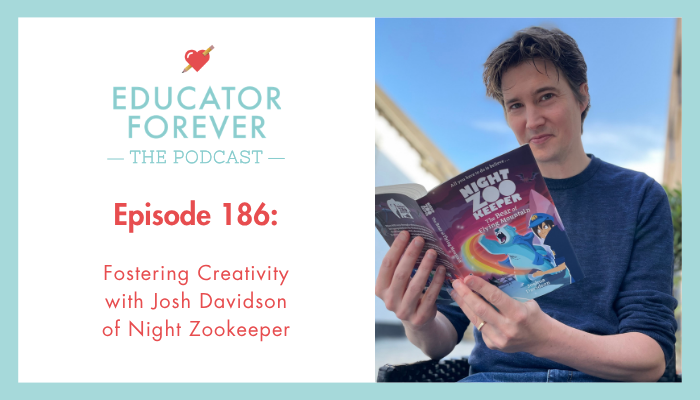
Josh Davidson is the creator and co-founder of Night Zookeeper, an award-winning online learning program that helps children fall in love with reading, writing, and creativity through games and storytelling. Josh is passionate about giving kids the confidence to see themselves as writers and creators, and he speaks regularly about the power of play, stories, and co-created worlds in education.
Josh and I have a great time talking about inspiring creativity and a love of learning in kids. We also get into the challenges he faced creating his show, and he provides a lot of great tips for budding content producers. You’ll want to tune in!
Topics Discussed:
Nurturing creativity in children
Integrating AI into education responsibly
The future of Night Zookeeper
Resources mentioned:
If you’re enjoying this podcast, please leave a rating and review on Apple Podcasts.
Related episodes and blog posts:
Read the transcript for this episode:
Welcome to Educator Forever, where we empower teachers to innovate education. Join us each week to hear stories of teachers expanding their impacts beyond the classroom and explore ways to reimagine teaching and learning.
Josh Davidson is the creator and co-founder of Night Zookeeper, an award-winning online learning program that helps children fall in love with reading, writing, and creativity through games and storytelling. He's also the author of the Night Zookeeper Adventure Book series, which follows Night Zookeeper Will into the magical night zoo, filled with fantastical creatures dreamed up by children. Josh is passionate about giving kids the confidence to see themselves as writers and creators, and he speaks regularly about the power of play, stories, and co-created worlds in education. Welcome, Josh. So nice to have you here.
Josh Davidson 0:34
Thank you so much for having me.
Lily Jones 0:36
So, I would love for you to start us off by telling us about Night Zookeeper and why you started it.
Josh Davidson 0:42
Of course, of course. So, Night Zookeeper is a reading and writing full language arts curriculum, but at its core, you know, and it's in its DNA, it's a creativity platform, and it started because I was, I mean, as a kid, I was one of those that was full of ideas and wanted to tell everybody and anybody all of the things that I'd been coming up with. My poor mother got the brunt of that. And then, as I grew older, I did - I did a fine art BA, so I'd studied painting, and I would always write stories about my paintings. It was kind of my thing to write stories about paintings. And then I did a master's in digital art, and I looked around at all the technology that was coming out, and this is back when blogs and wikis were first being invented, and everything that was labeled as creativity, digital creativity for kids was terrifying to me, because it was no better than a keyboard that played preset songs. It was, it was, you know, pick from one of six options, hit there's a dice, and it will give you an idea, you know, not none of what my childhood was about, which was thinking of ideas using the brain to come up with creative things, and I felt like technology could be used for so much more to enhance that sort of what I cherish in my life, which is the things that I'm able to come up with, and I want to enhance them, so you do things like connecting to other people, that's what technology is so good at, is you know, reaching out into, into, onto the line, and finding feedback, and all those sort of things. And so, Night Zookeeper is really a full expression of that. It's a platform that nurtures kids' imaginations, encourages them to develop the skills that they need in life to communicate effectively and with growing confidence, and then motivates them to keep doing that by using games as a, you know, because everything has to have the gamification element in this day and age, but really at the core, the meta game, if you like, is the love of connecting with other human beings using your ideas, and that's essentially what Matsuki for is.
Lily Jones 3:09
That's beautiful. I love the love of connecting, and the focus on creativity, which is something that I think is underrated in education.
Josh Davidson 3:17
Bizarrely, it seems to have found its way into the margins, which is absolutely incredible, especially when you think you know so many of our thought leaders and academics have proven time after time that we learn when we're engaged, when we're connected to another human being in the process that we're going through, when we make mistakes when we're thinking of different original things, and yet we've still designed curriculums and educational programs to focus around, fixate around, you know, fact retention and testing, and it's like, where did this get into such a come such a big thing, you know. We work with primary age or elementary age as students, but I believe that, you know, this is, you know, we all should be lifelong learners, right? And we would all be better learners if we didn't get turned off the concept of learning as we got older, if we managed to maintain our own understanding that we learn when we're playing,
Lily Jones 4:21
Yes, and we learn together, and learning is co-constructed with other people and not a straight line, but I completely resonate with what you're saying of this education system that has gone so far off course for over indexing on content knowledge and standardized testing and performance, and so knowing that you've created this lovely program, how do you fiddle into this world that exists that may have totally...
Josh Davidson 4:48
We struggled, we struggled for a long time, you know, for the first.. we've been going nearly 15 years, for the first eight.. thank you. Eight nine years of that was, you know, desperately trying to sell our solution into school systems that had no money, no desire to try something different, and to be fair to the school systems, very limited access to the sort of technology that we were, we were sitting on top of, and when they had that limited access to technology, they used it for programming classes that were becoming a thing, or maths, because computers are so easy, it's so easy to say right or wrong to a maths question with a computer, so when we were there, going, hey everybody, we can really enhance your creative writing and all of the imagination that we think will be. They were like, that sounds lovely, but you know, there's no budget, and I don't know when I would use it, and all this anyway. So that was the first seven eight years of real struggle before we, we thought maybe parents are interested, and they were. We got a TV show here in the UK based on the book series. So, I'm the author of the Night Zookeeper book series. That was sort of part of the genesis of the idea was that I'd come up with this children's story about a zoo with strange magical animals, and I realized that it was, though I loved my animals and story that I'd created, it was more of a question of all of the possibilities that of what could live in a zoo at nighttime, and the whole process over the last 15 years has been me realizing just how uncreative I am compared to children, because the characters that they've come up with to live in my magical night zoo far exceed what I was able to do, but I think you know that's that's the point, really. So, we've, you know, we work with a lot of home schoolers, a lot of parents who are interested in nurturing, you know, children who are, who love reading and writing, and maybe one day want to be authors, and they, we give them a platform to share their stories, but also parents who have, who have children that hate reading and writing and have no interest in doing it at all, and that's where Might Zookeeper can act as a fantastic intervention, because as a program it's presented as a game, and it's just that the game is inherently wonderfully creative and gives them the reasons to learn the skills to get better at that creative expression.
Lily Jones 7:30
That's so fascinating, hearing about the journey too, from trying to fit this program into a system where...
Josh Davidson 7:36
I did, I did worry, I tend to get passionate and ramble before we started. Apologies, that was a slightly long-winded answer.
Lily Jones 7:44
No, no, no, no. It was great. It was great. I love hearing about it, because I think it's realistic. I mean, I have been working as a curriculum developer for 15 years now, trying to create, you know, similarly creative or curriculum that doesn't always fit into school systems, and even if individual teachers want to do it, it's hard, right? Like, how do you...
Josh Davidson 8:04
Champions, you know, they're made to struggle inside their schools to affect change and bring something new in.
Lily Jones 8:11
Yes, so it's fascinating hearing how you went the parent route, and how that was a more direct way, because the ultimate goal is to get in front of kids, right?
Josh Davidson 8:20
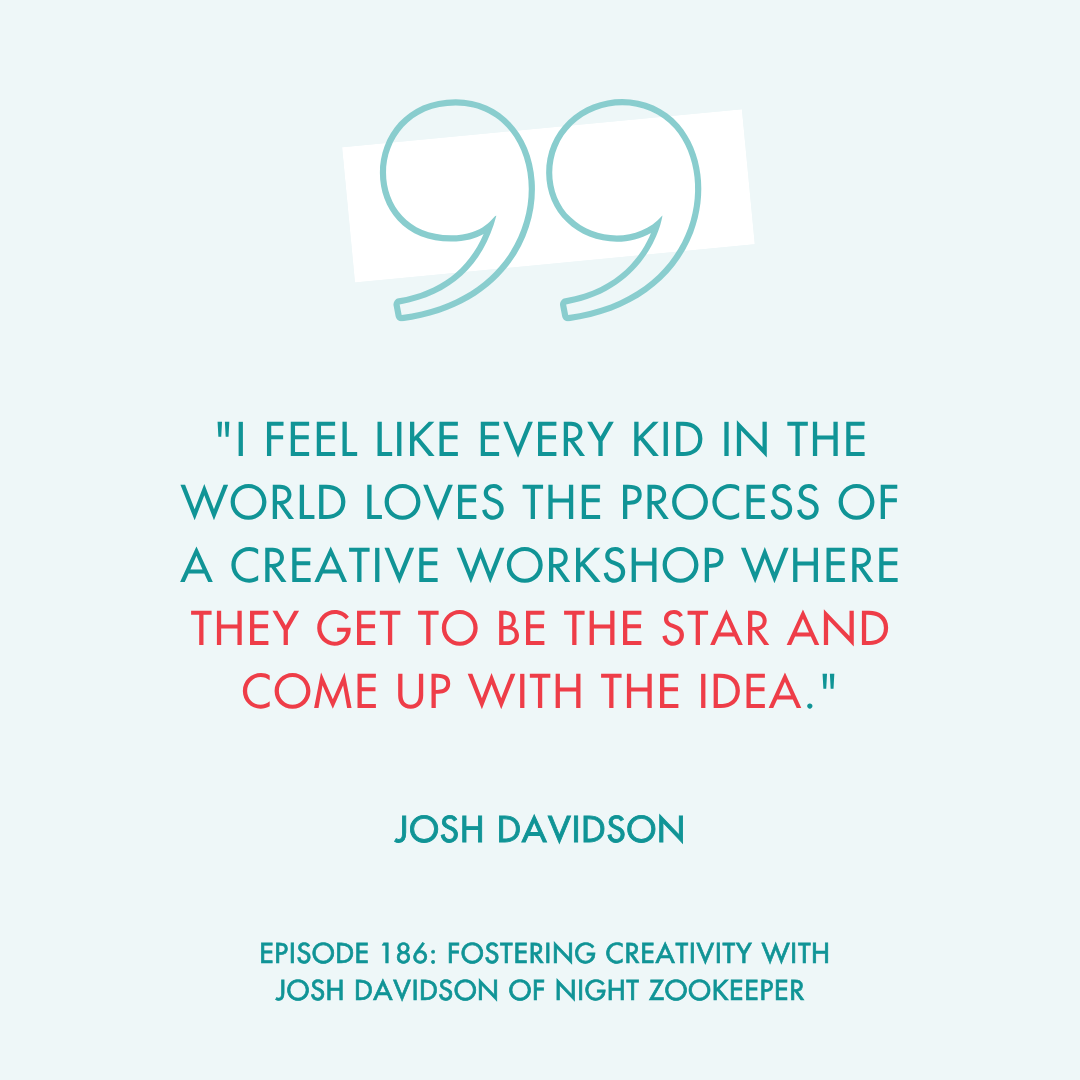
It is. Absolutely, get it, get it to kids in any way. I mean, I know it's, it's ambitious, but I, we don't have to be the ones to facilitate this, by the way. But I feel like every kid in the world loves the process of a creative workshop, where they get to be the star and come up with the idea, you know. We just want to make sure that we're doing our best to get our version of that, but you know, teachers for the Eons have been, you know, putting that question to kids, but not enough, and not in, not in all parts of the world either.
Lily Jones 8:56
So, I've heard you say that that kids are inherently creative, which I absolutely agree with, you know that kids generally want to do creative projects and think creatively, but do you think creativity is something that you can teach?
Josh Davidson 9:10
Absolutely, I mean, I think you can definitely teach it out of a child. I mean, I think that you know, you, the word that's most often ascribed to it is nurturing the creativity because you nurture, you know, if a plant's already growing naturally and it's there inside us, you just keep it alive, but that's that's not to say that you know it's a muscle, like, like the brain, it's absolutely a muscle. The more time you dedicate to thinking creatively, to pulling ideas together, I remember, I mean, there's a, you know, there's some fantastic thinkers on this out there, and I've read, as you can imagine, a few future many books, but the general point that I've taken from all of the academics around it is that if you're drawing, if you're writing, if you're engaging. In your brain in experimentation, which is at the cornerstone of what creative thinking ultimately is, then then you're going to be more receptive to creative ideas and a more innovative problem solver, and that is at the core of it. You know, writing is such a great example of this, because there's 1,000,001 ways to write a sentence, and we might get on to AI in a bit, but like the AI might pick a way for you to write a sentence, but it's completely devoid of human meaning at that point, because you could have written that sentence so many unique and different ways based on what you're trying to communicate, and who you are, and how you want to tell somebody that, but if we don't really teach people that, if we start, if we do allow, frankly, at this point, allow writing to become the new calculator, where you don't nurture that mathematical mind to understand numbers and arithmetic, we will be losing a huge part of our ability for agency in thought and being able to bring our own selves to bear in the world, and it would be such a tragedy, because it's creative thinking, it can be taught, it can be nurtured, you can be put in the right environment to come up with good ideas, and it can absolutely be stifled.
Lily Jones 11:25
I 100% agree, and I am so interested in just how humans learn, right? Like, I am fascinated by this idea of experimentation, and I would love your thoughts too, of like grown-ups. You know, I've been taking a lot of what I know of learning science and what kids learn, and helping grown-ups use that to learn anything or do things they want to do in their lives. And I'm so curious about this experimentation piece. I think as grown-ups, we often think we have to have it all figured out, right? And we have to know the answer. We have to have a clear path, and so getting that almost as like a frame of reference can be freeing to think of creative solutions,
Josh Davidson 12:04
Yeah, yeah, absolutely. I think that is the somehow something in our, in our world dominated by efficiencies and productivity and all of these insane pressures that we put on ourselves, humans in the in our adult phases of life struggle to get the chance to nurture that inner voice and hold on to that stuff, you know, and we also face commercial reality. Let's, let's not put it aside, like, why am I doing this? Why am I investing time in doing a drawing or writing a poem? Or, you know, that it's a question that rattles around in an adult's brain, and so you stop doing it, so you stop practicing it. So, in an ultimately, we are all poorer for it, in the same way we're poorer if we don't meet with friends and play with friends and don't send regular communication to the people that we love, like it is part of what makes us tick as a species, and those skills, if we do nurture them, could have profound influence on the course of your life, profound, because who knows what idea you have at the right time in the right place that you wouldn't have had if you hadn't given yourself that investment in yourself to think creatively.
Lily Jones 13:30
It's really interesting to think about what could change that way, and I try and keep it focused on the positive of the possibilities, rather than it also seems depressing, the things that we've missed, it's like oversimplification of learning, and I think you mentioned with AI, right? Like it's an oversimplification in many ways, right? Like you can get information quickly, great, but if you're farming out your creative thinking processes, or your critical thinking, we're not getting the chance to grapple, and I think one of the things we know about learning is, like, we need challenge, we need to be grappling with it and not know the answers.
Josh Davidson 14:13
And we're a generation that's, you know, we've had to learn critical thinking, you know, we've had to learn creative thinking. The terrifying thing, I use the word terrifying twice now in this podcast, but the scary thing is that there really is a danger that we will be eroding that for the next generation, and they will not be brought up with that same abs. absence of external support for thinking, you know, people really are outsourcing their thinking now, you know, and then if you're not an expert in something and you ask one of these large language models to explain it to you, it sounds. Was like, you know, sounds like it's the most intelligent human you could ever meet, and you have to take it at its word, but when you know about something yourself and you ask it about the thing that you know about, you have got so many issues with its answer, because you, you know, it, you know, so we're in that situation, we really are in that situation now, where we, when it comes to kids and AI, we have to be so careful, so careful as to what this impact, and you know, we haven't been careful with social media, we just haven't, and the consequences are there, and we have to learn those lessons.
Lily Jones 15:44
So I'd love to hear a little bit about how Night Zookeeper is evolving in this changing world to use technology as a way to enhance creativity rather than to outsource it.
Josh Davidson 15:55
Yes, so there is, there's a few few magic tricks that we love with the new technology. We haven't announced this yet, so this will just be for your listeners, but we have been working for the last four years. I saw a little tech demo of a to thing where someone, like, wrote a description of a speedboat, or took a magazine, and then they had model that is, that's cool for kids, and we're so we're in the process of creating a version of Night Zookeeper that has that where neutral child comes up with whatever they're coming up with, you know, it's the dinosaur doughnut caterpillar monster, or whatever they've invented, they draw it, they write about it, and then we're going to reward them with this model of their drawing, so it's not taking it through the, you know, the horrendous, I don't know if you've seen much AI artwork, but it's.. it becomes so obvious to spot, right? This is the kids' drawing, it's their idea, it's just popping it into so that it can exist inside a world that they are being inspired by, and they can decide more about that character and engage with it. So that's the first thing that I thought, that that's sort of where we sit. When we first started the company, we sent, we found something called a Makey Makey, and it was like a, you could turn anything into a controller, so we put like these little nodes inside a banana, and then had kids playing our spelling game by steering a banana. So, we, I love like creative technology that's going to get the kids to lean forward and be excited about what's going on. So, all of our tricks are, you know, all of our technological innovations sort of sit in that sort of engage, inspire, think, but on a more serious level, there is a lot of internal, you know, thinking to be done about the fact that if we exist and a kid could go on to an LLM and get the kind of the level of writing coach that you can have when you sit and talk to an LLM to see what it is, then you know you can't, you can't expose a kid to this because it could hallucinate, it can be wrong. These models are not built for this at all, but how do we stay relevant when a kid, as we know that they can always go on to YouTube and all this, whatever it is that they want to do, stay relevant in their world. So our solution is it's human, human adults using these tools to serve more appropriate, more personalized, more reactive content to the kids, so we go from having 10,000 you know, lessons that can be tailored and the curriculum can move around to having a big job for the education team, but having 100,000 200,000 you know, the building out are curated carefully, you know assigned content to kids that can meet them even more where they are, but it's not pure exposure to these things, and I also, I personally have a bit of an issue with the chat feature, like our Knight Zookeeper, right now that you log on and there's no AI, you're just chatting to characters and the characters that you're creating, and it, it so it happens that it looks like, because we thought it was a good idea to use a sort of a conversation thing when we were developing the program, so it feels like you're having a chat with the animal, but there's no AI involved, it's all our content, so now I'm like, oh no, they're going to think it's like a chat bot. I don't want that. So, you know, I'm exploring ideas of bringing different types of visual learning into that flow, so it's less reliant on that chat back and forth, and it's more about sort of the building blocks of different. Writing styles, so I mean, the technology is amazing, and there's so much that you can do with it. I just think, yeah, we have to be very responsible.
Lily Jones 20:08
Yeah, it has to be intentional. It seems like you're really thinking about how to use it as a way to enhance creativity, and I think that intentionality is key. You know, just because it can do something doesn't mean it should, and especially when it comes to kids, so I appreciate that. So, I'd love to switch gears a little bit into thinking about your journey starting Night Zookeeper. We have a lot of our listeners, our educators, who maybe want to start something of their own, or they have a creative project they want to do, and it can feel hard to even know how to start it, and so I'd love to learn, just like, how has your process been? You coming from this idea to building this great organization, you know, what have you learned through the process about yourself, skills?
Josh Davidson 20:55
This is a big one, right? So, first thing I should say is that I, I was very, very lucky, because although I had the idea when I was doing my masters, it was very much creative project and a creative idea, and my one of my best friends was a primary school teacher and elementary teacher, so we, he invited me in to his school way, at the time he was, you know, he just graduated, it was like a teaching assistant dinner school, and we ran a little project where I read my night, as it was at the time, the nighttime zookeeper, before it's just night zookeeper, but I read my story to the kids and got them all to invent animals for my zoo, and I uploaded them one at a time very carefully to a very old-fashioned website that I had created to showcase them, but just to sort of show these screens, you can put things on these screens, you don't have to just consume. I wanted to sort of start breaking down that, and at lunchtime, we, my friend Paul, my co-founder, Paul, often went out to play football with the kids, because he's a big football fan, and when we went out, the kids weren't playing football, they were all running around pretending to be night zookeepers, and so we were like, oh my goodness, this is really resonating. If this is the choice at lunchtime, not just the everyday match, soccer matches, you would say, but like it was that was like what they did every day, they wanted to play nuts, so like, so there's something here, 10 years later, savings, you know, regular jobs. He was still a teacher. I was just putting money aside in a marketing job, and then we thought, let's, let's go for it. It was back before there was quite so much support for startups. There's a lot out there now, so if your listeners, if there is somebody that's got an idea, I'd be really encouraged by the way the world has kind of woken up to supporting when we went, we had to go to a classic bank, you know, and spoke to the bank manager, told them our idea, they gave us a little bit of money, and that helped us build our sort of v of the website, where there was a bit more interactive, and any teacher in the world could sort of upload, still a bit manual, but upload the work that their kids were doing on the project, and Paul had developed like a resource pack, and the beginnings of our curriculum, but yeah, I mean, I was lucky, I think I think going on this journey with, with a friend, or you know, getting people involved is the key. I think a lot of people have ideas, and they sit on them because it's so hard on your own. Just don't have time. Ultimately, you're going to need at some point to commit to it, which is the really scary thing, but you don't have to do that until you get a few more kind of proof points on the way, and especially if you're doing it with friends, and you can all motivate, motivate each other in the evenings and in the weekends, like we did, you know, those first two, first just six, for the six months, while we were all still working and trying to build this thing, you know, we did 15 weekends in a row. I would wake, I moved to DC at one point in that time, and I would sort of wake up at 3am 3am and talk to my friends back in, in the UK about what needed to be happening to get the business to the next level, and then we started entering competitions, and that that was probably the thing that did it. There's a lot of competitions out there. You don't need to have a business that is firing or silly cylinders to present it with passion and show what your intention is and where it can grow, and going along to those events, talking about what your idea is, not being afraid, not thinking anyone's going to steal it, because I promise you, they're not like that. Just a business is the, is the idea. It is the idea. I rate the idea more than maybe most people, because I care so much about ideas, but an idea is nothing without the person that believes in it, and it's going to drive it so hard. So, if you've managed. Commits a few more people to believe in it, and then you're all driving at it, and you're all turning up at events and talking about it, and those events could be awards where there's people who are more in business, like that was basically the Knight Zookeeper story. It was, it was about more and more people getting involved, and ultimately, I guess that's what a company is, it's a team of people working towards something, so you just have to find a way to build that team.
Lily Jones 25:24
I think it's encouraging, though, knowing the step by step that it wasn't like automatically you have a team of people who believe in your idea, right? It's just sharing the idea with a friend, then seeing kids respond to it, then sitting on it for a while.
Josh Davidson 25:40
We feel getting to a point where we can actually do something about it, then telling a few more people, then persuading them to, they get excited. It absolutely is. It's been such a long journey, but it's been a really worthwhile journey.
Lily Jones 25:56
It's been so interesting hearing about it, and so exciting what you've built, and I really appreciate the focus on creativity and creative thinking. I think it is truly what we need more of in the world. So, Josh, can you tell folks where they can connect with you and learn about Night Zookeeper?
Josh Davidson 26:12
Yeah, please, please join our community, it's Night zookeeper.com We have, you know, hundreds of 1000s of pieces of writing from a community of kids every week, inspiring each other, commenting, you know, and then we have our tutors that feedback on everything your kid does, and a full language arts curriculum around building those skills and that confidence. So, yeah, there's a free trial, please sign up, give it a go. We're Night Zookeeper on all socials. I'm Josh at Night zookeeper.com If you have questions, yeah, just just excited for you to join us on this journey.
Lily Jones 26:48
Wonderful, thank you so much, Josh.
Josh Davidson 26:50
Thanks.
Transcribed by https://otter.ai