
Curriculum Developer Salary Guide: What You’ll Really Earn
How much do curriculum developers make? Explore curriculum developer salary ranges by employer, experience, and freelance rates, along with how you can boost your earnings.

Curriculum Developer Salary: How Much Do Curriculum Developers Make?
If you're thinking about becoming a curriculum developer, you might be wondering, Can I actually make good money doing this?
As a former teacher, I get it. You might be excited about using your teaching skills in a new way, working more flexibly, or exploring opportunities outside the classroom. But you also need to know whether curriculum development makes sense financially.
The question isn't just how much curriculum developers make. It's how you choose to earn as a curriculum developer. Most teachers (and former teachers) pursue curriculum development in one of three ways:
Do curriculum development on the side while continuing to teach. Your curriculum income is added to your teacher salary.
Leave the classroom and stack freelance or contract work. You build your income across multiple projects and clients. This path can offer the greatest earning upside, since you're not relying on a single employer or salary.
Move into a full-time remote curriculum development role. You receive a salary with benefits.
Each path has pros and cons, and you don't have to choose one forever.
You might start with a small curriculum project while you're teaching, eventually build enough recurring contract work to leave the classroom. You might decide you want the stability of a full-time remote role. Or you might find that freelancing gives you exactly the flexibility and extra earnings you're looking for.
In this blog post, we’ll take a closer look at your options, the numbers, and, most importantly, what they could mean for your path.
Average Curriculum Developer Salary: What Can You Expect?
Curriculum development is all about creating engaging learning experiences to improve student learning and support teachers, and it can absolutely be a well-paying career for educators.
Curriculum developers work for education publishers, textbook companies, EdTech product developers, education nonprofits, curriculum houses, school districts, universities, museums, children’s media outlets, education agencies, and other organizations.
Some have full-time salaried positions while others work as independent contractors. Many freelance on the side while teaching. And some even build their own businesses with multiple clients and income streams.
So instead of thinking, “Will I make more or less than I make as a teacher?” I encourage you to think of it more as, “What kind of career and earning potential can I build?”
If you're looking specifically at full-time curriculum developer jobs, current salary data gives us a helpful starting point.
Current salary data shows that curriculum development can offer strong full-time earning potential, including opportunities in the $70,000-$90,000+ range and six-figure potential in some roles and industries. As of 2026, ZipRecruiter reports an average curriculum developer salary of about $77,000 per year, while Glassdoor estimates median total pay around $89,000.
Freelance and contract roles often offer higher pay per hour or project. Typical ranges can be $40-$75 per hour, with specialized or higher rates at $100+ per hour. Project-based curriculum development work might pay anywhere from $500 to $10,000+ per project, depending on the size and complexity of the assignment.
Let’s take a look at exactly how this can look across the 3 paths below.
How Much Does a Curriculum Developer Make?
How much a curriculum developer makes depends on the path you choose, along with your employer, location, experience, specialization, and the type of curriculum work you do.
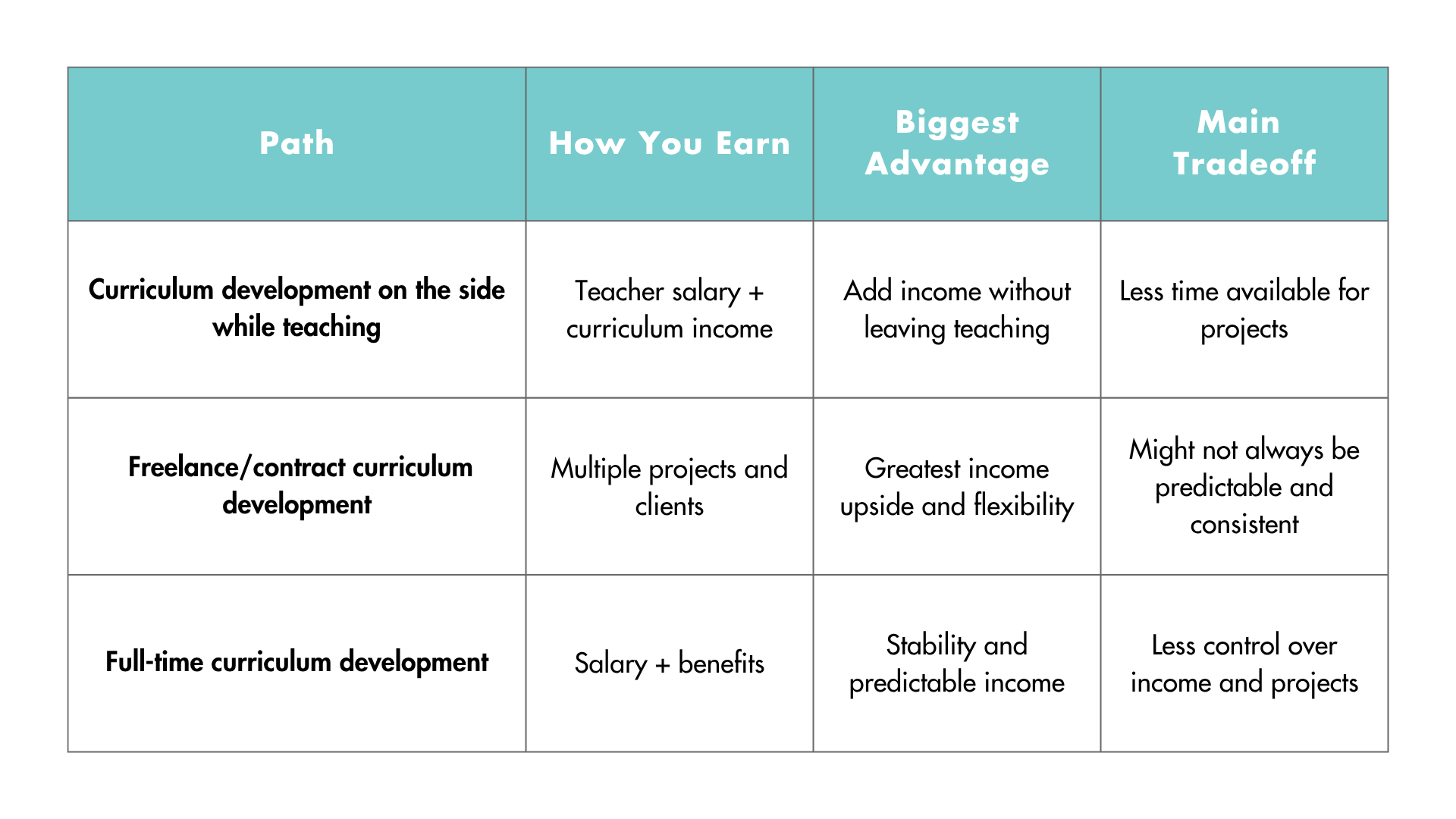
One important note when comparing these paths: salary, freelance revenue, and total compensation aren't the same thing. A $75,000 salaried position may also include health insurance, retirement contributions, paid time off, and other benefits. A freelancer earning $75,000 in contract revenue generally has to cover those expenses independently. Keep the whole compensation picture in mind when deciding which path makes the most sense for you.
There isn’t one path that is “better” than the others. The right choice depends on your lifestyle and financial goals, the amount of flexibility you want, and whether you actually want to leave teaching.
Here’s a closer look at each path, along with realistic income examples:
Path 1: Add Curriculum Development Income While Teaching
You don't have to leave teaching to become a curriculum developer. You can take on curriculum projects while you're still in the classroom.
Maybe you write lessons for an education company over the summer. Perhaps you develop assessments for an education publisher. Or you review instructional materials on weekends or take on a short-term project during a school break.
On this path, you aren't replacing your teacher salary. You're adding another income stream to it.
If you're taking on curriculum development as a side gig, even a relatively small amount of contract work can meaningfully increase your annual income.
For example, let’s say you earn $50 per hour and average just five hours of curriculum work per week for 35 weeks (or about 8 months) of the year.
That's: $50 × 5 hours × 35 weeks = $8,750 in additional gross income.
If you're earning a $65,000 teacher salary, you're not trying to replace that salary with a $50/hour freelance rate. You're adding nearly $9,000 to it.
And you're building professional curriculum development experience at the same time.
You now have work for your portfolio, a client relationship, and experience working with deadlines and feedback outside your school. You’ve also proven to yourself that organizations will pay you for the skills you've spent years developing as a teacher.
If you want to explore curriculum development without giving up the security of your teaching job, this is a great place for many educators to start.
Path 2: Leave the Classroom and Stack Curriculum Development Contracts
You don't necessarily have to leave teaching and replace it with another traditional job. You can build your income from multiple curriculum development contracts and clients.
For example, you might have an ongoing contract developing lessons for an EdTech company, another creating assessments for a publisher, and a shorter project reviewing SEL curriculum for a nonprofit.
Instead of one employer determining your entire salary, you're building your income across several sources.
This path can offer the greatest income potential because you have more control over the projects you accept, the clients you work with, and eventually the rates you charge.
While one contract alone may not replace your teacher salary, several contracts can.
For example, a curriculum developer with one ongoing contract worth $3,000 per month and another worth $2,500 per month would have $5,500 in monthly contract revenue before taking on any additional projects. You might also have a couple of longer-term projects simultaneously.
Keep in mind freelance workloads aren’t always consistent month to month.
As you gain experience, you may be able to take on larger projects, develop a specialty, increase your rates, or build recurring relationships with organizations that need curriculum support.
In this path, workloads can fluctuate, and you’re responsible for finding work and managing your business. You’ll also need to consider things a traditional employer might otherwise provide, including health insurance, retirement contributions, and the employer portion of payroll taxes.
This path can offer the greatest freedom and flexibility, but that flexibility comes with more responsibility for managing your own workload and income. Some curriculum developers intentionally take on fewer contracts because what they really want is control over their time.
That's one of the things I love about this field… Success can look different depending on what you want your life to look like.
Path 3: Move Into a Full-Time Curriculum Development Role
Leaving the classroom and moving into a salaried curriculum development position is another great option.
Curriculum developers can work remotely full-time for educational publishers, EdTech companies, curriculum houses, education nonprofits, museums and cultural institutions, school districts, universities, and more.
Depending on the position, you might spend your days writing lessons, developing assessments, creating online learning experiences, managing curriculum projects, collaborating with subject matter experts, or reviewing and improving educational content.
Remote curriculum developer jobs offer flexibility that's difficult to find in classroom teaching. Other advantages include predictable paychecks, benefits, paid time off, and a clear role within an organization.
Many full-time curriculum development roles fall somewhere in the 70,000-90,000+ range, depending on the employer, industry, location, and level of experience.
Since you’re working for an employer, you’ll generally have less control over your workload, projects, and earning potential than you would as an independent contractor.
For teachers who want to leave the classroom but still value stability, though, a full-time curriculum role is a really appealing option.
Regardless of which of the three paths you choose, remember that it doesn’t have to be permanent… You can move between them as your career evolves.
Your Teaching Experience Counts
When teachers hear the words “career change,” they sometimes assume they'll have to start over. Curriculum development is different because so much of what you've already learned as a teacher transfers directly to the work.
Think about what you've already done as a teacher. You've likely:
Created lessons
Taken standards and turned them into actual learning experiences
Modified materials
Written assessments
Differentiated instruction
Thought deeply about what students need to know, how to teach it, and how to figure out whether they've learned it
Those are all foundational skills in curriculum development. Of course, being a professional curriculum developer has its own processes, expectations, terminology, and deliverables to learn. You need to know how to take your classroom expertise and apply it to curriculum projects for organizations and clients.
But you aren't throwing away your years of teaching experience and starting over. You're learning how to translate that experience into a new context.
Curriculum development can open the door to roles like:
Curriculum developer
Curriculum specialist
Senior curriculum developer
Instructional designer
Learning experience designer
Curriculum manager
Curriculum director
Educational consultant
Freelance curriculum developer
And as you gain experience, develop specialized skills, and build a strong portfolio, you can qualify for increasingly valuable projects and positions.
Keep in mind that your first curriculum development opportunity doesn't have to represent your forever salary. It's the beginning of a new career path.
Curriculum Developer Salary by Employer Type
Another reason curriculum developer salaries vary so much is that curriculum development exists across many different industries.
Whether you're pursuing a full-time role or freelancing, employer type makes a difference.
Educational Publishers
Educational publishers need people who actually understand teaching and learning.
They hire curriculum developers to create lessons, assessments, student materials, teacher guides, intervention resources, and entire curriculum programs.
And publishers may hire curriculum developers both as employees and as contractors.
That means a publisher could potentially fit any of the three paths: a small project while you're teaching, a larger contract as an independent curriculum developer, or a full-time position.
EdTech Companies
EdTech companies are another major source of curriculum development opportunities.
Curriculum developers might create digital lessons, online courses, assessments, educational videos, interactive activities, or other learning experiences.
Depending on the company, opportunities may be full-time, contract, or freelance.
These organizations can be particularly interesting for teachers who want to combine their instructional expertise with technology, and many roles are remote.
Higher Education
Colleges and universities hire curriculum professionals to develop courses, support faculty, design online learning, and improve instructional programs.
You may also see related titles like instructional designer, learning designer, or course developer.
Education Nonprofits
Education nonprofits need curriculum developers for everything from literacy and STEM programs to professional development and community education.
As with publishers and EdTech companies, nonprofit opportunities can include both salaried positions and project-based work.
The same organization could have a full-time curriculum developer on staff while also hiring independent curriculum developers for specific projects.
School Districts
School districts hire curriculum specialists, instructional coordinators, curriculum developers, and other professionals to create curriculum, support implementation, analyze instructional programs, and work with teachers.
For teachers who want to step away from their own classroom without leaving public education entirely, district-level curriculum work can be a natural transition.
District roles may also offer familiar benefits, retirement systems, and schedules.
Above all, don't assume each organization hires curriculum developers in only one way. A textbook publisher, EdTech company, nonprofit, museum, cultural institution, or education agency might have full-time curriculum developers on staff and hire freelance curriculum developers for individual projects.
That's why I encourage teachers to think about both where they want to work and how they want to work.
Freelance Curriculum Developer Rates
Wondering how much a freelance curriculum developer can make?
This is where things get much more variable — and potentially much more interesting.
Freelance curriculum developers may be paid hourly, by the deliverable, by the project, or through an ongoing contract.
Projects might include:
Writing individual lessons
Developing complete units
Creating assessments
Writing teacher guides
Aligning materials to standards
Reviewing or editing curriculum
Creating online courses
Writing educational video scripts
Developing professional learning materials
Freelance projects can offer higher hourly or project rates than some salaried roles, although freelancers also need to account for non-billable time, taxes, benefits, and gaps between projects.
Rates depend on the client, subject matter, complexity, deadlines, your experience, and whether you're being paid hourly or by the project.
Freelance curriculum rates can vary widely, but $40-75 per hour is a useful benchmark for teachers moving into curriculum development. While lower-priced opportunities exist, there are also specialized or senior contract opportunities that can reach $100+ per hour.
You may be paid per lesson, per unit, per assessment, or for an entire project. Some longer-term contracts may essentially provide a set amount of work each week or month. Project-based curriculum development work might pay anywhere from $500 to $10,000+ per project, depending on the size and complexity of the assignment.
One advantage of project-based work is that as you become more efficient and experienced, your income isn't necessarily tied directly to the number of hours you work. And if you're building curriculum development into a full-time freelance career, multiple projects and ongoing contracts can become separate income streams rather than relying on one employer and one salary.
Salary by Experience Level
Experience matters in curriculum development, but when you hear “entry level,” remember that you’re not starting your career over from zero.
While you may be new to professional curriculum development, you're not new to education.
Entry-Level Curriculum Developer
If you're a teacher moving into curriculum development, “entry level” doesn't mean you're starting from zero. Your classroom experience is incredibly valuable. You've already designed lessons, created assessments, differentiated instruction, worked with standards, and thought deeply about how students learn.
Curriculum development, however, is different from planning for your own classroom. You may be designing materials that thousands of teachers and students will use, which means learning to design for scalability, write with greater precision, work within curriculum frameworks, incorporate feedback, and create materials that work across many different classroom contexts.
Translating your expertise will go a long way in landing your first role. Your first experience might be one small freelance project while you're still teaching. Or it might be an entry-level curriculum position.
Either way, keep in mind that first opportunity isn't your earning ceiling. It's where you start building professional experience.
Mid-Level Curriculum Developer
Once you've completed multiple projects, your options start expanding.
You may have a stronger portfolio, repeat clients, experience with different types of curriculum, and a clearer area of expertise. If you're freelancing, you may be able to raise your rates or take on larger contracts. If you're pursuing full-time roles, you may qualify for positions with more responsibility and higher compensation.
You also have more choices. Maybe you want the stability of a full-time remote position. Maybe you've built enough client relationships that contract work feels more appealing.
Experience increases both your earning potential and your options.
Senior Curriculum Developer
Experienced curriculum developers may lead teams, manage major curriculum initiatives, oversee other writers, consult with organizations, or specialize in a high-value area of curriculum development.
They may move into positions like senior curriculum developer, curriculum manager, director of curriculum, senior instructional designer, or curriculum consultant.
Independent curriculum developers may also reach a point where they can be more selective about clients, command higher rates, and focus on larger or more specialized projects.
Again, there's no single path you have to follow.
Curriculum Developer vs. Related Roles
Another reason it's difficult to identify one curriculum developer salary is that employers use a lot of different titles for similar work.
If you're interested in curriculum development, you might also come across roles like:
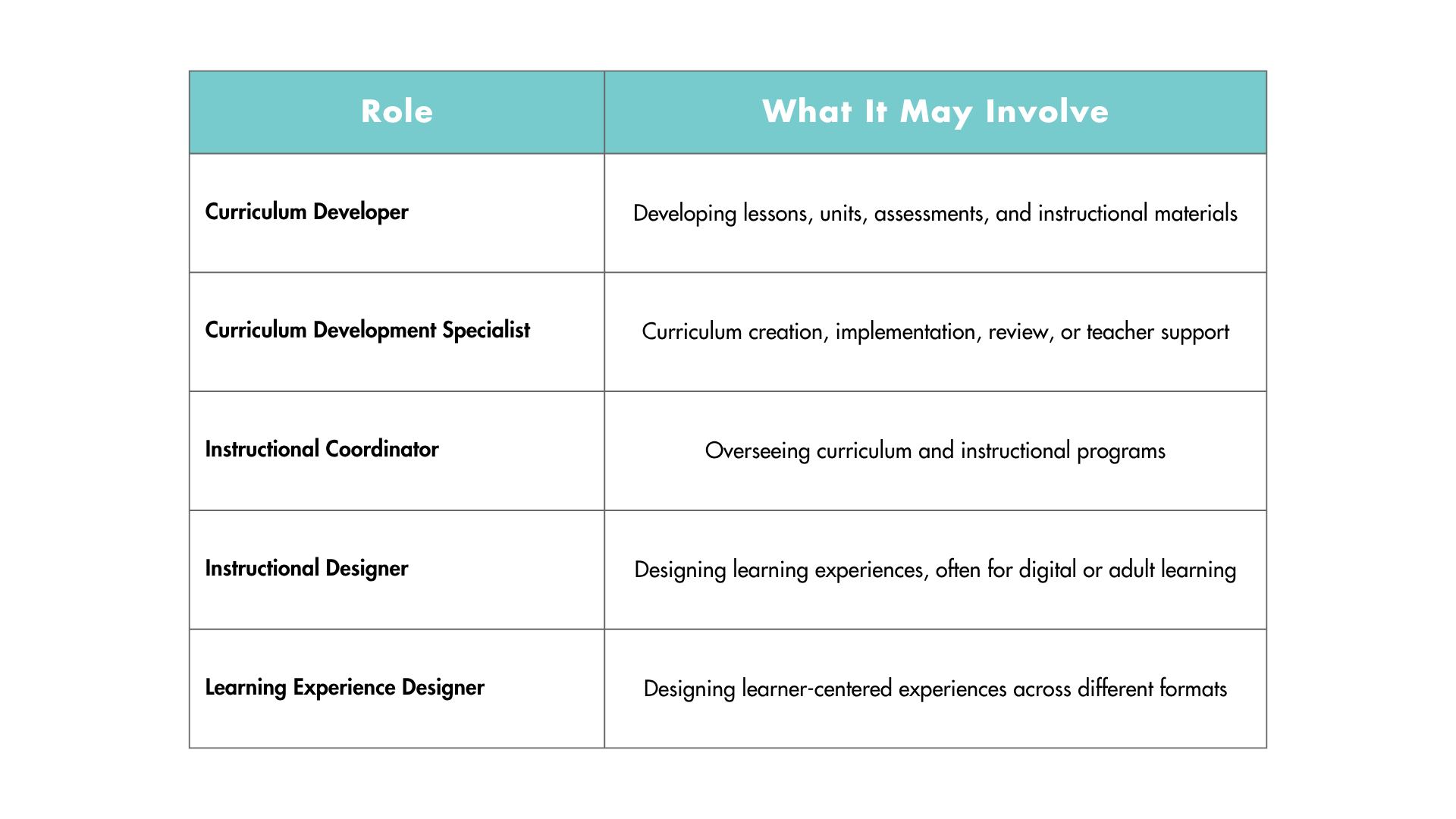
The exact responsibilities vary by employer.
A curriculum development specialist, for example, may do very similar work to a curriculum developer but have more responsibility for implementation or educator support.
Instructional design also overlaps significantly with curriculum development, particularly when you're creating digital learning experiences.
That's why I encourage teachers not to search for only one job title.
If you know how to develop high-quality curriculum, there are many ways organizations may describe the work they need.
How to Increase Your Curriculum Developer Salary / Income
If you want to earn more as a curriculum developer, focus not just on finding the highest-paying job posting but on becoming the person who's qualified for the best opportunities.
Build a Portfolio of Curriculum Samples
While a resume tells someone you can develop curriculum, a portfolio shows them that you can do the work.
Create strong curriculum samples that demonstrate your skills and ability to develop lessons, assessments, units, teacher materials, or other curriculum deliverables. You can also demonstrate skills like standards alignment, research application, etc.
The stronger your demonstrated experience becomes, the better positioned you are to compete for higher-level roles, larger projects, and more specialized work.
Translate Your Teaching Experience
Teachers have a tremendous number of transferable skills, but employers outside schools don't always understand teacher language.
Instead of: “Created weekly lesson plans.”
Think: “Designed standards-aligned instructional materials and assessments for diverse learners.”
Develop a Specialty or Niche
Specialized expertise can make you more valuable to employers and clients.
You might specialize in literacy, math, science, assessment, multilingual learners, special education, adult learning, professional development, standards alignment, or another area where you already have deep experience.
Learn How Professional Curriculum Development Works
Your teaching experience gives you an incredible foundation for curriculum development.
But developing curriculum for your own classroom isn't exactly the same as developing curriculum professionally for a publisher, edtech company, nonprofit, or other client.
You'll need to learn how professional projects work, how to follow a project brief and curriculum framework, how to create deliverables for audiences beyond your classroom, how to incorporate feedback and revisions, and how to build work that demonstrates your skills to potential employers and clients.
That's exactly what the Curriculum Development Foundations Program is designed to do.
This 5-week program helps you take the curriculum skills you've already developed as an educator and learn how to apply them in professional curriculum development. You'll build and refine portfolio-ready curriculum samples, receive expert feedback, and gain experience with the kind of process you'll encounter in real curriculum development work.
Whether your ultimate goal is to earn extra income from projects, build a full-time contract career, or land a remote curriculum development role, you need to be able to show employers and clients that you can do the work.
Read more in our guide on pursuing curriculum development certification: How to Get a Curriculum Development Certification
Start Before You're Ready to Leave Teaching
Your first goal doesn't have to be replacing your teacher salary overnight. It can simply be getting your first paid curriculum development project.
Then you have professional experience, something to add to your portfolio, a client or a project you can talk about in an interview. From there, you can decide what you want to build.
Ready to Go From Teacher to Curriculum Developer?
If you're considering curriculum development, you don't need to decide today whether you're going to quit teaching.
Maybe you love teaching and don't want to leave. Curriculum development could become an additional income stream that lets you earn more without giving up your classroom.
Maybe you're ready to leave teaching and want more control over your income and schedule. You might build a career by stacking curriculum contracts and working with multiple clients.
Or maybe you're ready for a career outside the classroom but still want the stability of a salary, benefits, and a team. A full-time curriculum development role might be exactly what you're looking for.
Start by exploring, trying it out, and learning how to build your curriculum development skills.
The 5-week Curriculum Development Foundations Program takes the guesswork away and gives you everything you need to go from teacher to curriculum developer.
Instead of trying to figure out the industry on your own, you'll learn how professional curriculum development works, gain real-world experience, build portfolio-ready samples that stand out to employers, and learn how to find and land your ideal roles.
Join the Curriculum Development Foundations Program to start this exciting new career path!
Curriculum Developer Salary FAQs
-
Freelance curriculum developers can earn more per hour than salaried roles. Freelance rates can range widely, but $40-$75 per hour is a useful benchmark, and specialized work can reach $100+ per hour. Salaried curriculum developers earn about $37 per hour on average based on a $77,461 annual salary, according to ZipRecruiter's July 2026 data.
-
Curriculum developers can make more than teachers. But it depends on experience, employer, and how you choose to work.
Teachers are typically paid according to a district salary schedule, while curriculum developers may earn a full-time salary, freelance on the side, or build income from multiple contracts and clients.
That means becoming a curriculum developer doesn't necessarily have to mean replacing your teacher salary with another salary. You could add curriculum development income while continuing to teach or eventually build a contract-based career with multiple income streams.
-
Freelance curriculum developers may charge around $40-75 per hour, with specialized or senior work reaching $100+ per hour. Some newer or less complex curriculum opportunities may pay below this range.
Curriculum developers can also charge by the project instead of by the hour. Depending on the scope and complexity, a project might pay anywhere from $500 to $10,000+. A small set of lessons would typically fall toward the lower end, while a complete course, large curriculum unit, assessment package, or specialized curriculum project could be worth several thousand dollars or more.
There are no standardized freelance curriculum development rates, so pricing depends heavily on the scope of work, client, subject-area expertise, timeline, deliverables, revisions, and the curriculum developer's experience.
-
There isn't one curriculum development job title that consistently pays the most. In general, senior, leadership, consulting, and highly specialized curriculum roles have the highest earning potential.
Roles such as senior curriculum developer, curriculum manager, director of curriculum, and curriculum consultant can pay more. Private-sector and technology companies may also offer higher compensation than some traditional education employers.
Independent curriculum developers can have a particularly high income ceiling because they're able to work with multiple clients, specialize, and set their own rates.
-
No. Current salary data shows remote curriculum developer pay can be comparable to curriculum developer salaries overall. What you earn is generally influenced more by the employer, industry, experience level, responsibilities, specialization, and the company's compensation policies than by whether you work from home.
Some employers do adjust salaries based on an employee's geographic location, however, so it's important to look at the compensation policy for each remote position rather than assuming all remote curriculum development jobs pay the same.