
Episode 170: The Regulated Classroom with Emily Read Daniels
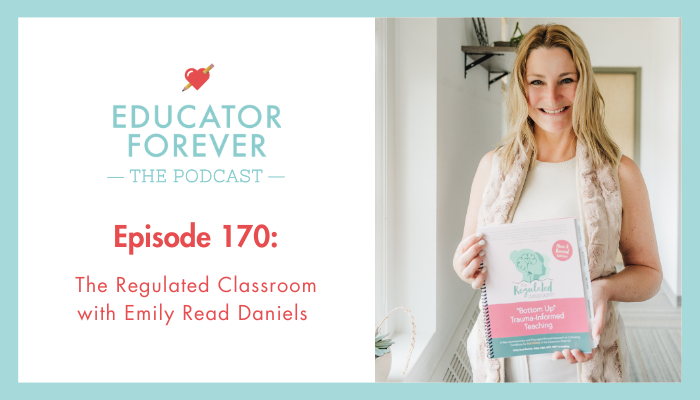
Emily Read Daniels is a former school counselor, a proud soccer mom, and the author and creator of The Regulated Classroom©. Through her work as a trauma specialist, she’s become internationally recognized in her field and as a trainer in the trauma-informed schools movement.
Emily and I spend the episode talking about the overemphasis on data in education. We discuss the need for schools to focus on outcomes and for teachers to align their lessons to their values. It’s an enlightening conversation that you don’t want to miss.
Topics Discussed:
The importance of noticing
How emotions can overpower a classroom
Prioritizing your well-being
Resources mentioned:
If you’re enjoying this podcast, please leave a rating and review on Apple Podcasts.
Related episodes and blog posts:
Read the transcript for this episode:
Welcome to Educator Forever, where we empower teachers to innovate education. Join us each week to hear stories of teachers expanding their impacts beyond the classroom and explore ways to reimagine teaching and learning.
Emily Read Daniels is the author and creator of The Regulated Classroom©, a former school counselor and a proud soccer mom. Emily is an internationally recognized trauma specialist and trainer in the trauma informed schools movement. and has served thousands through in person, virtual professional development, training, workshops, conferences, webinars and keynote addresses. Welcome Emily. So nice to have you here.
Emily Read Daniels
Thanks for having me.
Lily Jones
In whatever direction you'd like to go. I would love for you to start us off by telling us about your journey as an educator.
Emily Read Daniels 0:32
Oh, okay, well, I'm always proud to say that I was a I was a school counselor for a number of years, you know, and I don't do that work per se any longer, but I do work that's very much related to it. So when I was a school counselor, I was working with teens, and these were teens that were struggling with a lot of substance misuse and mental health, and this was like in the 2000 10s, the mid 2000 10s. So as you might recall, the opioid crisis was pretty intense at that point. So a lot of my kids were really getting into pills and that. And you know, one of the things I noticed when they would come in for counseling sessions with me is that they were talking a lot about stress and trauma in their life, in their lives, and I didn't know anything about stress and trauma because it never was a part of my training as a counselor, but I knew that it was becoming a hot sort of Buzz world in the mental health realm, so I went to a conference in Boston and listen to Bessel van der Kolk talk about the impact of stress and trauma on the body. And I was like *boom" you know, it was just a huge wake up call for me. It totally changed my whole perspective on the work that I was doing for my students, and even changed my perspective on my own lived experiences. And so I was hot to trot, to want to return to my school and be like, Let's become a trauma informed school. Like, let's do this right? And again, this is like 2016 and nobody even knew what a trauma informed school was then. And so I just got met with so much resistance. It was insane, like, the it was insane. And so, okay, teachers don't understand about trauma. They don't have a clue about that. They don't understand how it shows up in behavior and all that kind of thing. And so I just was like, This is my new mission. I've got to go teach teachers about trauma. That was literally like, what I did, I like, resigned my job, and I became a consultant, and I started training teachers about trauma, 101 like, what were adverse childhood experiences, and what is stress, and how does that affect you, and how does that affect students? And so on and so forth. So, yeah, that's, that's kind of how I got to the regulated classroom. Is from doing that work and having so many teachers say to me. I love this science. This makes so much sense, but what am I supposed to do? Like, great information, but how does this impact what I do in the classroom? And I was like, that's an excellent question. Clearly, I need to come up with a model of what to do, and so that's what I did. I created the regulated classroom as a result of that.
Lily Jones 3:22
Good, good for you. Coming up with that and following that desire of being like, Oh, this is a need that I see and I'm excited about doing. And I think so many of us who work in schools, or who have worked in schools, often feel like that about something, and then are met with resistance. And so I appreciate how you didn't take that as a sign to not do it. You were like, Okay, how can I still do this, but in a different way.
Emily Read Daniels 4:02
Yeah, yeah, well, yeah. I mean, I mean, the number one challenge today in schools is student behavior. I mean, that's just, that's what pushes people out of the profession. That's what confounds new teachers and veteran teachers. And, you know, it's like, you know, to me, it was like it is, it was, and it still is, the kind of biggest challenge of trying to do this work and do it in a way that feels like you're good at it, you know. So, yeah, I really wanted to be able to offer something that was relevant and meaningful and, more importantly, transformative. Like, wow, let's do it otherwise, right?
Lily Jones 4:42
Yeah, absolutely. So tell us a little bit about the regulated classroom. You know, you talked about how it kind of started, but where has it gone from there? And what do you offer?
Emily Read Daniels 4:53
It's crazy. I could not have in my wildest dreams believe that it would get to the point that it is at at this point. So I launched the first guidebook in in February of 2020 and then, yeah, well, I didn't know that covid was coming. I didn't know a lockdown was coming, but it created an incredible residue of collective trauma. And so in 2022 I got a state contract with my state of New Hampshire, and started doing this statewide as a way to try to help educators recover from the stress and trauma of the pandemic and what they saw in their students coming into the classroom, right? So, so it's just kind of, it's kind of exploded from there, and what it is is it's a way to think about like, what are the specific qualities of experience that teachers and educators can be facilitating with colleagues or with their students that actually buffer stress and trauma and also fills in a lot of missing developmental experiences? Right? Because, like our kids today, spend way too much time on screens, way too much time involved in adult led activities that don't play like we once did as kids. You know they're just, they're really kind of, you know that they're not coming into school with the requisite experiences that would help them be available for learning. So this model I developed helps to essentially, it's really simple, but it helps teachers understand, like, what should I be doing? And when they do these things, connectors, activators, settlers, affirmations, it resets their own nervous system with their students. So it's not just that it helps the kids be more pro social and available for learning, but it really helps the educators themselves reset their own nervous system and reset their own stress response, their body stress response. So it's it's kind of awesome. It sounds like a win win. It really is. And there's not a lot of like as somebody who did a lot of like SEL before that was even a thing. There was nothing that I did in SEL other than maybe a little bit of mindfulness work, but really nothing I did with students that was about my experience or what I needed, or how to like curb my own burnout. It was always just focused on the kids and so, yeah, it's awesome that these things we do with the students can be beneficial to both the adult and the kid.
Lily Jones 7:30
Yes, and it seems so key, right? Like so often, stressed out, burnt out teachers are sitting there teaching SEL lessons and not able to practice the things that we're teaching kids...
Emily Read Daniels 7:43
100% and struggling straight through the SEL program or lesson as the kids are doing the things they're doing, and it's stressing you, because you're like, pay attention! This is important!
Lily Jones 7:53
Yes, absolutely pay attention, right? So yeah, so I appreciate the wider view of all the important parts here. And I know that this month, January is mental wellness month, and January 24 is the International Day of education. So I would love to hear from you about why it's important, you know, to focus on educator well being. You know, you're preaching, preaching to the choir with me. But I would love to hear from you a little bit more of just like, why is this important to put at the center of school culture? Why should we prioritize this?
Emily Read Daniels 8:27
Well, it's just, I think it's fascinating how and in particular, effective neuroscience has helped us understand, like, how incredibly contagious we are with others. So if and I experienced this, and you probably do too, or have in the past, anyways, is that if you walk into a school environment or you connect with a teacher somewhere, you can literally feel their level of anxiety, their level of stress and anxiety, it's contagious. It's infectious, and it's contagious, and it, you know, it comes from, like, just a lot of overwhelm and insufficient ability to reset, to recover, to even know what that's about or how to do that, and so that high. It's funny, because when teachers come into my training, it's like when I first gathered them all. First of all, it's like herding cats. Everyone's like, oh my god, oh my god. I gotta sit with somebody I don't know. Oh, I hate this. I hate like they're so dysregulated, they're a hot mess, hot mess coming into training, and once you have some of them in the room that are not feeling at ease, it puts everyone else, yeah, also on their heels. Like, what's going on here, you know? And that's the conditions, and that's the context that we create in our schools when we don't take care of our teachers, when there aren't resources for them to have wellness in their work environment. Like, that's not good for our kids, you know? That's not like, just not a healthy... It doesn't create a healthy environment. So I 100% feel like you've got to center teacher well being in a school environment if you want to have adults who are going to be able to be present, attuned for the students that they work with every day, like and that's that's what our kids need. They need adults that a want to be there and B that are able to be actually present with them in a safe way. And so I think it's hugely important. And I also, and I say this to educators all the time too, because no one ever said it to me. It's like, Do you have any idea how important you are? Like, seriously, like, you know, other than teachers, there's very few professions where you can say your work is going to change the life of others, but teachers literally are that formative figure in the life of a child, or have the potential to be. You know, they're another attachment figure. They are... They're just, they're, I mean, you spend almost as much time, especially if you're a child in child care or, you know, dig and then preschool and that sort of thing, you spend as almost as much time with a teacher as you do with your own parent or your own primary caregiver. So like y'all matter like we matter as an educator. We matter so much because we play such a critical role in the in the development of the kid or the baby or the child. So, yeah, I mean, like, Duh, we gotta matter. We've got to matter.
Lily Jones 11:35
Yes, absolutely. I love that reminder. I mean, it's so true, and I've definitely seen this in my work, in various capacities, but I educate her forever, you know, helping teachers do things within and beyond the classroom that feel aligned to the impact they want to make in the world. You know, we started this almost a decade ago, and along with our director of learning and development, April, who went on to start a trauma informed Specialist Program, and it's getting her master's in social work and all these things, we started implementing educator wellness because it really was about reconnecting to that mattering, you know, that we do matter. And so much of like our work with teachers is kind of unpacking all these unhealthy school systems and the effects of these unhealthy school systems that start to get us to believe that we don't matter. And so really reconnecting to that, I think, within schools and beyond, is so important and honestly, really hard within a system that often tells us it's not important.
Emily Read Daniels 12:34
Yeah, I mean, it was explicit. I mean, I joke about it in some of my trainings, but it was explicit. I mean, I worked in four different school settings through my career as a school counselor. You know, everything from, like, an urban environment to a rural environment to a suburban environment. And in all of those, the mantra was just, you don't matter. It's not about you. It's about the kids. I mean, literally, that would be like, when teachers, or anybody who was the adult in the school would kind of offer, sort of like a, like a, I don't want to say resistance, but even just like a questioning about, why are we changing things, or why are we doing things in this way? It's not good for us the adults, or it puts us in an odd position, or whatever it might have been, the response, the rhetorical response, was not about you. You don't matter kids. And I, even as a counselor that just never sat right with set right with me, I just was like, Hold on here. You know, in a human system, everybody actually does matter, and we do need to consider the unintended consequences we make these adults do with their students? Yes, and we never, we never did that before, and now we're paying the price. We have workforce attrition. We have low entry levels, you know, people don't come into the profession and the numbers that they once did. Young teachers don't stay in the profession in the way they once did like so there's, you know, we're paying the price now for the fact that we haven't cared for our workforce and recognize them.
Lily Jones 14:04
Absolutely. And what a awful model for kids, too, right? Like my own kids in school, like, I want their teachers to be happy, healthy, regulated, all the things, right? And so it really just doesn't make sense.
Emily Read Daniels 14:17
Exactly it's like. So there's this one quote that I heard when I So, I do a lot of you know as somebody who trains others about stress and trauma, and it's such an emerging like, you know, field of study, and multi multitudes of fields of study, I'm always myself studying. And so I heard this quote at a conference that I attended in the fall, and it was, I think it was Bessel who said it, Bessel van der Kolk who said it, he's the gentleman who wrote Body Keeps the Score, yes. And he said unhealed, unacknowledged trauma shows up in an individual or in a community as constriction and rigidity. And I was like, oh, say it again.
Lily Jones 15:00
Say literally, like, say it again. Yeah.
Emily Read Daniels 15:04
I can't think of two better adjectives to describe most schools, yes, and rigidity. Like, everyone's like, Oh, kids need a schedule. That's like, you know, and it's like, yes, children do need predictable environments, and they do need to know what the structure is, and they need to, need to, but we also need to be adaptive and flexible. Imagine that flexible and adaptive to what is coming our way, or what's happening in the moment. And I'm literally, that's what I do with the regulated classroom. Is I'm like, trying to help the nervous system, trying to help the teachers have enough room in the nervous system to be able to do that. They feel so much pressure to a get it right and get it all in, and it just makes them like this. They're just so tight. So can you imagine that for like a child, a developing kid, or even a moody teen, to be in the presence of an adult who's just so braced, it's like, yeah, that's not good.
Lily Jones 16:03
It's not good,
Emily Read Daniels 16:06
Right? Now, that's like, not not good for that poor adult, not good for that poor kid, right? It's just like, not good.
Lily Jones 16:13
So, yes, yes. And I come at this from like, a curriculum standpoint, you know, I've spent my time since leaving the classroom almost 15 years ago working in curriculum development, and that shows up with so many things that I think are broken in the system of like, assessment culture, it's all about rigidity and constriction, right?
Emily Read Daniels 16:32
You're like, Okay, now you're like, a PLU.
Lily Jones 16:35
Yeah, exactly, yeah.
Emily Read Daniels 16:36
My gosh, because, oh my God. Don't even get me started about assessment. In fact, yeah, this is going to be hard for you. So I call my work a framework. People are always like, Isn't it correct job? I'm like, Absolutely not, yeah, not assess anything, please. When you start the classroom, I don't want to hear about your data points. Like, yes, yes. Not because I don't care about data, because I actually do, and we actually do collect outcome down, that sort of thing, but it's just yeah. I mean, we have spent the better part of 20 years in education, all about the data, and where are we at with that? Like, really, where? Let me see the gains. I want to see the gains. Where are the gains? Because even pre covid, the gains were nominal, like they were not.
Lily Jones 17:19
Yeah, and even the measured gains are not necessarily what I think we should be measuring, right?
Emily Read Daniels 17:25
Sister, Amen. please. Oh, you are like, yes, yes.
Lily Jones 17:30
Absolutely. I mean, I think absolutely, and I think so, not to get too far off track, I talk about this forever, but I'm finally getting my offline and talking about this. Oh yeah, absolutely. I'm getting my doctorate now in learning design, and my whole research is all about flexibility and curriculum. Like no curriculum is great as is, like, it becomes magical in the hands of teachers who are skilled and flexible and have the nervous system regulation and all the things right to be able to adapt. And so I think just this, like constriction regulation or rigid Lily made my brain go in so many different directions. Of like, we're working with a system that's built on that, and so that makes it extra important, and honestly, extra hard sometimes to go into it.
Emily Read Daniels 18:12
So like, you really would love if you came in and experienced what I do with the regulated classroom. I think, yeah, resonate for you, because when you start looking at it through the lens of what has the profession experienced in the last 30 years that has gone unacknowledged and UN healed, and it's a lot. And so it makes good sense that people, in their best efforts, have made things so rigid. Because you know, when you what is trauma at its basis? It's a loss. It's a loss of control. It's an helplessness, right? It renders someone you lose your sense of agency in the experience because you couldn't do what needed to be done in order to protect yourself, right? Or at least, that's kind of like the body experience. But my point here is that there's been a lot of things that have happened in education that haven't been acknowledged as trauma. And so instead of us doing that, we just create scripted curriculum. And like teachers can just be robotic and oh no, we have scripted responses too. So if they ask a question, there's here's the script for that. We have aI we could just answer. You know? So, yeah, it's and, and really what, what it boils down to is, here's, here's a little truth bomb that's so simplistic and timeless, which is, people need, people like, what people do? Well, yes, other safe people, absolutely yes. Like, there is all this complex science and all this stuff, but what it was like, people need people and experiences with people and that aren't just sedentary and you know...
Lily Jones 19:54
So absolutely yeah, and that are imperfect, you know, like, I. Like, so, like, rich learning occurs, yeah, yeah, taking risks, making mistakes. You know, in an environment where you feel supported to do so, which I think also is hard, but sometimes in these systems that have been created.
Emily Read Daniels 20:15
100%. I know it's so true. It's so true. I love all this. It's so great.
Lily Jones 20:20
Yeah. So thinking about teachers who maybe are like, Yes, I hear you. I want to focus on my well being. Maybe they don't have these systems or structures within their schools to support them. What advice do you have for them?
Emily Read Daniels 20:34
That's a really good question. One of the things I say to folks is just notice. Like, if you can't do anything else, I want you to just start noticing. And what do I mean by that, even if it's something that you just like, notice once a day, notice the next time you feel your heart racing, notice that you know, or notice the next time you feel like your throat is clenched and it's hard to speak, notice that you know. Just start trying to bring some conscious awareness to what's happening on the inside of your body, because it's actually a signal that you have turned off or or turned your attention away from. And you have to in teaching, that's the other thing too, is it's like again. I mean, there are other professions where it's like this, but like, teachers have to ignore that they're hungry because they can't they can't go get something to eat. They have to ignore that they're thirsty, if they don't have the water bottle there, they have to ignore that they ignore that they have to go to the bathroom, like there's all these, yes, actually, it's the nature of the job that requires you to kind of ignore. And so one of the first things I say, and it's part of the, you know, the framework I developed, which is tracking body state. But the first steps in being able to do that, in being able to walk back to integration is being able to notice, and so that's where I leave it at. Like I feel like people are very, very overwhelmed in their in their daily experiences, in their work experiences. And so the idea of like, do this strategy, or do this thing, or I feel like it just ends up coming in and going out, because it feels like just one more thing to have to do. And so noticing, I sort of feel like, even though it could be perceived as that one more thing to do, it's also not a heavy lift of just when your body is really screaming at you, stop and notice it instead of trying to ignore it. So in a heart like this, just notice your heart, and perhaps, if you have the space, notice what's happening in the moment your body's stress response like coming online or showing up there for you. Yeah, it's like the it's the words of Deb Dana, who's a polyvagalist and she's a clinical social worker, and she's world renowned and very well known. But she she has this language, this beautiful language, of befriending the nervous system, which is, instead of trying to avoid the sensations that are uncomfortable, trying to actually notice and allow and the reason why I say that is because that's the starting point of the regulated classroom. Isn't that you're going to just, oh, we're going to just allow all these horrible, dysregulated sensations, and now everything will be great. It's more like but awareness is the beginning of recognizing that you've got to shift what you're doing in the moment to reset, and you can do this with your students, right? And be like, Okay, guys, I can just feel this right now. My heart is just racing. I think maybe yours are too. Can you do this with me right now? Just do this. Okay, let's go right to this. And literally, I'm going to teach them how to reset in 3060, 90 seconds with their students that will also collectively reset the students as well. Okay, now, notice, now, notice what you notice in the body. Oh, I feel better, I feel calmer, I feel more at ease. I feel more flexible. Like you know, the beauty of it is that it doesn't take a lot of time, but it does take a certain degree of willingness to just notice. Start with notice.
Lily Jones 24:05
Yes, yeah, it's so powerful. And I think it's so related to mattering too. You know that we're saying that these things in our bodies matter? Oh, totally too we matter.
Emily Read Daniels 24:17
It matters? No, you don't need to deny. You do not need to ignore you can, you know, hold space, and it's funny that you we end up talking about sort of constriction, rigidity, you know, the system, how it is. Because I feel like in in so many ways, if we the biggest barrier to people actually using the regulated classroom is them giving themselves permission to not be so locked down. It's so funny, people it. I mean, this is how much the system as it is. Its current iteration is really controlling. Like, it's kind of amazing. Honestly, it is. But because people are like, well, I don't know if I can do the rhythm sticks for 60 seconds and I'll be like, Okay, talk to me about that. Like, what's going on? What do you what's what thoughts are coming up, what hesitation is coming up? Well, my administrator might see me doing that, and I was like, okay, but your administrator hired me. Right? You know? And they're like, well, but I'm not, I don't they might think I'm just fooling around. And I'm like, maybe you think you're just fooling around. You know, a lot of locked in really static beliefs that are that is a it's a process of shedding. The system gains more flexibility. There's a wider window of tolerance. It is easier to shed those old ways. But right now, we are just like, so locked and loaded like, and loaded like, just ready for defensiveness and so noticing can just start that soft thaw, right? Like that, just that gentle little bit of thaw so that introduce a little bit more flexibility.
Lily Jones 26:14
Yes, absolutely. I love the idea of the soft thought, too. The work I do with teachers is so much of just noticing, you know, like I run this curriculum program where I teach teachers how to create the curriculum they hope to see in the world, and even that is hard to think about what they want to see, because of all these years that many of us have had in the classroom, teaching in ways that didn't feel aligned to us, but then somehow teaching that For many years made it somehow aligned to us?
Emily Read Daniels 26:42
I love so much what you are saying. You have no idea language like, yeah, good. The language I use, which is which is kind of clumsy, but it's very true, is the inculcation. So that's what it is. When you are in education for a certain period of time, you become inculcated in the ways education. And part of it is like when you've been trained in the model of Danielson, and that's what you're going to be evaluated on, and you have to deliver a curriculum in a certain cut, like you know what the expectation is. And in yourself you want, you've now, you've now made it a part of who you are, is to try to try to shape who you are and how you are in service to that model that, what's the word I'm looking for? Rubric, essentially. We don't realize that that like it is, it's, it is like a, as my daughter would say, low key brainwashing.
Lily Jones 27:42
Yes, absolutely. It is, and it's like, we're all part of it, right? And so I appreciate how the noticing really is with anything right, like, whether professionally or personally, right, like, just the noticing is the key to starting anything.
Emily Read Daniels 28:00
Correct. That's exactly right. That really is, in my opinion, that is, I mean, that's supported by a lot of my training and my experiences, but it is. It's this, like, gentle, soft thing. Just notice.
Lily Jones 28:11
Just notice,
Emily Read Daniels 28:12
Just notice, let's just start there. Let's just notice.
Lily Jones 28:15
Yeah, yeah. That takes the pressure off. Notice.
Emily Read Daniels 28:18
That's my favorite. That's the favorite saying that I use often in the training. It's like, I just, I'm inviting you to notice what you can notice and and work out that for a moment, and then we're moving on. We're not even going to, like, go deep rabbit hole in that, because...
Lily Jones 28:30
Yes, yes. I mean, teachers get stuck in the frantic solving, right? Of being like, Okay, well, I'm noticing this, so I must make it better. And then how do I do this and all the things, and then it's like, No, I appreciate I was just like, slow it down, right? We're just going to notice first.
Emily Read Daniels 28:47
So one of the things I teach them about, too, is this concept I call sucky town. And it's when we start noticing things and then talking about it with a colleague or a group of people, and then all of a sudden we're just in this swirl of, like, disillusionment, despair, hopelessness, like the whole world just sucks, and everything sucks and we suck, and this is never getting better before, every IEP meeting, every parent meeting, or whatever, it's like, okay, we're in suckytown now, right? So, but I literally, like, teach them even a little gesture for it, because I'm like, please bring this back so that when you guys are heading into sucky town, you can recognize, you can notice it, and then also know that you can reset that, because that becomes this phenomenon, a collective nervous system, defense mobilizing phenomenon. You're not going to problem solve your way out of that, because you're not in a place of creativity, you're in a place of hopelessness and despair. So we get stuck there a lot, too, in education.
Lily Jones 29:51
Oh, absolutely, absolutely. Well, I could talk about all of this forever, but I want to shift gears a little bit from last question, because it's so cool, you know, see what you've created, and despite all the things right, like being able to really focus on something that truly matters and supports educators and a lot of our audience are educators who want to do something like that, right? They have something on their heart or their mind that they're like, I really want to change this thing about education. I maybe want to start my own business, start my own organization. What advice do you have for them?
Emily Read Daniels 30:23
Do it.
Lily Jones 30:26
Good advice.
Emily Read Daniels 30:27
Do it. I mean, that's exactly what I did. I mean, I also knew, like, you know, even when a school counselor, I tell my husband all the time, my husband school psychologist, you know, cool educators are married to other educators, but and I'd say to them, you know, one of these days, I'm going to leave and I'm going to do my own thing. I'm gonna start my own business. And he going to start my own business. And he's like, right? And so I do, I feel like, you know, if you are very passionate and determined and committed, you can make anything happen. And I truly do believe that, like, that doesn't mean you're not going to fail. That doesn't mean that you're not going to struggle, doesn't mean you're not going to have hardship. Doesn't mean you won't be up, you know, in debt, up to your eyeballs at certain moments in time, and all the things. But persistence, man, persistence and consistency is just, it's, you know, I'll be doing this for nine years now this may, which is yay. Congratulations. Thank you. And I, you know, I have, I have. I've learned a lot about myself in that process. I'm sure you have as well. And it's an ongoing journey. And it's also another thing to be a female entrepreneur and to that's its own journey in and of itself as well. But yeah, I say, if you want to go do something that's on your heart, do it. Do it.
Lily Jones 31:49
Yes.
Emily Read Daniels 31:49
You can do it. You can do it.
Lily Jones 31:52
Yes, absolutely. I think the focus on possibility is like, it's possible. You know, we talk ourselves out of so many things and say, Oh, it's not possible for me, or make all these excuses or, don't know, but, yeah, it is absolutely possible. It doesn't mean it's easy, right?
Emily Read Daniels 32:08
But, no, it doesn't mean it's easy, and it doesn't mean that it's just going to happen. Like, you have to make it happen, right? I think it was funny because, you know, a good friend of mine, like, you know, she's so bright and she's so brilliant, and she saw me go out on my own and do my own and do my own thing. And I was like, Well, come join me. Come do your own thing. And she's in a different field, and she's like, okay, and then she spent the five, next five years kind of just cleaning her house.Like, girl, you got to do the thing. If you're saying you can't, it's not just going to happen. You got to actually do it, you know. So..
Lily Jones 32:40
Yes, yes. And to tie it back to the mattering, I mean, I found that starting a business and helping other people, you know, do whatever's on their heart, right? Like that is how you show yourself that you matter. Like that is a confidence building practice to say this is an impact I want to make, or this is something I want to do, and then committing to actually do it day after day, even when it's hard. I think that's really where we do build true confidence.
Emily Read Daniels 33:07
Amen to that. Amen to that, absolutely.
Lily Jones 33:10
Well, Emily, it's so nice talking with you. I love hearing about your work.
Emily Read Daniels 33:14
It was so great. I had no idea it was going to be this good.
Lily Jones 33:17
Yeah, I know. I'm like, Oh, I made a new friend, too.
Emily Read Daniels 33:19
Yay. Same, same.
Lily Jones 33:23
Well, tell folks where they can connect with you.
Emily Read Daniels 33:26
So I would encourage you to check us out on the socials. Emma, who works with me, does a really great job there. So we're regulated classroom on Instagram and Facebook. You can also find us at regulated classroom com and yeah, we're located out of New Hampshire, but we do work across the US and in Canada, so hit us up. We would love to hear from you, and we do respond to all like the social media messages or emails or phone calls or whatnot. We we really pride ourselves on being an a real live educator resource, like we are. You know, we do a lot of every month, we do free webinars and give away content and that kind of stuff. We try to be really generous with our audience and help them to feel seen and supported. That's really the mission of the regulated classroom. So but if you can get to a training in somewhere around the country, there's, you can check out the website for more of those. There's train the trainers programs that are life changing, truly life changing. So we'd love to have have you at one of those. So, yeah, yay.
Lily Jones 34:28
Thank you so much.
Emily Read Daniels 34:29
Thank you. Thank you so much. Lily. Take good care.
Lily Jones 34:32
You too.
Transcribed by https://otter.ai