
Episode 190: Building Collaborative Schools with Kurtis Hewson of Jigsaw Learning
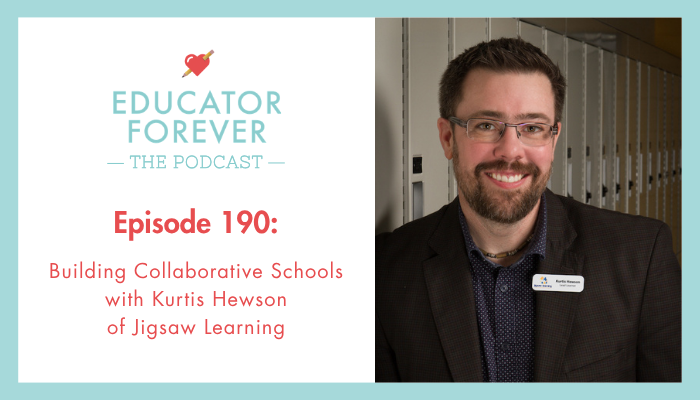
Kurtis Hewson is an author and the co-founder of Jigsaw Learning, a consultancy that teaches educators its Collaborative Response frameworks. With over a decade of experience as an administrator, Kurtis has championed the call for collaborative structures in schools to ensure success for all students.
In this episode, Kurtis and I discuss the creation of the Collaborative Response frameworks and how they’re used. We get deep into the four layers of team collaboration and the importance of letting teachers address the needs of their students.
Topics Discussed:
Moving from teaching to administration
The importance of tiering supports
Hosting effective, collaborative meetings
Resources mentioned:
If you’re enjoying this podcast, please leave a rating and review on Apple Podcasts.
Related episodes and blog posts:
Read the transcript for this episode:
Welcome to Educator Forever, where we empower teachers to innovate education. Join us each week to hear stories of teachers expanding their impacts beyond the classroom and explore ways to reimagine teaching and learning.
Kurtis Hewson is a keynote speaker, author, and professional learning facilitator. In addition to being an award-winning teacher, vice principal, and principal, he has served as faculty at the post-secondary level with over a decade of experience as an administrator. Kurtis has championed the call for collaborative structures in schools to ensure success for all students. He is the co-founder of Jigsaw Learning, a co-author of the bestselling text Collaborative Response: Three Foundational Components That Transform How We Respond to the Needs of Learners, and he currently works with districts and schools nationally and internationally, establishing collaborative response frameworks and interacting with 1000s of educators annually. Welcome, Kurtis. So nice to have you here.
Kurtis Hewson 0:42
Thanks so much, Lily. Absolute joy to be part of this conversation with you.
Lily Jones 0:47
I always love to start by hearing people's stories, and so if you want to take us through the story of your professional journey, that would be a great place to start.
Kurtis Hewson 0:57
Oh, you bet, Lily. So, when I graduated, and it's reaching 30 years here now. I took on the teaching job that I could get full time. For me, it ended up being in Northern Alberta. So, I'm located here in Alberta. It was in an area that was really struggling with retention of their teaching staff, as well as leadership roles, and this is a kind of an odd twist, but it also explains where my future work led to. Is I moved into administration in my second year of teaching, and so I took on an assistant principal role in a school that had an established veteran administrator. What they were trying to do is create roles in schools that might not have the student population, but to start building up this leadership base. So, I had to learn from a very, very early time that, a, I'm not the smartest person in the room, b there are others that have expertise that go well beyond my expertise, and I can't be the holder of all knowledge or the solver of all problems. I had to learn really quickly how to leverage the expertise of others, how to bring in and build teams, and look at that. The collective wisdom is smarter than what's held down in the administrator's office, and it really led to about two decades ago when I moved into my third school as an administrator principal. It was really evident in this school that amazing place for kids, great staff that were doing wonderful things for our students, but lots of siloed practice, and this whole idea that we have centuries of teaching experience in this building that we were not leveraging, so we started to create some really meaningful team structures started to look a little bit differently about what we were doing, and all of a sudden others started to come and visit. We had people asking to explain what it looked like in time. The same questions kept coming that myself and my wife, who was also teaching within the school and the school division, we started to write down some of the similar answers, and it led to a framework we now call as collaborative response, which is what I do full time, is work with schools and school divisions to lay out really robust structures for responding to the needs of students, but doing it in a way that's leveraging, empowering, and building upon the collective capacity, so bit of a whirlwind there for you, Lily, but yeah, it's been exciting work, and not any path that was intended when first starting out.
Lily Jones 3:56
Yes, it feels like so organic, though, right? Coming at work that you were doing, and seeing the impact of it, and having it naturally grow from there. Can you tell us a little bit more about what was what is collaborative response like? What is the approach that you found really making a difference?
Kurtis Hewson 4:14
Yeah, absolutely. So, obviously, during that time, looking at how are the most effective ways that we could work together? The professional learning communities literature was really well established at that point. We were putting in a number of those structures within our within our school. This was also at a time when response to intervention literature was just starting to pick up steam, and we started to think about how could we tier our responses to be able to really ensure that no student is slipping through the cracks, but that we're leveraging the capacity of the team, so we started to make some subtle shifts and nuances that then when we go and explain to other schools, they will go, "Oh, interesting. If we took this piece and this piece, then through working with the schools, we started to see common threads that were happening through this, and it led to understanding the this framework that we've referred to now as collaborative response, and it really hinges on three foundational components, Lily, and we talk about it in this book here through Corwin, collaborative response, and those three components are creating collaborative structures and processes, which in involves four layers of team across a school, and I can talk about that in a little bit, but having those structures in place for how we're working collaboratively together. The second foundational component is data and evidence. How do we use data and evidence to inform those conversations to identify trends to be able to look for celebrations and next steps that we want to take? Who we should be paying attention to. And then the third foundational component is building out a continuum of supports and thinking about how do we tier our supports all the way from the classroom to accessing supports beyond the school, and through this we talk about don't tier your kids, tier your supports in in order to be able to respond. These tiers then begin matching the four layers of team, so everything comes starts to come together, but it's really through three easy lenses. How are we creating teams? How are we using data and evidence? How are we building continuums of support? So any schools, Lily, that are engaging in professional learning communities work, or PLC, or we work with a lot of schools now that have MTSS, multi-tiered systems of support, clearly laid out, and when they come to this work, they go, 'Oh my goodness, this was that missing piece for us. It when a school that, let's say, they've been engaged in MTSS for a long time, hear of this, and go, we're not ready to change course. Our response is, oh, we're not changing courses, we're taking what you've got and just adding one more layer that's going to a be manageable and b have just an incredible impact across your organization.
Lily Jones 7:16
Fantastic. Yeah, I love that, and I love many things that you just said. I'd love to dig into a few pieces a little bit more. One thing you said was not tiering students, but tiering the supports. Can you tell us what you mean by that?
Kurtis Hewson 7:29
Yeah, so it's going to sound like just a subtle shift in language, but it is massive in mindset, and I see this all the time when a school says, well, that's a tier two student or that's a tier three student. We actually work off a four tier model, and it's not about adding one more thing on top of a traditional three tier. What we're trying to do is we take that universal tier, tier one, and break it apart to discuss what are the things that we agree we will all do, the non-negotiables in our building, and then what are the things that we could do? This, the differentiated strategies, interventions, and accommodations. Nobody's saying you must do those things, but they're all things that we could consider before we ever look beyond the classroom. And so, sometimes when we say, well, that's a tier three student, it allows a teacher to be able to say, well, that's that's beyond my pay grade or beyond my scope or my expertise, that's somebody else's. When we tier the supports, we say, whoa, no, every child is our responsibility. What layer of support are you providing? Because we start building up the layer, so a child's not a tier three student. This is a child named Ben, who currently needs tier three supports in this particular area, in addition to tier two, in addition to tier one. And so when we lay out our four tiers, we talk about tier one being the non-negotiables, and in time it's the five to 10 big rocks we agree we will see in whatever priority we're trying to move forward in a school, so if the school said we're really trying to impact literacy achievement across our school, we say, all right, what are the tier one big rocks that you will see in every classroom if we are guaranteeing literacy success for our students, tier two become the supports that are that could be in place for some students in some classrooms some of the time, but still under the guidance of the classroom teacher. Think of it this way, Lily. Tier one is thou shalt, tier two is you could. Then tier three become supports provided by someone other than the classroom teacher, and in a school this may be coming from a special education specialist or department, an intervention teacher, anyone else providing that support other than the classroom teacher, and then tier four are the supports provided by some. One external to the school, either from the district position or a community agency, and so by tiering those supports, it really, when we tier the kids, it's easy to be able to put the attention onto what's the kid doing. When we tier supports, it forces a reflection of what are we doing as the professionals in the building, and can we, in time, guarantee that if we're doing tier one and two effectively in the classroom, less and less students over time are going to need tier three and tier four level supports, or the ones that do are the ones that absolutely need it.
Lily Jones 10:38
That's a powerful shift, and I think using that person first language too, it really gets to what we're trying to do, right, like we're trying to support Jimmy, not necessarily the tier two student, we're trying to support Jimmy in all the ways that Jimmy needs support right now, and so leading with the kid,
Kurtis Hewson 10:58
Absolutely, and we may say right now in this area, Jimmy needs tier three level support, support beyond the classroom, in addition to what's in the classroom. So, no more can a teacher say, "Whoa, there's some really intense needs, that's somebody else's job. No, no, no, you're part of that as well. It doesn't mean that we won't involve others, of course we will, but it's not a hand off,
Lily Jones 11:22
Which at least me...
Kurtis Hewson 11:23
And I see this so, so often, Lily, especially in schools where there's the generalist teachers and the special education teachers to be able to say, well, who's who's responsible for this kid, and we want to get to a place of, well, we all are, they're all our kids,
Lily Jones 11:40
Yes, we all are, and that leads me to something else that you said earlier, too, around team collaboration, and these four layers of team. Can you talk about that?
Kurtis Hewson 11:50
Yeah, so this has been really interesting, Lily, because we didn't recognize it at the time that we had four layers of collaboration happening in the school. We were just building up all of these different structures and systems and processes, and then as we began to work with other schools, schools that were five times the size of ours, or had different grade levels, or occurring in different locations, we started to see some commonalities, and went, oh my goodness, if you lump in the schools that are really seeing success together and start to analyze, there's four different types of collaboration happening in all of these settings, so I'm going to describe these and think of them like categories for it. Now, in a school, you might not call anything that you do by the labels I'm about to give, but think of these as overarching categories. In fact, in some schools you might have multiple meeting structures that exist at a particular layer. We certainly did. So I'm going to start from the most intensive and work backwards. Our highest layer, like our fourth layer of team, and in time, this starts to connect to tier four level supports. We refer to it as the case consult layer, and essentially the easiest way to understand this, Lily, is anytime we get together with one kid on the agenda, or maybe one family, and we get the right people to be part of that conversation, that type of conversation exists at this case consult layer, and so the idea of this is there's always going to be students that we have to meet and build a plan or develop, usually these are in response to crisis or complexity, and if that was the only way we responded or collaborated in our school, oh my goodness, it would be like I had one school said it felt like we were playing whack a mole, just putting out fires, reactive all the time, and that the learning support team was just run off their feet because I'm in my classroom, I have a problem with the student, I want a meeting about Curtis. Okay, so that's that's our more most intensive layer. If we come back one more layer, we refer to this as the school support layer, and the idea here is who is having a conversation about students who need supports in addition to or beyond the classroom. So I'll give you an example, Lily. In my school, this was the principal, myself, the principal, our assistant principal, our learning support coordinator, think special education director type of role. And we also scared shared a family school liaison with the high school. Every Thursday, the four of us would come together and look at who are the students being referred to us. We sometimes would make the decision to say, oh, it's time that we meet about Lily, and let's get the right people around the table. Sometimes the conversation was about how do we support the kid. Sometimes the conversation was about how do we support the teacher. Sometimes it's the. I think this concern is happening because we have some classroom management issues that are occurring, which are leading to dysregulation, which is leading to this. How could we get some further help for that teacher who out of this could help to go model some things, or do we have another resource in the school that we could tap, and how could we coordinate around this, so I've worked with large high schools where they didn't have one school support team happening, they had multiple. It was a large high school where there was a grade 10 team, a grade 11 team, and a grade 12 team that we're looking, but again, this is the team that is saying who are the kids that we need to look at supporting in addition to or beyond the classroom, so I'm going to skip now. Do either of those layer layers sound unusual to you?
Lily Jones 15:47
I mean, they all sound like things that I've experienced at some level, but just not intentionally, necessarily, right? Yeah, these 10 collaborations that maybe spontaneously happened, or because of relationships, but I haven't been at a school where the intention around those was very clear.
Kurtis Hewson 16:04
Yeah, and so this is a big part of this work. Is when I describe these layers, the question I would start to ask as an outsider is, when do they happen? Who's involved? What does your agenda look like for it? Is it a, is it, is there clarity for how a student arrives at each one of these layers, so I'm going to skip the second layer and go down to the first, and I'll do that intentionally. The first layer we call collaborative planning, and it is essentially any time that we have teams of teachers coming together to look at what are we doing for the student population. Now it could be grade level teams, it could be subject area teams. Within my own school, we had multiple teams that were coming together to look at either things happening at a grade level, or sometimes we would have teams coming together to look at different priorities that were happening. We would start scheduling these, but at this conversation we weren't talking about individual students, we're talking about collectively. So the grade four team comes together, we look at our latest mass screener results, and we understand that students have a real difficulty making the connections between fractions and decimals. Okay, what could we do to help support them with that? This for any school that I share this layer with, they almost instantly goes that sounds like our PLCs. Absolutely, now we didn't use the term PLC because some schools had established this time for teachers to be planning, and it wasn't following a traditional PLC structure, but it was still really effective for it, so we had these in our school, and in time started to get really clear and really refined on what's its purpose, who's involved, when does it happen, and then we determine there's something missing, because even though these grade level teams were doing some great work around the things that they were looking at. We were still getting a lot of students being referred up into that school support layer, and again, at the time, we didn't understand this as layers. Sometimes we would say, you know, the thing this person is struggling with, the solutions about three doors down the hallway, there's somebody who's really good with what they're struggling with, and so we began to investigate how could we start to bring together teachers to start looking at in time it evolved into looking at key issues that they're experiencing for students, so I want to describe this meeting structure. We're actually writing a new book about this. It's, it's due to come out in October about just this meeting structure, because usually when we describe it to schools, they go, this is this is the piece we're missing. Here's what it looks like, Lily. Okay, so in time we say Lily, come ready with students in mind with key issues, and in time we start to say they should be informed by your data. This is where this data connection starts to happen for us in time. Then when we come together, we have, oh, anywhere from usually three to five teachers, plus an administrator in there, plus maybe we have someone from our learning support team, we try and create a bit of a diverse group, and it does not need to be the same teachers who meet together for PLC, or what we call collaborative planning. It could be different based on this structure that I'm about to share with you. So we start off by saying our norms, here are the norms we've agreed upon. Let's pick one that we'll practice today. Standard meeting, solid meeting structure things. And then we start with all right celebrations. Lily, who's a student you've brought to celebrate? And when you suggest, I have this student, and man, I'm so excited that I've seen this. We're going to ask explicitly, what do you think you did that led to that success. We want you to start describing the strategies, the things that you're doing that are leading to the success. We're seeing the beauty of this is it activates a deeper level of reflection for teachers. Other people around the room are going, oh, interesting, I'd love to see a copy of that anchor chart you're using in your room that you think is helping this kid.
Kurtis Hewson 20:25
It also reinforces this idea that we, we can articulate the impact that we're having for students, which really starts to build high levels of collective efficacy across our team. Actually, Jenny Donahue, the master of collective efficacy wrote the forward for the book that we're describing around this, so we do like 10 minutes of that celebration, and then this is where we see the magic happen, where we say, Lily, I know you've come with a student in mind, don't say their name, what is the key issue you're experiencing right now? And you may say, let's go really easy. You may say, I have a student that is struggling with letter reverses. Okay, now we might have, and when I say we, the meeting has a facilitator for it. In time, we get to a place of, we're so familiar with the structure, we can come in and say, who wants to facilitate today, but usually when we start, it's usually an administrator. Well, now we might ask you a few questions, but when we say, does everyone understand what we mean when we say letter reversals? Yep, then what we do to the rest of the room is we say, all right, everyone think of your class and think of a student where you're also seeing that concern, write it down privately. Don't say the name out loud. Now, what we'd like you to do is just take a moment and write down what are some ways you've dealt with that issue in the past, or what are ways we could, what are resources or websites that you might be aware of. We give everyone just a few moments to kind of collect their thoughts, and then we say, all right, what do we do when a kid struggles with letter reversals, and I jump in and I say I use visual cues right up on the walls of different letters and how they're reversed, and somebody says I do that, but I actually put it right on the student's working space where there's a picture of a B versus a D, and someone else goes, you know, when you do that, I actually use visual signals just like that, and someone else then jumps in and says, I have popsicle sticks where I kind of do the flip with this. Someone else jumps in and says, whenever I see a kid make the reversal, I usually do a tweet, tweet, because they remember that there's a difference, or that that's kind of their little visual reminder that I might have a flip to make. Someone else goes, I actually go around with a highlighter, and when I see a kid writing and make that reversal, I'll just do a little highlight, so that they can make that adjustment. Now, during this, you'll notice Lily, nobody is saying, 'Oh, that wouldn't work. You, we don't, at no point do you jump in and say, "Oh, I've tried that already. We're just offering up suggestions, ideas in time. We start to look to our continuum of supports and say, "Is there anything that's documented that we could have as an idea for this? But then, after a bit of that brainstorming, and we have timers that are in place for all of this, we turn to you, Lily, and we say, all right, Lily, who is the student that you've brought, just the name, no story, and what's one thing that you're willing to try for them? And you say, well, the student I was thinking of was Phoenix, and for Phoenix, I really like that idea of putting the pictures right on their desk, I have them up on the wall. I hadn't thought of doing that individually. I think that would help Phoenix a lot. And we say, all right, good. We write it down, then we go, Teacher B, did you have a student like this? If not, that's okay. But what's one thing that you want to try? Now you'll notice the conversation is about how to support Phoenix, but we're not actually talking about Phoenix in this, does that make sense?
Lily Jones 24:04
Absolutely.
Kurtis Hewson 24:05
And so in this collaborative team meeting, we try to, in our time, let's say we have an hour, maybe we can get to three or four key issues, but what we're doing is we're building everyone's capacity slowly and through every conversation, and we're also creating habits of when, when I encounter something with a student, a can I identify what, what do I think the key barrier is, and then starting to get that mental model of, okay, what could I try, what could I do around this, and the beauty of this is I've been in hundreds of these collaborative team meetings. Now I always walk away with something that I either never had heard of before or had forgotten. Oh, right, that is something I could try. Or you mention a website and I go, I've never heard of that before. That's excellent. I'm going to take that away. Teachers are amazing people, and what we're trying. To do is put the people who are having the challenges. Let's, let's start talking about the possible solutions for those that are closest to the student. Does that make sense?
Lily Jones 25:13
Oh, absolutely. I love that, and I think it's such a great way to harness teachers' expertise and hold space for that. You know, we totally have answers that we're so busy, right, as educators, and doing all the things that there's just not the space to share it. So, I appreciate in this, you know, really honoring the experiences that everyone's had, and really collaborating to find solutions that not only work for the person who brought the kid, but for everyone,
Kurtis Hewson 25:40
Absolutely, and really, through these four layers, what we're trying to do is that through the first two layers of collaborative planning and collaborative team meeting, we're actually creating intentional structures that are building up everyone's classroom capacity, so that in time we see less and less students start to surface in the school support and case consult layers because we're, we're empowering those closest to be able to say, oh yeah, that's an idea I could try, and you'll notice that in that conversation, no one in the room is saying, Lily, you should do this, Lily, you should do this, and now I'm overwhelmed, or Lily, you should do this, and you have the chance to say, oh, I've tried that. Oh, let me tell you more about the kids, so that you understand this instead of you saying here's my problem, somebody solve it for me. We're saying no, this is your issue. What are things that you could potentially try? And then you come back and say, okay, based on what I know about me, what I know about the kid, what I know about the environment, there's something I think I could take away as a commitment to try. It might not fix it, but it, it might give me my next insight.
Lily Jones 26:49
Yes, fantastic. I love that, and I love hearing about how you've taken this approach and gone in all these directions, right from the structure of the meeting to the big, you know, team, and how they work together on different levels, and I want to shift gears for my last question, which is, okay, we have many educators in our audience who are looking to do something beyond the classroom, you know, maybe they have something that's worked really well for them that they want to take to a bigger scale or share with a bigger audience or support teachers in a new way, and I know that you've, you know, created this whole approach, and also a book about it. And what advice do you have for educators who want to get out there and do something of their own?
Kurtis Hewson 27:29
First off, I would say educators are amazing people, and everybody has something that they could teach someone else for what they do. The biggest thing that I would suggest is really twofold, a, write it down, and b, explain it to somebody else. And what I mean by that is, once we began, questions would come, and we would have to explain how we did that, or why we did that, because as we were starting to see success for students and staff feeling more empowered, like I said, people started to come and visit the school. I started to get requests out to share what it was that we were doing. Starting by writing it down was really helpful, and the art, the tools at our disposal are so good now. Of I can create my own website in moments and start blogging, start writing it down. One of my friends, Will Parker, who has one of the Principal Matters podcast, which is massive. He said he started just by talking about things he was learning in it, and now 500 episodes later he brings on others to talk and to share. I mean, just as you're doing here, so I would say, find your platform, write it down, share it out with others, take that leap. If, if you want to turn on a camera and a microphone and start a podcast to share, do it, because every time you have to clarify what it is that you understand well to somebody else it just deepens your, your understanding, and all of a sudden someone will come to you to say, can you come show us how to do that, or come show me how to do that, or have you ever written a book around this thing, because it's quite amazing,
Lily Jones 29:17
Great advice. Yes, and I think it's, we don't have to wait for the full clarity, right, like clarity through talking about it, and through, we do things that we're learning, or the things that we're doing, and through the many conversations, is how it becomes clear, and I think oftentimes people think I have this idea, and I have to sit on it, and wait till it's perfect, oh, and do all these things before putting it out there, so I always say, you know, take the imperfect action of see it like being a comedian or something, right? Like trying out material, you know, like, does this land with you? Oh, how about this? Like, it's all an experiment.
Kurtis Hewson 29:51
Oh, and Lily, with that, I mean, I mentioned a few different platforms I started by just at local teacher convention. Is signing up to lead a session to share, and I would cower in a corner in fear if anyone were to see some of those first PowerPoints now, but it was a starting place, and I know that someone in the room, because I can remember the very first one clearly, someone coming up and saying, 'Wow, this was so valuable. Thank you. Where I reflect back now and go, oh boy, that was, yeah, but I mean, somebody values that. So I love what you say, of don't wait for it to be perfectly figured out, jump in, start explaining what it is that you know.
Lily Jones 30:42
And we all have to have the awkward first tries, you know. I think when you look at people's YouTube channels, like, look back at the first video, it's always bad, unless they deleted it. Or I always tell a story, like the awkward first webinars I did when starting Educator Forever, you know? Like, I didn't know any of this stuff, I had to do it really awkwardly to three people before it got better, and it got a little better every time, but I think really normalizing that is important too, because it's how humans learn.
Kurtis Hewson 31:09
Yes, it is absolutely. Amy Edmondson would call it intelligent failures, the idea that if, if we take a risk, a calculated risk. We try something, and then we have to adjust it. That's okay. It didn't quite work the way I wanted, but that's an intelligent failure, because you've learned something we can tweak, and now we come with the next version.
Lily Jones 31:34
Absolutely. Well, Kurtis has been such a pleasure talking with you and learning more about your work. Can you tell folks how they can connect with you?
Kurtis Hewson 31:41
Yeah, absolutely. So, if anyone is interested in that collaborative team meeting structure explicitly, we have a new book that's coming out here in the next little while. If you go to Collaborative Team meeting.com you're going to find there right now a free starter kit that includes all the templates that you would need, a short little rationale of how to structure that meeting, everything that you'll need there. Eventually, it'll also link to the book. You could also go to Jigsaw learning.ca and that's our main space. You could, there's a free download for the introduction for our collaborative response book, tons of resources available to help support schools in ensuring that they can, they can create structures and systems that ensure every child is being supported through our team efforts.
Lily Jones 32:37
Wonderful. Well, thank you again, Kurtis.
Kurtis Hewson 32:40
Thanks so much, Lily. Really appreciate the chance to share.
Transcribed by https://otter.ai