
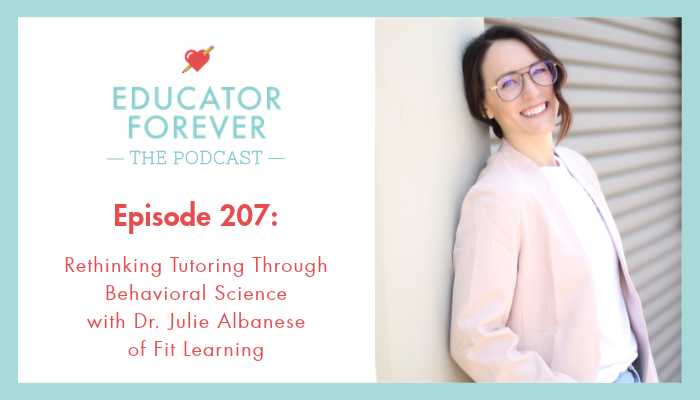
Dr. Julie Albanese is the founder and CEO of Fit Learning Inland Empire in Orange County, where she is redefining how children learn through the science of behavior. As a doctoral-level behavior analyst, educator, and entrepreneur, Dr. Albanese specializes in applying behavioral science, precision teaching, and evidence-based instructional methods to accelerate academic achievement and build confident, independent learners.
In this episode, Julie breaks down how Fit Learning uses behavioral science to help students improve their studying and how it differs from traditional tutoring. This conversation will give you a new way to look at how we learn.
Topics Discussed:
From criminal law to psychology
The issues with focusing on grade-level material
Team over individual
Resources mentioned:
If you’re enjoying this podcast, please leave a rating and review on Apple Podcasts.
Related episodes and blog posts:
Read the transcript for this episode:
Welcome to Educator Forever, where we empower teachers to innovate education. Join us each week to hear stories of teachers expanding their impacts beyond the classroom and explore ways to reimagine teaching and learning.
Dr. Julie Albanese is the founder and CEO of Fit Learning Inland Empire in Orange County, where she is redefining how children learn through the science of behavior. As a doctoral-level behavior analyst, educator, and entrepreneur, Dr. Albanese specializes in applying behavioral science, precision teaching, and evidence-based instructional methods to accelerate academic achievement and build confident, independent learners. Welcome, Julie. So nice to have you here.
Dr. Julie Albanese 0:25
Happy to be here.
Lily Jones 0:27
So I'd love for you to take us through your professional journey.
Dr. Julie Albanese 0:31
Yes, my professional journey. I started in the field of psychology by happenstance. I actually went to school to be a criminal law to be in criminal law, and I found that I just did not align personally with the values and and the the the classwork. I just couldn't keep up. It was really a big struggle. It was a pivot for me, and so I decided to do something different. I went into psychology, and in psychology I studied public health and cognitive science, and I just loved learning how we learn. And after I graduated with my bachelor's in psychology, I tried to find a job, and I landed in behavior analysis, and in behavior analysis, we were working with a lot of individuals with autism. I was working in this beautiful clinic that was a wraparound program. We had OT, speech, physical therapy. We had our behavior analytic clinicians, and it was just such a beautiful meld of all the professionals working together, that I decided to continue to pursue that side of psychology. Went on to my master's program, got my master's in behavior analysis. Worked in an excellent school that had the same type of wraparound programs, and returned back to California, where I just kind of just landed into in-home therapy, and I loved what we did, but it was rapidly changing in terms of what we were allowed to do in terms of medical necessity and what the science told us that we could do in terms of learning, and I just kind of felt a little stuck, and I I doubled down and I decided to work towards my doctorate, and I had this really strong inkling to get my doctorate in education because I just loved learning how we learn? How how do we teach skills? How do we capture opportunities and secure those to impact larger, more complex skills? But I learned that with a background of behavior analysis, that doesn't allow opportunities to go into education without having to go backwards to go forwards. So I found this beautiful program in psychology with an emphasis of behavior analysis, and I jumped right into it with no expectations, just to you know, just to see what else was out there, what I can continue to do in my field, and I came across Fit Learning, and I was taking a class in precision teaching and direct instruction, and it just made sense. It made sense as behavior analysts, as educators, as teachers, as as people looking to change the world with behavior analysis and learning. What else we could do, and I just jumped right into it. I knew that there was more that we can do with our science, with the science of learning, and to make an impact not just with learners with autism, but in the field, in like populations overall. At that time, I was also working in drug and addiction, I was working with ADHD populations. I was working with adult learners, and I wanted to show all the young professionals that were trying to pursue this journey that you didn't have to just go into one side of things. That you could do a lot of different things in education and make it your own.
Lily Jones 4:21
So cool! I love hearing about your journey, and I find a lot of overlaps. I'm so fascinated too with just how people learn and how we can support them to learn in various situations at different ages. And I love hearing about how you kind of fell into fit learning. Can you explain what fit learning is?
Dr. Julie Albanese 4:39
So fit learning is it it melds and marries the science of learning with the scope and sequences of education, and what we've done is we've been able to tailor individualized curriculum to learners on an individual basis and as a group basis. And what we started with was what is a bigger picture of a proficient reader, a proficient mathematician, a proficient logical problem solver, and we broke that down into the smaller component skills of what, where do we start, and how do we build that up? And that's not really reinventing the wheel, right? We have scopes and sequences to tell us how to teach reading, how to teach math, and but what we've done is take it a step further and not just look at skill sets and teaching based on accuracy-based learning. That's eight out of 10 opportunities. If you get a if you take a test, did you get an A, a B? Did you get 50% accuracy? What we want to see is proficiency based learning, and so at each of these component skills, what we've done is we've been able to norm what does a proficient learner look like in their alphabet awareness, their phonics, their visual decoding, reading words. What does the proficiency look like at these foundational levels? Because that's really what impacts these larger, more complex skills of learning, and that's what we've been able to take with with the science of education and science of learning is to apply that, you know, as a whole, and not just meet the learner where they are in terms of grade level, but where are they in terms of functional proficiency? And with that, it's just been a transformation of being able to work with learners of all ages, all abilities, from those struggling learners to those learners in the 99th percentile trying to achieve, you know, academic performance beyond their grade levels.
Lily Jones 6:47
It makes a lot of sense. I mean, if you think about it, just thinking of like all six year olds, like what can we really say about all six year olds, right? Like, and you know, all 45 year olds, like whatever, right? Like, we all have all these various things that we're working on to various degrees of proficiency, and so I appreciate you know kind of narrowing in. Like I think we need to have a more specific focus on a whole humans that are learning rather than thinking about things in really broad swaths.
Dr. Julie Albanese 7:16
Well, and not only that is you know all six-year-olds, all six-year-olds across the nation have different learning opportunities. You know, they have different exposure to different things. Some, you know, have had access, you know, to frequent academic skill sets. Some nuns. Some, you know, go and travel the world, and some, you know, are at daycare, some at home with mom, and so we all have different learning experiences that speak to different learning levels. So just because you have a six-year-old, you know, that are neighbors, they they're experiencing different types of learning opportunities that you know tell different stories, and so when we get to look at it at a more fine-tuned level, then we're able to to say, well, yes, they are six-year-olds, and yes, they should know their alphabet. However, you know, we're seeing these these differences in proficiency that we want to you know approach first to then work on to the next skill set.
Lily Jones 8:22
And I know you use something called precision teaching. Can you tell us what that is and how that fits in?
Dr. Julie Albanese 8:28
So precision teaching is a subset of learning science where we use precise behavioral operational definitions, and we use precise measurement systems, and these two cornerstones are really important because when I have a lot of learners that will come in families, we always start with an assessment. I want to know, you know, what's your goals for your learners? What are your expectations? Why are you reaching out? You know, what what's happening, and you know we start off with the assessment, and they're like, "Well, he knows his alphabet." For example, say we have a six-year-old; he knows his alphabet. Well, how do we define knowing? What does that mean? Because knowing could be two different things. It could be having the alphabet letters wrapped around my office and say, "Say your alphabet," and they go A, B, C, and they're seeing it, and then they're saying it. It could be a freely, you know, sought out cognitive ability where I'm freely thinking it and I'm saying it. I could be writing it. So it depends on what you mean by know, and so our first goal is to operationally define what is it that we're teaching and measuring. You think about IEP goals. Think about you know just standards in general. What do we mean by they know this skill? So the first set of precision. Is to operationally define what do we mean by know and in what context and what setting with who, so that we can actually know what we're teaching. And then the second part is that measurement system. So when we seek out to teach a skill, we have to measure if we're actually teaching it, and we want to graph it. We want to look at: Are we making progress? And we want to do that very quickly and through visual analysis. I want to look and make sure I can say this learner is making progress across two or three sessions. And if they're not, then I know how to put in interventions quickly or change my teaching approach so that I can make sure that that learner is making progress. So when we graph data using precision teaching, we graph it not just based on accuracy, but based on fluency and proficiency, and that is so key. And it's so easy for any educator to do. It's just incorporating a time component to it, so in 60 seconds, how many did they get right, and how many did they they get wrong, essentially, and we graph it and we change it to a rate based measurement. So then I can look at learning pictures across multiple different learners and see their learning path in real time, and I can make predictions on how long will it take them to achieve proficiency in this. And if I see that they're not going to to make proficiency in in a multiplier times two, meaning I learned two things yesterday, I learned four things today, eight things tomorrow, 16, then I know I need to make a change because it's so easy for for any of us to internalize something with our learners. Well, maybe they have ADHD, or maybe they have dyslexia, or they don't care. I just want him to care about it. But when we do that, that kind of puts us in a sick cycle of thinking. And when we are able to look at it based off of you know precision teaching methodologies or behaviorally, or look at the data, then we can take a step out and look at our responsibility to the learner and make changes to the environment, or the curriculum, or the the methods to which we're presenting the information, and how how that learner is giving us the information back.
Lily Jones 12:31
Fascinating, and I love all the different data points that you're including here. That it's not just accuracy; it's also fluency. It's also children's confidence. It's also probably how they come to learning. You know how they feel about learning, and I'm curious a little bit about that part. You know, how do you make this data-driven instruction fun and engaging for kids?
Dr. Julie Albanese 12:53
That's my favorite part. That's my favorite part. So every coach that is is trained in our methods. The first thing that I, the first conversation that I have with them is that our goal is for every learner to leave feeling better than they did coming in. That is number one priority across any day. Number two is of course making you know multipliers time too in their in their academic achievements, but we have learners coming after school during school time you know because they're unable to go to the traditional setting now. We have those that are in extracurricular activities, jujitsu, flight school, this and that, and so then they're taking this on top of that, and it's just another thing. And so we don't know what they're really coming in, what kind of attitude, what kind of you know, if they're tired at the end of the day, if there's these expectations by mom or dad or self expectations. So when when they're coming in, we do essentially like a preference assessment. Hey, how's your day? We we build rapport. What what are we earning today? So every program has a built-in reinforcement system based off of the learner themselves. A lot of times it's we use like a point-based system. We have golf counters that click. It's a tangible and it's an auditory, you know, feedback system. But they get to click it and they get to see how many points they earn, and they exchange that for fit dollars at the end of the day. And they can get, you know, prizes from the prize tower, gift cards, things like that. But they also get to see, wow, did I get more points today than I did yesterday, and we use like the shaping contingency of every time you're doing a little bit better, you get more points. And we use personal bests, and personal bests is so fun. And because I'm my aside from my professional journey, like I'm also an athlete. I love you know just anything athletic based, but I like for example I was a swimmer, and swimmers like you you compete against other swimmers, but you really compete against yourself. And you know every time that you're you're doing something, you're seeing how much you can improve the next time, and we get to do that in real time, you know, Johnny. Yesterday, you got eight correct in 15 seconds. Let's see if we can get nine today. Let's see if we can get 10. Let's see if we can get the ultimate goal, which is 15, and and see their academic progress go. And and when they meet those ultimate goals, we call it a p1. It's a preliminary pass, and then we pass a program, and they get to see how many times they pass programs, and they get to move through curriculum quickly. So they they just really come into access to contingencies built in, such as points and personal bests and praise, but then they get to like feel again that confidence. With you know, over a short period of time, they get to say, "Hey, I'm actually reading, or I can do that math. It's not as hard anymore." They're able to come in after a long day. They know what to expect, and and they're moving through it very quickly.
Lily Jones 16:20
Fantastic! And you painted such a great picture of what you offer at Fit Learning. But I'm curious to see or hear from you how you think it's different than traditional tutoring.
Dr. Julie Albanese 16:31
So traditional tutoring, what you'll see a lot of times is that the students will go in and they'll work on the grade level material to which they're at, which is great. So for some for some learners, they just need that extra little bit of instruction to help support their algebraic equations where they're at, and that is completely fine. We have learners that transition and pivot to traditional tutoring just to get that extra little bit of support. But what we do at Fit Learning is we look at foundational skills that are accelerating learning to either their current grade level or beyond by first looking at a foundational skill set. So we're not just targeting the the individual based off of the age on their birth certificate or what grade level they they should be or currently in, we're looking at well what do you actually do you know just because you're a walking talking human breathing person that shows this ability to be capable well what does that look like how how is your your understanding of hierarchical learning, categorical reasoning, compare and contrast, and what does that look like in proficiency? Because that's going to tell a little bit of a different story when you're expected to write a college-level essay. So we want to look at building up the proficiency at the foundational levels, maybe taking three, two or three steps backwards to move 567 steps forwards, and then with the traditional tutoring, a lot of times it's it's a lot of instruction. Like right now, we give a lot of you know speaking. I'm I'm doing a lot of talking, and you're nodding and you're agreeing and you're saying okay and then they say okay now take a test on what I said or now you go do by merging our instruction with direct instruction you know we have a lot of call and response we have you know cues into which we want the learners to continuously engage with the the teaching that's being presented, and we want to ensure like the learners are actually engaged in that material and making progress through it. Not just, you know, "I'm giving you the instruction now go do."
Lily Jones 18:56
Wonderful. I want to switch gears a little bit to to hear about your experience going and starting your own business, we have a lot of educators who maybe have something in their mind or heart that they want to create themselves. And so, I'd love to just hear from you. You know, how has that process been? What was hard? What was great? You know, any advice for our listeners out there?
Dr. Julie Albanese 19:21
Opening up a business is not for the faint of heart. I I've listened to a lot of your listen your your presenters, and it's definitely something that you want to go in knowing that you have your your values set in place, and you're you have a strong hold on your mission. When I went in to open up my business, I was still working a full time job in quality assurance. I was finishing up school, and I was also pregnant with my first child. You're busy. I know, and I was just like, okay, let's. Let's try this, and then at a certain point, you have to make a decision. And so I did what I needed to do to throw my my hat over the fence and say I'm I'm I'm all in because it also takes a lot of marketing, not just the the clinical side, but the marketing, connecting with your community, talking about what you do, presenting that, and then also the hands-on work is just the start, right? So when I was able to, you know, fully jump in, you know, of course you need to look at that financially and you know, with your resources, what you have available. Luckily for us here, the small business department they they provide excellent resources, free coaching, things that will help you really navigate the ins and outs. But now going into it nine years later, it's just a constant, you know, reevaluation of workflows, organization processes, ensuring that you know all the staff are continuing to align with the mission and the values of you know the company itself, and it's just a journey. It really is a journey that you have to be flexible in. You know, it would be easy to. Sorry, we have a bell going off right
Lily Jones 21:33
here. It's fine.
Dr. Julie Albanese 21:34
But it would be easy to for me to to run Fit Learning Myself as a one-to-one individual, but our mission is to transform educational practices in our communities and beyond. And not one person can do that. It does really take a team and a unique skill set of individuals that are passionate about seeing changes in in our in our learners that come through our doors, that I continue to build and try to scale what we're doing so that we can continue transforming the learners' lives and they can do what they want to do. You know, early on I said my my my first love was to go into criminal law. I really wanted to do that. However, I didn't have the foundational skills to do that, and so I I had to make a choice. I had to pivot, and you know we do end up falling in love with what we do. You know, and I love what I do, I would never go back. But what if I wasn't forced to have to make that choice because of lack of academic fluencies or proficiencies? Would I have gone into a different path? And I want to ensure that for you know the The learners in my community and you know across the world that they don't have to be forced to go into vote like a certain vocation or a certain class because they're lacking certain academic skills.
Lily Jones 23:14
Wonderful, yeah, it's such a journey, and I appreciate you sharing your mission too because I think many folks are like, yeah, I could do it just me, or I could think about what this means on a bigger scale. And I agree that you can reach more people, right? And you can impact more lives, even with the folks who work with you too, on a bigger scale that way.
Dr. Julie Albanese 23:36
Yeah, and and a lot of things aside from the resources with the small business department. AI has really transformed how you're able to work through your organizational processes a lot. So before we were doing a lot of hand hand charted graphs and looking at what is our outcomes, what are our financial outcomes, expenses, things like that. And now I can kind of, you know, bring it into an AI-generated system and kind of work through the data in a more fine-tuned comb, make some more flexible changes that I am so concrete in thinking one way, and just being presented a lot of different things in a short amount of time without having to knock on doors or you know call 1000 different people to kind of come to that same conclusion. I get to use some more you know generated systems to make the decisions within my company, and it's it's been really useful to streamline, you know, some of the the organizational processes that used to be bogged down by like maybe eight to 10 hours, and now I can do it, you know, Monday mornings before this meeting.
Lily Jones 24:56
Yeah, absolutely. Well, Julie, it's been such a pleasure. Talking with you, can you tell folks how they can connect with you?
Dr. Julie Albanese 25:02
Yeah, so you can find us on our website. I believe it's inlandempire.fitlearners.com. Schedule a free consultation. You can find us on Instagram, Facebook. Always happy to set up a consultation. I love connecting with with anybody just to talk about what we do and what your goals are for your your students or your community as a whole.
Lily Jones 25:27
Wonderful! Thank you so much.
Dr. Julie Albanese 25:30
Thank you.
Transcribed by https://otter.ai