
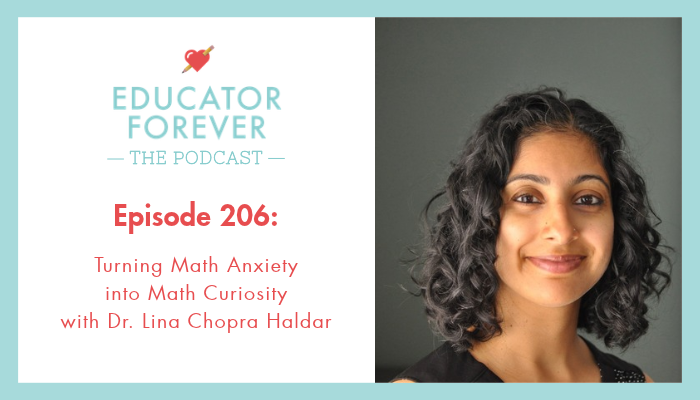
Lina Chopra Haldar writes children's books that weave math and storytelling together to spark curiosity and inspire young readers to see themselves as confident mathematical thinkers. She draws on 20+ years of experience in STEM education as a classroom teacher, researcher, evaluator, and curriculum developer, and she holds a PhD in mathematics education from the University of California, Berkeley.
Lina and I talk about her journey from math researcher to children’s book writer, her book Dear Math, We’re Not Friends, and her opinions on math education. She also has some fantastic advice for budding authors!
Topics Discussed:
Math anxiety
How some success in the classroom can mask a student’s conceptual understanding
Growth mindset
Resources mentioned:
If you’re enjoying this podcast, please leave a rating and review on Apple Podcasts.
Related episodes and blog posts:
Read the transcript for this episode:
Welcome to Educator Forever, where we empower teachers to innovate education. Join us each week to hear stories of teachers expanding their impacts beyond the classroom and explore ways to reimagine teaching and learning.
Lina Chopra Haldar writes children's books that weave math and storytelling together to spark curiosity and inspire young readers to see themselves as confident mathematical thinkers. She draws on 20 plus years of experience in STEM education as a classroom teacher, researcher, evaluator, and curriculum developer, and she holds a PhD in mathematics education from the University of California, Berkeley. Welcome, Lena, and I'm so excited to have you here.
Lina Chopra Haldar 0:25
Thanks, Lily.
Lily Jones 0:26
So I always start the podcast with the same gigantic kind of ridiculous question, which is to tell us in whatever direction you want about your professional journey.
Lina Chopra Haldar 0:35
Sure. Well, I always loved math as a kid, and my dad made it super fun, and he was also an engineer, which he made look really cool. So when I got to my undergraduate journey, I studied engineering, and after a very very brief stint on Wall Street, I went back to get my master's and credential at Teachers College, and then I taught 11th grade pre calculus. And two things kind of happened while I was getting my master's and credential, and while I was teaching, I fell in love with doing cognitive interviews with kids. I had the opportunity to take a class with Herb Ginsberg at Teachers College, and he's a star. And fell in love with doing that. I just loved sitting down with kids and learning about how they were making sense of like mathematical symbols and manipulatives, and I just thought it was the coolest thing ever. And and then I started teaching, but much older kids. I taught 11th grade pre calculus, and I started to get very curious about what was leading to these gaps in their understanding. Like, why are they having so much trouble with things like the equal sign, or why they can't really understand what a point represents on a graph? Like things that I thought my 11th graders would wouldn't be grappling with so much. So it was those two things that really inspired me to come out to UC Berkeley, where I completed my PhD in math education. It's been over a decade now since I finished my PhD, and since then I have been working on all sorts of full-time and part-time research, evaluation, and curriculum development projects. Right now, I'm working on an AI tech company. I'm helping them build out their math product, and I'm also writing children's books with a STEM focus.
Lily Jones 2:23
Yay! And I want to talk about that part because you recently wrote "Dear Math, We're Not Friends," which is amazing. What led you to write that? What made you interested in writing children's books?
Lina Chopra Haldar 2:34
Yeah. So I spent a lot of time in elementary classrooms while I was getting my PhD, collecting data and also volunteering, and some of that volunteer work involved reading with kids. And I realized that there weren't a whole lot of picture books for kids that focus on math. There were a number of counting books at the preschool level and the kindergarten level, and then there was that circumference series, which I'm not sure if you're familiar with. It's it's like a knight, and his name is Sir Comforts.
Lily Jones 3:03
Oh, this does sound familiar. That's funny. Okay,
Lina Chopra Haldar 3:06
Okay, they're very sweet. But besides that, there there wasn't a whole lot more. So I was really like inspired at that point when I was getting my PhD. I'm like, one day I'm going to write a book, a picture book with with a math focus, and I want more of these in the classroom, but then you know life happened. I had my own babies, and then finally, in 2020, right before the pandemic, which was an awful time to try to get into publishing, I started to write children's books, and it's been quite a journey. Like I, I've learned so much. I've learned how to write. I've learned about the publishing process, that you have to find an agent first. Your agent, you know, goes through this entire iterative process with you to develop your manuscript, and then they go out on submission in rounds. And it's it's a very complicated and very exciting process. But that's how I got really interested in in picture books.
Lily Jones 4:00
So fascinating! I had no idea all the different parts of going that go into writing a picture book. Yeah, you learn that stuff. Like, did you just dive in and figure it out, or was there sent to a place you went to?
Lina Chopra Haldar 4:12
Yeah. So I started off by just writing. I just kind of dove in and started writing, and then I had a friend who is in the publishing world, and she kind of gave me some revisions, and then it just turned into this cycle of writing, revising, writing, revising. And my husband wound up being my main writing partner for a while, and I realized I need a writing group. So that was a huge step for me. Forming a writing group with two brilliant writers has helped me come a long way. We've also developed a very deep and special friendship. I've also joined organizations like 12 by 12, which is a picture book writing group, and they have webinars like monthly webinars. I've learned a lot from those, and it's also just a wonderful community where I've met other people and have connected and. We'll like have one-off critique partner partnering sessions. I've also really enjoyed writing picture books by Anne. Have it written down somewhere. Anne Whitford, I think it is.
Lily Jones 5:14
Cool.
Lina Chopra Haldar 5:14
I can look it up if that's important. So so using different books and resources to to develop my craft. I also loved Big Magic by Elizabeth Gilbert, just because that that was more like about inspiration. So yeah, SCBWI is another one. If I didn't mention that one yet, Society for Children's Book Writers and Illustrators.
Lily Jones 5:37
Yes, yes. So thinking about your book, and you know it's called "Dear Math, We're Not Friends," and people have all sorts of big feelings about math. They think that maybe they're not math people, or they are math people. And what does your research say about that?
Lina Chopra Haldar 5:54
Yeah, you know, 20 to 30% of kids experience math anxiety in in some shape or form, and I've come to learn that adults experience math anxiety in similar forms. I think how often do you go to a restaurant and someone passes you the check because they want you to figure out the how to split it up, or they want you to figure out the tip, and they say things like, "Oh, I'm not a math person." So I think we need to do better at modeling, and I think for kids especially, we what the research really shows is that we need to foster a growth mindset early on in all the ways. Encourage kids to embrace challenges, capture their word yet in everything they do. Like if they can't figure out single digit addition yet. Well, they can't do that yet, but by the end of first grade, they should certainly be able to do that. And treating mistakes as part of the learning process is equally important. And celebrating all the little wins along the way, I think, just fostering a growth mindset in every shape and form is really important. And I think also making math fun and engaging and accessible at an early age, and making it less about steps to get to a correct answer, but more about solving a problem. A fun problem is is really important to help kids see themselves as math people.
Lily Jones 7:18
Yeah, it's so interesting to me thinking about math as like the perfect example of a fixed mindset for many people. You know, like it's just like, why do people feel like that with math or with everything else or many other things? It seems like people are more open to being like, well, I can't run a mile yet. Yes,
Lina Chopra Haldar 7:35
yeah, and like reading. If someone was like, you know, can you read me the grocery list? I'm not a reading person. You would look at them like they have three heads, like that doesn't make any sense. Or art, like people always picking up new hobbies. Like I'm going to learn to draw this year, you know. Well, math can math can do the same thing.
Lily Jones 7:52
Absolutely. And so I know you have two kids of your own. I'm curious if your experience as a mom informed your approach to teaching math, or I know that your book, the main character, is named after your son Nikhil. Yeah, you know, I'm just curious about like the mom experience on both the book and the way you think about math.
Lina Chopra Haldar 8:11
I think the mom experience and my son's some of his specific experiences in elementary definitely inspired the book. So going back to like math, having a positive math identity, I encountered a number of elementary educators who would describe themselves as not math people. And with someone with a math background, I was just so befuddled by that. I'm like, "You're you're teaching my children math." I'm like, "That that's not great." Or they would say like, "Oh, I would you know I have to do math at the beginning of the day because it's just it's too much at the end of the day. Like I heard teachers say things like that, and that was very puzzling and upsetting to me. So that kind of also inspired the book. And my son Nikhil, when he was in fifth grade, he had an assignment where he had to write a letter to math at the beginning of the school year, the whole grade did this, and then at the end of the school year, they all read their letters aloud and they reflected on their relationship with math, how it changed, how it grew, things like that. So I think being a mom made me even more aware of math anxiety in both kids and adults, and the importance of helping kids see early on just how important forming a positive mass identity is.
Lily Jones 9:30
Yeah, and those letters made their way into your book too.
Lina Chopra Haldar 9:33
They did, yes, yeah. I definitely stuck to, as you know, the it's a it's written in an epistolary format. A because it was inspired by my son's assignment, and B, I really wanted to like reduce the narrative or emotional distance between the reader and the main character, so they could just see how see his vulnerable side and see how. You know, scared he was, and I think it also lends itself to some of the humor in the book.
Lily Jones 10:04
Yeah, it's so fun. I mean, I think kids love that. It reminds me of like I used to have this book in my classroom that had envelopes, and you would take out the leather.
Lina Chopra Haldar 10:12
Oh, cute!
Lily Jones 10:13
It was so fun.
Lina Chopra Haldar 10:14
So each spread had an envelope inside of it?
Lily Jones 10:18
Yeah, Idon't remember exactly, but it was like some kind of story or like fairy tale book where it was like the big bad wolf wrote a letter or whatever and you actually take it out...
Lina Chopra Haldar 10:27
Oh, that's so cute,
Lily Jones 10:29
...which was so fun. I didn't.
Lina Chopra Haldar 10:30
You would have to find out what this book is later.
Lily Jones 10:32
Yeah, right. I remember the kids like you know misplacing the letters and everything too.
Lina Chopra Haldar 10:37
Of course it's like my worst nightmare.
Lily Jones 10:40
Yeah, I'm like, but it's empty. It's no longer changing.
Lina Chopra Haldar 10:44
We had a book like that when our kids got glasses. Like Arlo gets glasses, and each spread had like a different pair of glasses. But of course, we lost him.
Lily Jones 10:52
So I know you mentioned making mistakes, and I absolutely believe that making mistakes is a huge part of all learning, not just math, but I'm curious if you want to talk about you know why is that fear so common and what grownups can help their kids through it?
Lina Chopra Haldar 11:09
Yeah, I mean I think unfortunately we live in a culture and educational system that really emphasizes speed and correctness and testing, and that's unfortunate. So, as adults and educators, I think we need to move away from that approach. Like I mentioned earlier, I think we should be celebrating mistakes, and educators should be leading in with curiosity when a child makes a mistake, rather than saying. Which, for the record, lots of educators do this, and we're all like evolving as humans, and but sometimes like you know, there's not enough time. It's like you know what? Why don't you try that problem again? Instead of saying, "Oh, you got 14. Tell me how you got 14. Walk me through the steps." And then that process of going through each step of the math problem is a learning process for the kid, right? And then they can reflect on that process, see what they're doing right, see what they need to fix, see where the conceptual gaps are. So I think that's a huge thing we need to work on. Unfortunately, educators are spread thin and underpaid, and it's easier said than done. And I, I own that.
Lily Jones 12:20
Yes, and I think there's a whole like assessment culture that we live into, which is so focused on test scores and achievement and getting them right, which is really hard to like live in this culture and system that does that, whether inherently or explicitly, and all that be like mistakes are how we learn, which is completely true.
Lina Chopra Haldar 12:41
Yeah, yeah, totally. I mean, we do it. We do it for reading, right? And you you would think that it would be just as easy to do for math, but...
Lily Jones 12:52
Yeah, so interesting. I mean, I think people still have this idea of math is just being like right or wrong, you know, like very binary in a way that reading where it is also right or wrong when it comes to decoding right like yeah you read the word correctly you didn't it's just interpreted differently somehow.
Lina Chopra Haldar 13:11
I remember reading an article when I was in graduate school and I'm curious if there has been additional research since then. But at the time, they were looking at different things that influenced math teachers' approach in the classroom, and the biggest factor was how they learned math, right? So, like, think about how we learned math growing up. For me, it was there was a lot of memorization, focus on procedures, not concepts, particularly at the elementary school level. So it's not surprising, and also a lot of elementary educators don't have, you know, they're not necessarily a math math majors. They don't have as much of a math background, and that's challenging as well, right? Because they're they're less likely to pick up like the little mistakes or make sense of them in a way that someone with a stronger math background could make make sense of,
Lily Jones 14:02
yeah, or feel as comfortable with them.
Lina Chopra Haldar 14:04
Feel comfortable, yeah,
Lily Jones 14:05
yeah, yeah. Interesting.
Lina Chopra Haldar 14:07
So it's a lot. Elementary educators have to teach every subject.
Lily Jones 14:11
Yeah, it's so much. I mean, that's what made me excited about elementary school because I was like, I don't want to choose between English and math. I can do them both. Yeah. And I was like, oh, but then science, social studies, SEL, like all the things all the time absolutely.
Lina Chopra Haldar 14:24
But by the time you get to third, fourth, fifth grade, like it it gets harder. Similarly, I remember reading an article about how most fourth grade, fifth grade math teachers can't explain why invert and multiply works for dividing fractions, for example. And that's just one of many examples, right? So, if if an elementary educator can't explain it to a kid, like how do we expect a kid to have that conceptual understanding? They're just going to latch onto the procedures, and then that builds over time.
Lily Jones 14:52
Yes, absolutely, absolutely. So going back to your book, I know in your book Nikhil loves art and story time and garden. And he discovers math in different places, like snowflakes and shapes. Why was it important for you to show math inside the things that kids love?
Lina Chopra Haldar 15:09
I really wanted math to be a likable character because it's a character that the main character is writing letters to, and that meant showing kids not only that math is all around us, but that it's accessible in so many ways, and that it can be really joyful.
Lily Jones 15:23
So awesome! And I think that I remember when my kids were little, like when they started seeing math in different places, or they were like, "Oh, I can count these things," or like number, like they were so excited. Yeah,
Lina Chopra Haldar 15:36
yeah. I was worried that this book, like, it's definitely more elementary, not preschool. So I was wondering how it would land with with the younger kids. And one of the best stories, and I got from a from an old college friend of mine, was that she read the story to her four year old. She just turned four too, right before a flight, and she this her her little girl gets to choose four stories every night for bedtime. She chose dear math all four times, and she was just counting everything on every page. Like some of the math is more sophisticated, right? There's like some mention of angles, but there's still something for the four year olds, which is which is lovely. And then I think I may have told you this story before, but she also the next day she packed it in her airplane backpack, which is you know the highest praise.
Lily Jones 16:30
Absolutely, congratulations! That's amazing. Yes, and your book is just so delightful. Not only in having kids love math, but also there's a lot of wordplay and humor. And why was that important for you to infuse into the book?
Lina Chopra Haldar 16:46
Well, in general, as a human, I personally think humor makes everything better, and it just makes everyone more open to new ideas. In this particular case, I really just wanted the kids to look at the who the kids who like look at the title and see math and just get freaked out. I wanted to loosen them up, help them lean in, and I think humor is a great way to do that.
Lily Jones 17:10
Absolutely, always a good thing to add. Yeah. And so going back to you know we've talked about people with math anxiety, and some of our audience may be educators who are feeling like, oh, that's me. I actually don't know how to explain these concepts to my students, or I feel scared about teaching math. What advice do you have for them?
Lina Chopra Haldar 17:32
I mean, I would start by validating their feelings and trying to talk with them about where those feelings coming from, and then encourage them to step out of their comfort zone, and actually at the at the at the end of Dear Math, I have an author's note, and it talks about different ways to explore math anxiety. So one of that one of the ways is to create a space where kids and adults can communicate and work through their fears. Letter writing is one well known way to do that. You can also explore math with fun games and puzzles and other hands-on activities. Normalizing mistakes is also a wonderful way. Even adults aren't great at that either, right? And building confidence by breaking down complex problems is another example. I think most importantly, as adults, we need to do better a better job of modeling and not saying things like "I'm not a math person" or "math is boring" or "math is stupid." Like, I hear that on a pretty regular basis. Do you?
Lily Jones 18:35
Oh yeah, absolutely. Yeah, and from teacher friends too.
Lina Chopra Haldar 18:39
Yeah. So like, if if if how do we expect our kids to feel if if they're hearing that not only from adults in their home life but educators as well? So I think that's the first thing. And then educators, like you know, it's not too late for them to build some of those math skills. Like there's an activity where you can like sit down and better understand with visual visual with area models why invert and multiply works, and I've revisited it recently, and it's it's kind of like a fun brain puzzle.
Lily Jones 19:08
Cool, yeah, it can be really healing. I think too for educators to who maybe didn't have a good experience with math to be able to have an experience that feels good and makes more sense. And I think that you know, really digging into it rather than avoiding it is the key to most things.
Lina Chopra Haldar 19:25
Yeah, it's very empowering, right? Like as an educator, I'm like, oh, now I actually really understand this. I'm like, I'm going to teach it better, and now I understand it even more and more deeply. I'm going to improve as an educator and having that growth mindset, even as an educator, right? Because you know, I don't know about for you, but my first year of teaching was the hardest year of my life in terms of professional stuff. So just realizing that as an educator, you can continue to grow and should grow both in terms of your pedagogy and math content knowledge and math pedagogy. Content knowledge that that's always there's always room for improvement.
Lily Jones 20:04
Always absolutely, and so I know we mentioned this a little bit about like how you got started creating children's books, but I know a lot of our audience might be out there thinking, "Huh, maybe I want to write a kids' book too." What advice do you have about how to get started?
Lina Chopra Haldar 20:20
Just start writing. Write, write, write. Read. So whatever it is you want to write in, whether it's children books or YA or middle grade novels, read lots of books in that genre. I would go to the public library and just take out lots of picture books, funny picture books, nonfiction picture books. All just take a wide range and and dig in. It's really important to get your first crummy draft out, and then you can revise. Join a writing group. Do not wait for that. I waited a bit too long because I didn't just realize that it was an important step. 12 by 12 and SCBWI Society for Children's Book Writers Illustrators are both wonderful resources for children's book writing and writing picture books by Anne Whitford Paul is a wonderful resource that really helped me and I imagine there are similar books like that for middle grade novels and YA and other genres but just write.
Lily Jones 21:24
That's great advice. Absolutely. And so, Lena, what's next for you? Do you have plans to write more books?
Lina Chopra Haldar 21:30
Yes, I've written a number of fiction and nonfiction manuscripts. I'm out on submission with a couple now, and I may or may not have some good news to share soonish.
Lily Jones 21:41
I hope that I hear it soon. It's been so nice having you on the podcast. Can you tell folks where they can connect with you and learn more?
Lina Chopra Haldar 21:50
Yeah, yeah. You can. I have. You can connect with me on my website, lenahaldar.com. I'm also on social media, and those links are provided on my website. And I would love to hear from you.
Lily Jones 22:00
Wonderful. Thank you so much.
Lina Chopra Haldar 22:03
Thank you, Lily, for having me.
Transcribed by https://otter.ai