
Ever wondered what it's like to work in edtech? In this blog, we’ll explore 9 of the best edtech jobs for educators, what these positions actually involve, how your teaching skills translate, and where to start looking.
EdTech Jobs for Former Teachers: 9 Roles, the Companies That Hire, and How to Break In
If you're a teacher or former teacher considering a new career path, you might’ve heard about working in edtech.
And perhaps you've thought, That sounds interesting, but what does working in edtech actually mean?
Edtech, short for educational technology, includes companies that create learning tools, curriculum, assessments, and other resources for educators and students. And while some positions involve developing software, many edtech jobs for former teachers focus on skills you already use every day, including teaching, designing learning experiences, solving problems, communicating, and supporting others.
There are plenty of edtech jobs for former teachers that don't require a technical background. And often, your classroom experience is exactly what makes you a great candidate.
In this blog, we’ll explore 9 of the best edtech jobs for teachers, what these positions actually involve, how your teaching skills translate, and where to start looking.
What Jobs Are There in EdTech?
A misconception about edtech is that everyone who works at an edtech company needs to be a technology expert, know how to code, etc.
The reality is edtech companies need people who understand how teaching and learning actually happen.
They need curriculum developers who know how to create engaging lessons, trainers who can help educators use new tools, customer success professionals who understand the challenges teachers face, and more.
Edtech positions generally fall into four areas: curriculum and content creation, product development, customer support and training, and sales and marketing.
Here's a quick look at 9 potential career paths and how they connect to your teaching experience (we’ll dive further into these later!).
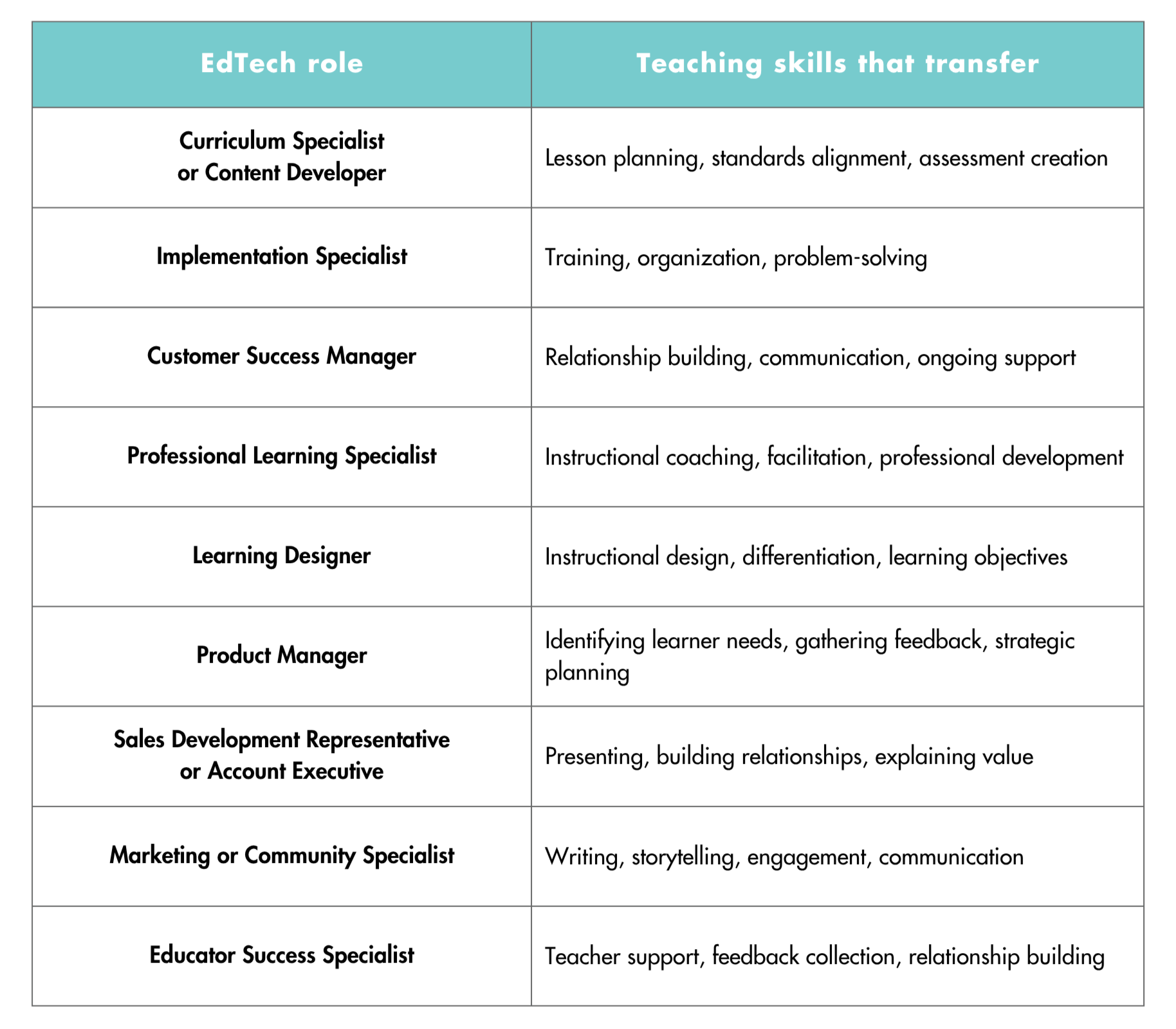
Notice something interesting about this list? You've probably done some version of many of these responsibilities already.
The difference is the setting, the audience, and sometimes the language used to describe the work.
Your experience managing a classroom, designing instruction, and collaborating with colleagues has given you valuable transferable skills. So it's really about learning how to communicate those skills to a different type of employer.
The 9 Best EdTech Jobs for Former Teachers
There isn't one perfect edtech job that’s right for all teachers.
Some educators love creating lessons but are ready to step away from teaching them. Others enjoy mentoring colleagues, building relationships, or solving problems. And some are excited to explore an entirely new type of work while remaining connected to education.
The best position for you depends on which parts of teaching you want to carry into your next career.
1. Curriculum Specialist or Content Developer
Best for teachers who love lesson planning, writing, and creating learning experiences.
Are you the teacher who enjoys lesson planning and creating curriculum? Do you love finding new ways to explain complicated concepts or designing resources that make learning more engaging?
Curriculum development might be a natural next step.
Edtech companies hire Curriculum Specialists, Curriculum Developers, and Content Developers to create lessons, assessments, instructional materials, and digital learning experiences.
In these roles, you might create engaging learning experiences, align content with academic standards, write instructional materials, review educational resources, or collaborate with designers and subject matter experts.
Your classroom experience is incredibly valuable because you understand what works with real students.
Search for: Curriculum Specialist, Curriculum Developer, Educational Content Developer, Curriculum Writer, and Assessment Developer.
Want to learn more? Explore how to transition from teaching to curriculum development, what a curriculum developer does, and our guide to curriculum developer salaries.
A great way to get started is to create a sample of your work. Our curriculum development portfolio guide can help you think about how to showcase your instructional expertise.
2. Implementation Specialist
Best for teachers who enjoy organizing projects, solving problems, and helping others navigate change.
Think about the last time your school introduced a new learning platform or curriculum program.
There were probably a lot of moving pieces! Someone needed to coordinate the rollout, make sure everyone had access to the right resources, troubleshoot challenges, and help things run smoothly.
That's the kind of work an Implementation Specialist does.
When a school or district purchases an edtech product, Implementation Specialists help guide the process of getting it up and running. They might coordinate onboarding, manage project timelines, communicate with school leaders, and solve problems that come up along the way.
While some implementation roles include training, the main focus is making sure the new product or program is successfully launched.
Teachers often bring valuable experience to this role because they're used to juggling multiple priorities, adapting when things don't go as planned, and finding solutions in real time.
Search for: Implementation Specialist, Implementation Consultant, Onboarding Specialist, and Education Implementation Manager.
3. Customer Success Manager
Best for teachers who love building relationships and helping people succeed.
One of the most promising edtech customer success jobs for former teachers is Customer Success Manager.
And despite the title, this isn't simply a customer service position.
Customer Success Managers help schools, districts, and other organizations get meaningful results from the educational products they've purchased.
You might check in with school leaders, answer questions, provide resources, identify challenges, or help customers discover new ways to use a platform.
Sound familiar? If you've ever worked closely with families, supported colleagues, or helped students overcome challenges, you've already developed many of the relationship-building skills this role requires.
Customer success can also provide opportunities to move into leadership, account management, and other business-focused positions.
Search for: Customer Success Associate, Customer Success Specialist, Customer Success Manager, and Education Account Manager.
For teachers without previous corporate experience, associate and specialist positions may be more accessible starting points than manager-level roles.
4. Professional Learning Specialist or Training Specialist
Best for teachers who enjoy mentoring colleagues, leading workshops, and helping adults learn.
If you love teaching but want to work with a different audience, professional learning could be a wonderful fit for you.
Professional Learning Specialists help educators learn how to use new curriculum programs, instructional tools, and educational technology effectively in their classrooms.
Rather than managing the rollout of a new product, these professionals focus on the teaching and learning that happens once educators begin using it.
You might lead webinars, facilitate professional development workshops, create training materials, or coach teachers as they implement new instructional practices.
Your classroom experience is especially valuable here because you understand how teachers learn, what challenges they face, and how to make new ideas feel practical and approachable.
And if you've ever led a professional development session, mentored a new teacher, or shared instructional strategies with colleagues, you already have experience that connects directly to this work!
Search for: Professional Learning Specialist, Education Trainer, Professional Development Facilitator, Learning Consultant, and Training Specialist.
If this sounds appealing, explore how your teacher coaching skills can support your career transition. You can also learn more about virtual instructional coaching.
5. Learning Designer or Instructional Designer
Best for teachers who love the creative process of designing effective instruction.
What if you could spend your workday designing learning experiences without being responsible for managing a classroom?
That's one of the exciting possibilities of becoming a Learning Designer.
Learning Designers and Instructional Designers create educational experiences that help people develop knowledge and skills.
In an edtech company, you might design online courses, interactive lessons, professional development modules, or digital instructional resources.
This work often involves planning learning objectives, organizing content, developing assessments, and evaluating whether materials are effective.
As a teacher, you already have a strong foundation in these areas.
However, some positions require additional experience with e-learning development tools, learning management systems, or instructional design software.
Search for: Learning Designer, Instructional Designer, Learning Experience Designer, E-Learning Developer, and Digital Learning Specialist.
6. Product Manager
Best for teachers who enjoy big-picture thinking, problem-solving, and improving educational tools.
Have you ever used an educational platform and thought, This would be so much better if it had one more feature?
Product Managers help make those decisions. They work with designers, developers, researchers, and other teams to determine what a product should do, which problems it should solve, and how to improve the experience for users.
In edtech, that often means understanding the needs of teachers and students.
Your classroom experience can be a major asset because you know what educators need from the products they use.
Product management is often (but not always) a more advanced career transition. While you don't always need coding skills, many edtech product manager jobs require experience with product strategy, user research, prioritization, and cross-functional projects.
Search for: Associate Product Manager, Education Product Manager, Product Specialist, Product Operations Specialist, and Product Manager.
If you're interested in product management, consider beginning with product support, curriculum, implementation, or product operations roles to gain relevant industry experience.
7. Sales Development Representative or Account Executive
Best for teachers who enjoy connecting with people, presenting ideas, and helping others find solutions.
Sales might not be the first career path that comes to mind when you're leaving the classroom.
But edtech sales jobs can be a strong option for teachers who enjoy building relationships and communicating the value of educational resources.
Sales Development Representatives typically identify potential customers, start conversations, and help schedule meetings.
Account Executives often take those relationships further by demonstrating products, answering questions, and helping schools or districts make purchasing decisions.
Your ability to explain complex information, understand educators' needs, and build trust can be valuable in both roles.
Sales is also worth exploring if earning potential is one of your priorities.
Search for: Sales Development Representative, Business Development Representative, Education Sales Consultant, and Account Executive.
Keep in mind that many sales roles include performance targets, so be sure to ask about quotas, commission structures, and expectations during the interview process.
8. Marketing or Community Specialist
Best for teachers who love writing, storytelling, creating content, and connecting with others.
If you enjoyed creating classroom newsletters, educational resources, social media content, or school communications, you might love working in edtech marketing.
Marketing teams help educators and school leaders understand the value of a company's products.
Depending on the role, you could write blog posts, create email campaigns, develop social media content, organize virtual events, or build online communities.
Teachers are often especially well-equipped to create messaging that resonates with educators because they know the audience firsthand.
Edtech marketing jobs may require additional skills in search engine optimization (SEO), email marketing, analytics, or content strategy. But you don't need to master every marketing tool before you start exploring opportunities.
Search for: Content Marketing Specialist, Education Marketing Specialist, Community Manager, Social Media Specialist, and Marketing Coordinator.
Consider creating a small portfolio featuring educational blog posts, sample emails, or other communication materials to demonstrate your abilities.
You can also explore our conversation with Kendell Hunter, who marks in Edtech marketing.
9. Teacher Community Manager or Educator Ambassador
Best for teachers who want to remain closely connected to educators and classroom experiences.
Some edtech companies have teams dedicated specifically to supporting educators who use their products.
These roles may be called Educator Success Specialist, Teacher Community Manager, Educator Engagement Specialist, or Educator Ambassador.
Depending on the company, you might answer teacher questions, organize community events, collect product feedback, create helpful resources, or collaborate with educators to improve a platform.
These positions can be especially rewarding for teachers who want to continue advocating for educators while working outside a school.
Not every educator ambassador opportunity is a full-time job, however. Some companies offer part-time, contract, or stipend-based programs.
Search for: Educator Success Specialist, Educator Engagement Coordinator, Teacher Community Manager, Educator Advocate, and Education Community Specialist.
You can also explore opportunities to provide feedback on educational tools through edtech product testing.
Entry-Level and Remote EdTech Jobs
One of the biggest reasons teachers explore edtech careers is the possibility of greater flexibility.
Maybe you're hoping to work from home, create more breathing room in your schedule, or find a position that allows you to stay connected to education without the demands of classroom teaching.
The encouraging news is that remote edtech jobs for former teachers do exist, and you don't necessarily need years of technology industry experience to qualify.
Some of the positions worth exploring include:
Curriculum and Content Developer: A possible fit for teachers who enjoy writing and creating educational materials.
Customer Success Associate: A potential starting point for teachers who enjoy relationship building and problem-solving.
Professional Learning Specialist: Particularly promising if you're comfortable leading online training and webinars.
Sales Development Representative: Some companies offer remote entry-level sales positions with structured training.
Education Content or Marketing Coordinator: A way to use your writing and communication skills while building experience in a new field.
Educator Support Specialist: A role where classroom knowledge may help you support teachers using educational products.
If you're looking for entry-level edtech jobs that are remote, you might consider looking for titles that include words like associate, coordinator, specialist, and representative. For example, you might search for positions such as Project Coordinator, Customer Success Specialist, or Sales Development Representative.
These can be more accessible than management-level positions, especially if you're transitioning directly from the classroom.
Remember that remote doesn't always mean you can work from anywhere. Some companies have state or country restrictions, set working hours, or require occasional travel.
You can also check out our guides to remote education jobs for teachers and remote jobs for former teachers for more ideas.
For a broader look at career possibilities, explore our guide to jobs teachers can transition to.
Which EdTech Companies Hire Former Teachers?
Now that you know which roles to explore, let's talk about where to look.
Many educational technology companies value classroom experience, particularly in positions involving instructional content, educator training, customer support, and school partnerships.
Here are some edtech companies worth researching:
Amplify: Develops curriculum, assessments, and instructional programs for K–12 schools. Explore opportunities in curriculum development, professional learning, implementation, and related areas. You can also listen to our conversation with Alexandra Walsh about working at Amplify.
Newsela: Creates digital learning tools and instructional content. Its teams include professionals working across curriculum, content, product, and school support.
Curriculum Associates: Develops educational assessments and instructional programs. Teachers may find relevant opportunities in content development, professional learning, and education-focused sales.
IXL Learning: Offers digital learning tools and educational resources. Depending on available openings, opportunities may include curriculum design, content creation, and customer-facing roles.
Instructure: Develops educational technology platforms, including Canvas. Potential career paths include customer success, implementation, training, and product-related positions.
Nearpod: Provides interactive instructional tools that help educators create engaging learning experiences. Look for educator-facing, content, and training opportunities within its organization.
Discovery Education: Creates digital learning resources and instructional solutions. Roles may involve professional learning, content development, and partnerships with schools.
Edmentum: Offers digital curriculum, assessment, and learning solutions. Depending on hiring needs, opportunities may include instructional content, customer support, and implementation.
These are just some of the many possibilities of companies to research, and keep an eye on for opportunities.
For a broader list of organizations and opportunities, visit our guide to companies that hire former teachers.
How to Break Into EdTech From the Classroom
Finding a career path that interests you is exciting. But if you've spent years in the classroom, applying to a technology company might feel intimidating. You may worry that you don't have the right experience or that your resume won't stand out.
Here's what I want you to remember: You don't have to start over. You need to learn how to position the experience you already have.
These five steps can help you get started.
1. Translate your teaching experience into industry language
One of the first things to understand is that edtech companies might use different words to describe work you've been doing for years.
For example:
Instead of lesson planning, you might describe your experience as instructional content development.
Instead of leading professional development, you might highlight training and facilitation.
Instead of communicating with families, you could emphasize stakeholder communication and relationship management.
Instead of using student data to inform instruction, you could describe data analysis and continuous improvement.
While the goal isn't to make your experience sound like something it wasn't, it's to help employers understand why your skills are relevant to the position.
Explore our resume tips for teachers and cover letter guide to strengthen your application materials.
2. Create one sample that demonstrates your skills
If you're interested in curriculum development, instructional design, or content creation, having a sample of your work can make your application more compelling.
For example, you could create a short curriculum unit, an interactive professional development presentation, a digital learning module, or a sample educator resource.
Choose something that connects directly to the type of role you want.
You don't need an enormous portfolio to get started. One thoughtful, polished project can help demonstrate your abilities.
Our curriculum sample guide and curriculum development portfolio guide walks through how to get started.
3. Choose a career direction before applying everywhere
When you're eager to leave the classroom, it can be tempting to apply to every job that looks remotely education-related. But you'll likely have more success if you narrow your focus.
Start by asking yourself what you actually enjoy doing.
Do you love creating instructional materials? Start with curriculum and learning design.
Do you enjoy mentoring other educators? Explore professional learning and implementation.
Are you energized by relationships and problem-solving? Customer success might be worth investigating.
Choose one or two career paths and begin learning the language, expectations, and qualifications associated with those roles.
You can also learn how to unpack education job postings to identify your ideal opportunities.
4. Build relationships with people already working in edtech
Networking doesn't have to mean sending awkward messages to strangers asking for jobs. It can be as simple as connecting with former teachers who now work in positions you're interested in.
Look for people on LinkedIn who have transitioned into curriculum development, customer success, implementation, or other edtech roles. Ask thoughtful questions about their experiences.
What skills helped them make the transition? What surprised them about their new position? What advice would they give someone getting started?
These conversations can help you understand the industry while building meaningful professional connections.
Our guide to using LinkedIn for networking can help you take the first step.
5. Apply strategically and prepare to explain your value
When you find an interesting position, read the entire job description before deciding whether you're qualified.
Pay attention to the responsibilities, required skills, and preferred qualifications. Then look for connections to your teaching experience.
You may not have held the title Implementation Specialist, but you might have helped your school adopt a new learning platform.
You may never have worked as a Customer Success Manager, but you have experience supporting people, identifying challenges, and communicating solutions.
Use specific examples to demonstrate how these skills transfer.
And don't forget to prepare for the interview! Check out our interview tips for teachers for practical ways to discuss your experience with confidence.
What EdTech Careers Look Like After the First Job
Your first edtech position doesn't have to be your forever job, and of the exciting aspects of transitioning into a new industry is the opportunity to discover career paths you may not have considered before.
For example, you might begin as a Curriculum Specialist, grow into a Senior Curriculum Developer, and eventually lead a team as a Curriculum Director.
Or you could start as a Customer Success Associate, become a Customer Success Manager, and later move into a leadership or strategic partnerships position.
Some educators also find that their first role introduces them to other areas of the company. A professional learning specialist might discover an interest in product development. A curriculum writer might move into instructional design or content strategy.
There isn't one single edtech career path you need to follow, and you don't have to know exactly where you want to end up before you get started.
The important thing is finding an opportunity that allows you to use your strengths while moving toward the kind of work and life you want.
If you're curious about what it's actually like to work in edtech, listen to our Working in EdTech podcast episode.
For more guidance on navigating your professional journey, read about the different stages of an education career path.
Your Teaching Experience Can Open Doors in EdTech
If you're considering a career outside the classroom, there are so many possibilities.
Your ability to create learning experiences, build relationships, manage challenges, communicate clearly, and understand the needs of educators is valuable.
And those strengths and skills can be applied in edtech and beyond.
Whether you're interested in creating curriculum, helping schools adopt new tools, supporting teachers, or exploring an entirely new direction, there are ways to continue making an impact in education while building a career that works for you.
Ready to take the next step?
Explore Ace the Application to learn how to showcase your experience, strengthen your application, and approach your next career opportunity with greater confidence.
And if you're looking for support and guidance as you explore new opportunities, join the Educator Forever Network.
You can also sign up for our newsletter for more resources, career inspiration, and opportunities for educators.
You have so much to offer beyond the classroom. Your next career chapter is closer than you think!
Frequently Asked Questions About EdTech Jobs for Former Teachers
-
No! Many edtech jobs for former teachers don't require coding experience or a degree in technology.
Roles in professional learning, customer success, educator support, and some sales positions often value teaching experience. While you may need to learn specific software or industry processes, your existing education skills can provide a strong foundation.
-
Some roles to consider include: Professional Learning Specialist, Educator Support Specialist, Customer Success Associate, Curriculum and Content Developer, and Sales Development Representative.
The best choice depends on your skills and interests, as well as the employer's specific requirements. Focus on positions where your classroom experience directly connects to the job responsibilities.
-
Yes, some are! Remote edtech jobs for former teachers can be found in areas such as customer success, learning design, digital content development, professional learning, and sales.
However, not every edtech position is fully remote. Some require school visits, travel, or hybrid work arrangements. Be sure to check the location requirements for each opening.
-
It depends on the position, organization, location, and your experience.
Some edtech roles offer higher salaries than teaching positions, particularly in product management, experienced customer success, and sales. Others may pay a similar amount, especially at the entry level.
When comparing opportunities, consider the complete compensation package, including health insurance, retirement benefits, paid time off, bonuses, and flexibility. A career change should support your financial goals as well as your professional goals.
-
Implementation Specialists typically focus on helping new customers get started with a product. This might involve onboarding, training, coordinating setup, and managing the initial rollout.
Customer Success Managers usually focus on the ongoing relationship after implementation, helping customers continue using the product successfully and achieve their goals. The responsibilities can overlap, particularly at smaller companies.
-
Companies such as Amplify, Newsela, Curriculum Associates, IXL Learning, Instructure, and Edmentum are examples of education technology organizations where classroom experience may be relevant.
The specific positions available change regularly, so check company career pages and focus on job descriptions that align with your teaching skills.
You can also explore our guide to companies that hire former teachers for additional options.