
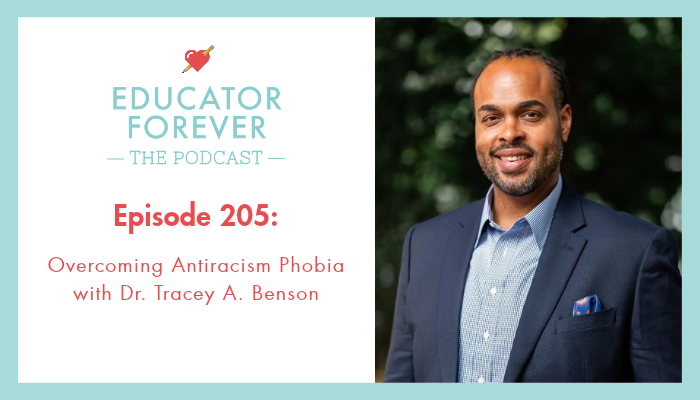
Dr. Tracy A. Benson is the founder and CEO of Tracy A. Benson Consulting and the Anti-Racism Leadership Institute. He is the author of Antiracism Phobia and co-author of Unconscious Bias in Schools: A Developmental Approach to Exploring Race and Racism. A former elementary school teacher, assistant principal, high school principal, and assistant professor of educational leadership at UNC Charlotte, Dr. Benson bridges research and practice to help leaders confront the systems that produce racial inequity and build schools where every student can excel.
In this episode, Tracy and I discuss his career, his work with communities of color, and how he’s helping students who are stuck in systems that prevent them from reaching their potential.
Topics Discussed:
Performative antiracism
Antiracism phobia
Embedding equity work in instruction
Resources mentioned:
If you’re enjoying this podcast, please leave a rating and review on Apple Podcasts.
Related episodes and blog posts:
Read the transcript for this episode:
Welcome to Educator Forever, where we empower teachers to innovate education. Join us each week to hear stories of teachers expanding their impacts beyond the classroom and explore ways to reimagine teaching and learning.
Dr. Tracy A. Benson is the founder and CEO of Tracy A. Benson Consulting at Anti-Racism Leadership Institute. He is the author of Anti-Racism Phobia and co-author of Unconscious Bias in Schools: A Developmental Approach to Exploring Race and Racism. A former elementary school teacher, assistant principal, high school principal, and assistant professor, professor of educational leadership at UNC Charlotte, Dr. Benson bridges research and practice to help leaders confront the systems that produce racial inequity and build schools where every student can excel. Welcome, Tracy. So nice to have you here.
Tracey A. Benson 0:35
Thanks for having me here, Lily. I appreciate your time.
Lily Jones 0:38
Absolutely. So I always start with the same gigantic question, which kind of makes me laugh because it go on forever, but it's so interesting, which is to hear about your professional journey.
Tracey A. Benson 0:48
Oh, thanks for that. Yeah, I'm. I started my career in education as an unexpected pre-K teacher.
Lily Jones 0:54
Cool.
Tracey A. Benson 0:55
I came out of college as a sociology major. Both my parents were educators. Didn't know what to do, so I joined an alternative certification program called Teach for America because I knew I wanted to teach. You know, I've been a tennis instructor. I taught Sunday school, and so I thought I was going to be a high school teacher, but you know, I wasn't. I didn't specialize in anything, so I was put in a pre-K classroom. Wonderful experience. Loved the littles; they were great. I did that for my training, but then quickly transitioned to be a fourth grade math and science teacher, which was a great experience. I love math. I love fourth grade. When I retire, I'm gonna go back and finish my career before retirement as a fourth grade teacher.
Lily Jones 1:33
Cool.
Tracey A. Benson 1:33
During that time, I my principal noticed that I convened a lot of teachers and sort of talked about pedagogy and teaching. So I was very, very, very committed to become the best teacher I could. And she's like, "You should think about going to administration. You bring people together well, and you're a great instructional leader." I was like, "Okay, I'll try." So I went back to school for my master's in educational leadership, and then transitioned. I was trying to find an elementary school principal position, couldn't find it for the life of me. So I was placed in a middle school, and again, being an elementary school teacher, my middle school the experience in middle school was very interesting because the pedagogy is a little bit different there. But I noticed that my expertise from elementary, you know, in in that we have to be very engaging instructors because you have to hold teachers, students' attention, was really paired well with the acuity at the middle school, and then after the middle school, the middle school I did one year in one middle school, two years in another middle school, and the prize you get for doing a great job in middle school is you get promoted, and so they moved me from that middle school to the high school, and so I was principal of a high school for for three years. Loved it again. Great learning experience. Left to go back for my doctorate with full expectation to be a superintendent. Decided halfway that superintendency wasn't for me. I went into academia for four years to work in educational leadership, and that's where I launched my consulting firm on anti-racist leadership because that's what I care about most: is leaving an impression on historically historically marginalized communities of color. So now I run the Anti Racism Leadership Institute, and I also write. I just my second book just came out. I speak about anti racism, and that's my life work my life's mission at work right now.
Lily Jones 3:16
Fantastic, and congratulations on the book and everything else. I love hearing about your journey. Like how cool it is that you did pre-K all the way to high school, then went and got your doctorate. Then we're like, no, actually, I want to do this other thing. Like, it's just so interesting to see all the different steps that inform somebody's path and where you end up, and you know what the through line is. I also just really like that you're like, and I'm gonna go back and teach fourth grade.
Tracey A. Benson 3:44
That's where I found my joy. That's my joy is teaching fourth graders.
Lily Jones 3:47
Yes, that's how I feel about teaching kindergarteners or teaching first graders. You know, I still am like, I don't want to do it all all full time. But you know, if I had like all the money in the world, and like you know, could just be a public school kindergarten teacher like that sounds like the dream still to me.
Tracey A. Benson 4:04
Me too, absolutely, absolutely.
Lily Jones 4:07
So let's talk about the Anti Racism Leadership Institute. Why did you create it, and what do you offer?
Tracey A. Benson 4:14
Well, I I offer it because that that was something that that was an ethos of mine unknowingly when I became a became a teacher. My parents, my mother was a counselor for like 40 years. My father was a special ed teacher for I think 30 years in Milwaukee Public Schools, and they were very dedicated to social justice, even though they didn't call it that. I was always wondering why they chose to stay in Milwaukee Public Schools. You know, because often folks start out in Milwaukee Public Schools and then go to one of the suburbs, because in a more desirable area with with with just different populations, they always stayed there, and they're very sort of driven to to serve in our communities. And so, when I got into teaching, that was just my natural proclivity of what I wanted to do, and I assumed that most teachers were like that. You know, when you're you start out teaching, you don't really observe a lot of other teachers, so you only know what you do. It's not until you get out of your classroom, you start looking at other classrooms, you realize that wait, not everyone teaches the same, and not everyone is is driven around populations that struggle. But that's where I have my passion around serving communities of color because I know it's like to grow up in a you know, and I grew up really poor in Milwaukee, Wisconsin, and experienced a lot of sort of the the the the negative sides of bias. You know, when I was a student in a predominantly white suburban school, because I was I was busted out of the city to a suburban school that's predominantly white, and even though I was a smart, well-behaved, quiet kid, and I was still treated as that other population, you know. So I knew what it felt like, and so when I got into education, that's I knew that you know I wanted to provide that experience as an educator to the students that I served. And so as I worked my way through from from teacher to AP to principal, I saw the same dynamics across several schools about how systems work to oppress, and you know, do not allow students of color to to achieve their fullest potential. And so, after doing a lot of research and publishing research and and writing several books around this phenomenon, launching the institute was a natural next step to provide you know just a holding environment for folks to struggle through what it means to alleviate oppression on communities of color into close gaps, and there's no. It's not a silver bullet. We don't have the answer, but we do provide the environment for folks to think about these really hard issues.
Lily Jones 6:29
And having that environment and having that conversation, right, and being able to hold the space of not only what's happening, but why and how do we change systems and people, and how do we be people within a system, you know, working to do this work together, I think that you know community component is so important too. Bringing folks together to talk about this. What kind of offerings do you offer people at the institute?
Tracey A. Benson 6:53
Well, it's grown over time. You know, the initial impetus. So this is my very my very first institute. So you know, I'm a teacher, right? And so basically, it's a it's a college course outside of college, right? And being in a leadership development program, I always believe that the coursework wasn't enough. There needs to be an extension into practice, so you can apply what you learn. And so I develop I developed a process. Oh yeah, so I mean, someone who's been in it who probably coach other teachers understand that you don't learn how to teach in a classroom, you know, sitting down listening to a teacher. You learn by practice, and you need a guide. And so, the initial institute I wrote for as 10 hours of learning, two hours, you know, two hours separated by a day or two, some homework, some reading. You know, the the core text is by book, of course. Sort of learning about the concepts of what it means to address these issues, along with really focusing in on one discrete problem of practice, one intractable discrete problem of practice that every leader brings to the institute, and that we provide the prescription for change. And then when folks develop their plan, they then leave the institute and they receive coaching by myself or our bench of coaches over the course of four and a half months. And so that was the initial iteration of what it how it began. We began with seven leaders back in 2000 and I think 2000 was like my first cohort. You know, it was COVID. I we had a smaller house, so I was in in a newborn, and so I was giving the the sessions in my closet. Right, it was super hot in my walk-in closet, sweating. But we grew from seven in our first cohort to 50, and a second cohort to 100, and a third cohort, because we're an outcomes-oriented firm, and so that's the that's our Cadillac our Cadillac offering. We do also offer sort of a quantitative analysis of like student outcomes, because most school districts don't have the time or the acuity to examine why systems operate the way they do, and have a quantitative sort of overhaul of like what it looks like in the in historically, so we can identify historic patterns and to identify how like viable solutions, and then we also offer extension support after the equity audit, and then the learning and the coaching. We then offer the an offering where we're typically with a district for 18 months to two years. About how do we then embed that into common practice, right? Because we can try things, we can have an initiative, but those things can burn out. We have to learn how to make it a part of the culture and the way things are done, as a as a part of sustaining the the progress that they make through our institute.
Lily Jones 9:17
That sounds wonderful. I love so much about what you said about the design, and I want to nerd out on the learning design part of it for a little bit because I love that. But having this be an ongoing process, you know, that it's not just like you take a class, right? You consume information. Like, sure, you get the information, you read the book, but you really get the support. And did you say prescription of change?
Tracey A. Benson 9:40
Yeah, a prescription for change.
Lily Jones 9:42
I was like, I love that. Who doesn't want a prescription for change? Like, write me a prescription for change, please.
Tracey A. Benson 9:48
Right. Yeah. It's just if you follow these very discrete steps that folks often look over, right? Often look over, and they default to what we call the no better do better paradigm, right? That if we just give enough PD, and I remember experiencing this. As a teacher, you know we have a two-day PD on whatever they want to teach us, and now I'm expected to master that and take it back to my classroom and change my practice. I'm like, I need help. Like, could someone come to my classroom and observe me and give me feedback? And if I'm doing this right, right, a two-day PD is not going to work. And so we try to get folks out of the know better, do better paradigm. Just because people know better and you give them the PD doesn't mean that they can take that and translate to practice in their classroom, and so that's the main part of getting folks to understand that. Especially when we're doing anti-racism work, the no better, do better paradigm has very, very little application to actual practice.
Lily Jones 10:34
Yeah, I'm so fascinated with this. Of like, there's a lot. I'm getting my doctorate right now in learning design, so I think a lot about you know translating just what I know about teaching little kids to now the past couple decades teaching teachers, right? Like we all need feedback, and I think as grownups, like we often don't get that feedback in the same way that kids do in the classroom. So I appreciate here too that it's like you're giving people the opportunity to get feedback, which is truly how we learn through that process too, rather than just being like, "Here you go, implement it."
Tracey A. Benson 11:05
Yeah, and and and you know, as you know that the same strategies that work with kids work with adults. Like we're the same learners. Yes, you know a lot of the strategies when I when I do my in person workshops, I use a lot of strategies that I use in my kindergarten classroom, right? Because you know, little trinkets, little awards, like being hyper positive, it's like a PBIS for adults, and so the same strategies work with adults that work with kids.
Lily Jones 11:27
Absolutely. So I want to go and I want to talk about your book, Anti Racism Phobia: Overcoming the Fear and Getting to Work. Can you talk us through what is anti racism phobia and why did you write this book now?
Tracey A. Benson 11:39
Oh, wonderful! Thank you for that. So I define define anti-racism phobia as a fear of confronting racial oppression, which leads to complacency, ineffective leadership, and unintentional reinforcement of racist systems. And I also explain it that it's a fear that's not often not intentional, that we're not often aware of, right? But still guides our actions. We want to when we see something that's explicit, that's you know that we identify as like ooh that's racist. We're so afraid of offending other people, adults, right? We're so afraid of saying the wrong thing and dealing with the emotions of saying the wrong thing around discussing race that we either talk around it or we don't talk it talk about it at all. And I talk in my very first chapter about my experience when I was a first year principal. I was like I was the first black principal in Berkshire County in Pittsfield High School ever, right back in in 2002 1010. And when I looked at the data, there was very clear discrepancies between the achievement of students of color and the white students there. And I wanted to say that in a very direct way, but I was afraid that if I said that immediately, they would the teacher would think that I'm calling them racist, right? We got this big black man. I had really long dreadlocks. I am 632 150 pounds. I'm a large black guy, right? And I know in society like that, the big black guy is often something that a trope that we use to describe someone who's scary. And I am that archetype of that guy. And so you have this guy, and a lot of these teachers have never had a black boss or a black principal. And the first day I'm going to come in and say, "Listen, guys, you know we got to we got to serve our black and brown students better." And someone can easily interpret that. Be like, "Oh, well, are you saying that we're racist?" Right? Then immediately, oh, he's angry. He's accusing us. And so my fear of saying the wrong thing caused me to use proxy language. So I would say these students, the students that we're going to focus in on, the students farther from opportunity. But I never actually got past there to to start talking about the dynamics of race during my principalship.
Lily Jones 13:33
So interesting, and I appreciate you sharing that story too, because I think yeah, it people live in this fear of making mistakes, right? Especially in cultures of schools, which are so focused on not making mistakes sometimes, and even though we don't want them to be, right? So I think so much of this too is almost like confronting ideas of perfectionism or like having to get something perfect to not fully engage in a really challenging and important conversation,
Tracey A. Benson 14:04
Right. And we we you know we we have to have to tremendous empathy because as a society in general, we do not have a lot of practice talking about our race in a multiracial environment. You know, we are not equipped to do that. We don't have. I don't remember ever having a conversation about race during my entire K 12 experience in a multiracial environment, right? We can talk about a bunch of other things, but that is a particular skill, right? And so we grow up with this absence of the ability to have these conversations, and then we do try to have these clumping conversations as adults. We're so afraid and we're so emotional, right? Because race has an emotional connotation to it, right? It draws up feelings of guilt and shame and anger, right? Feelings that come into the conversation. It's not purely intellectual, and so since we're not accustomed to dealing with the emotions that come along with talking about race, you know, we're not trained to do this for the formative formative years of our life in multiracial settings. We're horrible at it, you know. When we become adults, and we forget that if we have no experience at it, we got to have grace with us and grace with other people. At it, you know, I'm probably going to do this terribly. It's not going to come off right. That preamble. I want to say something to you all, and I don't mean it the way you're going to take it, but I can't not say it. Right? The whole preamble, right? That I'm going to say this, and then I want your feedback on how it landed, because this is what I'm seeing and what I'm feeling, and I want to learn how to have this conversation in a better way. But I don't know how to have that right now. That's the beginning point of starting to overcome that phobia. Just admitting that, yeah, I'm gonna do this terrible. I'm not gonna be perfect, and if it it comes off a certain way that lands poorly with you, let me know because I want to have it in a more productive way.
Lily Jones 15:40
So powerful, and I appreciate the like communication loop too. You know, really involving everyone in that. Like, okay, and then how did it go? Right? How can we do it better next time? Right? Maybe it was super awkward. Maybe somebody got heated. Like, whatever. You know, but like the reflection afterwards too, as an ongoing practice. And I know you talk about performative anti-racism. Can you tell us a little bit more about what that looks like and how schools can know if they're doing it?
Tracey A. Benson 16:06
Yeah, I mean, if this makes sense, it would make sense to teachers, right? You know, in the in the classroom, you know, our litmus test on if we're effective is how students are achieving, right? What are their grades they're getting on their tests? What the grades are they getting in our classroom? How are they performing on the their their formative assessments and their summative assessments. That's feedback for us. If we're as if we're being to tell it, let us know if our instruction is being effective, at least among reflective practitioners, right? And I was a reflective practitioner. I took it very personally when one of my students failed the test. I was like, okay, what did I miss, right? And how can I sort of plug the hole to make sure that they're getting the content. Not so much about a grade; it's like I feel bad because I didn't do right by you. And so that's the impetus for understanding. Like if we're if we're caught in this performative loop, that if our efforts are not resulting in these the the alleviating of whatever we intend to focus in on for our students of color, and a lot of folks don't are performative intentionally. You know, it's very common, especially post George Floyd, when we're at our national racial reckoning, for folks to be like, you know, I want to be anti-racist. I want to do something. So let's form a book study group. You know, that's the way our book became really popular. People are buying book, reading, having book studies, sort of talking together. You know, I went on a national speaking tour, you know, when I was the keynote, or I'd come in for a day or two do some PD, or there were folks formed these DEIB committees where they would meet monthly to talk about DEIB. You had schools that change their curriculum to be more representative. Like these are all well-intended efforts that often end up in the performative space because they never link to what then what is then for students like what okay we're doing these things but what now like what are the the the measures we're we're we're gonna sort of focus in on to say if we do this book study at the end of the day what's gonna be better for our black and brown kids, and in most cases, that never happened. Right, we based our progress just on how many activities we participated in, and totally forgot to think about this is all in service of students. And so that's how we know that we're caught in the performative loop. Is if we haven't done the due diligence around here's our pain points, you know, around how students are not being served well, and this is now upstream. The professional development is going to link directly to that because we're engaged in this activity, and we should see this data change.
Lily Jones 18:30
Yeah, that makes complete sense. I mean, it almost becomes like a checklist or something, right? Where you're like, "I did this," but it's like, "Yeah, for what?" And so, I think that absolutely going back to the students and the impact on students, and that can be for everything too, right? Like I think oftentimes in schools we have these initiatives, and it doesn't go back to the students. You know, it kind of stays at the adult level of these practices that we think we're doing, and we're not really measuring the impact with kids in the way that we could,
Tracey A. Benson 19:02
And all it takes is one. Anyone could be a tempered radical. Anyone at any time. It could be a teacher. It could be a para. It could be you know anyone who looks in the building, works in the building that cares about kids. You know, could stop at a professional development, be like, hey, hold on, okay, so let me get this straight. I just want to right right size on like why we're doing this right. I'm learning this professional development, and I really care about kids, but I'm not making the connection towards how this is supposed to be better for our kids. And pausing it there, and really spending the time having that discussion that if we do this well, if I buy in to yet another initiative, and I do it to the utter best perfection of what we've been asked to do. What are we measuring? What are the measures of success that we're going to hold ourselves responsible for because we're spending time, money, and energy on this effort?
Lily Jones 19:51
Yeah, so powerful. And I know kind of going along with that. I mean, that's great advice. Of just like it can start with a question, right? It can start with a. A a quiet challenge, I would say, right? Of just like recentering kids or recentering the purpose or why we're doing the things that we're doing. And I know you know it's a time where there's a lot of DEI bans and rollbacks. And what would you say? Any other advice for educators who feel like they have to stay quiet?
Tracey A. Benson 20:19
Yeah. Well, don't take any money to do right by kids, right? Doing right by kids is doing right by kids, and so with the DEI robot backed, and I'm I'm actually actively working on writing a keynote right now, especially considering last night's election results. Is that you know there's a bit of another swing back, an authorizing environment for DEI work might be reinvigorated again, possibly considering the political shift, maybe. But we have to be very careful not to get back into the same old thing, because what happened with the DEI, with the shift in folks hiring DEI officers, founding DEI offices, making these sort of window dressings to add on to their systems that once the authorized environment changes, they're easy to get rid of. Right, that we have to embed it in the work that we do in every system, like in instruction, in school management, in evaluation, in the way in which we assess kids for special education, right? That we have to look at it with an equity lens, especially when there's an outcomes gap. When there's an identifiable outcomes gap, there there's a difference between students of color and white students that's identifiable, right? That means that that the system has some sort of structural racism embedded in it, and you don't need a DEI office to address that. You need the will and ability of the individuals who are proximate to the problem to sit down and say, "Hey, we need to look for some solutions." Spend our planning time, spend our time that in our in our professional development time on learning more and addressing these very these issues that are embedded in the work that we do, and so the rollback on DEI and then possible reignition, the reigniting of the authorized environment to allow us to do this work, we have to be more strategic this time and embedded it in the work that we do, rather than doing it over here as sort of a separate entity.
Lily Jones 22:11
Yes, great feedback, and hopefully we get a chance to do the revised version. Right, do it again, like be able to try to go deeper in a really impactful way, and what would you say to educators? You know, we have a lot of educators listening to this who are just feeling overwhelmed, right? Where they might want to engage in this work, and they're just like, "I'm not sure how I can get started." You know, do you have advice to them on how they could get started, and also how to do it without burning out?
Tracey A. Benson 22:40
Wonderful. Yeah, I mean, I have immense empathy for just being able to teach in this day and age. Right now, there's so much going on out of school with the economy. You know, with just the the vitriol we have in our society and our politics. With you know the the school budgets, school closings. You know, there's this influx of trying to navigate technology and social media. You know, I didn't teach in this environment. The last time I was in a classroom was was 20 years ago. You know, when the last time I led a school was 13 years ago. So I was never in this environment. So I have a tremendous empathy for all the new layers of what teachers and students have to deal with, right? And if we're just keeping ourselves alive and head above above water and aren't able to do more, that is success. Right? We have to understand our our capacity because we want to live. We want to be effective. We want to have longevity in the classroom. So if that's where we are, that's where we need to be because we need we need teachers to be there and available for students. Now, if there's a will and a want to do more. It starts with just an individual conversation with another colleague. Just started there. Just you know, during a time where we would just meet with somebody anyway, we meet over lunch or we have a team meeting. Be like, hey, can I put this on the agenda? Right. I'm not expecting any outcome, but I just want to name it. You know, name what's on my heart. Name what's on my mind. You know, I want us to begin to reignite what's best for our Black and Brown kids in our school building because the gaps are still here. Just because the environment says that we can't talk about DEI or say equity or say anti-racism doesn't mean the problem has disappeared. So we still need to do right by our students. We just need to figure out how. And it just starts with just having that conversation and scheduling time for a follow-up conversation, and for a follow-up conversation, and for a follow-up conversation. And the more we get dedicated to carving out the time for progress, progress will happen. And we don't have to solve all the problems in the world. We have to do it within our circle of influence, and it starts with a simple conversation.
Lily Jones 24:37
And that seems so achievable. It's not like, oh wait, all right, I gotta like you know lead this whole PD and get all these sessions ready and all these things, right? Like it can be a conversation and it can be leading these inquiries or noticings that folks have in their classrooms already.
Tracey A. Benson 24:55
Right. And that's the way I work with superintendents, right? Because superintendents are over entire districts, right? And they want want to do what I call going for big air too soon. Like, oh my, I can't have an individual conversation at this one school with this one teacher. I have the whole district I'm responsible for. I'm like, all right, well, so if you launch an initiative that you haven't done before, so you don't have any proof point that it works, and you don't have the capacity to support people in doing it, you're setting yourself up for failure, so even though you're the head of this really large district with a lot of principals and a lot of teachers, the biggest mistake you're going to do is launch this initiative that you're not good at doing anyway. So you need to start it at the small scale and get folks on board so that they're buying in and trying things that are successful, and then you scale. Right. So even at the highest levels of in the hierarchy, you know, they start with individual conversations to begin to get the buy-in and experimenting with how to do things well before trying to take on take on an entire system. And the reason that people get so overwhelmed is because often school districts go for big air too soon, and then the initiative falls flat, and then we're deflated, and we're less likely to take on the next initiative.
Lily Jones 26:01
Yeah. I mean, this is again very true, and just like how we learn, right? We have to try out this material, right? Like I always think about like being a comedian or something, like teaching, right? You're like, all right, it starts with just like one kid or one colleague, right? Having a conversation, seeing how it goes, and then you have a conversation with another colleague, and then you're like, all right, like I have this strategy that I'm building on to, and we have to start small to be able to effectively scale it and like know what works. But you have to go through the like awkward beginnings one on one with folks and really listening to them to see what works.
Tracey A. Benson 26:37
Yeah, and it is just natural like human behavior. Like we develop our patterns when we get into our later years, right? 20, 3040. We develop our patterns. If we're trying to change any pattern in our life, we say we want to live a healthier life, right? If we put down the list, okay, well, I'm gonna eat better, I'm gonna sleep better, I'm gonna exercise more. We take on all these things. Maybe we'll do it for a day or two, but then it all fall apart because it's too many things. It's too big of a change, right? So the first thing is like, all right, you know, I typically go to bed at 10. I'm gonna try for a week to go to bed at 930. And some people would be like, hey, well, why not? Why not nine? Why not eight? You know, why? Why not? Like, hold on, we gotta do it so that it becomes natural first. So we have success first. And once we start having success and then reaping the benefits, because I feel more energized the next morning, we're more likely to be able to sustain another change. And so this is basic individual human behavior. It works the same with collectives in a system that we have to start small so that it becomes a buy-in process where people aren't just complying because you say so; they're buying it because they've tried it, they've had success, and they're willing to try more.
Lily Jones 27:39
Tracy, it's been so wonderful talking about with you and learning more about your work. Can you tell folks how they can connect with you?
Tracey A. Benson 27:45
Wonderful. Yeah, I'm one of the very few Tracy A. Bensons online, and so I don't want to be like the typical Google me. But you can Google me, and you can easily find me, right? But it's easy to reach me, Tracy Tracy at Tracyabenson.com. That's my email. I have a website. I have a podcast, Antiracism Leadership Institute Research and Practice Podcast. I have a TED Talk out there, and my two books, Unconscious Bias, a book that was released since 2019. My most recent book, Anti Racism Phobia, just came out on the 27th of October. is available at Harvard Education Press. So if anything sparks your fancy, feel free to reach out to me.
Lily Jones 28:19
Wonderful, thank you so much.
Tracey A. Benson 28:21
Thank you as well.
Transcribed by https://otter.ai