
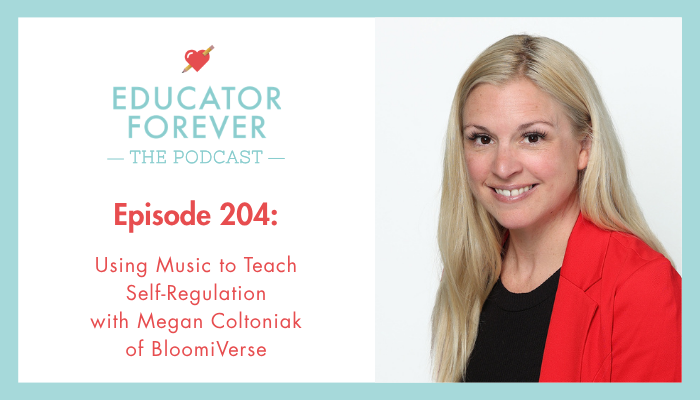
Megan Coltoniak is a board-certified music therapist with more than 20 years of clinical practice supporting children's emotional and developmental growth. First in schools and early intervention settings, and now through the companies she's built: BloomiVerse Music Therapy and Enrichment, Bloom Creative Arts Preschool, and Bloom Early Learning Center. Most recently, Megan created the Bloomiverse app for children ages two through nine, with the goal of creating a safe space for children to spend time on tablets.
In our talk, Megan and I discuss her music therapy practice and how she started it. We also dive into the challenges she’s faced in her business and her own music career.
Topics Discussed:
Creating and releasing an app
Helping children understand different feelings
Focusing on a distinct perspective
Resources mentioned:
If you’re enjoying this podcast, please leave a rating and review on Apple Podcasts.
Related episodes and blog posts:
Read the transcript for this episode:
Welcome to Educator Forever, where we empower teachers to innovate education. Join us each week to hear stories of teachers expanding their impacts beyond the classroom and explore ways to reimagine teaching and learning.
Megan Coltoniak is a board-certified music therapist with more than 20 years of clinical practice supporting children's emotional and developmental growth. First in schools and early intervention settings, and now through the company she's built, Bloomiverse Music Therapy and Enrichment, Bloom Creative Arts Preschool, and Bloom Early Learning Center. Most recently, Megan created the Bloomiverse app for children ages two through nine, with the goal of creating a safe space for children to spend time on tablets, so where they can learn through songs of love, diversity, acceptance, and also practice language that supports coping skills and self-regulation. Megan also released a new children's music album this fall, which you can find on Spotify, YouTube Music, and Apple Music platform. Hi, Megan. So nice to have you here.
Megan Coltoniak 0:46
Oh, it's so great to be here.
Lily Jones 0:48
Well, I would love for you to start us off by telling us about yourself and how you created Bloomiverse.
Megan Coltoniak 0:54
Great. Yeah. So, by trade, I am a music therapist. I've been working in early childhood forever. My parents own daycare centers, so I grew up in daycare. And then when I was too old to go to daycare, I started working in daycare. Amazing. So you know, I've just always felt a very strong connection with children, And then I fell in love with psychology, and boom, we have music therapy. So yeah, so I started out as a music therapist working in pediatrics. I moved around a little bit. I lived in Columbus, Ohio, for a while, and I really had a unique opportunity there, where I started working for a school called the Learning Spectrum. When I started, they had one classroom, I had one client, and by the time I left there, they had five locations, and we had hundreds and hundreds and hundreds of clients. And I was fortunate enough to help them grow in that aspect, and I felt very much in love with growing a business, growing a school, and kind of finding what every child needs and providing that.
Lily Jones 2:16
So cool! I love that this is like a family business that you started from too, being like around kids, and then also taking it fully in your own direction and creating something really awesome, which I know has bloomed, you know, in what you've created. And so, could you tell us a little about what you offer not only through Bloomyverse, but also I know you have Bloom Creative Arts Preschool and Bloom Early Learning Center.
Megan Coltoniak 2:39
Correct. Yes. So, yeah. So, I coming from that that background of family owned businesses, I always definitely felt this kind of vibe towards like, you know what, I'm gonna make it myself, right? So, and and coming from that, seeing how you think things should be, and then seeing those missteps, to me, I describe them as little gut punches. You know, the final straw for me was seeing my daughter, who needed to sit on sad spot in preschool because she was crying. She her hair was pulled by a friend, and they said, "Okay, well, you're going to sit in sad spot until you can be done crying," and it gave me a gut punch. I'm like, "No, that is not how it's meant to be. We need to teach children that they can feel their feelings, right?" I am someone that when I start to cry, I run away, and it's just because that's how how it was being raised to the '80s, you know. So so yeah, I I saw some missteps, and I said, you know what, I'm I'm gonna create it myself, and that's where Bloomyverse came in. So it started out as music therapy and enrichment, and we were going into preschool programs with our music rocks enrichment program, which focuses all on social emotional wellness and coping skills. And then we opened our doors with a 4410 approved preschool program, which is a New York State program, and we collaborate with over 35 districts in our area where the kiddos get bussed to us, and we offer their special ed preschool services. So I have a team of special ed teachers, OTs, PTs, speech, music therapists, and we all work together to give the child everything that they need. Wonderful, yeah. And then Bloom Early Learning Center is that Gen Ed aspect of it because I really firmly believe that we kind of have to have this integration, right? That we really want to make sure that we're inclusive. Of all children, and that our kiddos who are attending as you know that genetic portion that they learn about their friends who maybe struggle a little bit more than them.
Lily Jones 5:13
So powerful and so cool to see how all these different parts have been created and really work together. And what a powerful story! Also about the sad spot. I've never heard of that before. Like calling it a sad spot, and I also feel it as a gut punch of like, oh no! Like we should be excluded by having very human feelings.
Megan Coltoniak 5:35
Exactly, exactly. And what we talk about at Bloom is that we are a beautiful rainbow going in and out of all sorts of feelings all day every day, and that's okay. And that's what makes us beautiful, right? That we're different.
Lily Jones 5:50
And how do you use music to help students with their self-regulation and naming emotions?
Megan Coltoniak 5:56
Yeah. So at heart, I I am a songwriter. I've always been a songwriter, and so I really use that social emotional wellness piece in my song. So it's kind of multifaceted here. Music is innate. It's non threatening. Everybody has some sort of connection with music. Many of us sang before we even spoke. If especially if you want to kind of take in babbling and things like that when we're infants. So when you can teach how an emotion through song, you're going to connect to actually different areas of the brain that maybe a speech area wouldn't allow for. So what I like to do is I like to describe the emotion in song with things like your your jaw is clenched, your fists are tight, you just aren't feeling right, right. So we're describing how our body feels, how it looks, and then we're naming it with that emotion, so that way children are learning it when they're in a happy, content place, right? So these are meant to be circle time songs. They're meant to be songs that you do at home with your family when you're in a a place where you're ready to learn, and then when you might be experiencing that emotion, that you can draw back on that memory of oh my my fists are tight, I'm feeling angry, right? And then the second piece to that is now what do I do about it? And what we teach in all of our songs and all of our curriculum and our classrooms is that it's okay to feel that way, and for as long as you need to, right? Just because we're experiencing a different emotion doesn't mean that we immediately have to fix it, right? But when we're ready to fix it, now what? So one of my favorite songs that I wrote is called "Restart," and it's super catchy and repetitive, and it it gives this idea of that you can restart at any time during the day, like it does not have to be, you know. Oh, it's Monday now. You can start again, or oh, let's just call it a day. Go to sleep, and you can restart tomorrow. You can restart at 2o'clock in the afternoon, and that really came out of a time where my nephew, we were getting. I was getting all the kids on the bus. It was four kids, seven and under, and and there was I don't remember exactly what happened, but there was a very big emotion, and he just it it was an explosion. He was so upset, and I can see the bus coming around the corner, right, and I'm like, I've got to get him on this bus. I've got a meeting. Like, I think every mom has been there, right? Like, oh my gosh, what am I gonna do now? And so, but I, I gave him the hug. I watched for the breath. We took the deep breath together, and then I just said, restart, and things get better. Restart and solve the problem. And we repeated that together. He chimed in with me, and we sang it and sang it until he took a deep breath. And the bus rolled up, and he got on the bus. So then I went back to my notepad, and then I add more coping skills to go with it. So in that song, we actually teach grounding. We have a rhythmic phrase that says, "Feet on the ground, take a deep breath, think about it, restart." And we do all sorts of kinesthetic motions that go with it. But that's the thing: is that teaching the coping skills for the hard things usually don't happen in the hard moments because we can't hear, we can't speak, we can't respond. Right? But when we learn the repetitive phrases and the coping skills in a happy place, we can draw on them when we need them, and that's where Bloomyverse comes in and the app.
Lily Jones 10:28
Yeah, it's like building this toolbox that kids can create and then hopefully use in those moments. But absolutely, I think the key is not waiting for the moments to happen, you know, building those skills beforehand, and then pointing out like this is a moment where we could go back to this song or use this tool here.
Megan Coltoniak 10:47
Absolutely.
Lily Jones 10:48
So let's talk about the app. Can you tell us a little bit about it? Why did you decide to build it, and how did you make sure it was a safe screen experience for kids?
Megan Coltoniak 10:56
Absolutely. So the app again was born from another gut punch. We were coming out of the pandemic, and the kiddos that I was seeing come into my preschool program were attached to an iPad or you know some sort of tablet with some very big big needs, and I I was infuriated. I'm like, we have to get rid of technology with children. We have to get rid of it. How can we spread this message that this is not going to work? And and I lived in that space for a little bit too long. I think because it's not going anywhere, right? Like things changed during the pandemic, you know, parents do not punch out at five anymore. You know, there we have our phones. People are gonna text and say you have to look at this work email, or oh, did you see this work email? And then we're going back to it. And then what are our kids doing? You know, and much of the time it's tech time, so I thought, okay, how can I be a part of the solution if acknowledging that tech time is here, it's not going anywhere. How can I make a safe space for kids and also something that's meaningful, not just you know I hate to say it, but so many children's apps are meant to to make the children kind of addicted to it, right? They actually research ways that they can get kids to spend more and more and more and more times on on the app, and that's something that I did not want to do. I don't want to hear that your child won't get off of my app, you know. So I said, "How can I make this a tool not just for the child, but for the whole family, and also for educators as well?" Right. And so the answer there was that I needed to make something that was safe, that was ad free, because the ads can get scary too. I wanted to create something that they couldn't click and get sent somewhere else that's not safe, and then I wanted to create a part of it that would be tech free. So that was really important to me. That yes, the children can go and pick the different songs and learn some meaningful tools that will help them in life, but also that when it's time to hang up the the tablet for the night, you know, or if if a parent needs one of the songs and they don't want to say, okay, now here's tech time, that the parent can go and find a a tech free part, and so in the little sun section of the app, is just where you can find the song and play it without sort of any engagement. Another important piece for me was that yes, there's a cartoon element to it, but there's also faces. It was really important to me that children were still seeing human beings who are smiling and and and laughing and and also showing what it looks like to feel mad and squinting our eyes and like just real human kind of interaction because I thought that was really important as well.
Lily Jones 14:13
Yeah, that's great. I love how you're thinking about both the on screen and off, and even within an app. It doesn't mean necessarily the kid is staring at a screen the whole time. They could be listening to a song, you know, while driving in the car, or listening to a song while playing with their blocks, or whatever it might be. So I appreciate that perspective and mindfulness in creating the app as well.
Megan Coltoniak 14:34
Yes.
Lily Jones 14:35
So I want to shift gears a little bit to you as starting your own business and growing that, and I know that part of the process of learning anything, especially a business, is making mistakes and having things not go the way that we want them to. And I believe as a teacher, you know that is how we learn. And so I'm curious if there's anything that stands out to you in terms of like a mistake or an unexpected turn. That ended up being a learning opportunity for you,
Megan Coltoniak 15:02
100%. So business is not for the faint of heart. You know, it is. It's tough. My eye twitched for like two full years. I I kid you not. It just it did not twitch. It did not stop twitching, and so there were there were several moments where I thought to myself, "What am I doing? Can I do this?" Early on, it was like if someone who was really important to the team gave notice, you know, I would feel my stomach drop, and I would be like, "Now, what are we going to do? And we can't do this, but you find a way. You know, there was another piece that I distinctly remember with the 4410 programming. That's a very specific, like government-funded thing, and it's all it's related to rates that you are given, and they mistakenly gave me the wrong rate, which was higher than I should have had. And they realized it maybe six to eight months later, and then they were like, "Oh, we made a mistake that was actually for this agency. Your rate is this, so we need this amount back, and I was like, "Oh, that's gone!" Like I renovated a new building so we could open up more classrooms, and I just that was a gut punch to me. I was like, "Oh, what what could I what could I possibly do?" But what I've learned from that is that you find a way. There's always a way. There's always a third option. It's not just A or B. And so when things happen, when mistakes are made, or you know, or a pandemic hits, which was wild as a business owner, you you roll with it, which is funny. That's a song that I wrote, and we introduced it in our curriculum of February of 2020, which is funny. I guess I maybe like somehow sympatically saw the pandemic coming, but it's all about like the lyrics say, "Roll with it, let's roll with it." That was unexpected, but we'll roll with it, right? And that's the thing: things that are unexpected will always happen, but you can always find a way through it.
Lily Jones 17:45
So empowering, absolutely, and and I think it gets you into the mindset of like having agency, right? Like that there are solutions, and that looking for those solutions and finding them is actually a skill that you can build over time too. It becomes easier to not get like fully locked into. Oh no, this is over.
Megan Coltoniak 18:05
Yes, absolutely. You know, and with my staff too, especially with like some of the other administrators that I've hired, and they're leading their teams now. There, when they have those times, those tough moments, those like, oh no, now what what are we going to do things I'm like oh this is so great and do you know why because this is your storm right if it was all sunshine and rainbows every day like Pleasantville you know it would get boring right diversity is our friend here because the sun feels so much better on your face after a storm, right? There is, you know, when I'm not someone that could be, you know, down in Florida every day. I like the seasons, but I try and use that as an example. Is that it? When you go on vacation, when you're coming from a 20 degree tundra, that sun feels so much better on your face. So just recognizing, okay, right now I'm in a storm, and it's going to end eventually. And what it does is going to feel so amazing, and I'm going to feel so much prouder because I did that, you know. And to me, that self care is that you are building resilience in yourself, you're finding answers in yourself. You're doing hard things. You're trusting yourself through those hard things, and you're encouraging yourself that you can do it, and that it there will be better days.
Lily Jones 19:36
Yeah, having that perspective, like it's not going to last forever.
Megan Coltoniak 19:41
Correct.
Lily Jones 19:41
And I think that resiliency it does help us enjoy the good times, you know, and feel a sense of accomplishment too.
Megan Coltoniak 19:53
So, sorry, I was going to say the more storms that you experience, I think that it's easier to recognize. Your sunshiny phases when you're like, oh, everything's great, and I say that in a way of recognizing everything's great. Well, I think that there's some people that can say, well, everything's great, so when's the next shoe gonna fall or shoes gonna drop, whatever that phrase is, but getting I can get to a point where I'm recognizing this is a great phase. It's won't last forever, but I'm not even focusing on that or dwelling on it. Like I'm just enjoying the sun.
Lily Jones 20:36
Yeah, beautiful, beautiful. So a lot of our audience are educators, and they may be thinking of starting something of their own. You know, maybe they have a dream or just an idea that they want to follow through. What advice would you give them?
Megan Coltoniak 20:51
Yes. So my best piece of advice is: I think what happens so often is when anyone is thinking about starting something that they second guess themselves, they kind of have that imposter syndrome thing happening, or they'll have like this big big excitement for it. They start taking steps toward it, and if somebody doesn't meet them with the same exact enthusiasm, that they'll let the winds get taken out of their sails, but no one can do things exactly like you can do them. No one is going to come into the problem that you want to solve with your exact thought process and your exact spin on things. So, don't worry how many other children's apps there are. Don't worry how many other tutoring services or consulting firms are out there because no one is going to do it just the way you do it. And just kind of having that focus on it doesn't matter how many other people are out there doing it. I want to do this for me and in my way, and keeping that with you, I think, will help drive you towards success.
Lily Jones 22:11
That's great advice. Absolutely. So, Megan, it's been so nice talking with you. Can you tell us how we can connect with you?
Megan Coltoniak 22:18
Yes, absolutely. So, to hear my songs, you can download the Bloomyverse app, and it's a really great tool for teachers. The social emotional songs that are on there do teach the coping skills. They teach how to recognize emotions, all emotions, and then we also just released a album on Spotify and Apple Music. It's called "You Belong Here," and it's got some of my very most favorite songs, really about love, inclusion, diversity, and you could really use that as a tool in your classroom because you can build an entire social emotional curriculum on those songs, and so you can find us on Spotify, and then also I'm on LinkedIn, and we're on Instagram at Bloomiverse App.
Lily Jones 23:12
Wonderful! Thank you so much.
Megan Coltoniak 23:14
Absolutely, it was great being here.
Transcribed by https://otter.ai