
Episode 171: Supporting Students with Dyslexia with Dr. Coral Hoh of Dysolve AI
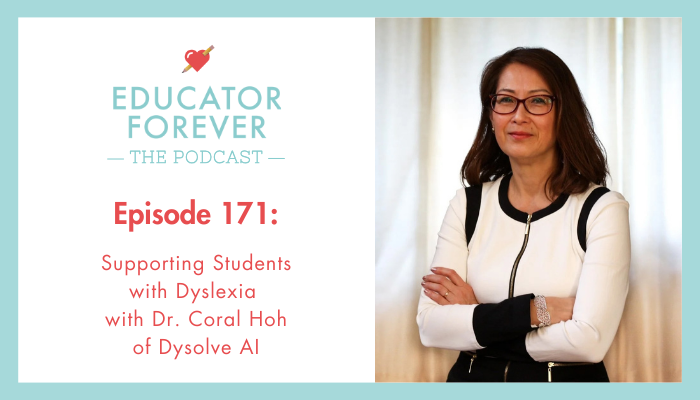
Dr. Coral P.S. Hoh is a clinical linguist and the founder of Dysolve AI, a technology platform designed to support students with dyslexia and other language-based learning differences. With a PhD in linguistics, her work focuses on applying research and artificial intelligence to improve how dyslexia is identified and supported at scale.
In this episode, Coral and I discuss how she began studying dyslexia and how that led to her creating Dysolve. She goes deep into how successful AI has been in helping language-processing issues and why she thinks AI should be integrated into education.
Topics Discussed:
Why Dysolve’s game-like program is successful
The importance of lessons tailored to students
The future of AI in education
Resources mentioned:
If you’re enjoying this podcast, please leave a rating and review on Apple Podcasts.
Related episodes and blog posts:
Read the transcript for this episode:
Welcome to Educator Forever, where we empower teachers to innovate education. Join us each week to hear stories of teachers expanding their impacts beyond the classroom and explore ways to reimagine teaching and learning.
Dr. Coral P.S. Hoh is a clinical linguist and founder of Dysolve AI, a technology platform designed to support students with dyslexia and other language based learning differences. With a PhD in linguistics, Her work focuses on applying research and artificial intelligence to improve how dyslexia is identified and supported at scale. Welcome coral. So nice to have you here.
Dr. Coral Hoh 0:22
Very happy to be here on a Snowy Evening.
Lily Jones 0:26
Yes, absolutely. Well, I would love for you to take us in whatever direction you'd like through your professional journey.
Dr. Coral Hoh 0:34
Okay, all right, so the word that comes up a lot when we talk about our product and company, dissolve is dyslexia, and so dissolve has to do with language processing, and dyslexia is very confusing for a lot of people, including practitioners in the field. I can go on and on, but you know, just stop after I say that. It is confusing and you have a really good question about you know that we should be flexible, and it is necessary because of the individual variation involved with dyslexia. Absolutely.
Lily Jones 1:12
So how did you get started in this field? What where did you start your career? And how did you get into focusing on dyslexia?
Dr. Coral Hoh 1:20
Well, I got a PhD in linguistics, and it's a cognitive science, and we're interested in really peering into the brain, so we use all sorts of language clues to to find that out. And I could have gone into a theoretical field and not do something that directly impacts people, but I wanted it to be useful in that way in my lifetime, and so I started working with children and adults, and it was just community service helping them because they had language issues. And soon enough, I stumbled on dyslexia because a friend of mine told me that her son is having difficulty reading at school, and he was in second grade, so she I asked her what she was going to do about it, and she said she was going to have him evaluate that point. And I wasn't familiar with this, so I asked, you know? So what's his qualification, you know, what are you going to get out of this? How much is it going to cost? And she said, $2,000 and that really, Lily is like, you know, microcosm of what really goes on around the country for a big part of the population, of families that they are trying to figure it, figure out why the children cannot read when you know everything seems fine otherwise, you know, and they have the support, a loving home, and, you know, supportive teachers. So then I told her not to do that. I was just going to do it for free. First, my background. Nice of you. Designed the test, you know, to figure out what was really going on with him, and I found it. I found the problem, but since I wasn't in the field, I didn't know how to solve it. What do you do when you when you see this problem? So I started reading up on it, and I realized, ah, that's what they call dyslexia. And then I realized that nobody could figure out what to do with it, either in terms of resolving it. So the methods that I used even up to now is really to help children cope with it for the rest of their school career, and early on, I was telling the parents that came to my practice that, well, that's not a satisfactory answer when they have decades in front of them, why don't we try to correct the problem? And as I went deeper and deeper into it, I realized that we had to go the AI route.
Lily Jones 4:04
Yeah, so interesting. I love hearing about how it came from this at one conversation with your friend and helping one kid, and then seeing from there where I could go and what I need, and what a great solution. And so, as we know, you know, AI has really taken over the world, and that caused a lot of advancements. Can you tell us a little bit about how you decided to start dissolve and the role of AI there?
Dr. Coral Hoh 4:32
We didn't do it just to jump on the bandwagon because we did. It was such a hot thing now, right? And it's because of the magnitude of the problem. This is a language processing difficulty, and so a lot of people, whether they are diagnosed with dyslexia or not, have language processing issues. Why is that? And that's because the linguistic system in the brain. Is like some massive, massive computer operating system with millions and millions of lines of code. So some parts, you know, may not work at 100% efficiency. Sometimes it doesn't matter, right? But at other times, then they make the system glitchy, or in the system starts to grind to halt or crash, and that's what you see, and that's why you see the variation in the population, and why it is so confusing, because it's not one thing. Now question is, how on earth are we going to find these problems, right, and these areas of difficulties in a massive, complex system. The only way to do it is with computing, because essentially, it's a computing, computational problem, and that's why it requires also computing computational solution three things, right? One is complexity. Two is speed. You see processing speed language is processed so fast, under a second for many, many processes and everything going on all at once, right? And the third thing is capacity, right? Magnitude of the problem when you have 20% of the population with dyslexia and a bigger chunk also with language processing, but not at that level of severity. And so then, when you look at the field of education, right, which is where we are, why is it that in some states, you have 70% of the students failing to meet reasonable reading standards, right? That's the Nation's Report. Why do we have 70% of them not being able to meet that because, for the most part, they do have language processing issues.
Lily Jones 7:08
Yeah, so fascinating. And so talk to us a little bit about how does dissolve work when a student uses it. How does it help a student with their language processing, right?
Dr. Coral Hoh 7:20
And the reason why we built this AI system, right? So it's not something that just borrows or slaps on some generic method or AI algorithm and put it in there, right? So it's not a tool we had to build a whole system from the ground up to deal with language processing. So the whole thing is AI, because people ask us which part is AI. This is not a generic thing. It has to be custom built specifically for this kind of a problem. And so it is very complex, but for the user interface, right? Because we are asking children to use it. So it is game based, and it's just plug and play, and the child just sits in front of the computer, logs in with their ID and password, and then there's a game lobby, and they just play game after game after game. And that's the way that the AI Express system on the server evaluates the child and decides what to build as the next activity, either to train, retrain or assess. So it's game after game for the child, but the complexities that they don't deal with, and also the teachers don't have to deal with. And so for the first time, we're able to get to brain processing to correct some of these difficulties, or what we call inefficiencies, because we measure them. And when you can do that, then teachers work is so much easier, right? Because teachers come in to teach content and skills. So when brain processes are not running well, then those things cannot be acquired easily or at all. And so then we make the foundational work, one that primes the brain, which has never been done before in an educational program, so that teachers can do their work right. Otherwise, you know, you have chronically failing students, and the teachers have to keep working with them over and over again. And I'm going to say this for your audience, because they care about we know what happens to their students, and they want the students to benefit from their instruction, but sometimes it doesn't work right? Not because they're not doing things with fidelity, but it's because there is a problem that has to be. Corrected first, so you prime the brain, and then everything falls into place. So I can tell you about cases, and we just came across one this week where the teacher worked with dissolve for the child, and in one year, right? This was the second year, one year, the child went up to grade levels in reading,
Lily Jones 10:22
Wow! Amazing.
Dr. Coral Hoh 10:26
Remarkable, right? Don't expect from students have been failing and failing for years, right? In fifth grade, sixth grade, right? You don't expect that to happen, but it does when you can actually correct that language processing difficulty.
Lily Jones 10:43
So you're already kind of getting into this, but I'd love to talk a little bit more about just how the educational system falls short for students with dyslexia, because I think, as you're talking about all these solutions, I mean, how amazing right to be able to give students what they actually need, to be able to fill these gaps or help with these inefficiencies. And I would just like to hear from you, you know, a lay of the land of what could be done better.
Dr. Coral Hoh 11:08
Right. So dissolve is new, right? And we just completed the clinical trial that showed yes positive effect, you know. And it was fast. Within three weeks, you know, we had 33% larger reading gains from dissolve than the other methods, and it was in nine states. So now, when it comes to where we are right now, dissolve is still not really used widely in school. So what we are seeing now is what the situation is, if you're not using something like this to correct brain processing first, right? So then you're using compensatory methods, very labor intensive ones, and because of that, the students still continue to fail, right? They may get a little bit better, but cannot get to where schools need them to be, where, when it comes to state testing, right or standardized reading assessments that they give quarterly. So that's one problem, right, that they're chronically failing still, no matter how much you know, instruction they get in very small groups, like one teacher to five, right? So I heard that's the requirement in New York. My The other thing is that, because of this heavy use of really highly qualified teachers, right? And they're not enough of them, half the students with dyslexia, do not get any kind of support right, and it must be heartbreaking, I think, not just for families who are involved, but also for educators, right, because the like you say, the landscape is such that You know you have this huge problem. Everybody recognizes it, right? But current methods cannot get us out of it.
Lily Jones 13:08
Yeah, yeah. I mean, I know being a teacher, you know myself, I always felt like it was so frustrating sometimes just knowing that either my skills or capacity or knowledge just wasn't enough to meet the needs of all my students, and that was heartbreaking. Right to be able to see that kids have gaps that you're really just not able to fill because you have so many other kids who have things that you need to help them with, or just don't have the specialized knowledge for that. So it is just generally so hard.
Dr. Coral Hoh 13:41
I was talking to another interviewer before who left the profession because of burnout, and then when we have a teacher shortage, it's really going to be harder and harder for the ones who are still there because they're asked To do so much more that it becomes humanly impossible. Yes, that's why we turn to technology. Like you ask the teacher to differentiate instruction for 20 students, that's a lot of planning, right? And then to take all these different assessments, interpret them manually, and then figure out what to do next. That's what they're asked to do. Yes, use technology to resolve this. And that's where Dysolve comes in, right? Because we thought about all these areas that technology can help. And therefore, when it comes to dissolve, it's the only product where the screening or evaluation just feeds into the intervention because it makes sense. You don't need anybody interpreting it, if the system can do it itself. And so then it is seamless, right? And it's there to get the student out of that five. Foundational, basic problem, so that teachers come in after that, and I have a message for teachers too, but yeah, please do it all right. So then the teachers are probably thinking, Oh, then what can I do? Right when it comes to a problem like dyslexia that affects at least 20% of their students? Well, two things, if they're in the public school system, then look into dissolve, and we have a website that is for give for parents and educators, because there's a lot of information that we put out there, and some of the information isn't found anywhere else, all right, because of the work that we've done, you know, in this area of brain science, you know, and really able to see the data from different individuals. So then go to Dysolve.com this, d, y, s, o, l, v,e.com, and go to Resources. And there you can even see like, how do you evaluate programs? How do you evaluate evaluations $1,000 or $5,000 and some people pay $10,000 are you getting really out of it? So, so the information is important, the education is important, right? So if there are, if the teachers are in the public school system, then look into this, right? And then, you know, if the school adopts it, then we provide also professional development. We also want to do our part to have educators also lead, right? This is one of the most advanced technologies in education, where this is patented technology, right, where you can actually develop or create an individualized evaluation and intervention for each child, it is person specific. Right? When people talk about game based online programs, they are talking once about ones where the pro the games are already pre made. Dissolve is different. It is only per session single use for that one child, because it has to be that tailored and utilized, right? So when we do things like that, you know, teachers coming into it, one was very honest. One say, Oh, I feel dumb, right? Because this is what's the teacher supposed to do? What are the students doing? And what do you expect the students to change in terms of their learning behavior? So that's why we want to provide professional development, right? It's not necessary for doing this plug and play program, but it is good to actually have the pioneers and be the leaders and the thought leaders, right? Because education is going in this direction, right? We're the forerunners. The individualization of education is coming. We have moved, actually, beyond adaptive, where students are moved from level to level and can skip levels, no. But now the individual is the unit. When we have that we need educators right to talk about this right and to share experiences and help others to do right, whether they're in the public school system, and then if they're in the private practice, they can join us. You know, reach out to us. Dysolve.com because they're different roles that they can play, but stuff in it great.
Lily Jones 18:49
That's great, yes, and I think just really hearing about the power of AI there, right? It does things that educators would never be able to do, right, like they would never be able to sit down with every single student and give all these many different Personalized Pathways. And so I think that is exciting, you know, to see the potential of how AI can be used. And I would love to hear your thoughts on where you see AI going in education.
Dr. Coral Hoh 19:19
So, like I said, the individualization, right? And then, so where does the educator fit in? Right? Teachers will always be necessary, right? Because why that human bond? We need teachers to continue to motivate and inspire. That's what we got going through our own Yes, journey, right, educational and career journeys that somebody helped us and inspired us. So that is still necessary, and that's where teachers come in for dissolve, right? You let dissolve do really the very basic foundational work. But teachers have to. Come in and also to see how the student has changed, and how to transition the student into the skills and the content learning part that is still part of the school curriculum. So there's a lot to work out, right? Because we will, for the whole field, we'll be going through this transition, all right, so that's why we need to have people come together and talk about it, all right. So that's part of our effort, too, and also for your audience, who are in private practice, you know, with their own say, first learning centers right and tutoring programs. We also have a reverse program, because, look, there are at least 10 million children that we're trying to reach right, and so many more young adults and adults, and by the way, we have adults in dissolve because they have not given up on trying to resolve their problem, regardless of their age, right? And so there's a lot for educators to do, whether they're in the public school system or in the private sector. And so work with us, and I tell you, it is so rewarding, right? Because, yes, you can actually change somebody's life, right? And it happens every week. We get these stories right, and teachers jaws dropped when the change in the assessment results.
Lily Jones 21:39
Yeah, it's wonderful. And so I know you mentioned before it flexibility, and I would love to hear from you. You know, why does flexibility matter so much in the education system?
Dr. Coral Hoh 21:52
Because everybody's going to be growing right as learners at their own rate, right, especially if they have certain difficulties. I don't like the word disability, because you see, when it comes to dyslexia, we see that it can be corrected, right, resolved, whatever word we want to use to say that, you know, the language processing difficulty is no longer there, right? So that will happen at different, you know, at different rates for different individuals, right? But there's one very concrete thing we can see from the data from dissolve, you know, when, when the system is interacting and collecting information about how students processing things. Sometimes you will see that the student seems very erratic, right? Some days they're good, other days they just refuse to work and they're moody. Now, when you look at the data from dissolve. It makes sense. Why? Because, for these children, their problem areas are very narrow slivers, but very deep. So when you hit it, they cannot perform. When you don't hit it, they can. It is really erratic.
Lily Jones 23:20
Interesting, yeah, yeah, it's interesting. Just the power of being able to have that data too, and being able to see as an educator, it gives more information, right? So yeah, I appreciate that, and being able to be flexible with it too. So I'd love to shift gears a little bit to your own experience founding dissolve. And I know that starting an organization is a huge undertaking, and I would love to hear about what you've learned about yourself through the process.
Dr. Coral Hoh 23:55
Well, you know, advice to anyone else who's trying to start their own venture. It takes persistence, resilience, because you have to bounce back. And you have to bounce back immediately. You can't mow for one day, because then the day is gone, right? And at some point you just become fearless, I think right? Because somebody was going to tell you, Oh, it's just too hard, you know, it's like one big mountain you had to climb, right? But after you've climbed one, then, you know, all the ones, you know, there'll be lots ahead of you, but it's okay, you know, yeah, I think that's what it takes, you know. And for anyone starting off, then, if you're fortunate, you have a mentor, right? And I found one, right? Somebody who has gone ahead of me, somebody from high school, so I can trust and because. He's gone through the whole thing, sold his business then, and, of course, made some mistakes, right? Then he this person can warn me, right, what it falls to avoid. So if, if you're lucky, then look for this, that person, because it helps, right? Because otherwise you know it is. You know, you're going into uncharted territory. So, so that's going to be a lot of backtracking, right? And there can be a lot of wastage, all right, in terms of resources and time. And so we've been fortunate that we didn't have to do that.
Lily Jones 25:37
I love both of those pieces of advice. I mean, I think that having a mentor is key. You don't have to figure everything out right. There are people who've done these things before, so learning from them can really collapse timelines in such a powerful way, and then going back to just the like becoming fearless. I think that's such a great reminder that taking risks, and, you know, starting something, and putting yourself out there. All of these are learnable skills, and particularly with the risk taking like you do develop this tolerance, or ability to balance back. And I think seeing that as a skill that we're learning is so powerful.
Dr. Coral Hoh 26:15
And I just want to just add one more thing, Lily, you know, if anyone is thinking of, you know, just leaving maybe her teaching position, and going into something on her own, right? Then consider that there is one that takes less risk, which is join us, right? Like I said, then, you know, you can have your program, right, but then work with us, and we'll provide the support in the refers program. The refers get 10% of group contracts. Wonderful.
Lily Jones 26:52
Well, it's been so nice talking with you. Can you tell people where they can connect?
Dr. Coral Hoh 26:56
Yes, go to dysolve.com, D, y, s, O, L, V, e.com, and then just yeah, go to the contact page and just fill out the form.
Lily Jones 27:06
Wonderful. Thank you so much.
Dr. Coral Hoh 27:08
Thank you. Lily, bye.
Transcribed by https://otter.ai