
Episode 187: From Regulation to Liberation with Dr. Niki Elliott
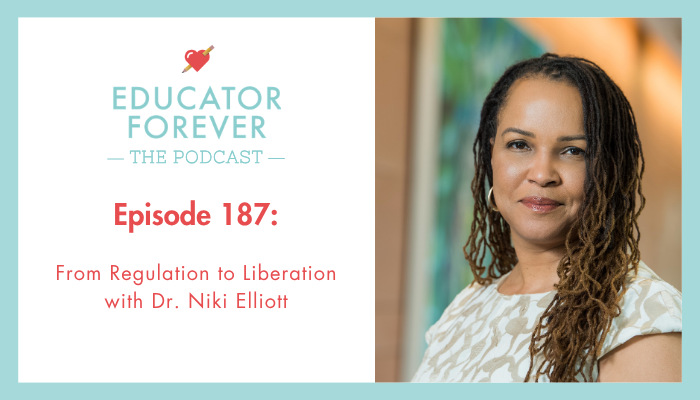
Dr. Niki Elliott is a clinical professor and director of the Center for Embodied Equity and Neurodiversity at the University of San Diego. A leading voice in neurodiversity and trauma-informed education, she has trained thousands of teachers, school counselors, and helping professionals worldwide to better support children with learning differences, mental health diagnoses, trauma histories, and behavioral challenges.
In this episode, Dr. Niki and I discuss the importance of embodied equity and the impact of the physical environment on neurodiverse children's nervous systems. We also get into her Center for Embodied Equity and Neurodiversity and how she prepares teachers for working with neurodiverse children.
Topics Discussed:
The need for schools to address sensory needs
Parents involving themselves in creating supportive environments
Starting her company Mindful Leaders Project
Resources mentioned:
Heart Centered Connections: A Guide for Supporting Neurodiverse Children
If you’re enjoying this podcast, please leave a rating and review on Apple Podcasts.
Related episodes and blog posts:
Episode 186: Fostering Creativity with Josh Davidson of Night Zookeeper
Summer Jobs for Teachers: Flexible Ways to Earn Extra Income and Explore New Opportunities
Episode 178: Supporting Students with Visual Dyslexia with Hillary Summerbell
How Language Proficiency Testing Informs Curriculum Development
Read the transcript for this episode:
Welcome to Educator Forever, where we empower teachers to innovate education. Join us each week to hear stories of teachers expanding their impacts beyond the classroom and explore ways to reimagine teaching and learning.
Dr. Nikki Elliott is a clinical professor and director of the Center for Embodied Equity and Neurodiversity at the University of San Diego. A leading voice in neurodiversity and trauma-informed education, she has trained 1000s of teachers, school counselors, and helped professionals worldwide to better support children with learning differences, mental health diagnoses, trauma histories, and behavioral challenges. Her work integrates educational neuroscience, polyvagal theory, mind-body practices, and embodied equity to build emotionally safe and inclusive learning environments. Dr. Elliot serves on the board of directors and teaching faculty of the Polyvagal Institute and is the author of the forthcoming book, Heart Centered Connections: Seven Essential Skills for Helping Neurodivers and Marginalized Children Thrive. Welcome, Nikki. So nice to have you here.
Dr. Niki Elliott 0:49
Thank you, Lily. It's a pleasure.
Lily Jones 0:52
Well, I would love for you, in whatever direction you'd like to take us, to tell us about your professional journey.
Dr. Niki Elliott 0:58
Oh, thank you. So my work has been always circling around education and educational equity for the over 30 years. I would say I started off my career as a fourth grade teacher in Teaneck, New Jersey, and at that time it was still a thing, maybe it is still somewhere in some school districts where veteran teachers could cherry pick and offload students that were non-preferred to the new teachers, and so that happened to me in my first few years of teaching, and although those were challenging classes for a new teacher to be learning the ropes, and while also being expected to navigate significant needs and behaviors, it was the blessing that really set me on the trajectory that I'm on now. I didn't have the best curriculum mastery, you know, all of those things that a new teacher is still learning, but what I did learn very quickly was how to relate to students and to really take the time to know them individually and understand what they needed and how to make a difference for those students. So I'm really proud to say, over 30 years later, I still keep track of some of those. They are professionals with children and families of their own, and it was a great practice ground for understanding the research that's become a part of my life. So from that experience teaching in Teaneck, I really, really cared more and more about understanding inclusion and especially intersectionality, and the ways in which students of color or students from lower-income communities would be assumed to have behaviors, whereas students from the dominant culture, if similar behaviors were exhibited, were immediately tested for autism or ADHD or other learning disabilities, and they were put on very different trajectories. So that kind of shaped my future interest. And from there I came back to get my doctorate, and what I thought at the time was that I'll just build charter schools, because then at that time the charter school movement was really a big thing, and what I assumed then was if we could just build our own separate schools still using public dollars, then we can give back then we didn't have the term neuro diverse, so we weren't using it commonly, but that's what they were, we could give neuro diverse children the chance to have hands on learning the kind of full body learning experience and we could tailor it to what they needed and so I went down that line for a while within my doctorate what would it take to build inclusive learning programs through the charter school movement so I spent the next several years of my career helping charter school founders understand the policy and the practice and designing curriculum and one charter school that I was a part of, I was the founding board president of Avis and Charter School in Altadena, California, and it was there that I got a chance to build an independent study program inside the charter school for neurodiverse children who struggled to come to school five days a week. Right, so the behaviors, the elopement behaviors, the meltdown behaviors were very significant. And we had an unused classroom, it was a double library, excuse me, in the charter school that was unused, and I asked the director, What if we did an experimental program here, and we brought all of the children who are struggling into this program, and it was beautiful. We had one group of students that came two days a week to school, and then I trained and coached their parents to teach them at home on the other days, and then we had another group of 20 students who were in this self-contained independent study class full time, and the results were just amazing, and so that the work that we did with them, the mind body work, bringing in the yoga, mindfulness, full body, multi sensory, all of the things. That students needed the growth that we saw in those students. It went from a classroom where people were like, who put those kids in that class together, to the next year teachers volleying to get their own children inside that classroom. So that became the seed ground of all of the research that came forward from that in Heart Center connections, so as I moved on from there, I went into university at the University of La Verne. We were building the Center for, excuse me, how well was it, CNLW, because we've got so many centers, CNLW, Center for Neurodiversity Learning and Wellness, and I had an opportunity there to start to help special ed teachers understand again how to bring yoga, mindfulness, clinical breath work, trauma-informed breath work, trauma-informed practices into our support of neurodiverse learners, and that was a great opportunity for about seven years, and then from there I was recruited to the University of San Diego, where I am now, and now a new center, Center for Embodied Equity and Neurodiversity. So, seen, so from that earliest days of understanding the mind-body needs of neurodiverse children has grown into the work that we deliver at Scene, which is a range of professional certificates helping not only classroom teachers, but also aides, healthcare workers, social workers, counselors, coaches, tutors understand the needs of neuro diverse children across settings. So it's been a wonderful 32 years of growth, and we are just getting started.
Lily Jones 6:43
So, inspiring. I love how it also started with those kids that you were given years ago. I also, you know, my first couple years of teaching were giving kids that other people, quote unquote, didn't want, and I still, you know, think about them in everything that I do. You know, 20 years later, designing curriculum for little Daniel, who's now in his 30s, but I think I really appreciated your story how this thing that you know you could have thought of as a challenge actually became a driving force and really a blessing to be able to dive into and go forward and unpack what are these students actually need, and it's so interesting hearing all these different ways that you've explored how to give students what they really need.
Dr. Niki Elliott 7:27
Yes, it's been a beautiful collision of my own personal life and lived experience, plus my professional passion, and then just what emerged, you know, as I worked to build programming and understanding what worked and what didn't work, but it's been a beautiful journey.
Lily Jones 7:42
Yes, so I've heard you say full body, and I love the title of the center that you're leading now, of embodied equity. Can you talk to us a little bit about embodiment and what it means to have full body learning?
Dr. Niki Elliott 7:54
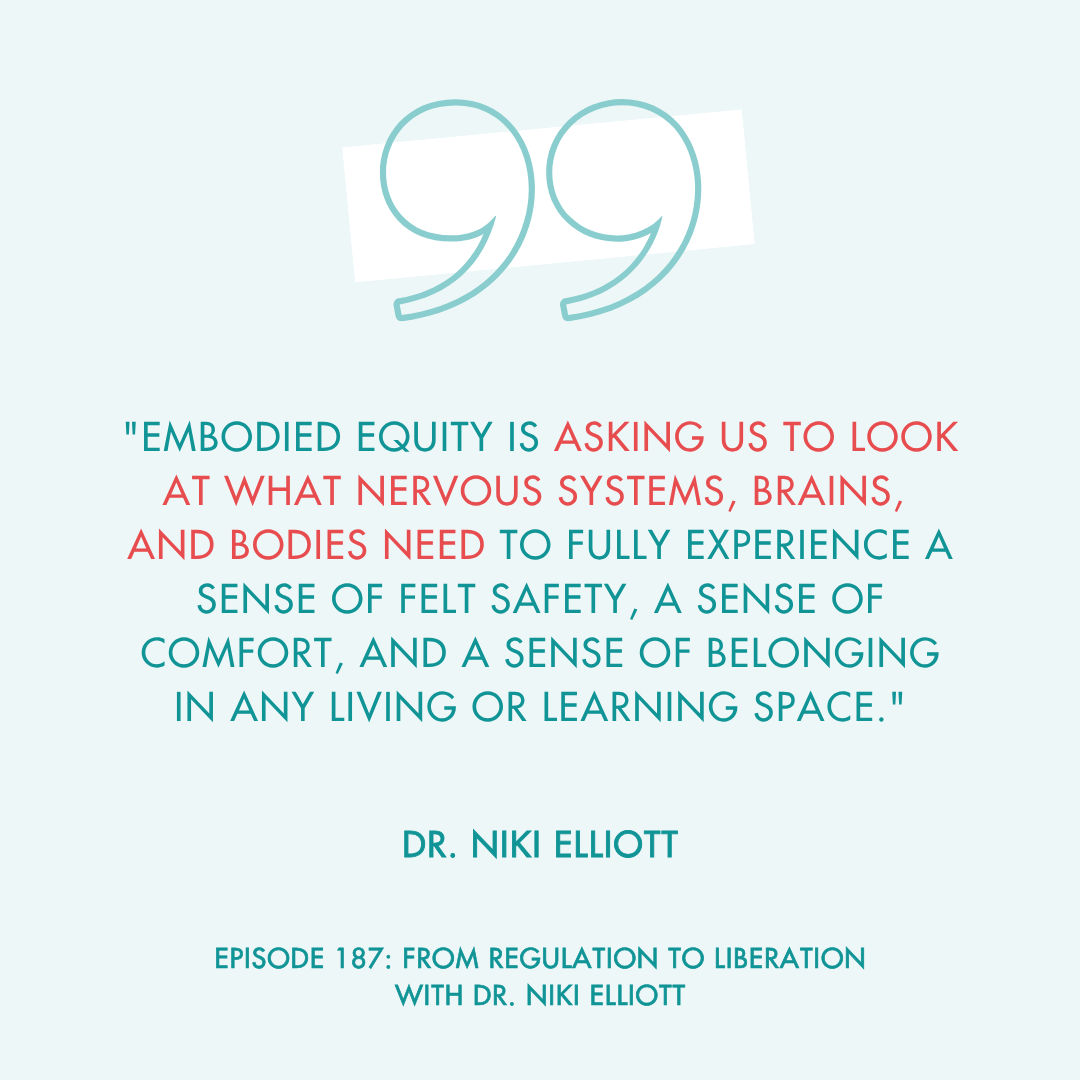
Thank you. So, when I came to USD, and we were building the center, we were toying with the name, and I said embodied equity has to be a part, because I truly believe that this idea of embodiment is the key missing feature in our common conversations about neurodiversity. So, if you're an occupational therapist, or you are an ABA, then those are the kind of domains or specializations where people have those conversations about the sensory triggers and the sensory needs and the nervous system state of neurodiverse people, but everywhere else it is not commonly thought about. So, when we use the term embodied equity, what we're asking people is to consider how the built environment, the physical environment in which we ask neurodiverse children to function and thrive, or individuals, not just children, impacts their nervous system, their brain functioning, their sense of sensory overwhelm, and how, when we do not account proactively account for those needs, we're creating environments that, by definition, are not equitable for them to access to thrive, and to show us their genius and what they're actually capable of. We create sensory stressors that lead to behavior triggers. We only see the behavior, but we're not taught how to back up and understand that the antecedent to that behavior was the fluorescent lights, or was the low tone sounds, or where the scratchy sensory things that we're demanding the child manipulate to get a grade, right? So, embodied equity is asking us to look at what nervous systems, brains, and bodies need to fully experience a sense of felt safety, a sense of comfort, and a sense of belonging in any living or learning space.
Lily Jones 9:39
So, important, and I absolutely agree that this is missing from many conversations, and I think it's so, so needed. I think it also, as you were talking, it made me think of just taking responsibility for the roles that school systems or teachers play, also, right, like really setting up an environment that we're. Works for all students.
Dr. Niki Elliott 10:01
Yes, and what I found, Lily, in observing teachers, training teachers, being a teacher, is that most children and adults actually, we set up environments based on what fits our nervous system's comfort, right? So you think about when you used, if you used to take old school road trips, right before we had, you know, streaming, and everybody had their own headphones and iPads in their own ears, right? The radio was set to who the driver, what the driver wanted to listen to, right? The temperature in the car was set to what the adult or the driver wanted to feel comfort, and everybody else had to bring their blankets and deal with it, right. But we kind of do that the same way in classrooms, so teachers that love things that feel very full, very bright, you know, they've got ceiling to floor, wall to wall things on the walls, on the shelves, and it can create such sensory overwhelm for students, but for the teacher it feels very comfortable, and you would not believe how challenging it can be to go into classrooms and help teachers understand these concepts of embodied equity to understand what their particular classroom design, the effect that it has on autistic nervous systems, on ADHD nervous systems, to actually have them create negative space or open space, or to declutter a classroom, or to move things down into a space where children can touch and have sensory stimulation versus being under aroused, right. So, we, it's not just this idea of hyper arousal, if it's too much, too loud, but there's also a really significant thing about hypo arousal, especially for students with ADHD, when the environment is not offering enough stimulation. So, then, to the opposite end, you go into classrooms where teachers have put very little effort into design, or they stack things very high out of reach, because they think students can't handle being trusted to handle the scissors or the squishy things, and so there's the students actually struggling with under arousal, and then they're in trouble for not being able to focus and pay attention, so bringing this nervous system and mind-body perspective into the awareness of teachers and parents has really been a game changer in our work.
Lily Jones 12:11
So, thinking about the environment for teachers and parents, do you have any suggestions? Like, are there any kind of universal principles that folks should have in mind, or is it really dependent on the specific children.
Dr. Niki Elliott 12:23
Well, it does depend on specific children. We have created something in our center called a sensory profile, and they are common. You can find them online, so if any of your listeners want to just go on and look at general sensory profiles, but some just say I'm sensitive to sight or to sound or to touch, but what we look at is a range of hypo arousal, meaning I'm sensory seeking in that, so I need strong visual stimulation, pictures, bright flashing lights, or I struggle with hyper arousal, meaning particularly, we were really always concerned. I'm pointing up at my own ceiling, fluorescent lights, right? So we know that for many autistic people, but not just that, I'm not autistic, but I'm also sensory sensitive, photo, very photosensitive, that they can see the flickering and fluorescent lights, and it can be over time a significant strain to the nervous system, so that would be a general thing. So, like in my home, we're switching out the fluorescent lights, we've got dimmer switches, we're looking for more natural lighting. Another thing that we are asking teachers to commonly be aware of are the low tone noises in a classroom or a space, so for example, because we know again that neurodiversity that is triggered by trauma for many people changes the inner ears and how they're processing sound, so auditory sensitivities can be sensory sensitivities in general can be sharpened, but auditory and specific, so the sounds of the HVAC machines, the sounds of the projectors, the sounds of desk scratching. Teachers that have run on verbal lectures and instructions that don't give time for processing or don't give visual cues or visual aids. Again, they're not aware that these auditory stressors can create some of the strong behaviors that we see with children, and then they're punished for the behavior, but we haven't stopped to examine the sensory stressor that we created.
Lily Jones 14:30
Yeah.
Dr. Niki Elliott 14:31
So also options to not have to engage with clay using markers as an alternative, so really helping students that can't handle when the foods touch, if the macaroni touches the veggies on fire, instead of pushing it right. Just, why not just put the plate with the little separators in it? Like, it's, it's little things that we demand children push past that as adults. If something was a sensory. Faster for us, we feel fully emboldened to be sure that it is accommodated, but yet we don't give those same easy accommodations to adjust to what a child's nervous system can handle in that time, with an expectation that over time we can support strengthening the nervous system, or that they'll continue to grow, the environment meets them, and then we have more time in a settled state, where we're in an optimal brain space for learning.
Lily Jones 15:27
I love that it opens up so many possibilities, and so many different ways of support, and I think it just reminds me how a lot of schools and teachers fall into this compliance, you know? Like, all right, nope, we all have to have our food exactly like it is on this plate, you know, and having to step back, like, well, why?
Dr. Niki Elliott 15:46
We like them for it, right? Instead of just why?
Lily Jones 15:49
Why, why, you know, and as you explain it so beautifully, like the impact it can have on everyone, like, yes, the student, but also the teacher, right, it creates this better learning environment for everyone, and so I appreciate as you're talking about picking out all these little things that really do come together to make a supportive environment, or an environment that's really challenging.
Dr. Niki Elliott 16:11
Absolutely, so in our work, in our certificate programs around heart-centered connections, we're asking teachers to audit their classrooms with that, and before they would punish, particularly around expulsionary discipline, we have very strong concerns around the amount of suspensions, expulsions, and office detentions that many of our neurodiverse children experience, and then every, we know that the research shows that every removal from the classroom is increasing a child's chance of ending up being fed into the school to prison pipeline, so we really care that teachers, general ed teachers, Lily specifically feel more equipped to support neurodiversity in the mainstream general ed classroom. So we're asking everyone to do classroom audits, we're asking everyone to collect sensory profiles from their whole class, and then understanding which modifications can be made proactively that support the largest number of students, and you'd be surprised how many changes can be made that make a huge difference in classroom climate that don't cost a lot of money.
Lily Jones 17:18
Yeah, it seems interesting to have teachers or parents to do some sensory profiles of themselves too.
Dr. Niki Elliott 17:41
Oh, that's exactly what we do. So, in our training, we first ask the teachers to conduct their own sensory profile, and then look at how is my home set up for what fits me, how is my classroom set up for what fits me. So what happens is, when the teachers conduct the profile and they're looking at the comparison between themselves and the children, then they have an opportunity to say, okay, well, if the students, like, are needing less sensory overwhelm, and I need more, then that puts a sensory stressor on the adult, but then then the adult is building mind body awareness to build nervous system capacity, so that's why we have mind body work as a part of the adult experience in our training, because now it can bother the adult less to be able to function optimally in an environment that's not tailored exactly how they need it, right, so it had that's why the embodiment keeps coming back through everything, and because most work in neurodiversity is cognitive, right? ABA, how do I get them to behave, understand this, do this, right? But it's not understanding that what we really are reacting to is our sensory experience of our environment and the nervous system triggers of danger or threat and that once that amygdala flips, you know we don't have access to the thinking and reasoning parts of the brain to talk somebody through why they do or don't behave the way that they do, so this nervous system approach has been a game changer.
Lily Jones 19:36
Yes, yeah, I mean, so much of how schools are set up or how we think about learning is like brains in bats, it's not right, like it's embodied, where humans embodies going through all these experiences.
Dr. Niki Elliott 19:49
Yeah.
Lily Jones 19:49
And so I know you recently wrote Heart Centered Connections. Congratulations. Can you tell us a little bit more about the book and the impact you hope it makes?
Dr. Niki Elliott 20:00
Yes. so in a nutshell, what I would offer is that Heart Center Connections is my love letter to every adult who touches the life of a child, particularly children who are impacted by neurodiversity diagnoses or trauma, particularly students like my son, children who have been impacted by foster care placements, and again, where there's a lot of marginalization, because people are misunderstanding the source of the behavior, and because of that misunderstanding, they're routing children toward more restrictive placements, more exclusion, more isolation, which worsens their outcomes over time, and so what we say in Heart Center Connections is that there are seven essential skills that every adult needs to help neurodiverse children thrive. Most of the time, as a teacher educator, I get people asking me, "Give me five tips, give me five strategies for making the kid do xyz, right? And I say....
Lily Jones 20:59
You want it to be be easy.
Dr. Niki Elliott 21:01
We want it to be external, right? We want it to be pointed at them, but what this work shows is that there are seven skills that the adult needs to learn and have in place before you turn the first strategy toward a child.
Lily Jones 21:17
Yeah, absolutely. I mean, that makes sense. It makes sense, and so I know you mentioned your son. Can you tell us a little bit about how raising him impacted your work?
Dr. Niki Elliott 21:29
Thank you. So, my family adopted Chas. He's 19 now, almost 20. We adopted him from foster care, and he came to us with a dual diagnosis of intellectual disability and emotional disturbance, so I will. As he's getting older, Lily, this is a thing. As he's getting older, he has now learned how to find me on the internet. So I want to be respectful of how I tell my son's story, because when I was, when he was younger, I could just tell the story, but now I'm like, my son can find me online and hear what I'm sharing about talk about you, so I'll be respectful of his history, but within that diagnosis, we were told never expect him to learn to read, never expect him to live independently. There was a long list of don't expect, and because at the time I didn't know what I know now about nervous systems, I did not know then what I know now about the impact of trauma on brain development and nervous system development. All I observed, and the thing is, I thought when we adopted him, I was so good with those kids when I was in fourth grade, teacher, right? I got this right. We're holistic, you know. I knew all his medical needs. We'll get him off that dairy, we'll do this, we'll do that, we'll go to this holistic provider, you know. But I wasn't prepared for the nervous system dysregulation that showed up in spaces where I'm not there, I can't control what's happening in preschool, what's happening in summer camp, and so the effect of that is that my son had behaviors that were so strong in different environments that he had the experience of never being accepted on a sports team, never being able to join Boys and Girls Club until 17 years old. The Boys and Girls Club in our community said, as long as he doesn't need a one on one aid, we'd love to have your son. We've been trained to support inclusion, right? But up until that time, now he had his nervous system capacity had strengthened, and he could manage that, but that was the first time, at his age 17, that we were told by an organization that they were proud that they had been trained for inclusion,and he had the best summer of his life, right. But up to that time, no Sunday school, no summer camp, before and after school programs could not support him, right. So you think about all these places he had exceptional, and still does, but it's much, much better now, exceptional auditory processing challenges. So, you think about all the noise that happens in all the spaces that people typically think are fun for children. A baby crying would have him kind of claw that baby out of their mother's arms. Some people could look at that and go, "What's wrong with that sociopath? Get him out, he's not going to be fit for society. But we didn't understand he was hearing like a five alarm fire, you know, or that sound of chalkboard scratching, you know, in his ears, so that journey of understanding when he was in environments where the adults took the time to understand his nervous system needs and to meet his sensory needs, he thrived, but then you move that same child to another environment, and he's tearing up the place, right? And so the amount of exclusion and special day programs, we put these classes in bungalows at the back fence of the schoolyard, right? So we just experienced all of the most severe. Types of social exclusion, academic exclusion, community exclusion, family members that did not get a chance to enjoy having him for the weekend over the summer, because everyone feels sorry I wasn't trained to quote unquote deal with behaviors like this, and so Heart Center Connections is dedicated to Chaz, because you know, if it's not your lived experience to navigate a neurological diagnosis that makes it difficult for your family to travel, get on airplanes, go to restaurants, go to Chuck E Cheese, go to Disneyland, or any place that's loud in baseball games, you know, all of these things people don't - they're not aware of, because those people have just disappeared from society, so they're not aware that people are at home feeling overwhelmed and excluded, because we keep on saying, I've never been trained to deal.
Lily Jones 25:56
Yes, that's so powerful, and I love that you've been able to take this experience and really help to train people to make environments more inclusive and to really support people, because it does seem like, as you were talking, it becomes such a perpetuating problem, you know, where it's like, all right, well, if students are, or kids are, you know, excluded from these experiences, then they never get to have them, right, and then it becomes harder to gain the skills and have access to things, and so really creating a pathway to support students within all these different environments is so powerful, and I know you focus not only on the classroom. Can you tell us a little bit about that? You know, it's not just the school, right?
Dr. Niki Elliott 26:37
Right, and yeah, so that's a big part of my work and my message through Heart Center Connections is that my work and my life is committed to supporting neurodiversity across the lifespan and across life spaces, right, because an autistic person isn't just autistic in the classroom, and in the past we've left all of the training and expertise to the special ed teacher who's had a special training and special add-ons to their teacher certification certificate, extra degrees in that, the aids that support them in the classroom, but that child still needs to be able to function in the cafeteria, on the bus, in the nurse's office, in the library, right in campus safety. When they're handling the students, they need to understand the difference between intentional behavior and symptoms of a diagnosis. And up to now, none of those auxiliary supported expanded learning professionals have received training. The before and after school program providers, people who monitor the yard and take children on field trips, so again, the arts teachers, all the supplemental teachers that bring arts, drama, music, dance, and these are places where neurodiverse children can thrive, right? The Sylvan tutors, so it's all of these spaces, and so I'm very, very proud that the Heart Center Connections certificate is not just offered in school districts to K-12 teachers, but we also have one I'm very proud of, Pastor Sarah Sumner Eisenbram from St. Andrew's Church, Lutheran Church in San Diego, came and did the training, and then introduced my work and invited me to be the keynote speaker for their national youth conference, and so now we're beginning this slow process of training the Sunday school teachers for the Evangelical Lutheran Conference nationwide, because they're like, oh, when we turn a family away and say sorry, we weren't trained to support your child in our Sunday school program, in our youth Bible program, in our, in our Bible summer camp, you're not just turning that child away from that experience, you're turning an entire family away from faith formation, right? Because now the parent can't come to church or to worship, whether it's a temple, mosque, synagogue, right, they can't feel comfortable there in a place where they've been told there's no accommodation or preparation for including their child, so now again you have an entire family going away marginalized from that environment and now missing the opportunity to know God in a deeper way, and when I put it to them that way, they were like, oh my god, it was such a conviction that wells up when you challenge people at that level. So, we've got Ocean Discovery Institute in San Diego, we've got a wonderful foster care program in LA, Peace for Kids, that has been a wonderful partner in helping spread the work. They train foster parents in these methods, right? So you open your heart and you open your home, but again, you don't know the things that need to be shifted in your parenting style, in your relational style, in your physical environment to bring in a child whose nervous system and neurology has been impacted by trauma and who may also be on. Autistic or have ADHD or dyslexia, so a lot of these old school parenting is not compatible with what these children need to experience inclusion, and so we've seen a 50% reduction, Lily, in failed foster home placements in among the families that have been trained in our work.
Lily Jones 30:18
Amazing, that's huge.
Dr. Niki Elliott 30:20
So it's all through the community. We train counselors, social workers. Excuse me. We've been invited to come into the juvenile justice system, because you think about it, the sentence a judge would give a child can depend on whether they think they're observing woeful defiance and disrespect. You won't look me in the eye, you know your answers are blunt versus understanding that eye contact can be a feature, challenges with eye contact can be a feature of autism, right. So, without that awareness, you're ascribing everything you're seeing as evidence that this child has no social connection, that they don't care, or that they're being disrespectful, and you're completely misreading common symptoms of a diagnosis.
Lily Jones 31:02
So powerful and so needed. I appreciate so much your approach, and really thinking about what kids need and adults need across the board, and it also makes me think of, like, if everybody is taking these approaches, and everybody is trained, and you know, really there to support students. Then we're all better together, right? Then we can really give data of, like, hey, over here at the bus stop, this was challenging, and, like, over here in the classroom, this really worked well, or at home, this isn't working, you know, like putting our heads together and really creating a plan that works across the board.
Dr. Niki Elliott 31:39
Absolutely, so that's why we encourage collecting holistic profiles of how a student's diagnosis manifests uniquely for them, right? Because again, the saying is that if you met one autistic person, you've met one autistic person, right? So we can't take the general symptoms of a diagnosis and apply them across the board. We have to know the unique manifestation of that diagnosis for each child, but particularly because we see like a 60% overlap of ADHD overlapping with autism, or ADHD overlapping with dyslexia, or ADHD overlapping with trauma, or mental health diagnoses. So, sometimes we're looking at multiple layered diagnoses, and so any one thing is not going to work, and so we have to have an individualized lens on each child and understanding what their unique set of strengths, challenges, and needs for advocacy are, and we cannot miss mapping the strengths, otherwise we train adults' lenses to only look for what's wrong or deficient in a child, and they're missing tremendous strengths that are ready to be optimized.
Lily Jones 32:49
Absolutely, well, Vicki, it's been so inspiring talking with you and hearing more about your work. Can you tell folks how they can connect with you?
Dr. Niki Elliott 32:56
Thank you so much. So, yes, I look forward to staying connected with all of you through Mindful Leaders Project, that is the name of my company that owns the Heart Center Connections program, but I also love if your organization is interested in having training to learn to be inclusive in any setting, then please reach us through the University of San Diego Souls Scene Center for Embodied Equity and Neurodiversity, and I would look forward to staying in touch. I also love, I do most of my work on Instagram, so that handle is I am underscore Dr. Nikki, and that's Bill D R N I K I, and I would love to be in community with any of you who want to help champion this cause.
Lily Jones 33:44
Wonderful, thank you so much.
Transcribed by https://otter.ai