
Episode 167: Working as a Literacy Consultant with Patty McGee
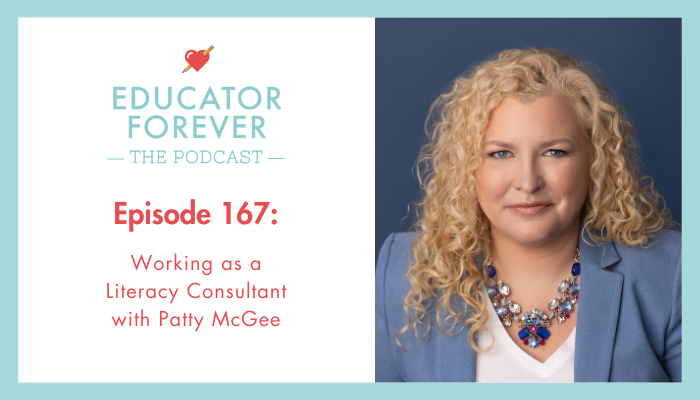
Patty McGee, the author of “Not Your Granny’s Grammar,” is a nationally recognized literacy consultant, speaker and educator with a passion for transforming classrooms into spaces where language and literacy come alive. With years of teaching experience under her belt, she’s become a strong advocate for delightful literacy practices.
In this episode, Patty describes how she went from teaching to starting her own literacy consultancy. She also gets into why there needs to be a shift in how grammar is taught, and why budding consultants and small business owners should write a book.
Topics Discussed:
Excitement and stress of starting a business
The struggles of teaching writing
Finding clients for her consultancy
Resources mentioned:
If you’re enjoying this podcast, please leave a rating and review on Apple Podcasts.
Related episodes and blog posts:
Read the transcript for this episode:
Welcome to Educator Forever, where we empower teachers to innovate education. Join us each week to hear stories of teachers expanding their impacts beyond the classroom and explore ways to reimagine teaching and learning.
Patty McGee is a nationally recognized literacy consultant, speaker and educator with a passion for transforming classrooms into spaces where language and literacy come alive. Patty has decades of experience as a teacher, coach and advocate for delightful literacy practices. Hi, Patty, so nice to have you here.
Patty McGee 0:17
So nice to be here. Thank you for having me.
Lily Jones 0:19
So I would love for you to take us through your journey as an educator.
Patty McGee 0:24
Sure, it's a pretty unconventional one. I started teaching back in the mid 90s in the school that I went to as a K to eight student, where my principal was my first grade teacher. So she taught me how to read, and she taught me how to teach. And from there, I became a school librarian slash instructional coach, and in a different school, but very close. It's actually the town I live in. And then I became something more regional, where I was able to support both the high schools in this area and the K to eight schools. And I really started a focus in literacy, especially literacy instruction. And I also kind of began working outside of this area called the northern valley, a lot of schools were looking for embedded PD and demo in classrooms. And so through the curriculum center, I started to do that. And then eventually I thought, maybe I can make this my own. And I did, and it's wonderful. I call myself a traveling teacher, and a definition of a traveling teacher that I love the best came from a second grader. She was talking to her grandpa, saying, grandpa, that lady isn't a stranger. She's a traveling teacher. So she comes to schools to help make the teachers' jobs just a little bit easier, and sometimes she teaches us, and I love that definition, and that's what I'm still doing.
Lily Jones 2:12
So talk to us a little bit about that leap that you took of starting your own consultancy. I know a lot of our listeners, our teachers who are maybe thinking about taking a similar leap themselves. So can you tell us a little bit just about how that went? For you?
Patty McGee 2:28
Sure, it was at first, just absolutely wonderful. It was the work that I wanted, just personally and professionally, because I was in so many different places, which meant I was both experiencing different communities and then also learning so much from both teachers and Students, and it was fantastic. And I was everywhere from Abu Dhabi to, gosh, California. You know, there were so many different so many different places I was able to go. But one thing that I neglected to do when I was first getting started was to really think about the business side of consulting. And I would recommend, for anyone who's interested in either creating some type of like outside school job to supplement things you might be doing in school, or starting your own consultancy, I would definitely recommend finding a business coach that knows both business and education, because I did start with business coach once, but he coached CEOs of Fortune 500 companies, which is very different than working with school districts. So find yourself. I have a great person. He knows both business and education and education consulting, and that's made a big difference. So I'm making up for lost time in that, but I highly recommend that being one of your first stops if you're considering moving into this consultancy world.
Lily Jones 4:14
I absolutely agree. I think we often feel like we have to figure it out all on our own, and it's important to think about who's already cracked the code, you know, who's already done the things that we want to do, and really learn from them. So I love that advice.
Patty McGee 4:28
So it's really good to not know to feel like I don't have to think of everything. Do you know what I mean? It's like I can think about literacy and follow what my coach is asking me to do, and I can still, like, keep my focus on literacy.
Lily Jones 4:46
Yes, you can stay in your zone of genius, and they can help you, you know, get it out to other people as well, right? So I know your work focuses on literacy, and specifically, I think, on writing and grammar. Can you tell us why you decided on that focus?
Patty McGee 5:01
Yes, yes, it's funny, because I never would have thought that would have been my focus. But the roots of it came from my early years in the classroom. When I was a student, I was very strong at reading, moderately strong at writing, and so because I didn't have a lot of struggle with either of those things, I wasn't really sure how to teach them, well, sure. Excuse me, I wasn't sure how to teach them well. And so I never struggled. So it wasn't it was like I didn't have the understanding of how to work through those struggles. And so I just started a self study of it started with writing instruction, because I knew that just having kids write and me fixing it afterwards was not working. There was not a lot of transfer happening, so I did a deep dive for a number of years in writing, and then grammar has been like a 30 year focus for me, because in the classroom, it was the most ineffective and boring part of our day. I felt obligated to teach grammar, but I didn't know any methods beyond the traditional worksheet, identification, memorization sort of approach, and so I really have been on the search, knowingly or unknowingly, for different ways to teach grammar that really are much more effective and students enjoy it's like now one of my favorite things to teach amazing.
Lily Jones 6:54
So let's talk about some of those strategies for our teachers out there. Listening. What advice do you have about how to make grammar more fun?
Patty McGee 7:01
Yes, well, I think a couple of things that need to happen prior to any instruction. Is rethinking grammar. We were taught that grammar is a static set of rules, and we need to comply by those rules, and if not, our writing is not good. And I think of grammar as more than a set of rules. I think of grammar as something that creates meaning on the page. And the better and deeper we know grammar. You know, grammar was very linear in the days that I was learning it. There wasn't a lot of depth to it, but there is a lot of depth to grammar. And we don't learn things in a snap. We learn things over time, and so the majority of us still think that way, which is there's nothing wrong with that. It's just that that's how we learned. And we were really never taught how to teach grammar in teacher school. Weren't really taught how to teach writing either in teacher school, most of us, I think I've met one person in my travels who has so it's a matter of establishing a beginner's mindset and being okay with that as a teacher, because, as Voltaire said, Don't let perfect be the enemy of good. We are going to grow into this, and we need to be okay with things being a little messy at first. So step one is a mindset of grammar is deep. Grammar is learning. It is long. There's a trajectory. Most adults do not know grammar in the way that they wish they could, and most teachers feel the same way, in my own like anecdotal research, and so with that in mind, we just need to know it's okay that we don't know grammar really well, if we're one of those teachers. You know, there is so much shame around grammar, when you think about it, there's like grammar police, and I'm silently correcting your grammar, and I wrote a whole blog post on this, and it's like the grammar haves and have nots, and there's like bundles of shame wrapped up in that, and we really want to undo that, and So once we have a different mindset with grammar instruction, which is realizing it's not something that happens right away, it's something that happens over time, and that we can make little bits of time for it just as frequently as possible. I recommend a grammar. Grammar experience, not a grammar mastery, but a grammar experience, three to five times a week, for about 10 minutes, and then, because over time, it's it's like a snowball accumulating, and that space between is important. And so another kind of, like, first step is the use of grammar manipulatives. So taking very simple I like, just like, print and cut. Those are my favorite kind of manipulatives. Like, for example, we can get a really juicy sentence, or set of sentences that go together, print them in large font and then cut out each word and cut out each piece of punctuation, and then, with a partner, try and create as many sentences as we can, reusing the words as often as we want to, and see what we can do to create we're not trying to recreate the original sentence. We're just working on writing sentences. But it takes away all of the other things that we need to be thinking about, like, if we are handwriting a sentence, right from our heads, there are so much work that needs to be done. To do that, you know, there's the handwriting, there's the so fine motor skills, the spelling automaticity, the just the ability to, like, compose something. It's it. There's so much in there. So if we have manipulatives, like the one I just described, kids are having a scaffold there that helps them really focus on grammar.
Lily Jones 11:53
Great advice. Yeah, I love this idea of a grammar experience too, and the mindset shifts that make that possible. And yeah, the hands on manipulatives too. I love that. So let's shift back a little bit to you building your own consultancy. And kind of, let's take you, take us back in time to How did you even go about finding your first clients?
Patty McGee 12:16
Yes, um, it's interesting, because I had some clients already because of my work at the curriculum center, so I had about want to say I was there for about five years. So when I went out on my own, there were a lot of school districts that wanted to either continue with me or had heard it was really word of mouth, mostly, and that's where I felt the confidence to be able to kind of take the leap. I also partnered for a couple of years with a publisher, and so I would do some things for the publisher that would bring me to places all over and so that gave me exposure as well. And so at the beginning, I had a base already, and then I found somebody who has a lot more contacts than I did and do publisher to help me out. It just was a mutual kind of help. They helped me by, you know, me having opportunities to meet schools and people that I wouldn't have met, but also I represented a simpler way of teaching writing and grammar for them.
Lily Jones 13:43
I think that's great advice too. That sometimes at the beginning stages of starting a business, or at any stage really, we can feel like, oh, it has to be just all us on our own. But often it's really helpful to partner with other aligned organizations or individuals, and so I love that as an option as well. Yeah, and where do you see your consultancy growing from here?
Patty McGee 14:04
Yes, so I am doing a couple of things. I'm creating hybrid classes so that that can make things a little bit more accessible for some schools and some some educators. I'm also creating some synchronous, I'm sorry, asynchronous courses. So that's where it's going. I also just want to point out to anyone who is thinking of making a leap, whether it's like part time or full time. I think writing a book is something really significant, so not your granny's grammar. My latest book is my third. And having a book for some reason, even though I feel like, Yes, I learned. A lot by writing the book, but it gives like a seal of approval from a publisher that just adds an extra lift to who you are. I feel like I'm still just as thoughtful in my instruction as I have ever been, but having a book next to your name is something that can really boost, boost consultancy experiences, add that to your kind of reputation, that sort of thing.
Lily Jones 15:38
Yeah, absolutely. I think it's a win win, because, like you said, you had to learn so much of kind of solidifying your own thinking and your approach. And also it lends this legitimacy, and also another tool that people can learn from you through the book and then hire you for some things, or hire you for some things and then buy the book. It opens up a whole different stream.
Patty McGee 15:59
Yes, exactly, exactly. And you have something to like hand to people or show to people too, and you could easily just turn to the materials you've created already. And it just makes planning for different places a lot easier, too.
Lily Jones 16:18
Yes, absolutely. So I know that starting a business is I always say it's like a personal development project. You know, you learn so much about yourself, but through starting your own thing and committing to it, and I would love to hear what you've learned about yourself through starting your consultancy.
Patty McGee 16:37
I received from when I was working at that curriculum center, there was a person I worked with. Her name is Lily Mayer. She was my mentor as a staff developer. She was also a high school teacher of mine child development, and when she retired, I'm just going to read you the Winnie the Pooh quote that she gave me, and it was promise me, you'll always remember you're braver than you believe, and stronger than you seem, and smarter than you think. And that part, that quote, while I didn't believe it, you know, probably like 1213, years ago, I was like, okay, Lily, I I'll try the best, but I think through this, through my own consulting, that has become more believable for me. Beautiful.
Lily Jones 17:36
Well, Patty, it's been so nice to talk with you. Can you tell folks where they can connect with you?
Patty McGee 17:40
Sure I have a website that I'm very proud of. There's so many cool things on there, and that's Patty mcgee.org you would need to spell patty with a y, because if you spell it with an i You're going to get a famous skateboarder, and that's not me. And there's lots, lots on the website. And you can, I have some free things to download, like a really cool grammar, how to master content using grammar, something post production that I came up with. And I'm also on Instagram, at PMG McGee, and I'm on LinkedIn, awesome. So those wonderful spots.
Lily Jones 18:25
Thank you so much.
Patty McGee 18:27
Thank you. Bye.
Transcribed by https://otter.ai